MBTI self-test — your 4-letter type
≈ 17 min read · 3,407 words
The MBTI self-test is 20 either/or questions: you pick from five pairs per dimension (E–I, S–N, T–F, J–P), and the four letters form your type.
At every question you mark pole A or pole B, whichever fits you more naturally; the majority gives the letter, and the margin gives the “clarity” of the preference. The MBTI is an indicator, not a test: you are the one who confirms the result. It shows which pole is the more comfortable one, not what you are good at, and it is not suitable for selection or appraisal.
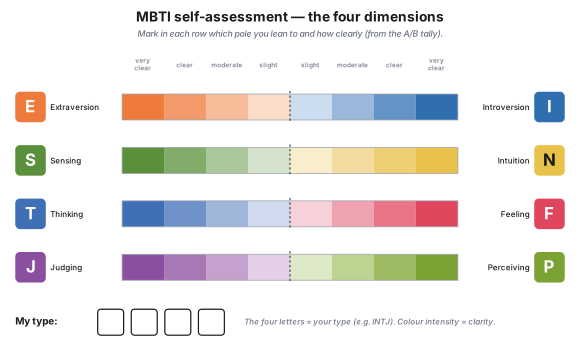
The self-assessment arrow chart: at the end of the test you mark on this, dimension by dimension, which pole you lean to and how clearly.
If you do not yet know the MBTI itself, read the MBTI main article first. This page is the test.
Who is this for?
Section titled “Who is this for?”For anyone who works in a team and wants to name their own way of working: shift supervisor · plant manager · process engineer · maintenance manager · project manager · team leader · HR and training staff · Lean/CI coordinator.
Learning objectives
Section titled “Learning objectives”After completing the test you will be able to:
- determine your four-letter type and the clarity of your preferences;
- recognize the poles of the four dimensions from everyday behavioural cues;
- distinguish preference from ability, and the indicator from a test;
- state what the type may and may not be used for.
How do you determine your MBTI type with a self-test?
Section titled “How do you determine your MBTI type with a self-test?”Short answer: per dimension you choose between A and B at five questions; the majority gives the letter, the margin gives the clarity of the preference, and the four letters together are your type.
How do you score it?
Section titled “How do you score it?”The test can be filled in on paper or on a notepad.
- Choose A or B. A is the left pole, B is the right one. Mark the one that is generally, most naturally true of you, not the one you would like. There is no right or wrong answer.
- Add them up per dimension. Five questions belong to each dimension.
- The majority gives the letter. More A: the letter of the left pole; more B: that of the right pole.
- The margin gives the clarity:
| A–B ratio | Clarity of the preference |
|---|---|
| 5–0 | very clear |
| 4–1 | clear |
| 3–2 | moderate or slight (the two poles are close in you) |
The four band names come from the original scale of the self-assessment arrow chart; the assignment of the A–B ratios is an illustrative mapping fitted to the five-question format.
- Assemble the type: Introverted + iNtuitive + Thinking (T) + Judging (J) = INTJ. Mark it on the self-assessment arrow chart, then look at the decoding table.
How do you know which pole is yours?
Section titled “How do you know which pole is yours?”If you get stuck, do not look for the “correct” answer but for the comfortable one:
| Preferred pole | Non-preferred pole |
|---|---|
| easy, fast | uncomfortable, slow |
| you don’t have to think about it | you have to concentrate |
| recognizably my own work | messy, “as if a child had written it” |
| automatic, natural | with practice it gets easier and faster |
Like writing with your non-dominant hand: you can write with both, but only one of them goes by itself.
Important: the MBTI is an indicator, not a test. It is not the questionnaire that pronounces your type, but you. And a preference is not an ability: everyone uses all eight poles, the test only shows which one is the more comfortable and faster.
Dimension 1 — Extraversion (E) vs Introversion (I)
Section titled “Dimension 1 — Extraversion (E) vs Introversion (I)”The question: where do you draw your energy from? The E turns towards the outer world (people, action, talk) and is recharged by it; the I towards the inner world (thoughts, reflection). Note: E–I is not about sociability.
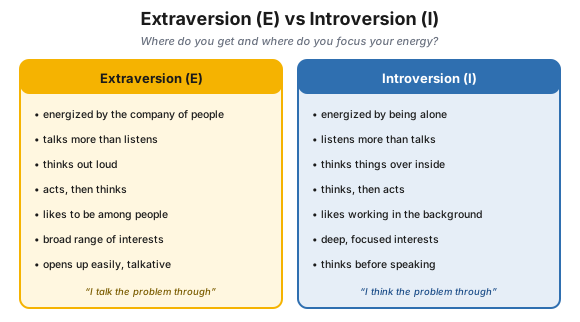
Column A = E, column B = I.
E–I 1. How do you get started on a task? (action vs. reflection)
Section titled “E–I 1. How do you get started on a task? (action vs. reflection)”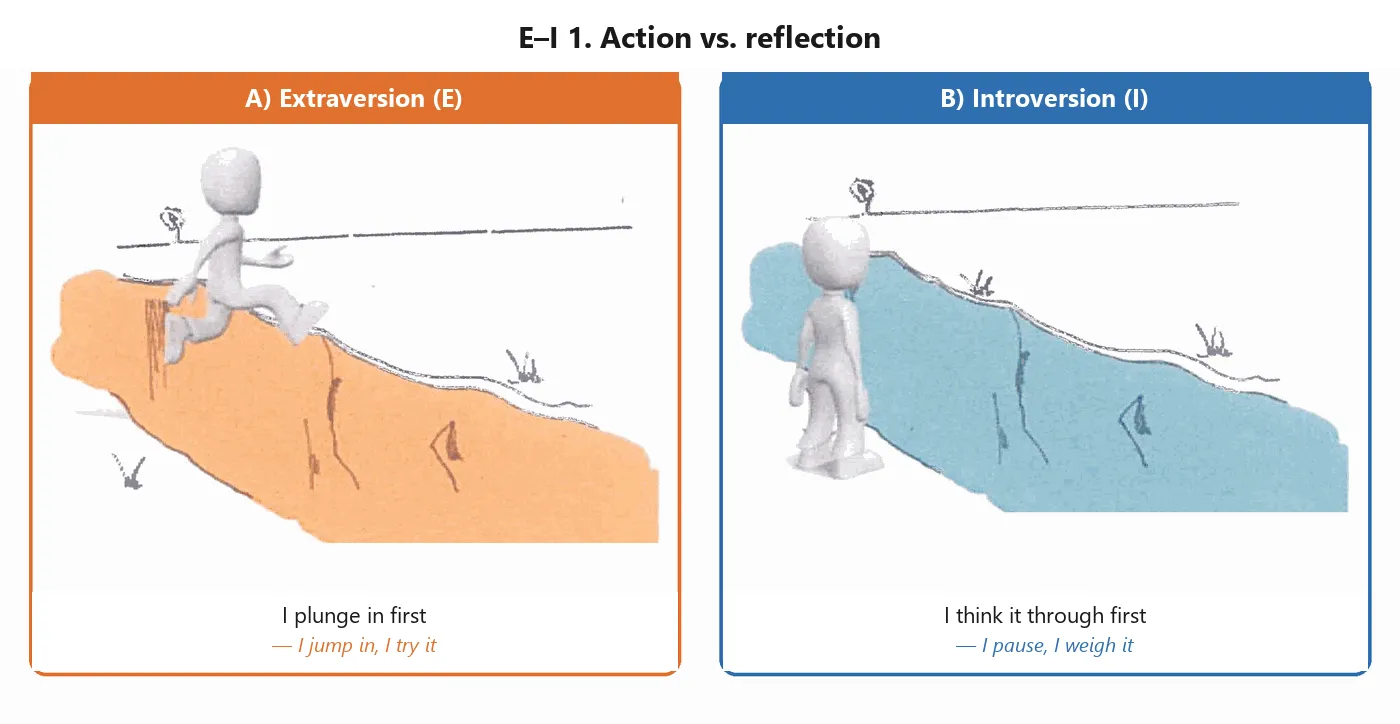
| A) Extraversion | B) Introversion |
|---|---|
| I try it out first | I think it through first |
| I plunge into action | I spend time pondering |
| I talk things through | I think things over |
| I solve the problem in interaction | I solve it in solitary immersion |
| Act – think – act | Think – act – think |
E–I 2. How do you behave in a meeting?
Section titled “E–I 2. How do you behave in a meeting?”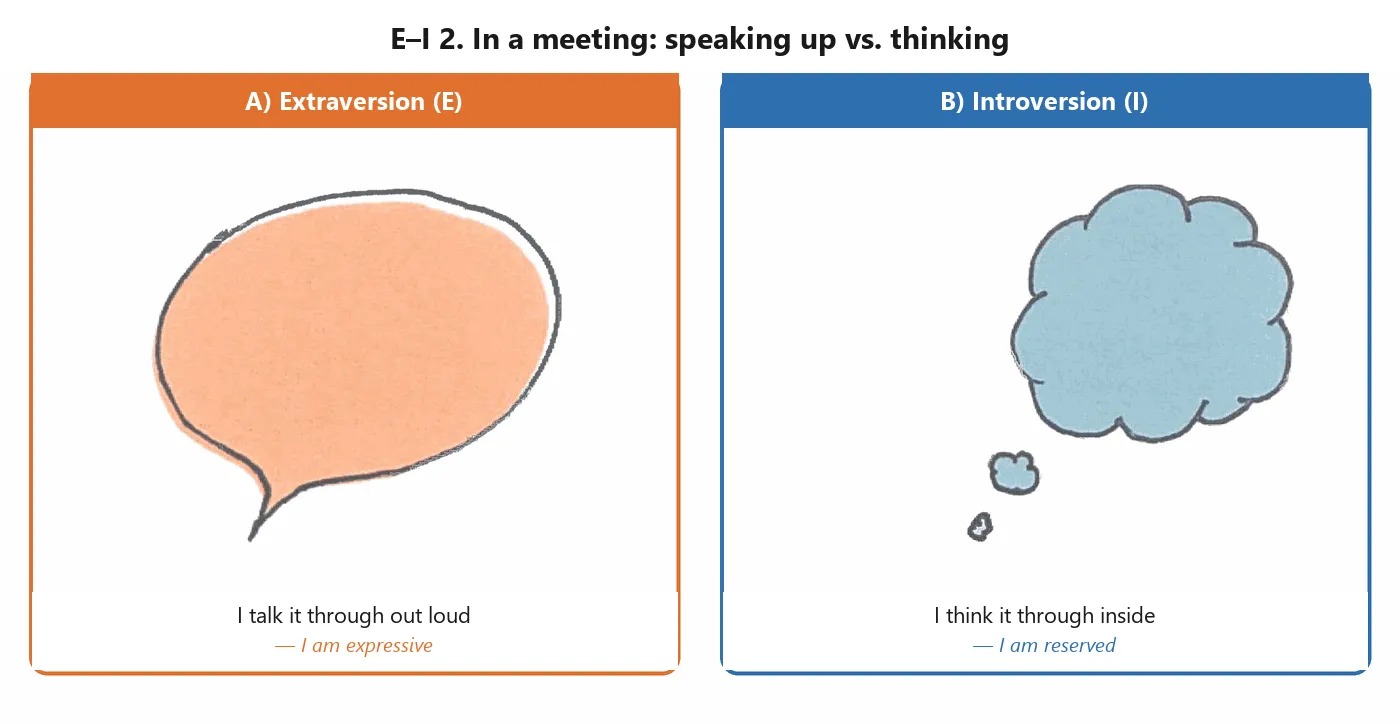
| A) Extraversion | B) Introversion |
|---|---|
| I talk things through out loud | I think them through inside |
| I am expressive in discussions | I am reserved in discussions |
| Action recharges me | Reflection recharges me |
| I cut in on others | I wait for my turn |
E–I 3. What kind of work environment do you like?
Section titled “E–I 3. What kind of work environment do you like?”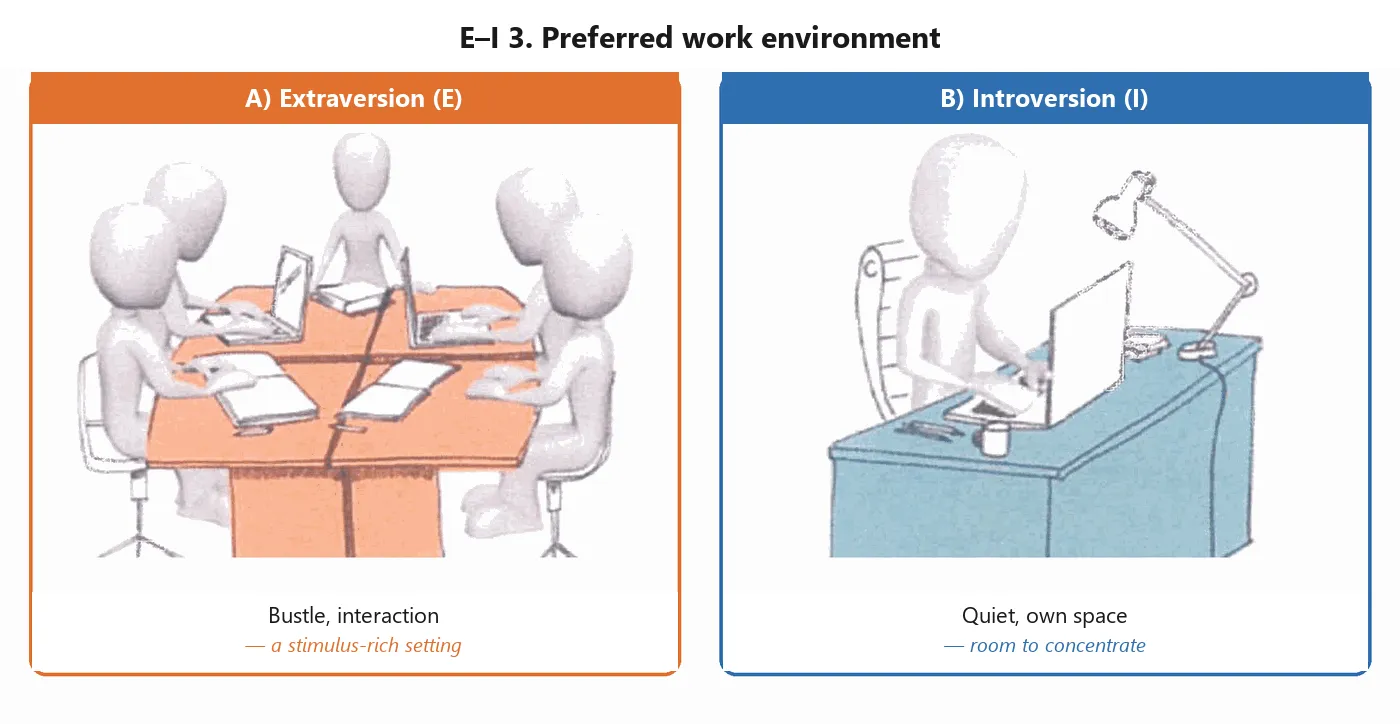
| A) Extraversion | B) Introversion |
|---|---|
| I enjoy interaction | I need room to concentrate |
| I like a stimulus-rich setting | I like quiet for reflection |
| Some background noise does not bother me | Background noise can bother me |
| The busy, lively environment suits me | The calm, spacious environment suits me |
E–I 4. How do you recharge at the end of the day?
Section titled “E–I 4. How do you recharge at the end of the day?”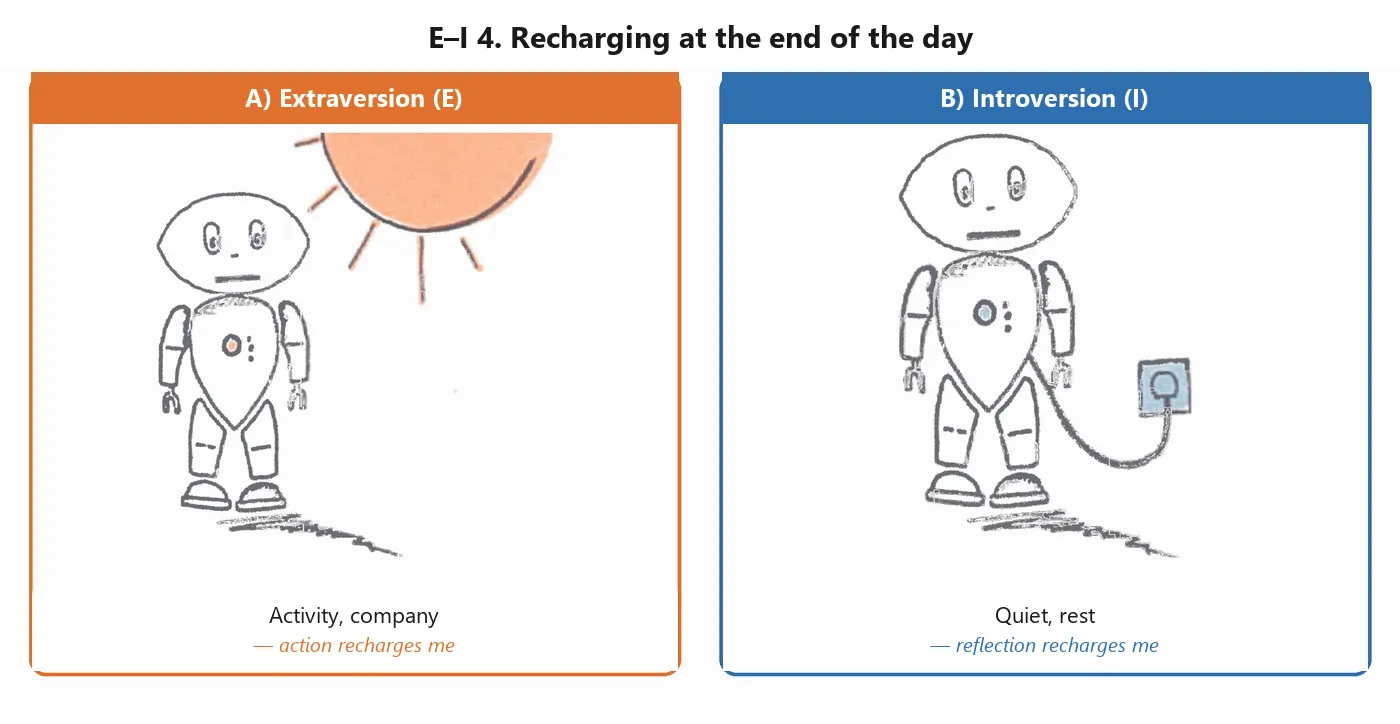
| A) Extraversion | B) Introversion |
|---|---|
| Something active recharges me | Reflection and quiet recharge me |
| I gladly talk my day through with someone | I think my day through in silence |
| After work I gladly go into company | After work I would rather rest first |
E–I 5. What hobbies and interests do you like?
Section titled “E–I 5. What hobbies and interests do you like?”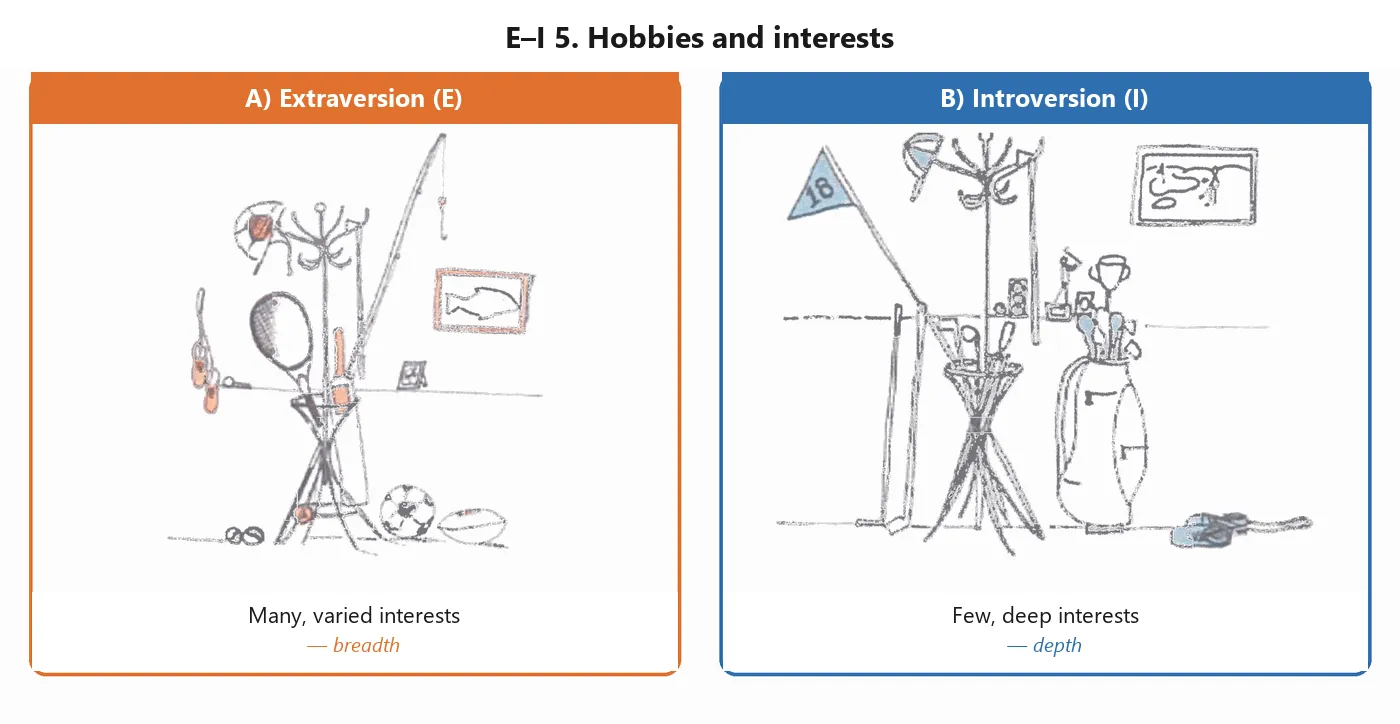
| A) Extraversion | B) Introversion |
|---|---|
| A broad range of interests | A few, but deep interests |
| I switch between my interests | I pursue a single interest for a long time |
| Active hobbies attract me | Reflective hobbies attract me |
| Activities that allow interaction | Activities that allow concentration |
Tally — dimension 1: E (A) = ____ / I (B) = ____ → letter: ____ · clarity: ____
Dimension 2 — Sensing (S) vs Intuition (N)
Section titled “Dimension 2 — Sensing (S) vs Intuition (N)”The question: what information do you trust? The S attends to concrete, observable facts and details, here and now; the N to the big picture, the patterns, the possibilities. Note: sensing ≠ sensitive, intuition ≠ common sense.
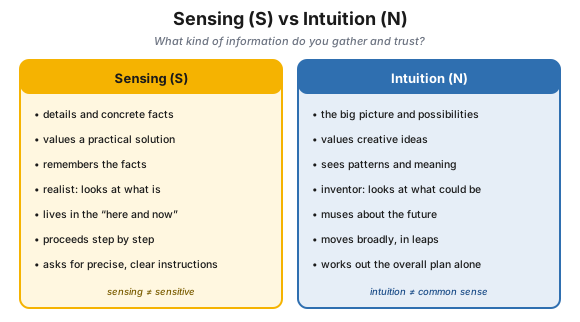
Column A = S, column B = N.
S–N 1. What do you see? (tell a story about a picture)
Section titled “S–N 1. What do you see? (tell a story about a picture)”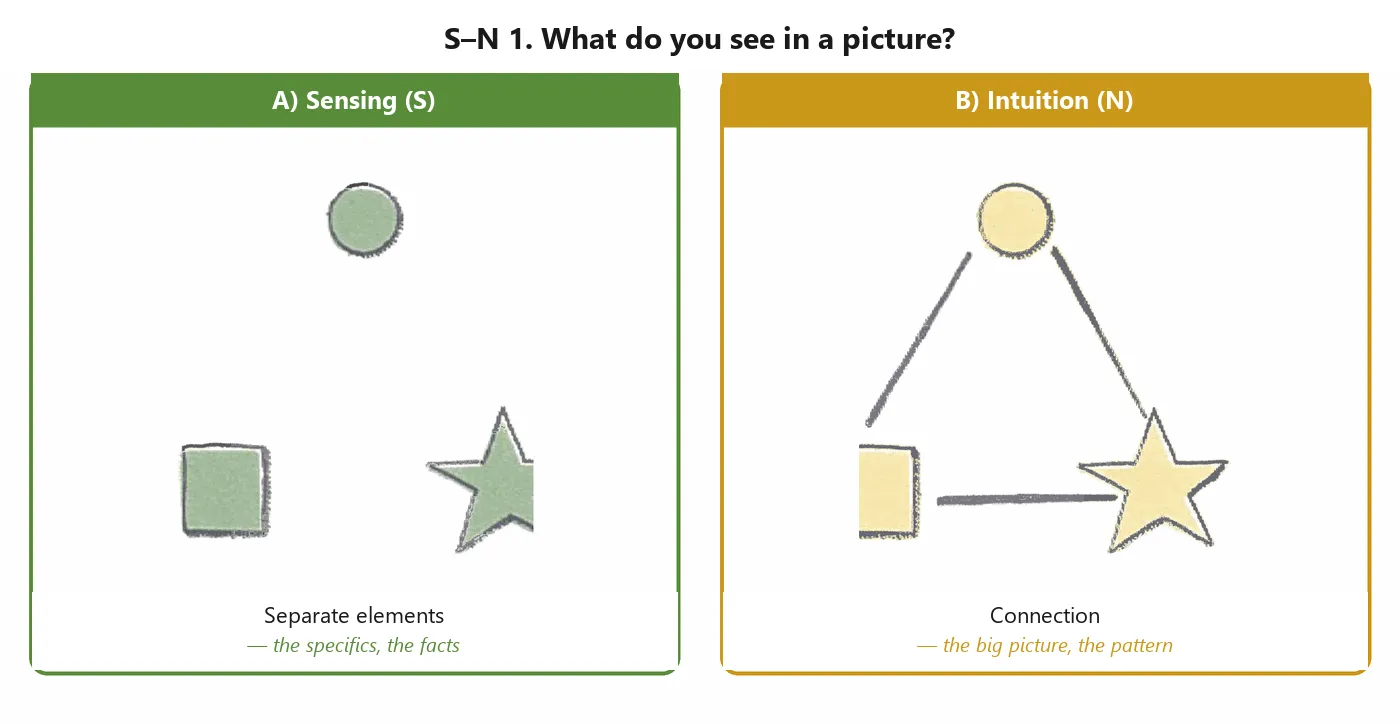
| A) Sensing | B) Intuition |
|---|---|
| I tell what is in the picture | I notice the connections |
| I list the specifics | I talk about the “big picture” |
| I attend to what is real | My imagination switches on too |
| I attend to the here and now | I also imagine the future |
S–N 2. How do you learn something new?
Section titled “S–N 2. How do you learn something new?”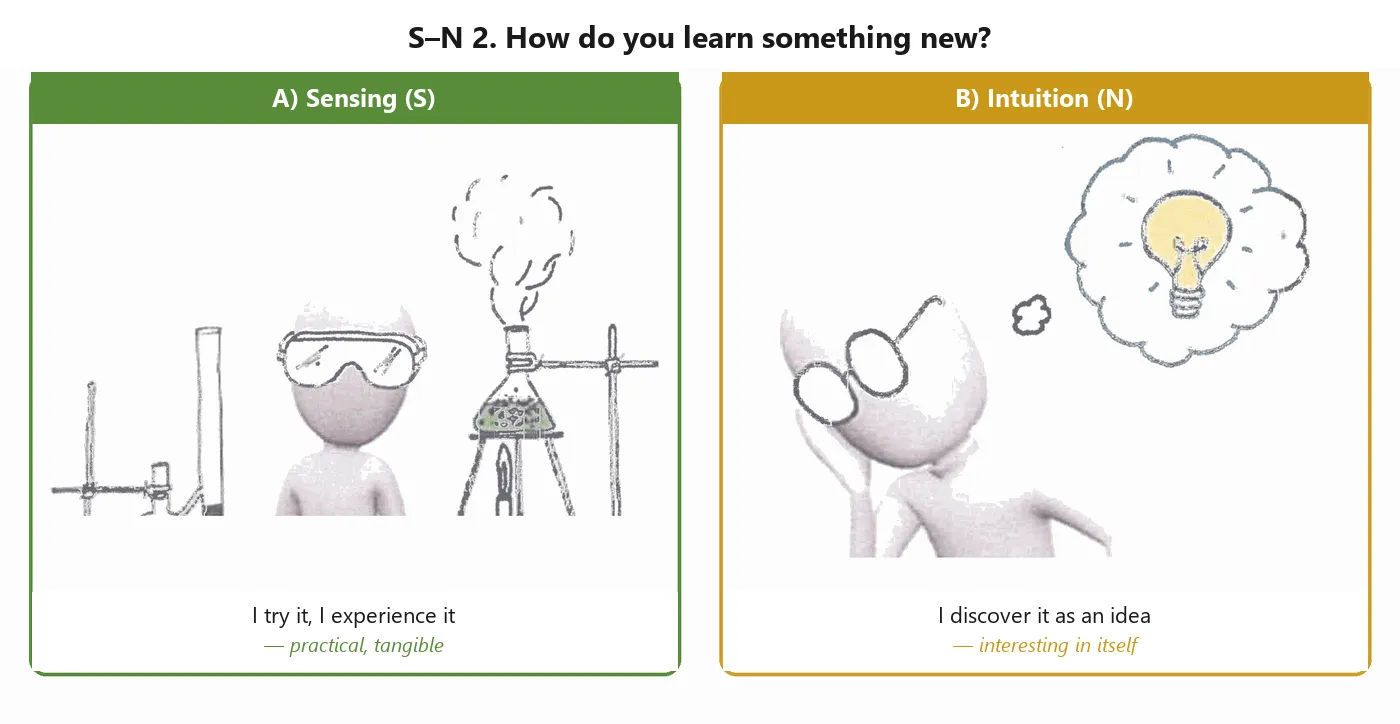
| A) Sensing | B) Intuition |
|---|---|
| I have to tie it to my earlier experience | I discover how it fits other ideas |
| I want to try it out, to experience it | I explore it in my imagination |
| Knowledge of practical use interests me | Interesting ideas for their own sake too |
S–N 3. What information do you need for a purchase?
Section titled “S–N 3. What information do you need for a purchase?”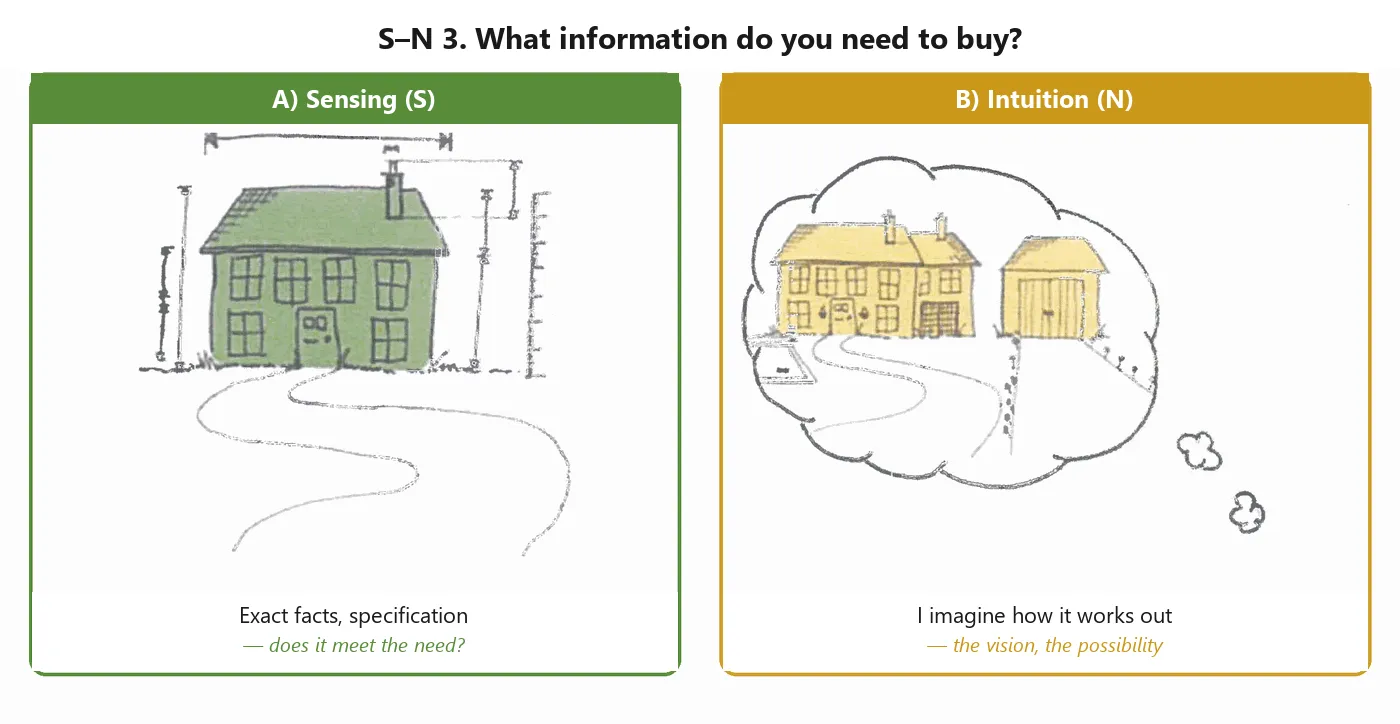
| A) Sensing | B) Intuition |
|---|---|
| I want the facts: does it meet my needs | I imagine how it will work out for me |
| I ask for the product’s exact specification | The idea and vision of the product excites me |
| I solve the needs of the here and now | I attend to ideas that open up the future |
S–N 4. What kind of instruction works for you?
Section titled “S–N 4. What kind of instruction works for you?”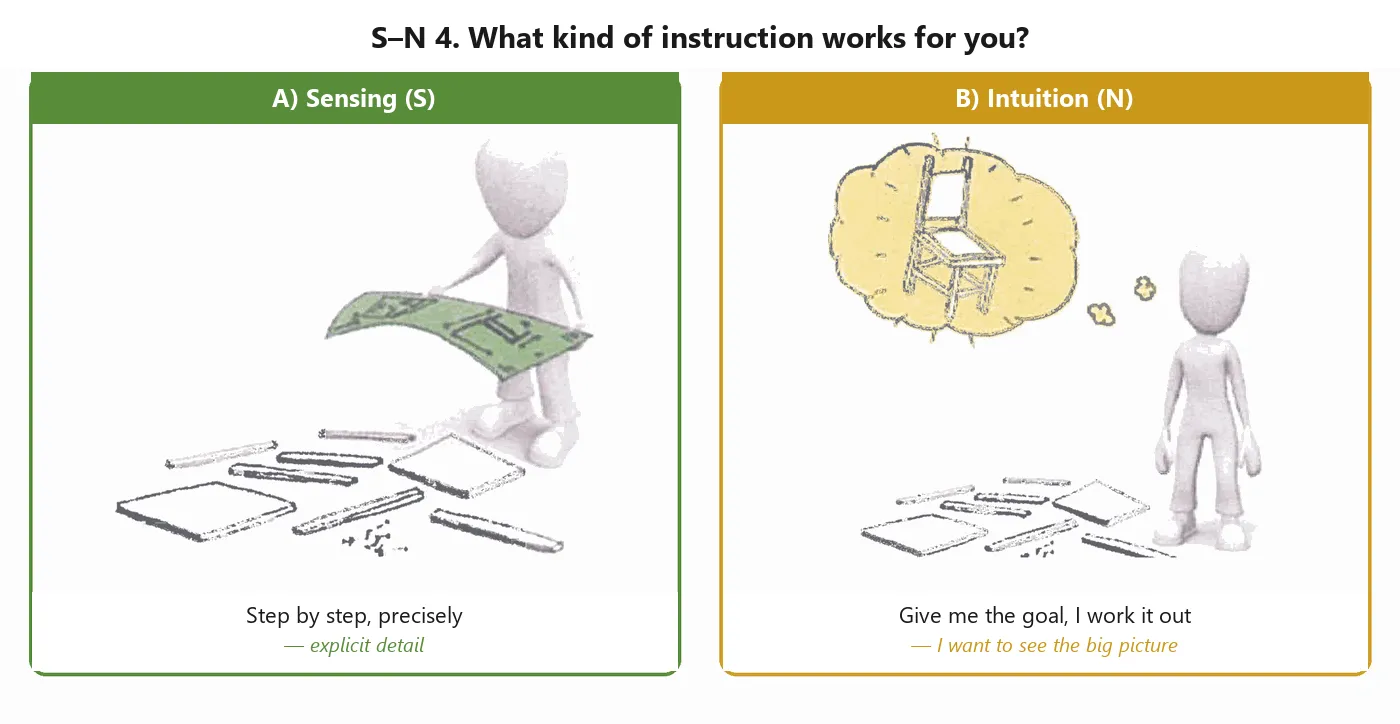
| A) Sensing | B) Intuition |
|---|---|
| I ask for step-by-step, concrete instructions | Give me the goal, I work out the rest |
| Let the details be spelled out | I want to see the big picture |
| Let the instruction be clear and precise | I can live with imprecision and uncertainty |
| A vague instruction feels too foggy to me | Too detailed an instruction restricts me |
S–N 5. How do you react to a proposed change?
Section titled “S–N 5. How do you react to a proposed change?”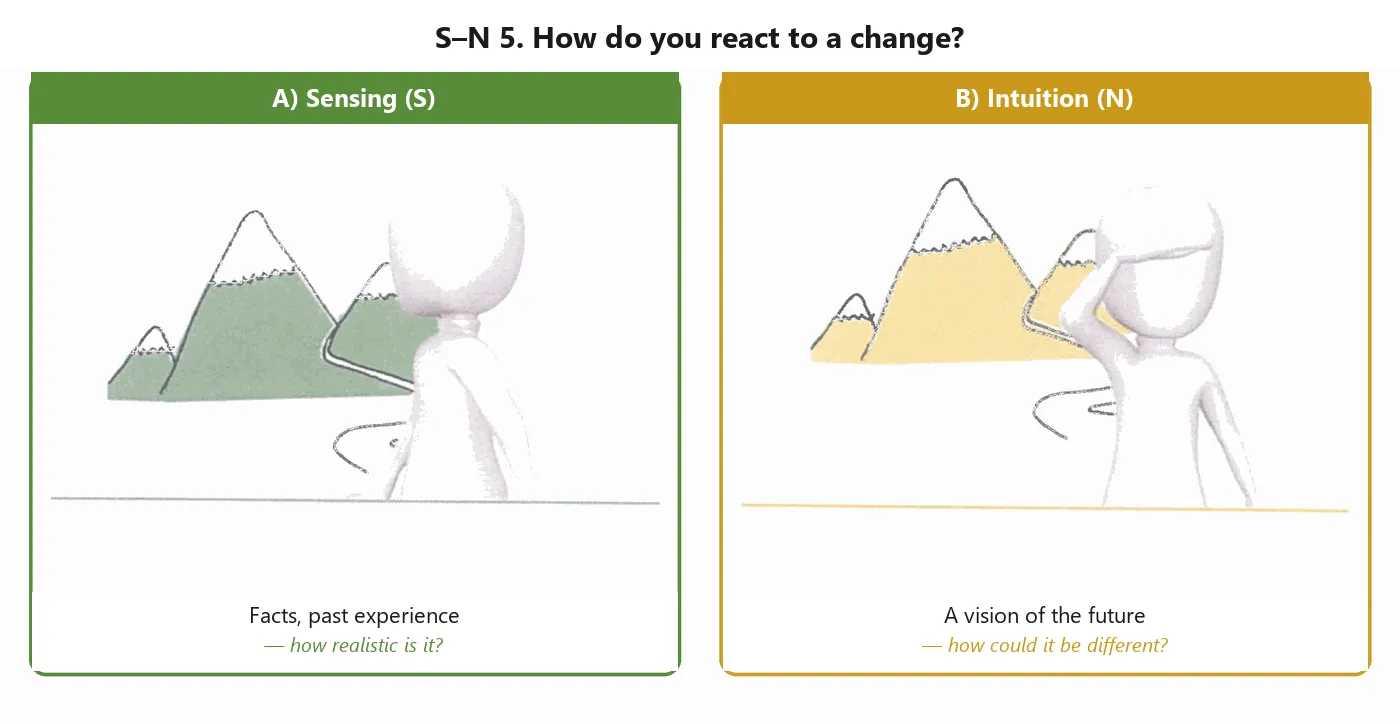
| A) Sensing | B) Intuition |
|---|---|
| I weigh it against past experience | I enjoy anticipating the future |
| The facts: what the change improves | The vision: how it could be different |
| The specifics: what exactly it affects | I look at the overall goal and the opportunity |
| I measure with data how realistic it is | I explore in imagination what it could be like |
Tally — dimension 2: S (A) = ____ / N (B) = ____ → letter: ____ · clarity: ____
Dimension 3 — Thinking (T) vs Feeling (F)
Section titled “Dimension 3 — Thinking (T) vs Feeling (F)”The question: how do you make decisions? The T decides along objective logic and consistent principles, focusing on the task; the F along personal values and harmony, on the relationships. Note: a “thinker” can feel too, a “feeler” can think too; the question is the primary basis of the decision.
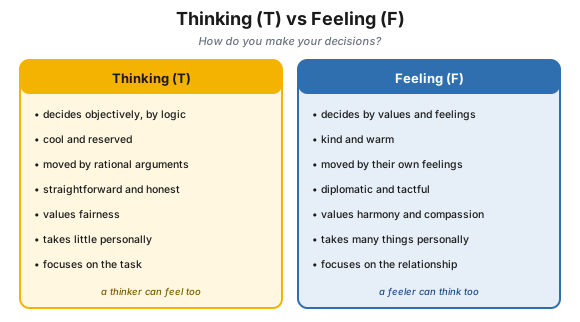
Column A = T, column B = F.
T–F 1. How do you handle a disagreement?
Section titled “T–F 1. How do you handle a disagreement?”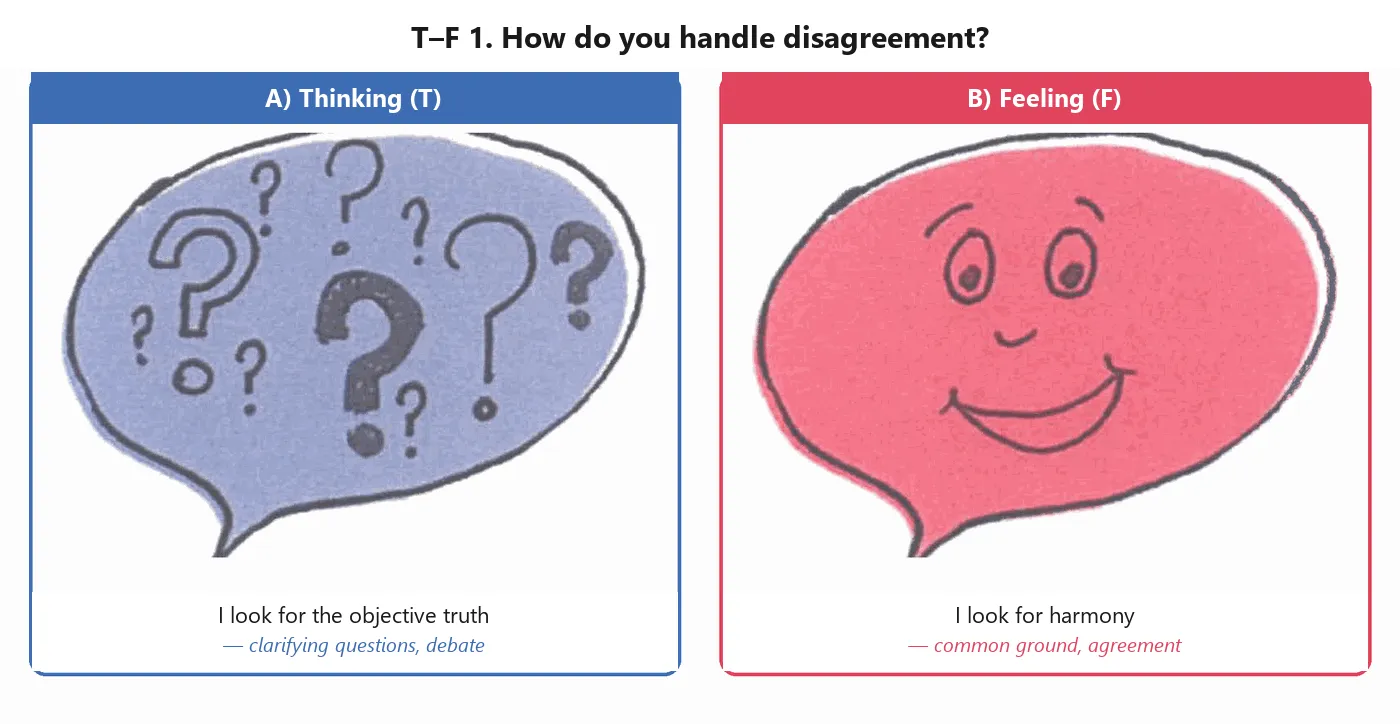
| A) Thinking | B) Feeling |
|---|---|
| I look for the objective truth | I look for harmony |
| I get to the right answer through questions | I look for common ground and agreement |
| I may come across as critical | I may seem to avoid differences of opinion |
| I argue about differences comfortably | Conflict is less comfortable for me |
T–F 2. How do you make a decision?
Section titled “T–F 2. How do you make a decision?”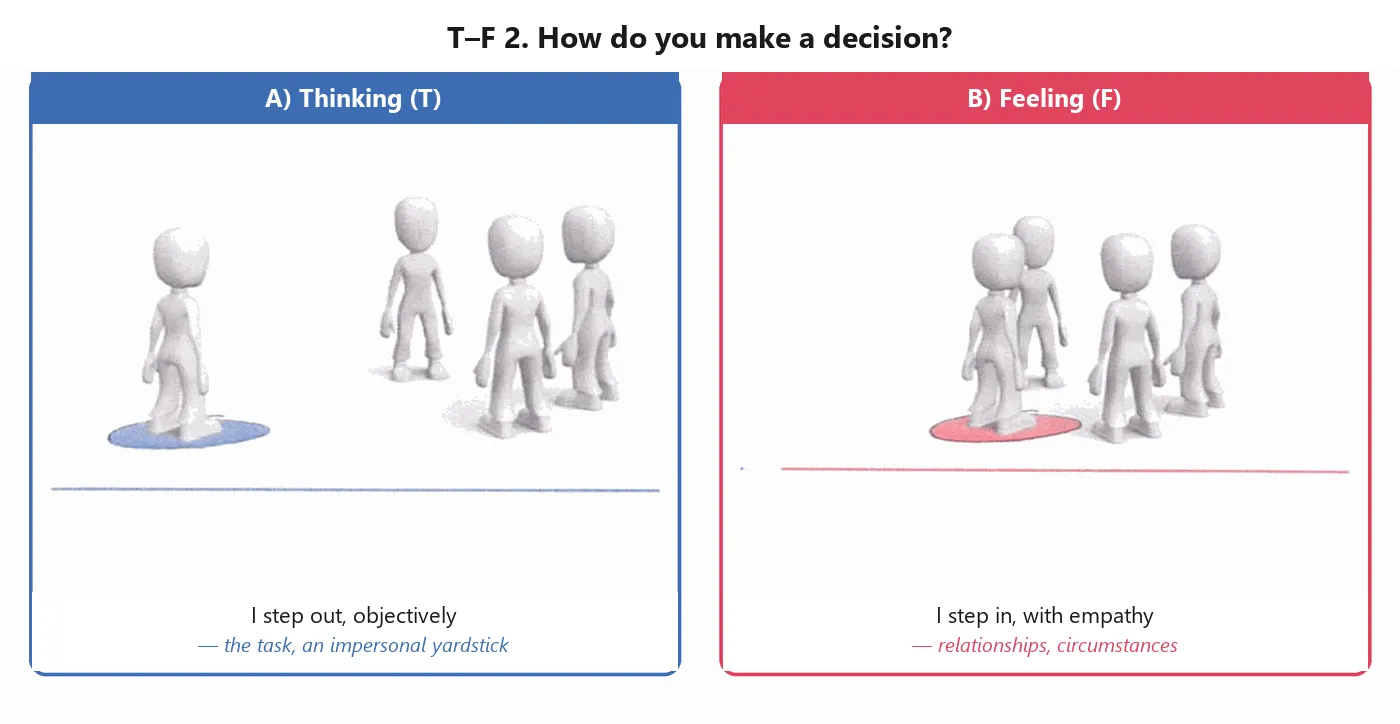
| A) Thinking | B) Feeling |
|---|---|
| I step out of the situation to be impartial | I step in, to weigh it with empathy |
| I set the emotions aside, my own too | I connect with empathy, to how each one feels |
| I evaluate with impersonal criteria | I take the circumstances into account |
| I focus on the task | I focus on the relationships |
T–F 3. How do you give feedback?
Section titled “T–F 3. How do you give feedback?”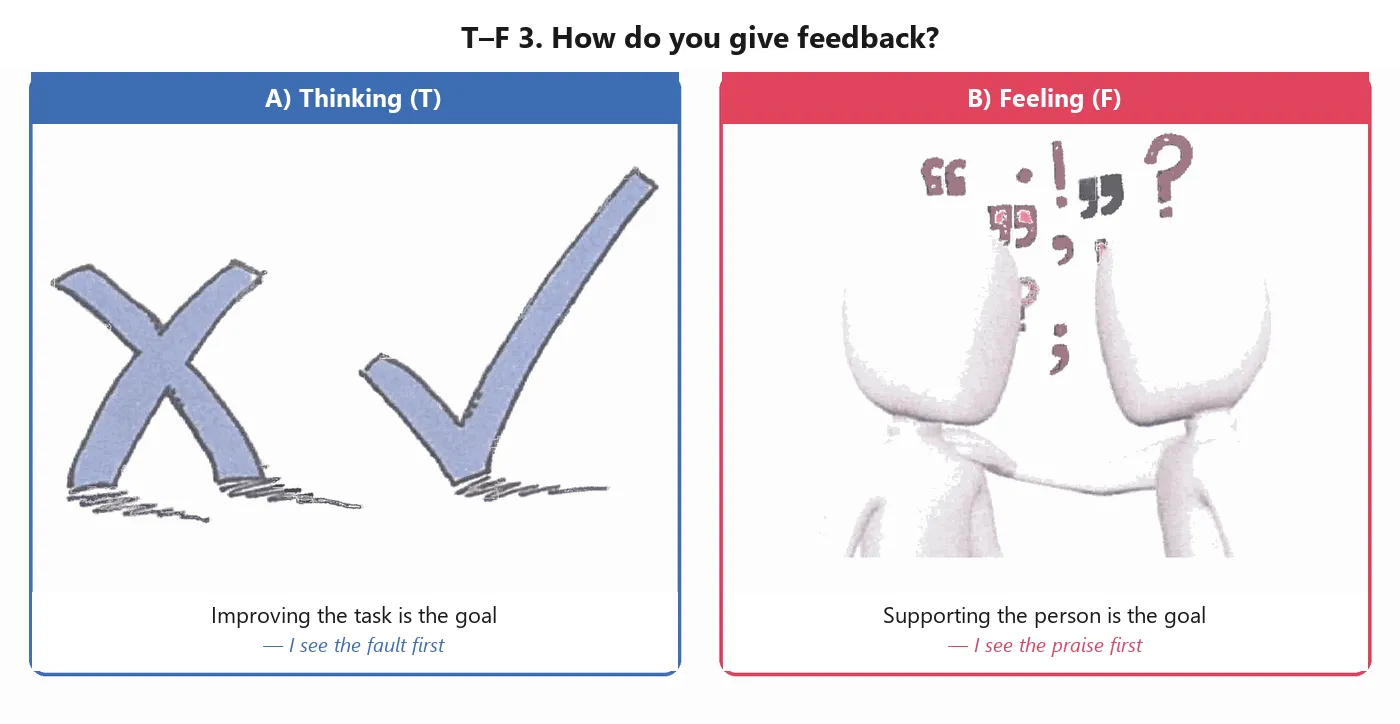
| A) Thinking | B) Feeling |
|---|---|
| So that task performance improves | So that I support the person |
| I notice the mistakes first | I notice the good points first |
| I have to remind myself to praise | I have to be careful not to skip the mistakes |
T–F 4. How do you like to be recognized?
Section titled “T–F 4. How do you like to be recognized?”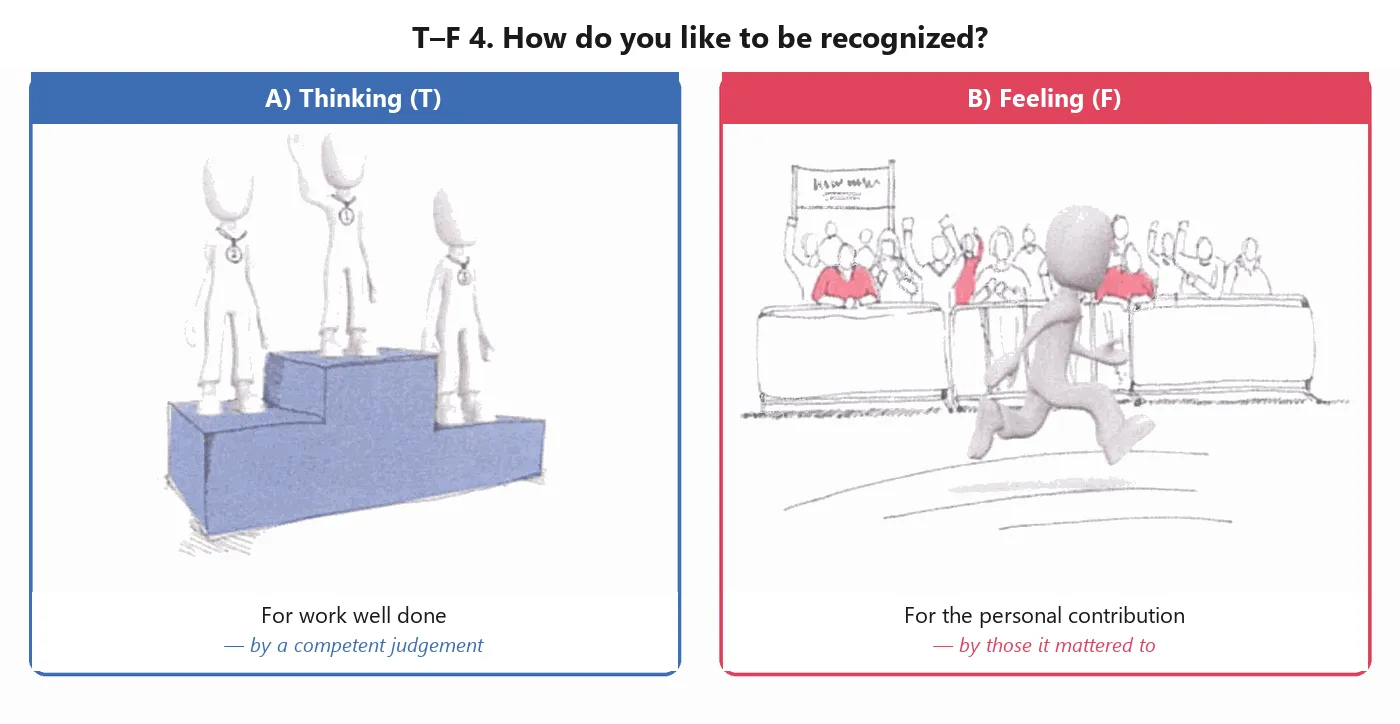
| A) Thinking | B) Feeling |
|---|---|
| For the job well done | For my personal contribution and effort |
| At the end of the project or for outstanding performance | I would like to feel valued during the project too |
| By someone who can judge it competently | Also by those I have had disagreements with |
T–F 5. How do you help someone with a problem?
Section titled “T–F 5. How do you help someone with a problem?”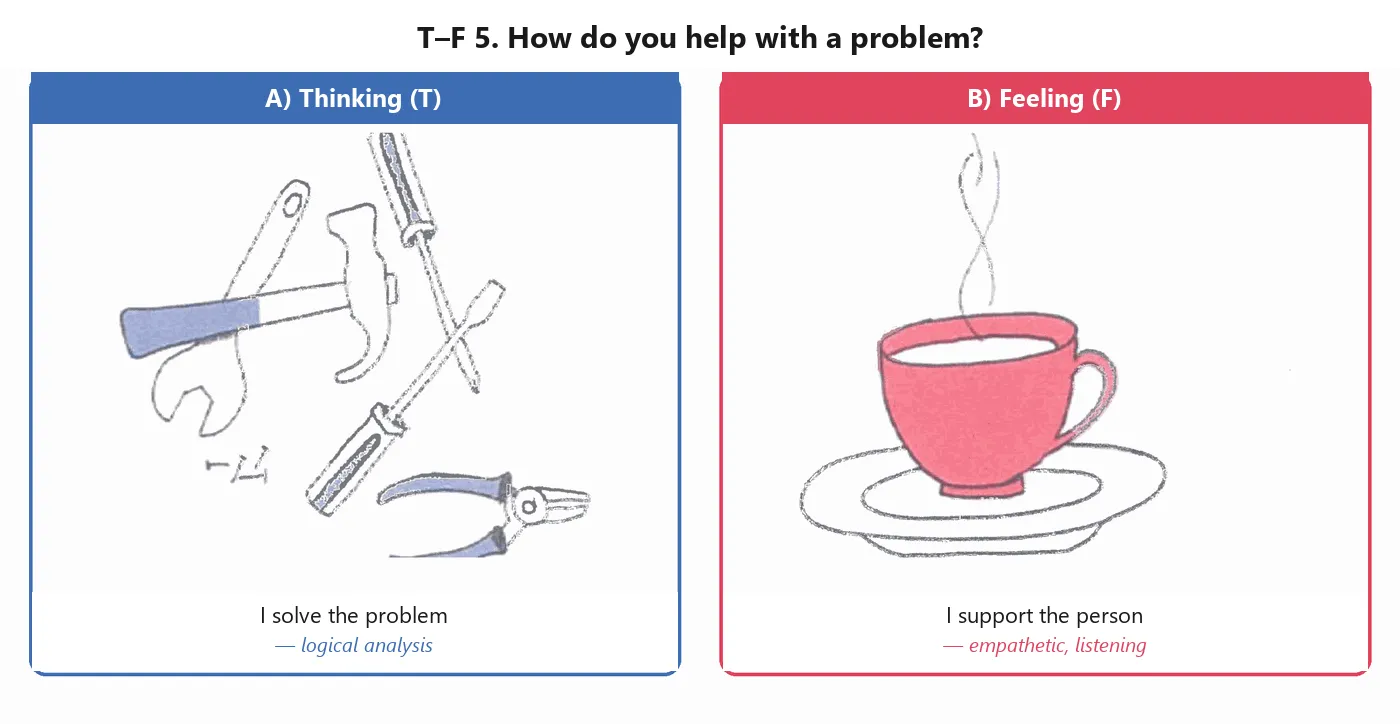
| A) Thinking | B) Feeling |
|---|---|
| I solve the problem | I am empathetic and supportive |
| I look at the practical side, I analyse logically | I look at how people feel |
| I focus on the task | I focus on the relationships |
Tally — dimension 3: T (A) = ____ / F (B) = ____ → letter: ____ · clarity: ____
Dimension 4 — Judging (J) vs Perceiving (P)
Section titled “Dimension 4 — Judging (J) vs Perceiving (P)”The question: how do you relate to the outer world? The J prefers a planned, organized life and likes to close questions; the P a flexible, spontaneous attitude, and keeps the options open. Note: judging ≠ judgemental.
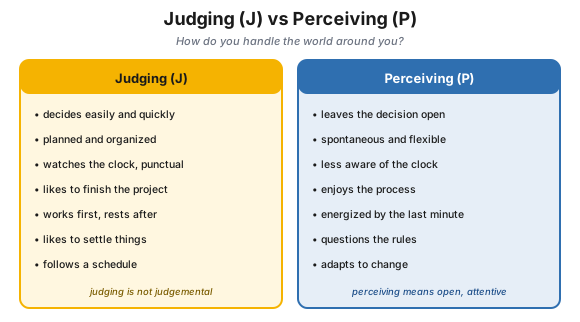
Column A = J, column B = P.
J–P 1. What is your relationship to deadlines?
Section titled “J–P 1. What is your relationship to deadlines?”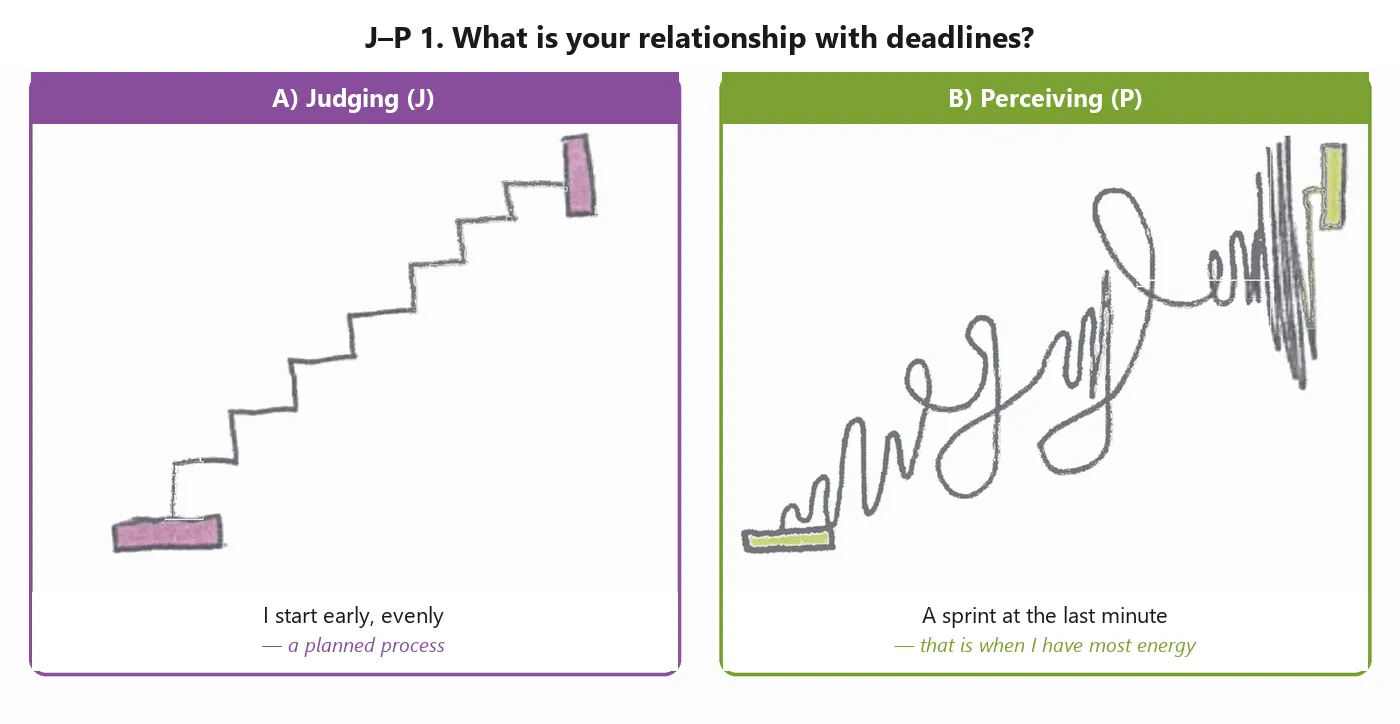
| A) Judging | B) Perceiving |
|---|---|
| I start early to be finished on time | I have the most energy at the last minute |
| I plan the process, with a buffer | I adapt as I go |
| Changes can frustrate me | A precise plan can feel restrictive |
| Time pressure stresses me | My best work is born before the deadline |
J–P 2. When do you close a decision?
Section titled “J–P 2. When do you close a decision?”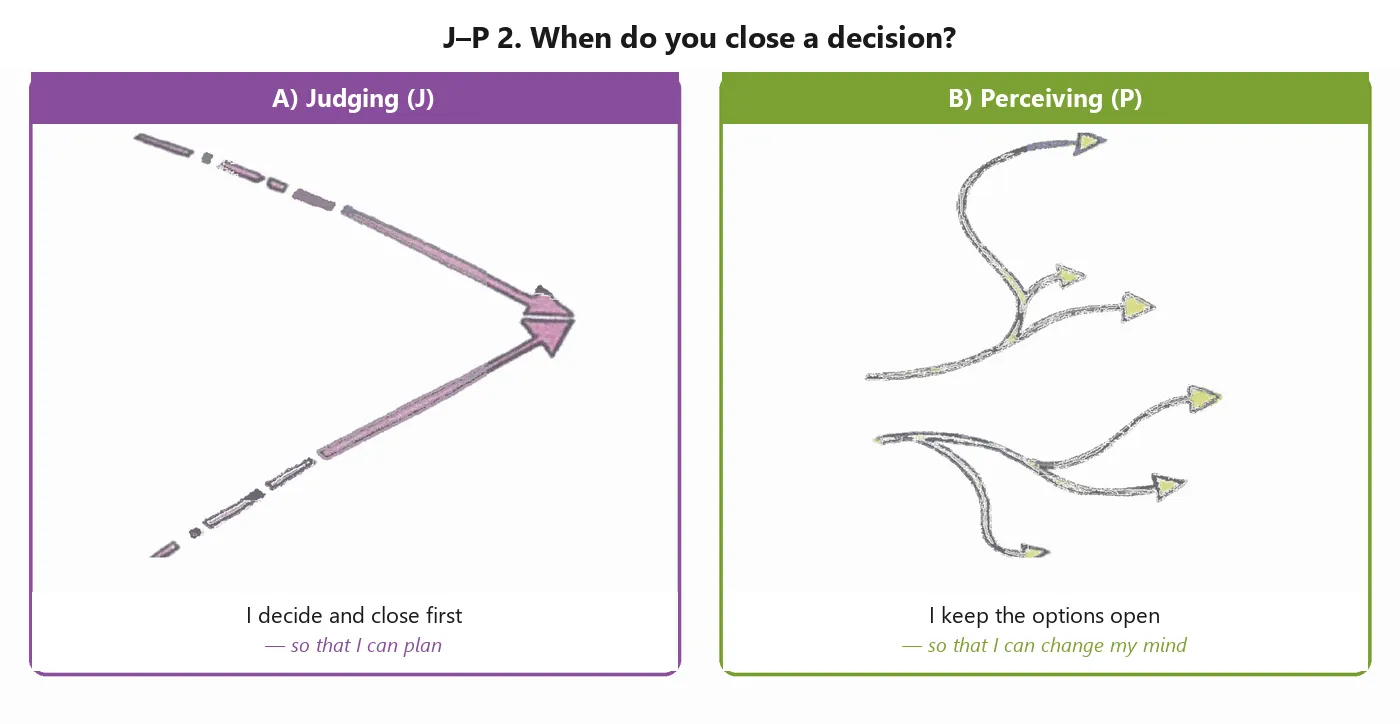
| A) Judging | B) Perceiving |
|---|---|
| I would rather decide sooner than later | I keep the options open for a long time |
| I like the decision to be made so I can plan | I leave it open so I can change my mind |
| I feel good when things are settled | A fixed decision is tying me down |
J–P 3. How do you get started on a complex task?
Section titled “J–P 3. How do you get started on a complex task?”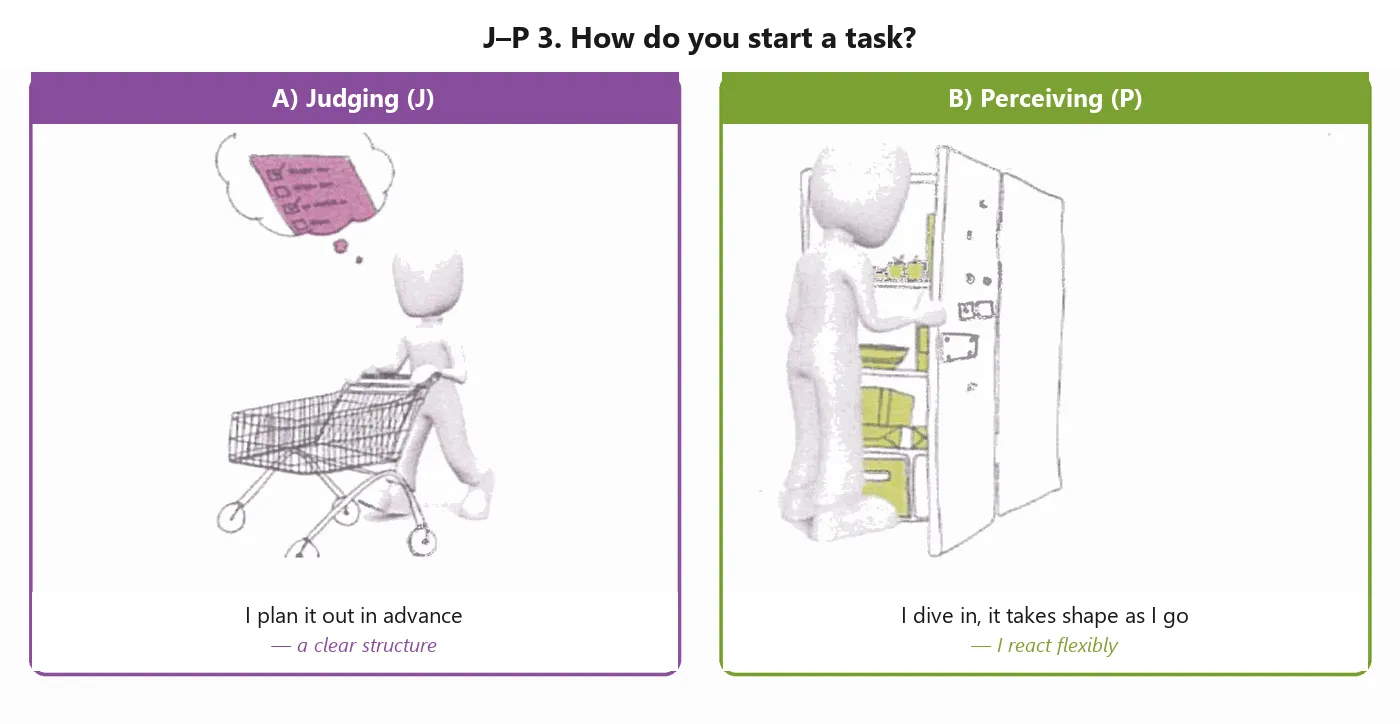
| A) Judging | B) Perceiving |
|---|---|
| I plan it step by step | I wait to see what unfolds |
| I follow a plan decided in advance | I react as I go |
| I organize at the beginning | I plunge in first |
| I have a clear structure | It turns out along the way what it needs |
J–P 4. What are you doing next weekend?
Section titled “J–P 4. What are you doing next weekend?”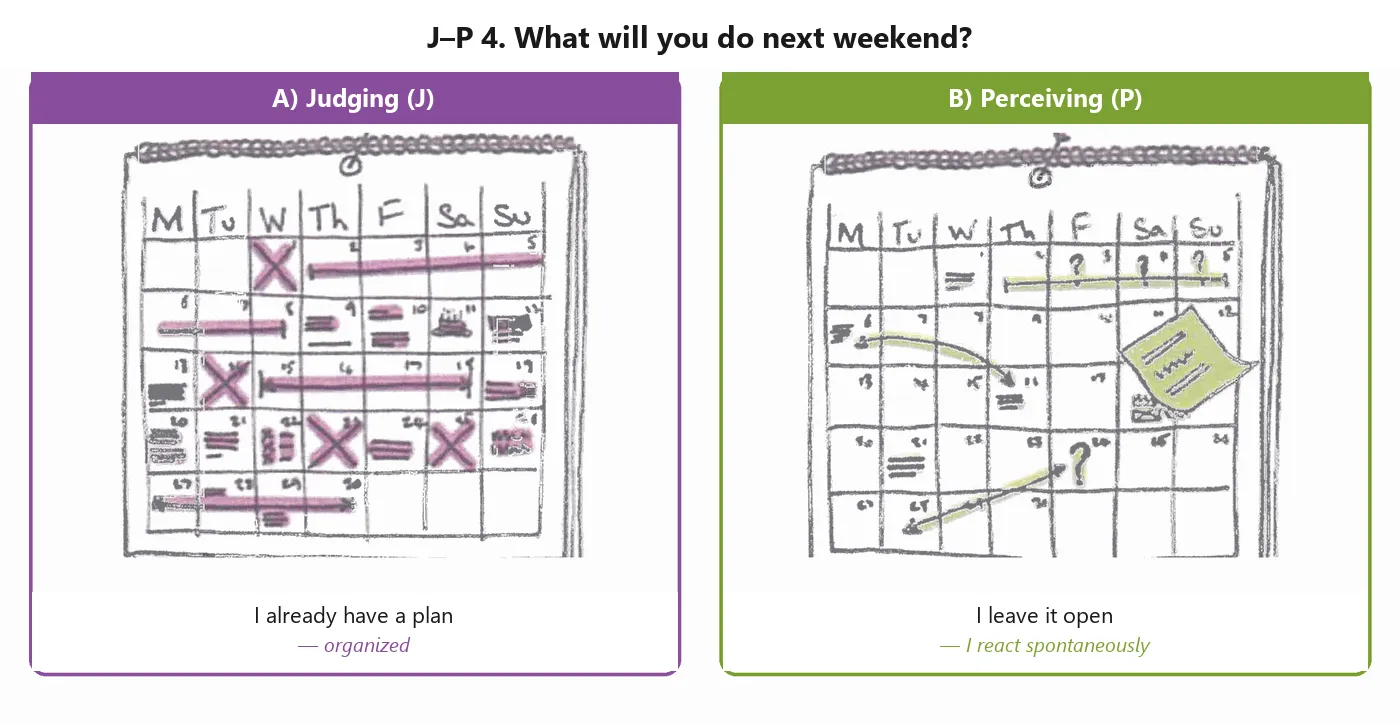
| A) Judging | B) Perceiving |
|---|---|
| Chances are I already have a plan | I may have no idea |
| I like it organized | I like keeping the options open |
| Structured | I go with the flow |
| There is a schedule I would follow | I react spontaneously to what comes up |
J–P 5. When do you work and when do you play?
Section titled “J–P 5. When do you work and when do you play?”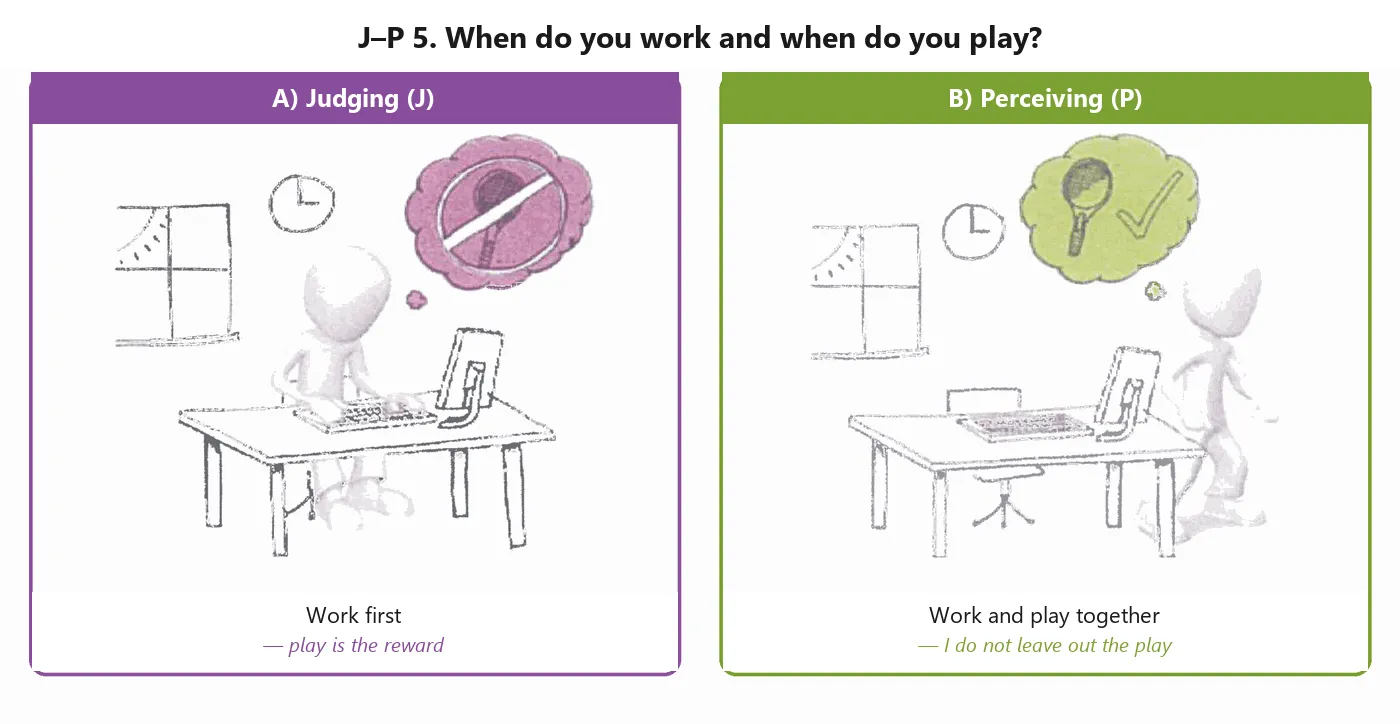
| A) Judging | B) Perceiving |
|---|---|
| I cannot “play” while there is work to be done | The remaining work does not spoil the experience |
| First I have to “put the work down” in my head | I “play” while working, I “work” at unusual hours |
| I separate work time and play time | Work and play are one for me |
| Play is the reward for finished work | Life is too short to skip the play |
Tally — dimension 4: J (A) = ____ / P (B) = ____ → letter: ____ · clarity: ____
Result — mark it on the self-assessment arrow
Section titled “Result — mark it on the self-assessment arrow”The four letters and their clarity together give your profile. Mark row by row which pole you lean to and how clearly.
My type: ____ ____ ____ ____ · (e.g.
I – N – T – J)
A 3–2 is normal: there the two poles are close in you. Read both columns again, because in that case you yourself can decide which one is closer to you. You are the best judge of your own type.
The 16 types — what do your four letters mean?
Section titled “The 16 types — what do your four letters mean?”The table gives the name, the established English mnemonic and the “most characteristic” trait, as a reminder, not as a box. The detailed characterizations are in the main article.
| Type | Name | English mnemonic | Most characteristic |
|---|---|---|---|
| ISTJ | The dutiful administrators | Does what should be done | most reliable |
| ISFJ | A heightened sense of duty | A high sense of duty | most loyal |
| INFJ | Imagination directed at others | An inspiration to others | most reflective |
| INTJ | Life’s strategy makers | There’s always room for improvement | most independent |
| ISTP | The born troubleshooters | Will try anything once | most pragmatic |
| ISFP | “Sees much, shares little” | Sees much, but shares little | most artistic |
| INFP | Noble server, helper in company | Noble Service To Aid Society | most idealistic |
| INTP | The absorbed scholar | A love of problem solving | most conceptual |
| ESTP | The ultimate realist | The ultimate realist | most spontaneous |
| ESFP | People of momentum | You only live once | most generous |
| ENFP | “Everything, out of everything” | Gives Life Extra Squeeze | most optimistic |
| ENTP | The person of serial challenges | One exciting challenge after another | most inventive |
| ESTJ | Life’s administrators | Life’s administrators | toughest |
| ESFJ | Life’s great carers | Hosts/hostesses of the world | most harmonious |
| ENFJ | The persuader who gets through | Smooth-talking persuader | most persuasive |
| ENTJ | The natural leader | Life’s natural leaders | most commanding |
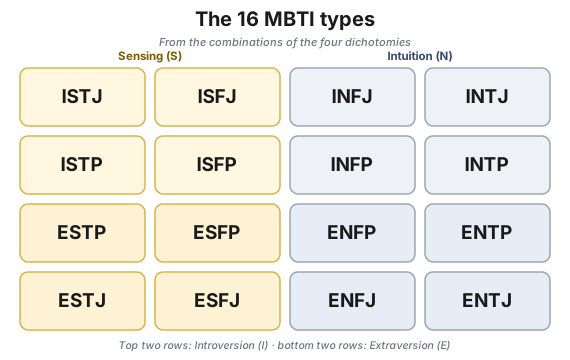
The 16 types from the combination of the four letters. The type is the combination of the four preferences and the context: two people of the same type can also differ.
How do you use the result properly?
Section titled “How do you use the result properly?”Short answer: the test is worth something if it starts a development conversation, not if it sticks on a label. The ethics in four points:
- What is fine: you understand the benefit and the consequence of the preferences, you recognize them in yourself and in others, and this makes you more effective in cooperation.
- What is not acceptable: judging; using the type as an excuse (“I’m an I, that’s why I don’t speak up”); thinking in stereotypes, since everyone uses every preference to some extent.
- There is no better or worse type. Each has its strengths and its traps; the model describes the differences constructively.
- Sharing your type is your decision. What you have just written on the sheet stays confidential until you decide otherwise; the same holds for your colleagues’.
Sentences worth saying out loud: E: “I like to think out loud” · I: “give me a moment” · J: “let’s be practical” · N: “let’s muse about the possibilities” · S to the N: “good idea, how can it be realized?” · P to the J: “here it is, as I’m working on it” · T to the F: “thank you”.
When NOT to use it? (the limits of the method)
Section titled “When NOT to use it? (the limits of the method)”Short answer: it is the wrong tool if you want to base a decision about people on it, or if you expect from it something it does not even measure.
- For selection, recruitment, appraisal. The MBTI gives no information about abilities and skills, so there is nothing to base such a decision on.
- For typecasting others. The type is self-reported: determining it on someone else’s behalf is inaccurate and offensive.
- As a permanent label. The two-pole classification hides the fact that the underlying traits move on a continuous scale, and the stability of the classification differs greatly depending on the method.
- For predicting performance or aptitude. It is not a proven tool for this; the details are in the reliability section of the main article.
- Instead of an “official” result. Five questions per dimension: it is for an estimate, it does not replace the accredited assessment.
Nor is the clarity to be misread: it shows how consistently you chose the same pole. It is not a skill and not a “quantity”.
Take it home (keys)
Section titled “Take it home (keys)”- The four letters are a starting point, not an end result. The marked profile is the start of a conversation with yourself, not a diagnosis.
- The clarity shows the consistency of your answers, not how “good” you are at that pole; at a 3–2 dimension you decide.
- Preference ≠ ability. The non-preferred pole can also be developed, it just takes longer and more concentration.
- Your type is confidential. Sharing it is your decision, your colleagues’ is theirs.
Self-test (check your understanding)
Section titled “Self-test (check your understanding)”- One dimension came out 4–1. What does this say, and what does it not say?
- Why is the MBTI an indicator and not a test? What follows from this for the result you have just got?
- A colleague would use their team’s types for allocating tasks. What do you answer, and which two rules do you cite?
Answer key
- That out of five questions you consistently chose the same pole at four: the preference is “clear”. It does not say that you are more skilled at this, nor that you do not use the other pole.
- Because it does not measure but sorts: it gives a signal, the final word is yours. So you have to confirm the four letters, and you may override them if, reading the pole descriptions, the other side is closer.
- They may not use it. (a) The tool is for development only, because it gives no information about abilities; (b) the type is self-reported and confidential. Instead: task allocation should be based on documented performance, and at most the form of the message should be adapted to the preference.
Terminology (HU / EN)
Section titled “Terminology (HU / EN)”| Hungarian | English |
|---|---|
| Extrovertált / Introvertált | Extraversion / Introversion (E/I) |
| Érzékelő / Intuitív | Sensing / Intuition (S/N) |
| Gondolkodó / Érző | Thinking / Feeling (T/F) |
| Megítélő / Észlelő | Judging / Perceiving (J/P) |
| preferencia tisztasága | clarity of preference |
| indikátor, nem teszt | indicator, not a test |
Why did I get a different result than earlier or on another test?
Because a preference is not a sharp boundary: your daily state, the context and the wording of the questions all influence your answers, especially in the 3–2 dimensions. This is exactly why the retest reliability of the MBTI is disputed.
Can I use this test to assess a colleague or a candidate?
No. The ethics of the MBTI forbid using it for selection, appraisal or typecasting others. The type is self-reported: determining it on someone else’s behalf is inaccurate and offensive.
How "official" is this test?
It is a short, self-awareness practice self-test, with 5 questions per dimension. It is good for understanding the four dimensions and estimating your preferences, but it does not replace the accredited MBTI assessment.
Related concepts
Section titled “Related concepts”MBTI · self-awareness · which self-awareness model, when · DISC · Insights colour energies · Belbin team roles · assertive communication · feedback
Next step
Section titled “Next step”Once you have your four letters, in this order:
- MBTI — the four function pairs (ST, SF, NT, NF) and the reliability picture.
- feedback — the structure of feedback, on which your T/F preference bears.
- Belbin team roles — the same thing seen from the side of team roles.
References / further reading
Section titled “References / further reading”- Isabel Briggs Myers: Introduction to Type, CPP, 1998; Gifts Differing, CPP, 1980 — the foundational work on the preference pairs.
- Otto Kroeger – Janet M. Thuesen: Type Talk, Dell, 1988 — the source of the English mnemonics and the “most characteristic” tags.
- Stephen P. Robbins – Timothy A. Judge: Organizational Behavior, 15th edition, Pearson, 2013, chapter 5 — the organizational evaluation of the MBTI and its limits.
- National Academy of Sciences MBTI review — the reservations about retest reliability.