Muri (inflexibility)
≈ 14 min read · 2,785 words
At eight in the morning you are standing in line at the coffee shop. One coffee machine, one barista — and ten people, each ordering something different. While the barista switches from the complicated latte to the plain espresso, time ticks by; at the peak the queue keeps growing, yet at ten in the morning the machine steams away idle. The coffee shop cannot adapt fast enough to what the guests happen to be ordering. This is muri, in English inflexibility — one of the basic concepts of Lean. The meaning of muri is simple: the system cannot adjust quickly to the customer’s real demand, so it either waits (idling) or catches up by force (overtime) — both cost money and add no value. Let’s look at what it is, where inflexibility comes from, and how to reduce it.
Muri (inflexibility) is the system’s inability to adapt quickly to the customer’s real demand — it adds cost, but no value. According to Lean, three factors inhibit value-creating flow — waste (Muda), inflexibility (Muri) and variability (Mura) — and muri is one of them. Its four types are capability (we cannot provide the required product/service), configuration (the product/process/network cannot meet demand), capacity (we cannot match volume to demand) and changeover (we cannot switch quickly between products). The price of inflexibility is either idle capacity (idling), or overtime and capacity increase — both raise cost without improving flow.
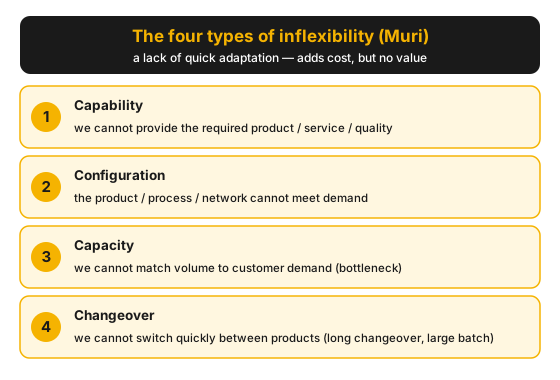 Figure 1 — the four types of inflexibility (Muri): capability, configuration, capacity and changeover. Each is a missing ability to adapt quickly to customer demand.
Who is this for?
Section titled “Who is this for?”This article is for those who deal in practice with rigid capacity and slow changeover: operator · production and plant manager · shift supervisor · production planner · process engineer · logistics/supply chain · Lean/CI specialist.
Learning objectives
Section titled “Learning objectives”After reading this article you will be able to:
- say what muri is, and why it adds cost without value;
- list the four types of inflexibility (capability, configuration, capacity, changeover), and give an example of each;
- recognize the typical sources of inflexibility (large batches, long changeover, rigid shift pattern, bottleneck);
- choose the right remedy (SMED, levelling, multi-skill training, standard work);
- draw the line: when raising flexibility is not the right answer.
In brief
Section titled “In brief”- Muri = inflexibility: the system cannot adapt quickly to the customer’s demand — it adds cost, but no value.
- One of the three inhibitors of flow (Muda, Muri, Mura); for the full frame see: muda-mura-muri.
- It has four types: capability, configuration, capacity, changeover.
- The price of inflexibility runs both ways: either idle capacity (idling — workers wait, machines stand still), or overtime / capacity increase. Neither creates value.
- Typical sources: large production batches, long changeover times, rigid shift pattern, labor rules, bottleneck, high WIP.
- Remedy at the source: SMED (quick changeover), heijunka (levelling), multi-skill training, standard work.
Why it matters (the stakes)
Section titled “Why it matters (the stakes)”Inflexibility is dangerous because it penalizes in both directions: if customer demand falls below capacity, idle capacity arises (workers wait, machines stand still); if it rises above capacity, it can only be met with overtime or extra capacity. Both are pure cost with no value — and the more rigid the system, the more often it tips into one of these extremes.
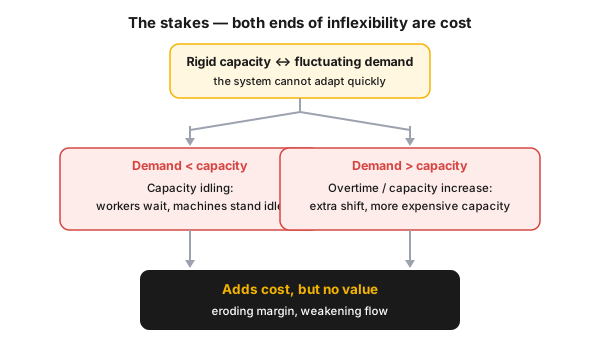 Figure 2 — both ends of inflexibility are cost: the gap between demand and capacity forces either idling, or overtime and capacity increase. Neither improves flow.
In a process plant the price of inflexibility is quickly quantifiable. At the start and end of a flaring event, to avoid soot formation the steam flow must be ramped up and then down — if the system cannot adapt finely and quickly enough, the excess steam burns money: on the order of 60 t of medium-pressure (MP) steam ≈ €2,000 per event. The lesson: inflexibility is not an abstract “lean concept” but a direct margin loss, which is best attacked at the source (changeover, capacity, levelling).
What is muri, and where does it come from?
Section titled “What is muri, and where does it come from?”Muri is one of the structural inhibitors of flow: the system’s inability to adapt quickly to what the customer really wants. The Japanese word muri literally means “overburden, unreasonableness” — in the Lean frame it denotes inflexibility, alongside Muda (waste) and Mura (variability). The root of the idea is the Toyota Production System: it is not enough to improve flow by chasing visible waste (muda), because on the cause side sit inflexibility and variability, which keep regenerating the waste.
The logic comes from a simple input–process–output model: the inputs (people, machine, method, material, information) are transformed through the value-creating process into output — the goal being the right-quality product, in the right quantity and at the right time. Inflexibility hinders this transformation: it does not let you adjust fast enough to the fluctuation of demand.
What are the four types of inflexibility?
Section titled “What are the four types of inflexibility?”Inflexibility has four types, and each is a missing ability to adapt quickly (see Figure 1):
| # | Type (HU / EN) | What it means | Typical source |
|---|---|---|---|
| 1 | Kapabilitás (Capability) | we cannot provide the required product / service / quality | machine capability, lack of expertise |
| 2 | Konfiguráció (Configuration) | the product / process / network cannot meet demand | inflexible process or network design |
| 3 | Kapacitás (Capacity) | we cannot match volume to customer demand | bottleneck, rigid capacity |
| 4 | Átállás (Changeover) | we cannot switch quickly between products | long changeover time, large production batches |
Where does inflexibility come from? (its sources)
Section titled “Where does inflexibility come from? (its sources)”Inflexibility is not accidental: it stems from concrete, nameable sources that can be reduced deliberately:
- High WIP in the FIFO system and large production batches — they make the sequence and the response rigid.
- Long changeover times — this is the most obvious changeover muri, and at the same time the main target of SMED.
- Rigid shift pattern and shift template, as well as statutory labor rules — they limit the quick reallocation of capacity.
- Bottleneck (the limit of available machine capacity) — the classic source of capacity muri.
As long as these sources persist, the system responds to every fluctuation of demand with either idling or overtime — both wastes that degrade flow.
How to reduce muri (diagnosis and remedy)
Section titled “How to reduce muri (diagnosis and remedy)”Inflexibility must be attacked at its source, with a remedy targeted by type. A suggested order of steps:
- Diagnose by the four types. Compare demand and capacity: where does idling arise, and where the need for overtime? Name which type (capability / configuration / capacity / changeover) is dominant.
- Reduce the changeover time (SMED). Convert internal changeover steps into external ones, and prepare everything before the machine stops — this way you stay economical even with smaller batches.
- Level the load (heijunka). By smoothing demand and production, the fluctuation of capacity demand decreases, so you tip into idling or overtime less often.
- Increase the flexibility of capacity. With multi-skill (multiple-operation) training, the workforce can be reallocated to the bottleneck.
- Fix it in a standard (standard work) — the proven changeover and reallocation method, so it becomes a durable capability rather than a one-off fix.
Process-industry context + safety
Section titled “Process-industry context + safety”In the process industry, inflexibility stems from the campaign-change (changeover) time and from the capacity limits of the units: when the plant cannot follow the change in demand or feed quickly, it forces buffer stock (intermediate storage), which is inventory waste. The lack of fine, fast control costs money directly — as the flaring-steam example above shows.
Hands-on / mini-scenario
Section titled “Hands-on / mini-scenario”How you would introduce it tomorrow. Choose a machine or unit where product or campaign change hurts. Over one shift, measure the changeover time (from the machine stop to the first good part / to the on-spec state), and split it into internal (only possible with the machine stopped) and external (can be prepared while the machine runs) steps. At the next changeover, prepare the external steps in advance — that alone already shortens the stop noticeably. Note how many minutes you gained, and how much smaller a batch thereby becomes economical — that number kicks off the SMED project.
Homework. Take a typical demand fluctuation from your own area (e.g. one week’s order curve). Mark on which days idling arises and on which overtime. Which type of muri (capacity or changeover) causes it? Which remedy (levelling or faster changeover) would reduce it?
Measurement / audit
Section titled “Measurement / audit”The effect of muri shows up mostly in changeover time, capacity utilization and stock level. Auditable, muri-specific metrics:
| Metric | What it measures | Target |
|---|---|---|
| Changeover time | from the stop to the first good part / to the on-spec state | falling trend (SMED) |
| Economic minimum batch | how large a batch is still worthwhile | falls as changeover shortens |
| Ratio of idling vs. overtime | how much capacity stands / how much extra shift is needed | both decrease |
| Buffer stock (intermediate storage) | how much intermediate stock hides the inflexibility | falls as flexibility rises |
Target logic: the point is not the absolute value of the metrics, but the trend — as flexibility improves, changeover shortens, the extremes (idling/overtime) become rarer, and the buffer can be drawn down.
Common mistakes
Section titled “Common mistakes”The pitfalls of inflexibility almost all stem from treating the symptom instead of the cause. In anti-pattern ↔ correction pairs:
- We only chase waste (Muda). We reduce the buffer stock, but not the inflexibility — the problem returns, because the cause regenerates the buffer. Instead: attack the muri at the source (changeover, capacity, levelling).
- We take the long changeover as “a given.” We accept the large batch because “changeover takes ages anyway.” Instead: changeover can be cut dramatically with SMED — this is the most obvious muri remedy.
- Overtime as a permanent solution. Capacity inflexibility is masked with constant overtime. Instead: levelling (heijunka) and multi-skill training — overtime is unsustainable.
- We mistake buffer stock for safety. Intermediate storage is “reassuring,” but it actually hides the inflexibility and ties up capital. Instead: draw down the buffer step by step as you improve flexibility.
When is raising flexibility NOT the answer?
Section titled “When is raising flexibility NOT the answer?”Reducing muri is powerful, but it is not the right tool for every problem. Knowing when raising flexibility is not the answer is just as important:
| Situation | Why (primarily) not muri reduction | The right answer | ||
|---|---|---|---|---|
| The real trouble is fluctuating demand (variability) | more flexible capacity hides it expensively, but does not eliminate the cause | first smooth the variability ([[mura.en | mura]], levelling) | |
| The problem is pure waste (waiting, rework) | it is not flexibility that is needed, but eliminating the muda | [[muda.en | muda]] analysis, [[vsm.en | VSM]] |
| The bottleneck is deliberate (a safety/technology limit) | a “more flexible” plant here would push against the limit | keep the limit, adjust demand to it | ||
| Faster changeover would risk safety | speed must not come at the expense of protective steps | keep the safe sequence; let SMED speed only the non-safety-critical steps |
Rule of thumb: muri reduction is strongest for recurring, structural inflexibility (long changeover, rigid capacity). It does not replace dealing with variability and pure waste — Mura and Muda must be handled with their own tools.
Key takeaways
Section titled “Key takeaways”- Inflexibility penalizes in both directions: idling or overtime — neither gives value.
- Four types, four questions: can we make it (capability)? can the process carry it (configuration)? is the volume enough (capacity)? do we switch fast enough (changeover)?
- Attack at the source: the most obvious and fastest-paying step is shortening the changeover (SMED).
- Levelling + multi-skill training give capacity its flexibility — overtime is not a solution.
- The buffer is not your friend: it hides the muri; draw it down as flexibility improves.
- In the process industry, inflexibility is margin loss and a safety risk too — a stable, levelled operation is also safer.
Self-check
Section titled “Self-check”- What are the four types of inflexibility, and give one example of each from your own area?
- Over a week, where does idling arise and where overtime on the line? Which type of muri (capacity or changeover) causes it, and which remedy would reduce it?
- Why is it not enough to draw down the buffer stock if you do not eliminate the cause of the inflexibility? What happens without the buffer?
How does this show up in digital practice?
Section titled “How does this show up in digital practice?”Reducing inflexibility does not stop at the production line: the same logic can be supported in software too. The goal is always the same — to make the gap between demand and capacity visible and measurable before it turns into idling or overtime.
| Muri principle | Digital implementation | What it delivers |
|---|---|---|
| Capacity–demand comparison | load planner / capacity dashboard | predictable idling and overtime risk |
| Changeover time | automatic changeover-time collection, trend | the SMED target becomes measurable |
| Flexible scheduling | digital shift and resource plan | faster reallocation to the bottleneck |
| Multi-skill capability | digital competency matrix | it is visible who can cover for whom |
| Levelling (heijunka) | order scheduler / load smoother | more even load, smaller buffer |
Connection to OPEREX (shift log)
Section titled “Connection to OPEREX (shift log)”The sources of inflexibility — long changeover, capacity limit, upset, rigid shift pattern, deviation from the standard — are by nature shift-level, time-series events. These can be logged per shift in the shift log (OPEREX), so the causes that block flow become visible not as anecdote (“the changeover dragged on again”) but as a trend. From the trend, targeted improvement can be planned (a SMED project, levelling, standardization), and the effect of the intervention can be measured back from the data of the following shifts.
Terminology (HU / EN / JP)
Section titled “Terminology (HU / EN / JP)”| Hungarian | English | 日本語 / note |
|---|---|---|
| Rugalmatlanság | inflexibility / muri | ムリ / muri — “overburden, unreasonableness” |
| A rugalmatlanság 4 típusa | capability · configuration · capacity · changeover | the four adaptation gaps |
| Kapacitás-tétlenség | capacity idling | workers wait, machines stand still |
| Átállás | changeover | product-change time (SMED target) |
| Szűk keresztmetszet | bottleneck | the source of capacity inflexibility |
| Az áramlás három gátja | three inhibitors of flow | Muda · Muri · Mura |
What is muri (inflexibility)?
The system’s inability to adapt quickly to the customer’s real demand. It adds cost, but no value: if demand falls below capacity, idling arises; if it rises above, it can only be met with overtime or extra capacity.
What are the four types of inflexibility?
Capability (we cannot provide the required product/service), configuration (the product/process/network cannot meet demand), capacity (we cannot match volume to demand) and changeover (we cannot switch quickly between products).
What is the difference between muri, muda and mura?
All are inhibitors of flow. Muri is inflexibility, muda is waste, mura is variability. Muri and mura always breed muda (waste), so durable improvement starts on the cause side, at Muri and Mura. The full picture: muda-mura-muri.
Related concepts
Section titled “Related concepts”muda-mura-muri · muda · mura · smed · heijunka · standard work · flow · the three types of activity
Next step
Section titled “Next step”If you have understood this, from here it is worth going on — in this order:
- muda-mura-muri — see the three inhibitors together: how Muri connects to Muda and Mura in flow.
- smed — the most obvious muri remedy: how to shorten the changeover so you stay flexible even with a smaller batch.
- mura — variability, the “sibling” of muri: smoothing demand and the process often leads to the real root of inflexibility.
References / further reading
Section titled “References / further reading”- Taiichi Ohno: Toyota Production System: Beyond Large-Scale Production. Productivity Press, 1988. — the canonical foundational work of the muda / mura / muri frame.
- Shigeo Shingo: A Revolution in Manufacturing: The SMED System. Productivity Press, 1985. — the methodology of quick changeover (SMED), the main remedy for changeover muri.
- James P. Womack – Daniel T. Jones: Lean Thinking. Simon & Schuster, 1996. — flow and levelling (heijunka) as tools against inflexibility.