Vertical organization vs. horizontal value stream — who owns the flow?
≈ 15 min read · 3,001 words
A customer’s order is late. It passed through sales, the warehouse, production, quality and logistics, and every department did its own job: production hit the piece count, quality issued the paperwork, logistics kept to the shipping plan. On the board every metric is green, yet the customer is angry, because the order slipped by two weeks. Where did the time get lost? At the hand-offs, between the departments, where no one’s metric measures it. This is one of Lean’s deepest tensions: the organization is built vertically (by function), while customer value flows horizontally across it. Let’s look at why the two collide, and who owns the whole flow.
The vertical organization is built by function, while customer value flows horizontally across it, and often no one owns the whole value stream. Every organization looks upward, toward the CEO, and organizes itself along functions (departments); customer value, by contrast, is one thing but generally flows through several departments and organizations. This is one of Lean’s central tensions: the vertical organization optimizes its parts, but no one is responsible for the whole, horizontal value stream, so the performance the customer experiences deteriorates. The solution is a named value stream owner and a horizontal, end-to-end value stream walk.
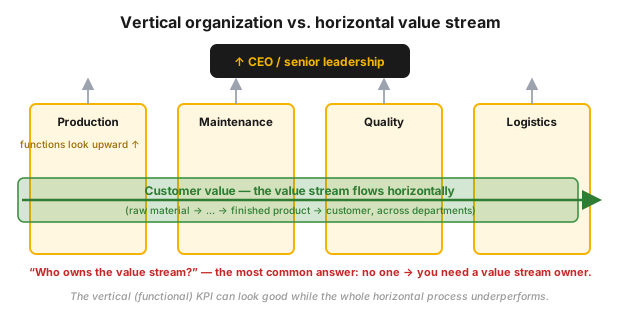 Figure 1 — the functional silos look upward to leadership while customer value flows horizontally through them; the loss arises at the hand-offs.
Who is this for?
Section titled “Who is this for?”This article is for those who watch performance disappear between department boundaries: shift and plant manager · production controller · process and technology engineer · quality and logistics manager · Lean/CI specialist · senior leader who owns the whole flow.
Learning objectives
Section titled “Learning objectives”After reading this article you will be able to:
- distinguish the vertical (functional) organization from the horizontal value stream, and name where they collide;
- explain why a functional KPI can look good while the customer experiences poor performance;
- answer the key question, “who owns the value stream?”, and why the most common answer is “no one”;
- derive the resolution: the named value stream owner and the end-to-end value stream walk;
- recognize when breaking up the organization is not the right answer, but rather placing horizontal responsibility on top of the existing structure.
The essence
Section titled “The essence”- Vertical: the hierarchy and the functional departments (production, maintenance, quality, logistics) look upward, toward leadership.
- Horizontal: customer value flows across the departments, and rarely coincides with a single organizational unit.
- The key question, “who owns this value stream?”, most often gets the answer: no one.
- The distortion: the vertical KPI can look good while the horizontal process (customer delivery, quality, lead time) performs poorly, because the metrics hide the hand-off loss.
- Solution: a named value stream owner + a horizontal, end-to-end value stream walk, where the problem becomes visible.
Why does it matter? (the stakes)
Section titled “Why does it matter? (the stakes)”The stake is that an organization made up of superbly functioning departments can deliver poor performance as a whole, without anyone knowing why. Every function optimizes its own metric, so the local improvements cancel each other out, and the loss hides between the departments, in the hand-off gaps, into which not a single KPI can see.
The consequence is three-tiered, and all of it lands on the customer:
| If the flow is ownerless… | What happens in the organization | What the customer experiences |
|---|---|---|
| Local optimization | each department pulls its own KPI, the whole flow deteriorates | costlier, slower service |
| Hidden hand-off loss | the information lost at the function boundary is not measured | defective or incomplete delivery |
| Ownerless responsibility | no one owns the end-to-end flow | complaints, churn |
The lesson: an organization can be no better than the weakest hand-off between its departments. That is why it pays to shift attention from the silos to the value that flows between them.
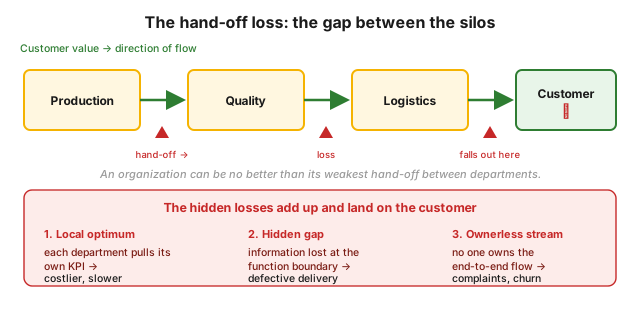 Figure 2 — customer value passes through every function boundary, and at every hand-off a loss arises; the hidden losses add up and land on the customer.
What is the difference between the vertical organization and the horizontal value stream?
Section titled “What is the difference between the vertical organization and the horizontal value stream?”The vertical organization is organized by function, upward; the horizontal value stream is the path of customer value, which runs sideways, across several departments. The two rarely coincide, and it is precisely this gap that is the source of the loss.
Verticality belongs to the hierarchy and the functional departments: production, quality, logistics look upward, toward leadership, and optimize their own functional metrics. Horizontality, by contrast, is the logic of flow: the value stream runs across the departments, and no single organizational unit “owns” the whole path.
The distortion arises because the vertical, functional KPIs can look good (for example a plant’s availability) while the whole, horizontal process (customer delivery, quality, lead time) performs poorly. For the functional metrics hide the loss that arises at the hand-offs between departments.
“Who owns the value stream?”, and why “no one”?
Section titled ““Who owns the value stream?”, and why “no one”?”To the question — “who owns this value stream?” — the most common answer in practice is: no one. Not out of ill will, but because the organization’s structure does not assign an owner to the horizontal flow.
Senior leadership’s mindset typically consists of three parts, and none of them focuses on the whole value-creating flow:
| Viewpoint | What it focuses on | What it leaves out |
|---|---|---|
| Operational | narrow focus, on one step and one result at a time | the flow between the steps |
| Financial | connected metrics, many KPIs | the customer’s experience behind the metrics |
| Strategic | dropping the “wrong” activities, the portfolio | the daily value creation of the existing flow |
So the whole flow remains “ownerless”: the metrics are designed and prescribed while it goes unconsidered how the employees meet them and what the customers feel. The missing link is a named owner who looks at the whole path.
How can the tension be resolved? Value stream owner and the horizontal walk
Section titled “How can the tension be resolved? Value stream owner and the horizontal walk”The resolution consists of two steps: name an owner for the whole value stream, and walk the flow horizontally, crossing the department boundaries. This way the hidden hand-off loss becomes both visible and manageable at once.
- Name an owner for the whole flow (value stream owner). Assign an owner to the entire value stream, regardless of how many departments it spans. This is the person who is responsible for the end-to-end performance, not for a single function.
- Walk the flow horizontally. Lead the walk end to end, along the flow, not within a single department. The direction does not matter, but often working backward from the end of the flow is the most effective, because from there you can see what the customer actually expects.
- Make the hand-offs visible. The walk reveals the hand-off losses and bottlenecks between departments that the vertical metrics conceal (see VSM).
The senior leader’s role here is not to answer but to ask: “5 Whys?”, not “1 Who?”. The goal is not to find a scapegoat, but to understand the process, to clearly assign responsibility, and to run PDCA-based experiments to eliminate the performance gap.
Process-industry context
Section titled “Process-industry context”In a process plant the path from raw material to finished product spans several vertically organized units and functions (production, maintenance, quality, logistics). The vertical KPIs, for example a plant’s availability, can look good while the whole process (customer delivery, on-spec ratio, lead time) performs poorly.
This is where the value stream view makes the hand-off losses between departments visible, typically the information lost at the shift and function boundary (shift handover). In the process industry, moreover, these hand-offs are often also safety-critical: an incompletely handed-over plant state or a warning lost at a function boundary affects not only customer performance but also safety. The horizontal walk therefore has a double benefit here: it lights up the hidden gaps of yield and of safety at the same time.
Practical section: how you would introduce it tomorrow (mini-scenario)
Section titled “Practical section: how you would introduce it tomorrow (mini-scenario)”You don’t need to reorganize anything to try it tomorrow. The question list of Womack’s senior-leadership Gemba walk is a practice that fits into half a day. Choose a value stream, and go through it backward from the customer, seeking answers to these questions along the way:
- Choose a value stream. Not the whole factory, just one concrete customer demand (one product, one order type). Question: which value stream do we focus on?
- Ask: who owns it? Walk around and put it simply: who owns this value stream? If the answer is “no one” or “everyone a little bit”, you have found the gap.
- Walk the flow horizontally. Start from the customer, and go backward along the flow, crossing the department boundaries. At every hand-off stop: what goes across (paper, spoken info, e-mail), and what can get lost here?
- Record the current performance and the gap. Question: what is the process’s current performance, is it visible to everyone, and how big is the gap from the target? Give the answer not from memory but from data seen on the spot.
- Ask, don’t answer. During the walk ask “5 Whys?”, not “1 Who?”. The goal is to understand the process and to clearly assign responsibility, not to find a scapegoat.
When NOT to use it? (the limits of the method)
Section titled “When NOT to use it? (the limits of the method)”The horizontal value stream view is powerful, but it does not mean the functional organization must be abolished. The vertical structure has real value: it provides deep professional knowledge, a career path and standard discipline. The goal is placing horizontal responsibility on top of the existing structure, not tearing it down.
| Situation | Why (primarily) not this answer | The right step | |
|---|---|---|---|
| Deep functional expertise is at stake (e.g. certified welding, lab analytics) | the expertise lives and develops in the function | keep the function, put value-stream responsibility on top of it | |
| The problem arises within a single department and is solved there too | it needs no full horizontal reorganization | local [[kaizen.en | kaizen]] within the function |
| There is no stable process yet | on an unstable flow there is nothing to walk through | first stabilize, then measure and improve the flow | |
| Leadership uses the walk as a “management by walking around” tool | the point is learning and asking, not command | a question-based walk, with delegation of responsibility |
Rule of thumb: don’t break up the silos, but make visible and accountable the value that flows between them. Functional depth and horizontal responsibility are strong together, weak against each other.
Common mistakes
Section titled “Common mistakes”- Local optimization. Every department improves its own KPI, the whole flow deteriorates. Why it’s a problem: the local gain comes at the neighbor’s expense, the customer is worse off. Instead: measure the result of the whole, horizontal flow, and optimize subordinated to it.
- Ownerless value stream. There is no value stream owner, so no one owns the customer experience. Why it’s a problem: the gaps stay in no man’s land, the problem persists for years. Instead: name an owner for the whole flow, regardless of function boundaries.
- Vertical walk. The gemba walk is led within a single department. Why it’s a problem: the hand-off loss is precisely between the departments, so it stays hidden. Instead: walk end to end, along the flow.
- Trusting functional metrics. A good functional KPI conceals weak horizontal performance. Why it’s a problem: even with a green board the customer can be angry. Instead: next to every functional metric put the question “what does the customer feel?”.
- “1 Who?” instead of “5 Whys?”. The leader looks for a scapegoat during the walk. Why it’s a problem: fear hides the real problems, learning stops. Instead: ask for causes (5 Whys?), show respect, and delegate finding the answers.
Take it home (keys)
Section titled “Take it home (keys)”- The organization is vertical, value is horizontal: it is precisely between the two, in the hand-offs, that performance disappears.
- A good functional KPI is not proof: always ask what the customer experiences of the whole flow.
- “Who owns the value stream?” If the answer is “no one”, the first task there is: name a value stream owner.
- Walk horizontally, end to end, often backward from the end of the flow, because that is where the hidden loss shows.
- Don’t break up the silos, but put horizontal responsibility on top of them: functional depth + flow ownership are strong together.
Self-test
Section titled “Self-test”- Why can every functional KPI look green while the customer experiences poor performance? Where is the loss?
- What is the most common answer to the question “who owns this value stream?”, and what is its organizational cause?
- Why is abolishing the functional departments not the right answer? What do we do instead?
How does it appear in digital practice?
Section titled “How does it appear in digital practice?”The vertical-horizontal tension does not disappear in a digital system, but it can be made visible and traceable. Instead of the physical hand-offs (paper, verbal briefing, e-mail), a well-designed digital process strings onto a single thread the events that span the departments, so the hand-off gap is drawn out rather than disappearing.
| Concept / principle | Digital implementation | What it makes visible / what it prevents |
|---|---|---|
| Horizontal value stream | an end-to-end tracked process timeline (not per-department islands) | the whole lead time, not just the functional partial times |
| Hand-off loss | a logged, timestamped hand-off at the function boundary | the immeasurable dead time hiding between the departments |
| Ownerless responsibility | a named owner and escalation at the level of the flow | so a stuck case does not stay in no man’s land |
| Whole-flow measurement | a flow-level metric above the functional KPIs | so the green department board does not conceal a poor customer experience |
| Horizontal walk | a shared status picture seen by every function | so that not everyone sees only their own slice |
Connection to OPEREX (shift diary)
Section titled “Connection to OPEREX (shift diary)”The losses that arise at the hand-offs between departments become visible in the shift diary (OPEREX). The information handed over (or lost) at the shift and function boundary is the weak point of the horizontal process, and the diary ties the silos together into a traceable thread: the hand-off is documented, timestamped and retrievable. This way the loss that the functional metrics hide becomes demonstrable in the diary and thus reducible, and the senior-leadership walk can ask about concrete, logged hand-offs instead of working from memory.
Terminology (HU / EN)
Section titled “Terminology (HU / EN)”| Hungarian | English | Note |
|---|---|---|
| Vertikális szervezet | Vertical / functional org | upward-looking functional silos |
| Horizontális értékfolyam | Horizontal value stream | the path of customer value across the departments |
| Értékfolyam-felelős | Value stream owner / manager | the owner of the whole flow |
| Átadási veszteség | Hand-off loss | the gap between the silos, where performance disappears |
| Értékfolyam-séta | Value stream walk / gemba walk | end to end, along the flow |
Who owns a value stream?
In practice the most common answer is: no one, because the organization is built by function, not along the path of customer value. The solution is a named value stream owner who is responsible for the whole horizontal process, not just for one functional department.
Why does customer performance deteriorate if the functional KPIs are good?
Because the vertical, functional metrics hide the losses that arise at the hand-offs between departments. The whole, horizontal flow (delivery, quality, lead time) can therefore perform poorly while every department “looks good”.
How does the value stream walk make the problem visible?
By tracking the flow horizontally, end to end, so it shows the hand-off losses and bottlenecks between departments that the vertical metrics conceal. The direction does not matter, but often backward from the end of the flow is best.
Does the horizontal view mean the departments must be abolished?
No. The functional organization has real value (deep expertise, a career path, standard discipline). The goal is not to tear down the silos, but to place horizontal, whole-flow responsibility on top of the existing structure.
Related concepts
Section titled “Related concepts”vsm · flow · gemba-walk · the three lenses · Lean leadership · pdca · shift handover
Next step
Section titled “Next step”If you have understood this, from here it is worth going on — in this order:
- gemba-walk — the practical tool of the horizontal value stream walk: how to lead an end-to-end walk, and what questions to ask.
- vsm — the value stream map, with which you also demonstrate the hidden hand-off loss and the bottlenecks visually.
- Lean leadership — the leader’s role: how to ask “5 Whys?” instead of “1 Who?”, and how to delegate finding the answers.
References / Further reading
Section titled “References / Further reading”- James P. Womack — Daniel T. Jones: Lean Thinking: Banish Waste and Create Wealth in Your Corporation. Free Press, 2003 — the canonical exposition of the value stream as one of Lean’s basic principles.
- James P. Womack: Gemba Walks. Lean Enterprise Institute, 2011 — the source of the leadership gemba walk and of the vertical organization vs. horizontal flow tension.
- Mike Rother — John Shook: Learning to See: Value-Stream Mapping to Add Value and Eliminate Muda. Lean Enterprise Institute, 1999 — the foundational work on value stream mapping and the role of the value stream manager.