MBTI — Myers–Briggs type indicator
≈ 30 min read · 5,931 words
The MBTI is a self-report personality typology sorting people into 16 types along four preference pairs; it serves self-awareness and development only.
The model builds on Carl Jung’s theory of psychological types, and it describes where you draw your energy from, what information you trust, how you decide, and how you relate to the outer world. The four dimensions are: Extraversion (E) – Introversion (I), Sensing (S) – Intuition (N), Thinking (T) – Feeling (F), and Judging (J) – Perceiving (P). The combination of the four preferences gives 16 types (for example INTJ, ESFP). The basic principle of the MBTI is that there is no “better” or “worse” type: everyone uses all eight preferences, only one pole is the more natural. It is not suitable for selection or appraisal.
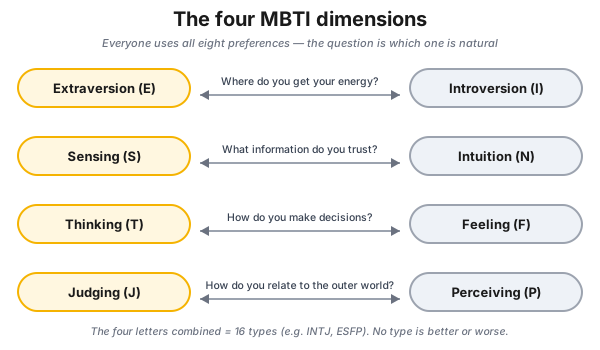
Figure 1 — the four MBTI dimensions and the question each of them answers. The combination of the four letters (E/I, S/N, T/F, J/P) gives the type.
Who is this for?
Section titled “Who is this for?”This article is for people who work in teams and regularly experience that the same sentence gets through to one colleague and hits a wall with another: shift supervisor · plant manager · process engineer · maintenance manager · HSE specialist · project manager · team leader · HR and training staff · Lean/CI coordinator.
Learning objectives
Section titled “Learning objectives”After reading this article you will be able to:
- explain what the four MBTI dimensions measure, and what they do not measure;
- distinguish preference from ability, and the indicator from a test;
- recognize the other person’s momentary communication need from behavioural cues, and adapt your own message to it;
- derive the characteristic leadership styles from the four function pairs (ST, SF, NT, NF);
- state where the reliability and validity of the MBTI stand, and when another tool should be chosen instead.
In brief
Section titled “In brief”- Two people sit through the same shift handover. One immediately asks back, thinks out loud, throws in three ideas. The other stays silent, then comes over half an hour later with a precise, thought-through suggestion. Neither is more passive or smarter than the other: they draw their energy from different places. This is exactly the difference the MBTI names, along four dimensions.
- Four dimensions, four questions: where you draw your energy from (E/I), what information you trust (S/N), how you decide (T/F), how you relate to the outer world (J/P).
- Preference, not ability. The MBTI shows which pole is natural and comfortable, not what you are good at. Everyone uses both poles, and the non-preferred one can be developed with practice.
- An indicator, not a test. It is not the instrument that tells you your type: you are the best judge of your own type, the questionnaire only adds a signal.
- 16 types, from the combination of the four letters (for example ISTJ, ENFP). Each has its own strengths and possible traps.
- Ethics: there is no good or bad type. The MBTI describes the differences constructively and positively, and can be used for development only, never for selection, appraisal or putting people in boxes.
- What it is good for: self-awareness, valuing diversity, and developing communication, leadership style, problem solving, change and conflict management.
- It has limits. The classification is dichotomous, and the stability of the classification gives a very different picture depending on the measurement method. Excellent as an opener for a development conversation, poor as a decision label.
Why it matters (the stakes)
Section titled “Why it matters (the stakes)”Friction within a team rarely comes from someone doing their job badly. Far more often it comes from them doing it well, only differently from the way you would.
If you give the “big picture” to a colleague tuned to details, they will feel the task is uncertain, and will ask back three times. If you give a step-by-step written instruction to a colleague who thinks in possibilities, they will experience it as restrictive, and will improvise. If you argue with the mood of the team to a matter-of-fact decision maker, they will not hear the argument; if you show only numbers to a values-driven decision maker, they will not own the decision. Both sides act in good faith, yet the price is real: lost time, needless rounds of alignment, quietly eroding trust. The MBTI does not solve these situations, but it makes them nameable, and a named difference is something you can work with.
What is the MBTI, and where does it come from?
Section titled “What is the MBTI, and where does it come from?”Short answer: the MBTI is a self-report, non-appraising tool built on Carl Jung’s theory of psychological types, and developed by Katharine Cook Briggs and her daughter, Isabel Briggs Myers, during the Second World War, originally to help place recruits in suitable roles.
In his 1921 work Psychological Types (English edition: 1923) Jung described two dichotomous function pairs:
- the “rational” (judging) functions: thinking and feeling;
- the “irrational” (perceiving) functions: sensing and intuition.
According to Jung, in everyone both function pairs are expressed in either an inward- or an outward-turning form. That gave three bipolar dimensions: turning outward/inward, the way information is gathered (sensing or intuition) and the way decisions are made (thinking or feeling). The fourth dimension was added by Briggs and Myers, also on Jungian grounds: it measures how we handle the “outer world” (a judging or a perceiving attitude). This is why there are exactly four letters, and not three.
Jung compared psychological type to handedness: a person is either born with or develops certain preferred ways of perceiving and deciding. Just as it is hard work for a right-handed person to write with the left hand, using the non-preferred psychological pole is also harder, even if it can be developed and made more flexible with practice.
The purpose of the MBTI is to help you:
- get to know yourself in terms of the four preference pairs,
- value the differences between people,
- see how people of different types can complement and help one another.
An indicator, not a test
Section titled “An indicator, not a test”This distinction is one of the most important and most often skipped points of the model. The questionnaire does not measure but sorts the answers (sorting, not measuring), and gives back an indication of your preferences. Your type is ultimately confirmed by you: you are the best judge of your own type. This is also why it is called an “indicator” and not a “test”. The self-test referenced at the top of this article should be used in the same spirit: a starting point for a conversation, not an announcement of results.
The four assumptions of type theory
Section titled “The four assumptions of type theory”- Preferences are innate.
- The environment strengthens or inhibits the expression of the type.
- We use both poles in different situations, but not with the same confidence.
- Every type is equally valuable.
From this follows the separation of preference and ability. The preferred pole is easy, fast, automatic, natural; the non-preferred one is less comfortable, slower, demands concentration, but becomes easier and faster with practice.
The ethics of the MBTI in five rules
Section titled “The ethics of the MBTI in five rules”- It describes differences constructively and positively.
- There is no better or worse type: every type has its strengths and its possible traps.
- The tool may be used for the purpose of development only.
- It may not be used for selection, recruitment procedures or appraisal, since it gives no information about the individual’s abilities and skills.
- It is your decision to share your MBTI type with others. The type remains confidential information until its owner decides otherwise.
What are the four MBTI dimensions?
Section titled “What are the four MBTI dimensions?”Short answer: four preference pairs, each of which answers one question: where you draw your energy from (E/I), what information you trust (S/N), how you decide (T/F), and how you relate to the outer world (J/P).
The comparisons below show the characteristic, observed patterns of the two poles, as a reminder, not as a box.
Extraversion (E) – Introversion (I): where do you draw your energy from?
Section titled “Extraversion (E) – Introversion (I): where do you draw your energy from?”It describes where you get your energy from and where you focus it. The extravert tunes in to the outer environment, likes to “talk the problem through”, learns from discussion and action, has a broad range of interests, and often proceeds in a talk-act-reflect order, because they are recharged by interaction. The introvert wants to reflect in the inner world, likes to “think the problem through”, learns from pondering, knows a few topics deeply, and rather thinks before speaking or acting, because they are recharged by solitude. Important: E/I is not about sociability or self-confidence.
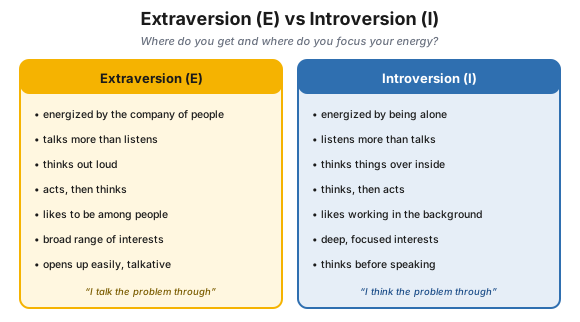 Figure 2 — the observed behaviours of the Extraversion (E) and the Introversion (I) pole.
Sensing (S) – Intuition (N): what information do you trust?
Section titled “Sensing (S) – Intuition (N): what information do you trust?”It describes what type of information you gather and trust. The sensing person focuses on real, observable and concrete facts, values practical application, notices and remembers the details, thinks “here and now”, and prefers step-by-step, precise instructions. The intuitive person attends to the big picture and the possibilities, values imaginative insights, sees the patterns and the underlying meaning, likes to muse about the future, and prefers the overall plan, which they work out themselves. Important: sensing ≠ sensitive, intuition ≠ common sense.
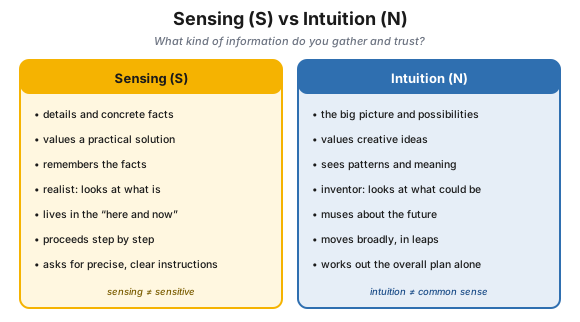 Figure 3 — the observed behaviours of the Sensing (S) and the Intuition (N) pole.
Thinking (T) – Feeling (F): how do you make decisions?
Section titled “Thinking (T) – Feeling (F): how do you make decisions?”It describes the preferred way of deciding. The thinking person decides on the basis of objective logic, attends to cause and effect and to logical errors, applies consistent principles, steps out of the situation in order to be impartial, and concentrates on the task: straightforward, honest, values fairness. The feeling person decides along personal values, strives for harmony and common ground, treats everyone as a unique person, steps into the situation and weighs with empathy, and concentrates on the relationships. Important: a “thinker” can feel too, a “feeler” can think too; the question is the primary basis of the decision.
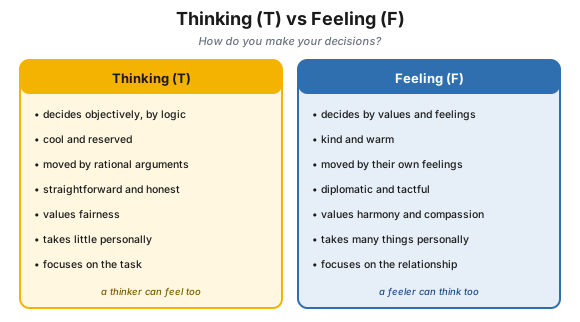 Figure 4 — the observed behaviours of the Thinking (T) and the Feeling (F) pole.
Judging (J) – Perceiving (P): how do you relate to the outer world?
Section titled “Judging (J) – Perceiving (P): how do you relate to the outer world?”It describes how you handle the world around you. The judging person prefers a planned, decided, organized life: likes to close questions, proceeds along lists and deadlines, and feels good in predictability. The perceiving person prefers a flexible, open, spontaneous attitude: likes to keep the options open, adapts to the situation, and is happy to revise in the light of new information.
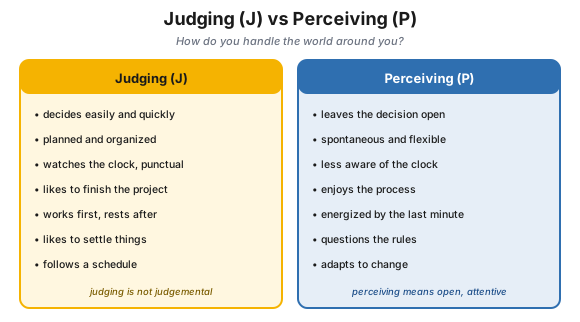 Figure 5 — the observed behaviours of the Judging (J) and the Perceiving (P) pole.
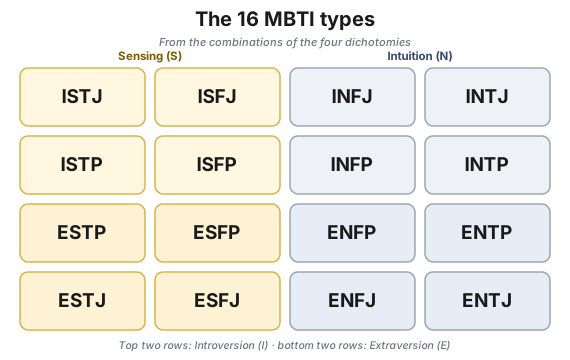
Figure 6 — the 16 types from the combination of the four letters. The left two columns are sensing (S), the right two intuition (N); the top two rows are introversion (I), the bottom two extraversion (E).
A brief characterization of the 16 types
Section titled “A brief characterization of the 16 types”The combination of the four letters gives 16 types; each has a recurring, characteristic pattern. The short characterizations below follow the names used in the detailed Hungarian type descriptions, as a reminder, not as a box. The type is the combination of the four preferences and the context, not a single label; two people of the same type can differ in many ways.
| Type | Name | Characteristic essence |
|---|---|---|
| ISTJ | The dutiful administrators | A sense of responsibility: doing here and now what has to be done; thorough, reliable, builds on facts, respects structure. |
| ISFJ | A heightened sense of duty | A lasting personal sense of responsibility; practical help to others; guardian of the details, the tradition and the relationships. |
| INFJ | Imagination directed at others | The inner world of possibilities and symbols; knowledge based on empathy, deep, quiet commitment. |
| INTJ | Life’s strategy makers | A drive built on inner possibilities; a systems-level, long-term, independent strategist. |
| ISTP | The born troubleshooters | Logical and practical; understands how things work; a calm, effective problem solver. |
| ISFP | “Sees much, shares little” | Deep attention towards the living world; quiet, sensitive, expresses themselves rather through deeds. |
| INFP | Noble server, helper in company | Attention to people and idealism; values-driven, authentic, inward-turning. |
| INTP | The absorbed scholar | To understand the phenomenon; seeks meaning and a logical system; an independent, analytical thinker. |
| ESTP | The ultimate realist | Enthusiastic attention to the practical experiences of the outer world; ready to act, a here-and-now doer. |
| ESFP | People of momentum | Continuous participation in new activities and relationships; spontaneous, sociable, energetic. |
| ENFP | “Everything, out of everything” | Attends to the possibilities of the outer world; always taking part in something new; enthusiastic, full of ideas. |
| ENTP | The person of serial challenges | Excited by possibilities and by debate; a person of ideas and of “what if”. |
| ESTJ | Life’s administrators | Analyses the outer world and puts it into logical order; an organizer, decisive, result-centred. |
| ESFJ | Life’s great carers | The most sociable type; draws energy from relationships; caring, harmony-creating. |
| ENFJ | The persuader who gets through | Active attention to people; creates alignment; an inspiring, developing leader. |
| ENTJ | The natural leader | A believer in a logically assembled, analysable world; a born leader with a strategic outlook. |
What do the four function pairs say about leadership style?
Section titled “What do the four function pairs say about leadership style?”Short answer: the middle two letters (information gathering and decision making) give four function pairs, and it is these four pairs that describe most precisely what leadership style someone brings with them: ST brings competence, SF dialogue, NT interpretation, NF creation.
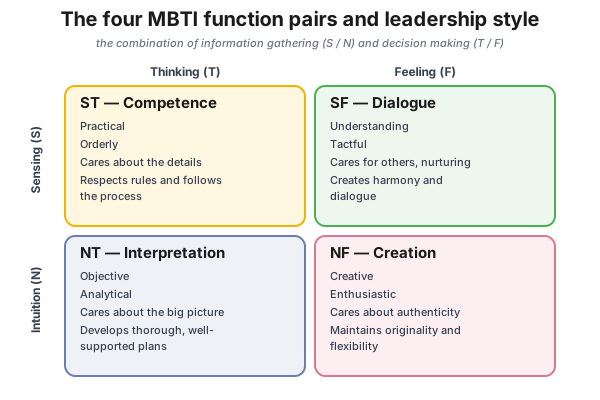
Figure 7 — the four function pairs and the leadership style tied to them.
- ST — Competence. Practical, orderly, cares about the details, respects the rules and follows the process. Strong where stability and adherence to the specification are at stake.
- SF — Dialogue. Understanding, tactful, cares for and looks after others, creates alignment and dialogue. Strong in maintaining team cohesion and everyday cooperation.
- NT — Interpretation. Objective, analytical, cares about the big picture, develops thorough and well-supported plans. Strong on the terrain of systems-level problems and longer-term planning.
- NF — Creation. Creative, enthusiastic, cares about authenticity, strives to maintain originality and flexibility. Strong in creating commitment to changes.
These four pairs are not a ranking. A team typically needs all four: the ST so that the standard holds; the SF so that people stay together; the NT so that the system improves; the NF so that there is something to join. If one of them is durably missing from a leadership team, that gap predictably shows up in the operation.
Type in practice: communication, team, leadership
Section titled “Type in practice: communication, team, leadership”Short answer: the practical benefit of the MBTI is not the label but the conscious handling of differences: recognizing the other person’s momentary need, and adapting the form of your message to it.
The platinum rule
Section titled “The platinum rule”The golden rule says: treat others as you would like to be treated. This is well intentioned, but it has a quiet flaw: it assumes that the other person wants the same as you. In practice your colleagues, your subordinates and your customers often want to be treated quite differently. So the platinum rule is more worthwhile: treat others as THEY would like to be treated. That, however, requires knowing the differences, and this is where the MBTI helps.
Mode, not type
Section titled “Mode, not type”Assessing people’s type in everyday work is neither realistic nor necessary. What is needed is the mode: what the other person needs at that particular moment. Type is a preference, not a permanent state; nobody is always “in type”. Anyone who assumes that a colleague of a known type will always be experienced in the same way easily goes astray. The point is not to typecast, but to tune in.
The three steps of adapting
Section titled “The three steps of adapting”- Recognize your own preferred communication style. If you know what your own default setting is, you will also see how much your own style adds to the misunderstanding.
- Tune in to the other person’s momentary communication need. This is observation, not guesswork: the behavioural cues below help.
- Adapt your approach if necessary. It is not the content that has to change, only the form.
Behavioural cues: what to watch for?
Section titled “Behavioural cues: what to watch for?”| Dimension | Cues of one pole | Cues of the other pole |
|---|---|---|
| E / I | Let’s talk it through: fast speech, thinks out loud, interrupts, louder volume | Let’s think it through: pauses while speaking, quieter voice, shorter sentences |
| S / N | Specifics: asks for step-by-step information, “what” and “how” questions, precise description, factual details | Big picture: asks for current and long-term consequences, “why” questions, more general wording, wants more options |
| T / F | Logical consequences: as if “testing”, weighs the objective evidence, is not swayed by others having already decided, “if this, then that” logic | Human impact: strives for harmony, talks about what matters to them, asks how others have solved it, cares whether people were taken into account |
| J / P | The joy of closure: arrives on time, impatient with long descriptions, a “let’s get it done” tone, uses completed verb forms | The joy of the process: may run over time, wants room for their own decision, is bothered by early closure, uses continuous verb forms |
The four-part adapting framework
Section titled “The four-part adapting framework”Three different preference pairs give a handhold for the three phases of a conversation:
| Phase | What to watch for |
|---|---|
| Opening | E: let’s talk it through · I: let’s think it through |
| Exploration and proposal | ST: facts, with practical benefit · SF: tailored help · NT: logical alternatives · NF: support their vision |
| Closing, next steps | J: the joy of closure · P: the joy of the process |
This framework works because at different points of the conversation you have to hit something different. At the opening the energy preference matters, in the content part the information and decision preference, and at the closing the relation to the outer world.
Practical consequences in the team
Section titled “Practical consequences in the team”- E/I in the team: involve the extraverts in brainstorming and joint planning, and use their presentation skills; give the introverts time to think, create a risk-free opportunity to share their opinion, and give them a task they can complete on their own.
- S/N in communication: with the sensing person be concrete, practical and factual, outline the plan step by step, bring examples from experience; give the intuitive person the big picture and their visions, avoid needless detail, and use their originality for new approaches.
- T/F in feedback: the thinking person expects objective feedback aimed at improving the task (and has to pay attention to praise as well); the feeling person values the recognition of personal effort (and has to make sure that mistakes are not passed over either). This connects directly to the way feedback is given.
- J/P in planning: with the judging person start and finish the meeting on time, be organized, and avoid last-minute changes; with the perceiving person be flexible, accept their spontaneity, avoid tight deadlines, but check the work and steer it towards the end product.
This is why all nine of the typical applications of the MBTI belong here: valuing the diversity of working styles, improving workplace relationships, developing leadership style, improving communication, developing problem-solving strategies, supporting the handling of change, understanding stress reactions, conflict management, and taking the team and organizational culture into account. In a shift-based, team environment, knowing the type differences brings a better shift handover, more effective meetings and fewer misunderstandings, without putting anyone in a box.
Putting it into practice — a 45-minute team workshop
Section titled “Putting it into practice — a 45-minute team workshop”Preference awareness can be started in a team even without a questionnaire licence and a certified consultant. The outline:
- Presenting the framework (10 minutes). Draw up the four dimensions and the question belonging to each. Say up front that there is no good and bad pole, and that the material of the conversation stays confidential.
- Opposite-pairs exercise (15 minutes). Form pairs so that the two members of the pair represent opposite preferences on a chosen dimension. In 5 minutes the pair prepares a short presentation about how they see the same task from the two poles, then presents it to the team.
- Self-nomination (5 minutes). After the presentations everyone marks their own preferences on a simple list; from this the type that fits them best is assembled.
- Retrieving behavioural cues (10 minutes). Recall one good and one bad recent conversation. What behavioural cues were visible on the other person? Did they match your preferences? If not, how did this affect the conversation?
- Closing and homework (5 minutes). Everyone chooses one colleague to whose preference they will deliberately adapt the form of their message during the coming week, and reports at the next meeting on what happened.
How does the MBTI differ from DISC?
Section titled “How does the MBTI differ from DISC?”Short answer: the MBTI describes cognitive preferences (how you think, decide, recharge) and gives 16 types; DISC describes observable behaviour with four styles, and is meant for a quick description of everyday workplace communication. The MBTI is the “why”, DISC is the “how it looks”.
The four DISC styles are: Dominance (D), Influence (I), Steadiness (S) and Conscientiousness (C). The model was developed by the physiologist-psychologist William Moulton Marston around two questions of perception: do I see the situation as favourable or unfavourable, and do I feel myself stronger or weaker than it. The four combinations give the four styles. (Marston’s original concepts were dominance, inducement, submission and compliance; for today’s notation and the details see the DISC article.)
| Aspect | MBTI | DISC |
|---|---|---|
| What does it describe? | the personality type, the inner preferences | the behaviour in different situations |
| Theoretical basis | Jung’s type theory | Marston’s emotional-behavioural model |
| Categories | 16 types (4 dichotomies) | 4 styles (D/I/S/C), with intensity levels |
| Its nature | a relatively stable preference | situation-dependent, the behaviour can change |
| Typical use | type self-awareness, career choice | communication, team building, coaching |
| Suitable for selection? | no | no |
The two do not replace each other, and neither of them is suitable for selection.
How reliable is the MBTI?
Section titled “How reliable is the MBTI?”Short answer: the answer depends on how you handle the scores. As a continuous scale the reliability of the MBTI is comparable to that of similar tools; as a dichotomous type classification, however, the stability of the classification is weak, so no decision should be based on a type label.
What speaks for it
Section titled “What speaks for it”- If the scores are handled continuously (as is customary with most other psychological tools), the reliability is as good as or better than that of other personality tools.
- On retesting, people get three or four preferences the same in 75–90% of cases.
- When someone “changes” type on a retest, it typically happens on a single dichotomy, and precisely on the one where the clarity of the preference was low to begin with.
- The reliability can be called good in most age and ethnic groups.
What speaks against it
Section titled “What speaks against it”- According to a national academy of sciences (NAS) review committee, the retest reliability is weak in most of the earlier research: in one large review study only 47% of respondents kept their original type classification over five weeks.
- The same review, on the data of more than 20 studies, concluded that only the I–E scale has adequate construct validity.
- Of the four scales, the T–F pair has the lowest reliability.
- According to the reviewers, the 16 categories are valid for 54% of the population; the remaining answers fall into the “nearest category”.
- In certain groups (for example children, underperforming students) the reliability can be low, so there the result can be used at most as a starting point for a conversation.
The MBTI and the Big Five
Section titled “The MBTI and the Big Five”For predicting workplace behaviour, the textbook literature of organizational behaviour recommends not the MBTI but the Big Five model: extraversion, agreeableness, conscientiousness, emotional stability and openness to experience. This framework is supported by substantially stronger research material, and its connections with workplace behaviour are also better documented.
That does not mean the MBTI has to be thrown out. As the textbook concludes: although the MBTI is widely criticized, it may have a place in organizations, namely in training and development. There it helps people understand themselves better, helps team members understand each other, opens up communication in work groups, and can reduce conflicts.
The “dark side”
Section titled “The “dark side””One of the most practical concepts connected to the MBTI is the “dark side”: the least preferred Jungian function, which comes out when a person is tired, stressed or under pressure. Recognizing and handling this is already consultant terrain requiring additional training, but the mere awareness is worth a lot: your behaviour under pressure is not your “real self” but the voice of your least developed function.
The correct use is therefore: for self-reflection and development, not for decisions. You are the best judge of your own type, and the goal is understanding, not appraisal.
When NOT to use it (the limits of the method)
Section titled “When NOT to use it (the limits of the method)”Short answer: the MBTI is the wrong tool if you want to base any decision about people on it, or if you expect from it something it does not even measure.
What the MBTI does not measure
Section titled “What the MBTI does not measure”It does not measure IQ, psychiatric disorder, emotions, trauma, stress, learning, “normality”, maturity, illness or well-being. If you are looking for answers to these, another tool and another professional is needed.
Unethical uses
Section titled “Unethical uses”Using the MBTI for hiring, selection, promotion and reward is expressly unethical. The reason is not formal: the tool gives no information about the individual’s abilities and skills, so there is nothing to base such a decision on. If the output concerns someone’s job, pay or career progression, the basis of the decision should be a structured interview, a work sample and documented performance data.
Further improper uses
Section titled “Further improper uses”- Predicting other people’s behaviour. Type is not a prediction machine.
- Estimating another person’s type (“you must be an extravert, you’re so sociable”). Type is self-reported.
- Assuming that a preference plays out the same way in you and in the other person. Within a type there is a wide spread.
- Justifying behaviour (“he must be a P, he’s always late”). A preference is an explanation, not an excuse.
- Stereotyping. To a certain extent everyone uses the other preferences as well.
- Misreading the “clarity” score. The clarity point of the report shows how consistently the respondent chose that pole, that is, consistency. It is not a skill, not a competence, not a “quantity”: someone with a high clarity score on E is not a “better extravert”.
Formal condition: a certified practitioner
Section titled “Formal condition: a certified practitioner”Administering and debriefing the official MBTI questionnaire requires training and a successful certification exam. The certified practitioner helps the individual and the team recognize their own and others’ preferences; understanding and handling the “dark side” requires further training. A conversation within a team for self-awareness purposes needs no licence, but issuing and interpreting an official report does.
Common mistakes
Section titled “Common mistakes”- Typecasting others. Type is self-reported; determining it on someone else’s behalf is offensive and inaccurate. Instead: the “mode, not type” approach, that is, reading the momentary need.
- Using it for selection or appraisal. The ethics of the MBTI expressly forbid this; it is for development only.
- Using it as an excuse (“I’m an I, that’s why I don’t speak up”). A preference is an explanation, not an exemption from development.
- Taking preference for ability. The non-preferred pole can also be developed and used.
- Judging from one letter. The type is the combination of the four dimensions and the context, not a single label.
- Passing the type on without consent. Sharing the type is the decision of its owner.
Take it home (keys)
Section titled “Take it home (keys)”- The MBTI sorts, it does not measure. It sorts into four preference pairs, and the classification is confirmed by you; that is why it is an indicator, not a test.
- Preference ≠ ability. Everyone uses all eight preferences; the non-preferred one can be developed with practice.
- The practical benefit lies in adapting. Recognize your own style, read the other person’s momentary need, and adapt the form of your message, not its content.
- Mode, not type. Do not typecast; watch what the other person needs right now.
- Do not base a personnel decision on it. Yes for development, communication, team building; never for hiring, selection, promotion or reward.
- Know the measurement limits. As a continuous score it is fine; as a dichotomous type label the stability of the classification is weak, and only the I–E scale has strong construct validity.
Self-test
Section titled “Self-test”- Why are there exactly four MBTI dimensions, if Jung originally described three? Which is the fourth, and what does it describe?
- What does the “clarity” score mean in the report, and what are the two things it certainly does not mean?
- A shift supervisor says: “this colleague is a P type, so I don’t give him tasks with deadlines.” Name two separate rules this sentence breaks, and say what the correct step would be instead.
Answer key
- Jung described three bipolar dimensions: turning outward/inward, the way information is gathered (sensing or intuition) and the way decisions are made (thinking or feeling). The fourth, the judging–perceiving (J/P) dimension, was added by Briggs and Myers, also on Jungian grounds; it describes how a person handles the “outer world”.
- The clarity score shows how consistently the respondent chose that pole, that is, the consistency of the answers. It does not measure skill or competence, and it does not mean the “size” or strength of the preference in the sense that someone would be “better” at that pole.
- (a) According to the ethics of the MBTI the tool may be used for development only, not for appraisal and work-organization decisions; (b) it is forbidden to estimate another person’s type and to justify behaviour with the type, because type is self-reported. Instead: task allocation should be based on documented performance and an agreed arrangement, and only the form should be adapted to the preference at most (for example an earlier reminder of the deadline, an intermediate checkpoint).
Terminology (HU / EN)
Section titled “Terminology (HU / EN)”| Hungarian | English | The dimension’s question |
|---|---|---|
| Extrovertált / Introvertált | Extraversion / Introversion (E/I) | where the energy comes from |
| Érzékelő / Intuitív | Sensing / Intuition (S/N) | what information |
| Gondolkodó / Érző | Thinking / Feeling (T/F) | how one decides |
| Megítélő / Észlelő | Judging / Perceiving (J/P) | relation to the outer world |
| preferencia | preference | the natural pole |
| típusindikátor | type indicator | the combination of the 4 letters |
| tisztaság-pontszám | clarity score | the consistency of the answers |
| funkció-pár | function pair | ST / SF / NT / NF |
| sötét oldal | dark side | the least preferred function |
What do the four MBTI dimensions measure?
Four preference pairs: Extraversion–Introversion (where you draw your energy from), Sensing–Intuition (what information you trust), Thinking–Feeling (how you make decisions) and Judging–Perceiving (how you relate to the outer world). The combination of the four letters gives one of the 16 types.
Why is the MBTI an indicator and not a test?
Because it does not measure but sorts: on the basis of your answers it gives an indication of your preferences, but the final word is yours. You are the best judge of your own type, so you have to confirm the result for it to be your type.
Is there a "better" or "worse" MBTI type?
No. The basic principle of the MBTI is that every type has its strengths and its possible traps; the tool describes the differences positively, and is meant solely for self-awareness and development.
What must the MBTI NOT be used for?
For hiring, selection, promotion, reward and performance appraisal, because it gives no information about the individual’s abilities and skills. It is likewise improper to estimate other people’s type, to justify behaviour with the type, and to stereotype. Beyond that, it does not measure IQ, psychiatric disorder, emotions, trauma, stress, learning, maturity or illness.
Does a preference mean that I am good at it?
No. A preference shows which pole is natural and comfortable, not what you are skilled at. Everyone uses both poles, and the non-preferred one can also be developed with practice.
What is the difference between the MBTI and DISC?
The MBTI focuses on cognitive preferences (thinking, deciding, energy) and gives 16 types; DISC focuses on observable behaviour along four styles: Dominance (D), Influence (I), Steadiness (S) and Conscientiousness (C). The MBTI is the “why”, DISC is the “how it looks”; both are self-awareness tools, and neither is a selection tool.
What do the four letters tell you about the type?
Each letter is the preferred pole of one dimension. For example ENTJ is extraverted (E), intuitive (N), thinking (T) and judging (J): in the Hungarian type descriptions “the natural leader”, a believer in a logically assembled, analysable world, and an organizer with a strategic outlook. The 16 names and short characterizations appear in the type table of this article; the type, however, is always the combination of the four preferences and the situation, not a single label.
How reliable is the MBTI?
The picture is twofold. Handled as a continuous score, its reliability is comparable to that of other personality tools, and on retesting three or four preferences stay the same in 75–90% of cases. As a dichotomous type classification, however, it is weak: according to an independent review, over five weeks 47% of respondents kept their original type, and on the basis of more than 20 studies only the I–E scale has adequate construct validity.
Related concepts
Section titled “Related concepts”the MBTI self-test · DISC · self-awareness · Belbin team roles · assertive communication · feedback · effective meetings · Lean leadership and coaching
Next step
Section titled “Next step”If you have understood this, from here it is worth going on — in this order:
- the MBTI self-test — determine your own four-letter type with 5 questions per dimension, so that you have something to relate to.
- DISC — the other lens: the same differences seen from the side of observable behaviour, plus a comparison of the reliability figures.
- feedback — the structure of feedback, on which your own T/F preference bears most strongly.
References / further reading
Section titled “References / further reading”- Carl Gustav Jung: Psychologische Typen (Psychological Types), 1921; English edition 1923 — the theoretical basis of the MBTI, the source of the “rational” (thinking, feeling) and “irrational” (sensing, intuition) function pairs.
- Isabel Briggs Myers: Gifts Differing. Consulting Psychologists Press, 1980 — the foundational work of the model’s creator on type differences.
- Isabel Briggs Myers: Introduction to Type. CPP, Inc., 1998 — the most widespread short introduction to type.
- Sandra Krebs Hirsh: Using the Myers-Briggs Type Indicator in Organizations. Consulting Psychologists Press, 1991 — the handbook of organizational application; the source of the preference scales and the dichotomy descriptions.
- Otto Kroeger – Janet M. Thuesen: Type Talk: The 16 Personality Types That Determine How We Live, Love, and Work. Dell Publishing, 1988; and Type Talk at Work (with Rutledge), Dell Publishing, 2002 — the workplace appearance of the types.
- David Keirsey: Please Understand Me II. Prometheus Nemesis Book Company, 1998 — a related, temperament-based typology.
- Jean Kummerow – Nancy Barger – Linda Kirby: Work Types. Warner Books, 1997 — the connection between type and working style.
- Stephen P. Robbins – Timothy A. Judge: Organizational Behavior, 15th edition, Pearson, 2013, chapter 5 — the organizational evaluation of the MBTI and its contrast with the Big Five model.
- National Academy of Sciences MBTI review — the source of the 47% retest agreement, the construct validity of the I–E scale and the 54% category coverage cited in this article.