Operations and the asset team — the integrated operating unit
≈ 26 min read · 5,134 words
A pump’s vibration rises. The operator sees it in the field, the technologist in the trend, the maintainer in the vibration report. If these three people sit in three separate organizations, three separate reports are written, and the decision on whether to shut down or hold on until the next maintenance window is made somewhere up the line, weeks later. But if they are members of the same team, the decision is made tomorrow morning, at one table.
In the process industry this organizational model is usually called the asset team. The asset team is a cross-functional team built around a given plant or technological unit. Its essence is that operations in the process industry is not a collection of separate disciplines, but a team working for one shared goal, jointly responsible for the performance and reliable running of a given asset.
The “asset” in this context does not mean merely a machine, but the plant, technological unit or other productive asset that creates business value. The term therefore does not denote yet another organizational unit; it expresses that every discipline involved takes joint responsibility for the performance of the same asset.
Below we go through the meaning of operations and the asset team, the matrix principle behind it, and — through plant examples — how it works in practice.
Operations is an integrated unit around one asset: the cross-functional asset team of operators, process technology and maintenance, under one shared goal.
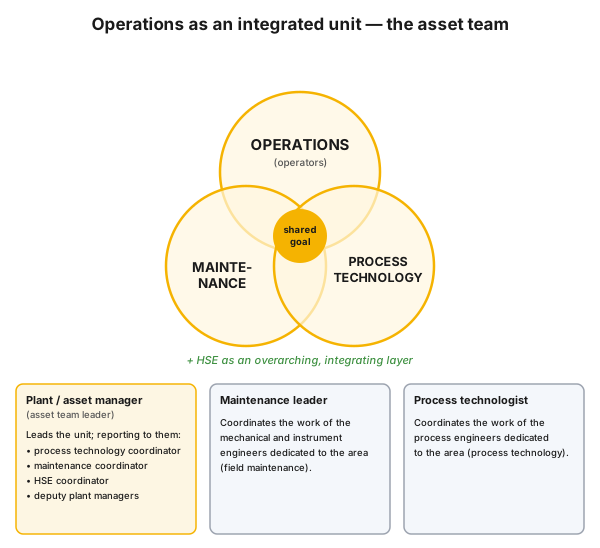 Figure 1 — the asset team consists of the overlapping circles of operations, maintenance and process technology, around a shared goal, led by the asset manager and with HSE as an overarching layer. The value arises in the overlap of the circles. The coordinators in the boxes are the daily roles of each function; in the matrix the maintenance and technology leaders are not subordinates but equal partners (see below).
Who is this for?
Section titled “Who is this for?”This article is for those who are jointly responsible for a plant’s daily operation, or who are building such an organization: plant manager · shift supervisor · operator · process technologist · maintenance leader and planner · reliability engineer · HSE and process safety specialist · production manager · Lean and OE specialist.
Learning objectives
Section titled “Learning objectives”After reading this article you will be able to:
- distinguish operations (the umbrella, the whole integrated unit) from the narrow operating function;
- explain what the matrix principle means and why it aims at a flat organization;
- name what the business team empowers the asset team to do, and where the limit of the empowerment runs;
- list the composition of the asset team, and justify why the three core functions are equal, yet whose is the final word;
- plan the biennial, cold-eyes review of the team’s operation.
In brief
Section titled “In brief”- Operations is not just the operators. The integrated unit is operations + process technology + maintenance, and broadly HSE too, organized around a single asset (plant, block).
- The asset team is a cross-functional team with shared responsibility and shared goals. Not three silos working side by side, but one unit whose value lies in the overlap of the circles.
- The concept is a matrix overlay on the existing functional organization: you need not build a new hierarchy — two cross-functional platforms (the asset team and the business team) are enough.
- The superordinate business team empowers the team to operate, maintain and optimize the asset, and accepts its daily operational decisions within the empowerment.
- The three core functions are equal in the matrix, but at the moment of decision the operations leader has the strongest vote (the right of the last word), because the legal responsibility is theirs.
- The key to performance is alignment: by the rope analogy, with misaligned, imposed goals
1+1+1−1 = 2(50%), with consensus-aligned goals1+1+1+1 = 4(100%). - Alignment is created by strategy deployment (OGSM, Hoshin, catchball) and the operating rhythm (daily, weekly, monthly).
Why it matters (the stakes)
Section titled “Why it matters (the stakes)”The stake is the unplanned shutdown: silo operation is not an organizational-theory nuisance but a reliability risk. If the three functions optimize in separate organizations, each improves its own metric while the system as a whole degrades. Operations drives the production plan, so it postpones the shutdown; maintenance protects its own budget, so it does not bring the intervention forward; technology maximizes yield while the equipment runs at its limit. No function errs within its own logic, yet together they build up the next unexpected shutdown.
The typical path of silo operation can be traced end to end: everyone seeks their local optimum, from which clashing priorities arise, the decision slips, the equipment fails or the product falls outside specification, and in the end it becomes an unplanned shutdown. The reverse is just as true: shared responsibility and a shared daily picture are the fastest, capital-free reliability intervention a plant can make.
What do we call operations, and what is the asset team?
Section titled “What do we call operations, and what is the asset team?”Operations is the umbrella; the operating function is the narrow part. In everyday usage, “operations” often means only the operators’ work — leading the process day to day from the control room and in the field. But that is a narrow reading: for this narrow function we consistently use the term the operating function throughout this knowledge base.
The reliable, safe and economical running of an asset is, in fact, in no single function’s hands alone:
- the operating function leads the process, but its room to intervene is set by the technology and the state of the equipment;
- process technology optimizes the parameters and the yield, but only by relying on the operating function’s daily data and the equipment’s capability;
- maintenance sustains the asset’s reliability, but preventing failure also depends on operator observation and the technological limits.
This is why the three functions organize into a single unit, and that unit is the asset team. The three overlapping circles of Figure 1 show exactly this: value arises in the overlap around the shared goal, not in the separate circles.
What does the matrix principle give you?
Section titled “What does the matrix principle give you?”The asset team concept is a matrix-style overlay on the existing functional organization, not its replacement. The disciplinary organization (operations, maintenance, technology) remains: everyone still reports there to their own professional leader; the function stays the owner of professional standards, development and standards. What the matrix adds is a second, cross-functional platform where these same people work around one asset, for a shared result. The practical conclusion is reassuring: you do not need to build a new organizational structure — it is enough to create two cross-functional platforms, the asset teams and the superordinate business team.
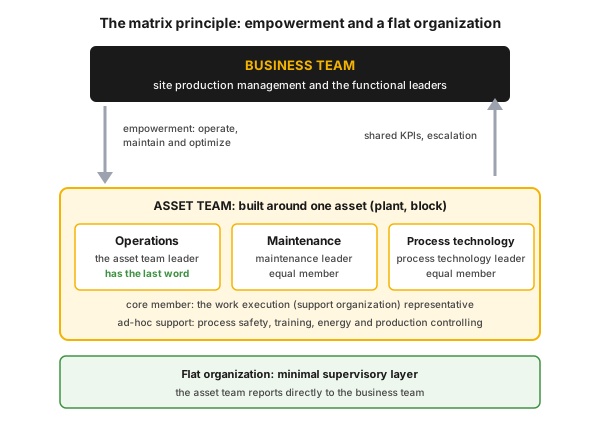 Figure 2 — the business team empowers the asset team to operate, maintain and optimize the asset, and the team reports back with shared KPIs and escalation. The three core functions are equal, the organization is flat: there is a minimal supervisory level between the team and the business team.
The matrix aims at a flat organization, with the fewest possible supervisory levels. That is why the asset team, as a unit, reports directly to the business team: the superfluous communication relays drop out, and the performance review is about the team’s shared KPIs, not three parallel functional reports.
| Aspect | Official (functional) organization | Matrix (asset team) |
|---|---|---|
| Who it reports to | everyone to their own functional leader | the asset team as a unit to the business team |
| What the report is about | functional goals, professional standards | the shared result areas of the asset |
| What the main role is | professional home, development, resource | the daily primary role: running the asset |
| Decision | up the functional line | within the team, within the empowerment |
The main benefit follows from this: fewer management layers, better alignment across disciplines, goals and plans prepared cross-functionally, and increased ownership, because the team has a name, a face and a result.
What does the business team empower the asset team to do?
Section titled “What does the business team empower the asset team to do?”The business team is the superordinate forum of the asset teams, which empowers them to operate, maintain and optimize the asset. The team consists of site production management and the functional leaders (operations, maintenance, technology, production and energy management, process safety, operational excellence), and representatives of other areas can be invited as needed.
The empowerment has a sharp consequence for the leaders: the functional leaders lose their traditional role of deciding day-to-day operational questions. Within the empowerment, these decisions belong to the asset team, and it is the business team’s job to accept them.
The business team’s most important role is to create the environment in which the asset teams can flourish:
- sets an example: it operates as a “model asset team” itself, visibly cross-functional, without silo management;
- gives a set of expectations to the asset teams for all key result areas — this is the starting point of the annual goal-setting;
- approves and aligns the goals, so that the KPIs of the asset teams and the other areas do not clash;
- sets priorities in site-level and inter-asset-team conflicting matters;
- holds regular performance reviews, with lagging and leading indicators, feedback and recognition;
- provides resources and continuity: the stability of key positions and deliberate continuity planning preserve the shared experience and knowledge, and the required seniority level for every position;
- considers even the location of the offices: the physical proximity of the maintenance and technology leaders to the operations leader decisively helps communication within the team.
Who makes up the asset team?
Section titled “Who makes up the asset team?”The core of the asset team is made up of the empowered representatives of operations, maintenance and process technology, joined as needed by further experts. The team’s leader is appointed from operations, because operations is the owner of the equipment; maintenance and technology are the two key supporting disciplines.
| Role | Provided by | Its job in the team |
|---|---|---|
| Asset team leader | operations | leads and aligns the team for safe, undisturbed operation; is the link toward the business team |
| Maintenance leader | maintenance | the single point of contact toward the maintenance organization; responsible for the area’s work |
| Technology leader | technology | responsible for the technology of the assigned units, the monitoring and the troubleshooting |
| Work execution representative | serving (support) organization | efficient execution of the maintenance work, even when not part of the production organization |
| Ad-hoc experts | process safety, HSE, energy and production controlling, training, inspection | expert input for the shared team view and the good decision |
The three core functions are equal in the matrix: the maintenance and technology leaders are not subordinates of the asset team leader but partners. At the moment of decision, however, the situation is not symmetric: the operations leader has the strongest vote, the right of the last word, because the legal responsibility rests on them. This duality is the strength of the model: the debate happens among equals, while responsibility clearly has a name.
HSE and process safety in this setup are not an external, bolted-on function. In some places a separate HSE or process safety coordinator carries it, in many places it is the general operations coordinator’s remit — similarly to how energy efficiency falls to the operations technology coordinator. What matters is not the name of the position, but that the safety viewpoint is part of the team’s decisions, not an after-the-fact approval.
The asset team is also an organizational level of the OGSM cascade: in strategy deployment the team is the Tier-2 (block) level between the site and the equipment level (see the KPI cascade).
Why does alignment decide? The rope analogy
Section titled “Why does alignment decide? The rope analogy”The asset team’s performance is not the sum of the members’ strength, but the resultant of the forces. A simple task is enough for the picture: move a heavy load from A to B with rope and rollers, using four people.
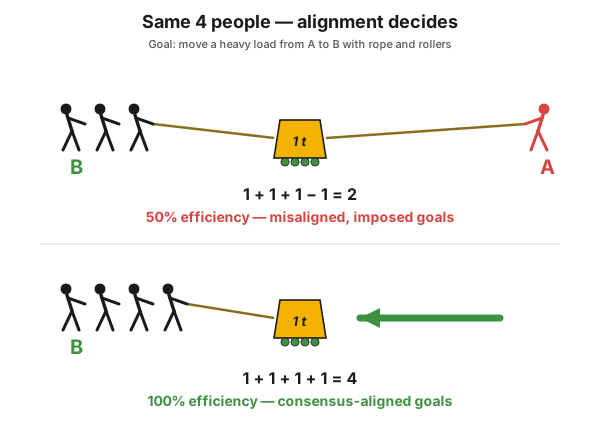 Figure 3 — the same four people. If the goals pull apart or are imposed, the resultant force is only half; if they are aligned by consensus, the resultant is the whole.
- Imposed, unaligned goals: if three people pull one way and one pulls the other way, the resultant force is
1+1+1−1 = 2, i.e. 50% efficiency. The functions each “work,” but against one another. - Consensus-aligned goals: if all four pull the same way, the resultant is
1+1+1+1 = 4, i.e. 100% efficiency, and the load starts moving.
The lesson: goals should not be imposed but built by consensus. This takes time, but in the end people’s goals are aligned, and commitment is born. This is exactly the catchball principle, the two-way strategy deployment of policy deployment and OGSM: the one-way, dropped-down goal delivers roughly half, the two-way, negotiated goal the whole.
How does the rhythm hold the operation together?
Section titled “How does the rhythm hold the operation together?”Alignment is not a one-off event but a rhythm. Goals and plans must be set against the facts in regular, structured meetings, so that from the continuous, orderly flow of information everyone has the picture needed for safe and efficient operation.
| Forum | Its job |
|---|---|
| Daily asset team meeting | the facts of the past 24 hours against the daily plan, HSE events and near-misses, daily task allocation |
| Weekly asset team meeting | weekly performance, periodic technology monitoring, problem-solving, troubleshooting, looking ahead |
| Weekly risk review | dedicated review of the operational risks and the recommendations coming from assessments |
| Monthly asset team review | report to the business team on the key result areas, escalation, feedback and recognition |
| Monthly business review | the functional leaders’ report at site production management level |
The levels are connected by feedback loops: the facts of the lower level aggregate upward, the goal and decision of the upper level cascade downward. The exact content, limits and pitfalls of the forums are covered by the operating rhythm article; the broader operating system by MOS, the logic of the metrics by performance management, and the handover between shifts by the structured shift handover.
Process-industry and safety context
Section titled “Process-industry and safety context”The asset team model is the natural organizational form of the process industry (chemicals, petrochemicals, oil refining, pharmaceuticals and food), because in these industries the process, the equipment and human intervention are inseparably intertwined. In Seveso-classified plants this is also a safety matter: HSE and process safety are part of the team, and the ownership of reliability is shared. By the principle of “operations driven reliability,” the plant and the shift are responsible for asset reliability, and maintenance is an equal partner (see the operations reliability program and the operator–maintainer partnership). The clearest image of the principle is the automobile: a car’s reliability belongs not to the mechanic but to the driver. The operator lives with the equipment day in and day out, just like the driver with the car, so they are the first to sense when performance begins to deteriorate. If ownership of their own equipment takes hold in operations, the intent grows to fix it before it breaks, rather than waiting for failure.
The team’s key result areas reflect this weighting: safety (HSE, process safety, operational risk management), reliability (availability, mechanical integrity), energy, production plan and quality, the handling of planned and unplanned shutdowns and start-ups, operating cost, projects and competence development. The essence is industry-independent: one integrated, shared-goal team around one asset.
Putting it into practice (roadmap)
Section titled “Putting it into practice (roadmap)”Introducing the asset team is not a reorganization but the building of two platforms and the clarification of decision rights. Suggested order:
- Delimit the asset. Designate what belongs to one asset team (one plant or plant block), so that responsibility is also physically interpretable.
- Set up the business team. Let site production management and the functional leaders be one forum that itself operates cross-functionally.
- Name the three leaders. Operations provides the asset team leader, alongside the maintenance and technology leaders as equal members.
- Write down the empowerment. Record which decisions belong to the team in daily operation, and what must be escalated (matters affecting another team, stepping outside the plan, exceeding the budget, or with a long-term effect).
- Align the KPIs. Have the business team break down the high-level goals and eliminate the clashing metrics before the team starts.
- Start the operating rhythm. Daily, weekly and monthly forums with a fixed time, an owner and a one-page, standard format (operating rhythm).
- Seat the team together physically. Office proximity is the fastest, most underrated improvement to communication.
- Evaluate and improve. Every two years, review the operation with a cold-eyes team, and close the loop by the logic of PDCA.
Practical mini-scenario. If you had to start tomorrow: sit down with your maintenance and technology partners and write on one sheet the five most important shared questions of the next two weeks (equipment condition, maintenance window, technological deviation, risk, plan). Put an owner and a deadline on each, then fix a daily 15-minute slot to review this list. This list and this quarter-hour are already a working asset team, without a formal reorganization.
Measurement and audit: how do you know it really works?
Section titled “Measurement and audit: how do you know it really works?”The org chart is not proof. On paper the structure is often fine, but practice can be quite different, so the effectiveness of the operation must be examined regularly, from the outside.
The proven method is the biennial, “cold eyes” assessment: a small, three-to-four-person team screens the asset team’s operation in about a week. The team needs people from production with real experience of well-run asset team management: typically the site production manager or a leader they designate is responsible, alongside two or three experienced business team members so that every aspect is covered, and experienced asset team leaders can be invited too. The assessment closes by the principles of the PDCA cycle: the findings turn into action, and the lessons are built back into the description of the operation, so that the standard stays alive.
What is worth looking at:
- Decision retention: how many daily operational decisions still slip up to the functional leader, even though they are within the empowerment?
- Escalation quality: do the matters that genuinely need escalating reach the business team, and do they get an answer?
- KPI friction: is there a pair of metrics that pushes two team members toward opposite behavior?
- Forum discipline: are the daily, weekly and monthly meetings held, with owners and closed actions?
- Continuity: are the key positions stable, or does the team relearn itself every six months?
Common mistakes
Section titled “Common mistakes”- Silo thinking. The functions optimize separately, so local optima and coordination loss arise, the rope pulls apart. Instead: shared goals and shared result areas, with a cross-functionally prepared plan.
- Empowerment on paper, not in practice. The team gets the right to daily decisions, but the functional leader keeps overriding them. Instead: the business team accepts the decisions made within the empowerment, and steps in only on matters beyond the frame.
- Imposed goals. A goal dropped from above without negotiation breeds resistance and delivers roughly half, because commitment is missing. Instead: catchball, two-way goal negotiation.
- Clashing KPIs. One member’s metric works against the other’s. Instead: the business team aligns the metrics at breakdown time.
- Building a new organizational layer. The matrix is implemented with new management levels, so the organization becomes deeper, not flatter. Instead: an overlay on the existing structure, with a minimal supervisory level.
- Leaving HSE out of the unit. If safety is an external, bolted-on role, it ends up opposed to performance. Instead: the safety viewpoint is part of the team’s decisions, whether with a separate coordinator or as the operations coordinator’s remit.
- Structure without dialogue. An asset team on paper, without operating rhythm and feedback. Instead: disciplined daily, weekly and monthly forums, with closed actions.
- Revolving door of key positions. If the team’s leaders change every year, the shared experience is lost. Instead: deliberate continuity planning in the key roles.
When NOT to use this model (the limits)
Section titled “When NOT to use this model (the limits)”| Situation | Why it does not work this way | The right answer |
|---|---|---|
| No real empowerment | the team becomes responsible for a result whose means it does not own | first, the business team should decide what to hand over, and write it down |
| The asset cannot be separated | if responsibility cannot be physically delimited, there is no reason to organize a team | process- or product-line-based responsibility, a different frame |
| The members cannot work in a matrix | two reporting lines without discipline and partner behavior generate conflict | selection and preparation, then a gradual transition |
| In the middle of a turnaround or crisis | at such times a dedicated, own command system operates | the turnaround’s own organization; the asset team resumes afterward |
| A safety-critical decision | the team’s consensus does not replace the risk analysis | the rule set of HAZOP, LOPA/SIL and management of change |
Take it home (keys)
Section titled “Take it home (keys)”- Don’t reorganize the structure, clarify decision rights. The matrix is an overlay, not a new hierarchy.
- Write down the limit of the empowerment. What is daily operation belongs to the team; what affects another team, plan, budget or the long term must be escalated.
- Equality in the debate, named responsibility in the decision. The operations leader has the last word.
- Align the metrics before you start. Clashing KPIs are the surest rebuilder of the silo.
- The rhythm keeps the structure alive. Without a daily, weekly and monthly forum, the asset team is just a diagram.
- Have it looked at from outside every two years. The cold-eyes assessment is the only way to keep paper and reality from drifting apart.
Self-test
Section titled “Self-test”- What is the difference between the official functional organization and the matrix structure in the case of the asset team, and in which one does the maintenance leader report to whom?
- A technological modification would exceed the asset team’s annual operating budget. Can the team decide on it? Justify with the logic of the empowerment.
- Why are the three core functions equal in the matrix if the operations leader has the right of the last word? What would it solve, and what would it spoil, if the other two leaders were formally their subordinates?
How does it show up in digital practice?
Section titled “How does it show up in digital practice?”The asset team principle does not stop at the org chart: cross-functional operation lives on all three functions seeing the same picture at the same moment. Today software carries this — the mechanism differs, the principle is the same.
| Asset team principle | Digital implementation | What it delivers |
|---|---|---|
| Shared goal, shared result | one shared KPI board for the asset, not three functional reports | everyone debates the same number |
| One daily picture | a shared daily log and deviation list for operations, maintenance and technology | there are not three truths about the same 24 hours |
| Empowerment and escalation | an approval path tied to decision levels, with automatic forwarding | it is visible who may decide and what went up |
| Actions with an owner | a task with an owner and a deadline, tied to a forum | the trace of the meeting is not lost |
| Regular evaluation | historized performance and action data for the cold-eyes screening | the biennial assessment works from facts |
Connection to OPEREX (shift log)
Section titled “Connection to OPEREX (shift log)”The daily alignment of the asset team is realized where the three functions and HSE actually meet: in the shift log (OPEREX). The shift handover, the daily performance dialogue, the deviations (technological limit exceedance, alarm, risk action) and the triggered measures live here, in one place, auditably (ISO 45001 §10.2), and visibly to everyone: to the operator, the technologist, the maintainer and the process safety specialist alike. This way the digital shift log is the layer in which the asset team’s rope pulls one way, day after day.
Terminology (HU / EN / JP)
Section titled “Terminology (HU / EN / JP)”| Magyar | English | 日本語 (romaji) |
|---|---|---|
| Üzemeltetés (az ernyő, a teljes egység) | Operations | 操業 (sōgyō) |
| Üzemvitel (a szűk funkció, operátorok) | Operations (function) / operators | 運転 (unten) |
| Eszköz-csapat | Asset team | — |
| Asset team vezető | Asset team leader | — |
| Üzleti csapat | Business team | — |
| Felhatalmazás | Empowerment | — |
| Mátrix-szervezet | Matrix organization | — |
| Lapos szervezet | Flat organization | — |
| Eszkaláció | Escalation | — |
| Fő eredményterület | Key result area | — |
| Folyamattechnológia | Process technology | — |
| Karbantartás | Maintenance | 保全 (hozen) |
| Biztonság, egészség, környezet | Health, Safety, Environment (HSE) | — |
| Összehangolás | Alignment | — |
| Konszenzus | Consensus | 合意 (gōi) |
| Friss szemű értékelés | Cold eyes assessment | — |
What do we call operations?
In the broader sense, operations is an integrated unit around one asset (plant, block), which includes the operating function (operators), process technology and maintenance, and broadly HSE too. It is not merely the operators’ daily work — that is the narrower operating function. This unit is the asset team.
What is the asset team, and who leads it?
The asset team is a cross-functional team built around one asset, with shared goals and shared responsibility. Its leader is appointed from operations, because operations is the owner of the equipment; maintenance and technology are the two key supporting disciplines.
What does it mean that the asset team is a matrix organization?
That the concept is an overlay on the existing functional organization, not its replacement. Members still report professionally to their own functional leader, but their primary role is in the asset team, and the team as a unit reports to the business team. The goal is a flat organization, with a minimal supervisory level.
What does the business team empower the asset team to do?
To operate, maintain and optimize the asset — that is, to decide on daily operational questions. The business team accepts these decisions as long as they do not step outside the empowerment. Whatever affects another asset team or the whole of production, steps outside the business plan, exceeds the budget, or has a long-term effect must be escalated.
If the three functions are equal, who decides in a dispute?
In the matrix the three leaders are equal partners, but at the moment of decision the operations leader has the strongest vote, the right of the last word, because the legal responsibility rests on them.
Where does HSE belong?
To the organic part of the asset team. The safety and process safety viewpoint is part of the team’s decisions; in some places a separate coordinator carries it, in many places it is the general operations coordinator’s remit.
How can you check that the asset team really works?
Every two years a cold-eyes assessment is recommended: a team of three or four experienced specialists screens the operation in about a week, because the structure is often fine on paper but not in practice. The assessment closes with PDCA logic, and the lessons are built back into the operating description.
How does all this connect to Operational Excellence?
The asset team is the scope that the Operational Excellence framework makes excellent. OE is the umbrella system (strategy deployment, operating rhythm, leadership), and the asset team is the integrated unit on which this system works.
Related concepts
Section titled “Related concepts”the operating function · maintenance · process technology · the support functions · operating rhythm · Operational Excellence · OGSM · policy deployment · MOS · performance management · KPI cascade · shift handover · operator–maintainer partnership · operations reliability program · Lean leadership and coaching
Next step
Section titled “Next step”If you have understood the frame, from here it is worth going on — in this order:
- the operating function — the leading role: why operations provides the asset team leader, and what daily coordinator roles belong to it. Start with this.
- operating rhythm — the content and limits of the daily, weekly and monthly forums; without it the structure runs empty.
- maintenance and process technology — the role, reporting lines and connection points of the two key supporting disciplines, and finally the support functions on the participants outside the core.
References / further reading
Section titled “References / further reading”- ISO 55000 / ISO 55001 — the asset management standard family: the framework for the responsibilities around the asset’s life cycle and organizational alignment.
- ISO 45001 — occupational health and safety management system; §10.2 prescribes the audit trail of incident handling and corrective actions.
- Seveso III Directive (2012/18/EU) — the safety-management requirements for major-accident-hazard establishments, including the clear definition of the organization and responsibilities.