Operator–maintainer collaboration
≈ 14 min read · 2,881 words
Operator–maintainer collaboration eliminates mutual waiting through shared visibility, and raises equipment availability. Visibility, not headcount.
Better coordination and transparency make sure that the tool and the information needed for maintenance are in the right place at the right time. Mutual waiting is pure waste (muda): neither the operator nor the maintainer creates value in the meantime, and it directly degrades availability. The key to the solution is shared visibility (a shared work status, a standard handover), not more people.
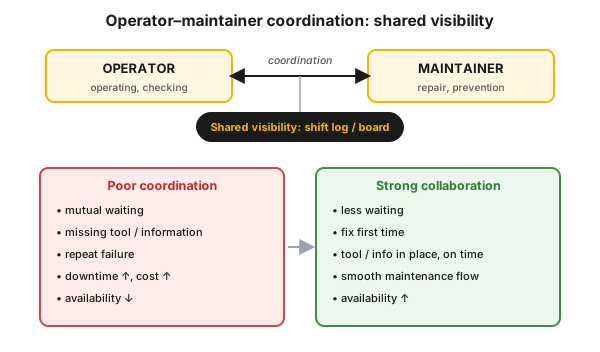
Figure 1 — the operator and the maintainer work well together when they have shared visibility of the work (shift log / board). Weak coordination breeds waiting, a missing tool or piece of information, repeat failures and downtime; strong collaboration brings less waiting, fix-first-time repairs and higher availability.
Who is this for?
Section titled “Who is this for?”This article is for those whose daily work is decided at the interface between production and maintenance, and who can make that interface better.
Plant manager / production manager · shift supervisor · operator · maintainer (mechanic, instrument technician) · maintenance planner · reliability engineer · issuer / receiver of work permits · HSE.
Learning objectives
Section titled “Learning objectives”After reading this article you will be able to:
- recognize why mutual waiting between the operator and the maintainer is pure waste (muda), and how it degrades availability
- name the typical points of coordination loss, and eliminate them with shared visibility (a shared work status, a standard handover)
- place the collaboration within the autonomous maintenance pillar of TPM (operator basic care vs. specialist complex work)
- decide when coordination is not the problem, and when more capacity or a technical solution is needed instead
Why it matters (the stakes)
Section titled “Why it matters (the stakes)”When operator and maintainer wait for each other, the loss is twofold: the equipment stands still (lost production), and two people stand still as well, creating no value in the meantime. Poor coordination does not stay an efficiency question either: in continuous operation a fault fixed in a rush, not at the root cause the first time, comes back, and a misunderstood work permit or a system that was not fully drained can turn into a safety event. The stake is therefore availability, maintenance cost and safety all at once.
In brief
Section titled “In brief”- Mutual waiting is pure waste. When the operator waits for the maintainer (or the other way round) because of poor coordination, that is muda: nobody is creating value meanwhile, and the equipment is standing still.
- The solution is transparency, not more headcount: make the planned and in-progress work, the pending tasks and the status of permits visible to both groups.
- The tool and the information should be in place, on time. Maintenance runs smoothly when the tool, the spare part, the drawing and the permit are ready when the work starts.
- Fix first time. The goal is to fix the fault the first time, durably, so that it does not recur — this reduces repeat downtime.
- Result: less waiting loss, higher availability, lower maintenance cost.
- A relative of autonomous maintenance in TPM: the operator does the daily basic care (cleaning, lubrication, inspection), the specialist does the complex work; the key is a sharp but collaborative boundary between the two.
- The standard shift handover is the main carrier: this is where the handover of maintenance work either happens or gets lost.
What causes coordination waiting?
Section titled “What causes coordination waiting?”Waiting almost always comes from the silo effect between the two groups: the operator and the maintainer plan separately, communicate separately, and the loss is created at the interface. This is exactly one of Lean’s classic questions: how can the work of operators and maintainers be supported so that they do not have to wait for each other, and can cooperate better? The typical waiting points:
- the maintainer arrives, but the plant section is not yet shut down / drained / permitted → waits;
- the operator has stopped the machine, but the maintainer is still elsewhere, or a spare part is missing → waits;
- the work is finished, but the operator does not know whether they may start up → waits;
- the fault is fixed “quickly,” but not the first time, not at the root cause → it breaks down again.
Every one of these waits is muda, and every one of them reduces availability — the first factor of OEE.
How can the waiting time between operator and maintainer be reduced?
Section titled “How can the waiting time between operator and maintainer be reduced?”Waiting time is reduced not with more people but with shared visibility: if both groups see the same planned and in-progress work, the blind spot that bred the waiting disappears. The direction of the solution is therefore transparency and collaboration, in four practical steps:
- Make the waiting points visible between operator and maintainer — where, for what, and how long they wait (the wrench-time / waste shadowing observation measures exactly this).
- Create shared awareness of the planned and in-progress work: one shared work status (a board, a shift log) that both groups see and update.
- Make sure the tool, the spare part and the information (drawing, SOP, permit) are available at the right time and place, before the work starts.
- Aim for fix-first-time, so that the fault does not recur — this is the ground of root-cause analysis and prevention.
The essence: what is needed is not more people, but fewer blind spots. Shared visibility is what ties the two silos into one process.
Connection to TPM — the boundary of autonomous maintenance
Section titled “Connection to TPM — the boundary of autonomous maintenance”Operator–maintainer collaboration sits at the heart of TPM (Total Productive Maintenance). The autonomous maintenance (jishu hozen) pillar of TPM says exactly this: the operator does not merely “push the buttons” but performs the daily basic care: cleans, lubricates, inspects visually, and flags anomalies early — while the specialist can concentrate on complex, planned work. The precondition of good collaboration is a clear but collaborative division of labour:
- Operator: daily cleaning, lubrication and inspection, early fault signalling, the “owner” of the machine.
- Maintainer: planned preventive maintenance, complex repair, root-cause analysis.
If this boundary is unclear, or the operator “has no time” for basic care, the condition of the equipment deteriorates invisibly, and the maintainer is forever just “firefighting.” This foundation is strengthened when easy-to-understand, visual descriptions and diagrams are available for the machines and equipment for their proper and safe operation: this way the operator knows exactly what to do and how during the daily care.
A process-industry Lean case and a benchmark
Section titled “A process-industry Lean case and a benchmark”One process-industry Lean programme shows well how operator–maintainer collaboration can be improved as part of a coherent package of measures, in a short time and with quantifiable savings. Several elements of the package targeted coordination directly:
- an on-the-job training system and a new training regime, in which experienced operators train those with less knowledge (on a complex plant, operators often know only part of the process areas well), thereby increasing work flexibility (see training and onboarding);
- rotation within the plant, so that the operators’ multifunctional knowledge stays up to date;
- standardizing the exchange of information between shifts, avoiding the case where the loss of important information leads to a fault (see shift handover);
- optimizing and unifying the checking routes, so that no time is lost to random route choice and no piece of equipment is left out of the check;
- easy-to-understand, visual operating descriptions and diagrams for the proper and safe operation of the machines;
- and on top of all this: improved operator–maintainer collaboration, greater transparency and less waiting time.
The power of Lean in maintenance can be measured against a benchmark too: at the aircraft maintenance company Lufthansa Technik the turnaround time of component repair was shortened from 17 days to 5 days, and maintenance cost was reduced by 15% compared with 2009, purely by improving the process and the collaboration.
Putting it into practice
Section titled “Putting it into practice”You do not need a big project for this: a single shift supervisor can start it tomorrow, piloting it on one piece of equipment or one plant section.
- Measure where you wait. For a week, note down when and how long the operator waits for the maintainer (or the other way round), and what was missing (permit, tool, spare part, information). This is the logic of the wrench-time / waste shadowing observation.
- Create one shared work status. A board or a shift log that both groups see and update: what the planned work is, what is in progress, what is pending, where the permit stands.
- Prepare the work before the start. Before maintenance begins, the tool, the spare part, the drawing, the SOP and the permit should be in place. Read the missing-items list off the shared status.
- Close the loop with fix-first-time. Take recurring faults to root-cause analysis, so that you do not have to wait for each other again for the same reason.
Process-industry context and safety
Section titled “Process-industry context and safety”In continuous process industry, coordination is safety-critical, not merely an efficiency question. Maintenance work here is tied to a work permit (permit to work), draining, depressurizing and LOTO; poor coordination is not only waiting but risk: a misunderstood permit, a system that was not fully drained, a missing isolation. Shared visibility here reduces waiting and rules out dangerous misunderstandings at the same time. And the “fix-first-time” principle is a safety principle too: a fault repaired repeatedly and in a rush is the breeding ground of near-misses and incidents. Loss reduction (shorter waiting) may therefore never come at the expense of permitting and isolation discipline.
Common mistakes
Section titled “Common mistakes”- “Solving” the waiting with more people. Coordination loss is not a headcount shortage but a blind spot — the solution is transparency.
- Verbal, undocumented handover. If the status of maintenance work lives only in people’s heads, it is lost at the shift change — you need a standard handover.
- An unclear division of labour. If it is not clear what the operator does (basic care) and what the maintainer does (complex work), the condition of the machine deteriorates.
- A “quick” fix without the root cause. A fault not fixed the first time, not at the root cause, recurs — it causes more downtime than it saved.
- Classing the safety steps as “waiting.” The permit, the draining and the LOTO create value; trimming them is dangerous.
When NOT to use it (the limits of the method)
Section titled “When NOT to use it (the limits of the method)”Better coordination is not a cure-all: waiting disappears only if the problem really is a coordination problem. A few cases where something else is needed:
- A genuine capacity shortage. If there are simply too few maintainers in a shift for the work required, the shared board makes it visible but does not solve it: here you need resource planning or external capacity, not more transparency.
- A chronic fault with an unknown root cause. If the same piece of equipment breaks down again and again for an unknown reason, coordination reduces the waiting but does not remove the fault: you first need root-cause analysis or FMEA.
- A design / engineering fault. If the equipment is inherently unmaintainable (no access, no isolation point), collaboration will not substitute for the missing design decision.
- At the expense of safety discipline. The aim of coordination is never to speed up permitting, draining or LOTO as if they were “waiting.” These steps create value; shortening them is not a coordination gain but a risk.
How does this show up in digital practice?
Section titled “How does this show up in digital practice?”The principle of operator–maintainer collaboration does not stop at the level of a board and a verbal alignment: the same “shared visibility” logic is realized in software too. The mechanism differs (recorded, time-stamped, searchable data), the principle is the same: eliminating the blind spot.
| Concept (routine) | Digital implementation | Value |
|---|---|---|
| Shared work status | a common, real-time digital shift log / work board for both groups | the blind spot disappears, less mutual waiting |
| Handover of maintenance work | structured digital shift handover with a time stamp and an owner | the status of the work is not lost at the shift change |
| Pending (open) tasks | an open-task list with priority and escalation | the next shift knows exactly where the work stands |
| Status of the work permit | e-PTW / permit status in the log | the operator sees when they may start up; an audit trail remains |
| Fix first time | recording recurring faults and root-cause analyses | the fault does not recur, repeat downtime falls |
Connection to OPEREX (shift log)
Section titled “Connection to OPEREX (shift log)”This concept is one of the most direct application areas of the OPEREX shift log. The source of coordination loss is the lack of shared visibility — and that is exactly what a digital shift log provides: the handover of maintenance work, the pending (open) tasks, the status of permits and the necessary tools/information can be made visible and trackable for both groups, with a time stamp and an owner. This way the operator sees when they may start up; the maintainer sees what has been prepared; and the next shift knows exactly where the work stands. The shared work status eliminates the blind spot that bred the waiting, and gives an auditable trail for the work permit and the done / not-done status.
Terminology (HU / EN)
Section titled “Terminology (HU / EN)”| Hungarian | English (canonical) | Note |
|---|---|---|
| operátor–karbantartó együttműködés | operator–maintainer collaboration | the coordination interface |
| autonóm karbantartás | autonomous maintenance (jishu hozen 自主保全) | the operator pillar of TPM |
| egymásra várakozás | mutual waiting | the main coordination loss |
| rendelkezésre állás | availability | the first factor of OEE |
| elsőre javítás | fix first time / right first time | the durable elimination of the fault |
| munkaengedély | permit to work | a frequent point of waiting (and safety) |
| ellenőrzési útvonal | checking / inspection route | to be standardized |
The terminology follows established TPM usage.
Why does waiting arise between operator and maintainer?
Typically because of poor coordination and lack of transparency: the parties do not know exactly when and what is needed, or the right tool, spare part and information (drawing, permit) are not in place for the maintenance. Increasing transparency — one shared, visible work status — reduces this waiting.
How does this connect to TPM?
The autonomous maintenance (jishu hozen) pillar of TPM entrusts the daily basic care to the operator (cleaning, lubrication, inspection, early fault signalling), and frees the specialist for complex, planned work. The precondition of good collaboration is clarifying this division of labour.
What does the "fix-first-time" principle mean?
The fault is fixed the first time, at the root cause, so that it does not recur. A fault repaired repeatedly and in a rush causes more downtime and risk than the “quick” repair saved — which is why it is linked to root-cause analysis (the 5 Whys).
Can coordination waiting be solved with more people?
No. Waiting is not a headcount shortage but an information blind spot. The solution is shared visibility (a shared work status, a standard handover), not more people; in fact, better coordination is precisely what frees up the existing capacity.
Take it home (keys)
Section titled “Take it home (keys)”- Look at the interface, not at the two groups separately. The loss arises where the operator’s and the maintainer’s work meets: make that visible first.
- Introduce one shared work status that both groups see and update, rather than more coordinators.
- Prepare the work before the start: tool, spare part, drawing, SOP, permit in place before anyone sets off.
- Close the loop with fix-first-time, so that the fault does not recur and you do not have to wait for each other again.
- Never trim the safety steps as “waiting”: the permit, the draining and the LOTO create value.
Self-test
Section titled “Self-test”- Why can mutual waiting be called pure waste, and which factor of OEE does it directly degrade?
- In two plants the waiting of operators and maintainers is the same. In one there are too few maintainers, in the other the coordination is poor. Which one does shared visibility help, and what is needed instead in the other?
- A shift supervisor has a recurring fault fixed “quickly” in order to reduce waiting. Why can this be worse in the long run than aiming for fix-first-time?
Related concepts
Section titled “Related concepts”TPM · shift handover · wrench-time · OEE · muda · the 5 Whys · training and onboarding · management of change · standard work
Next step
Section titled “Next step”- Start with the standard shift handover: this is the main carrier of coordination, this is where the status of maintenance work is either handed over or lost.
- Then TPM and autonomous maintenance: where the boundary runs between operator basic care and specialist complex work.
- Finally wrench-time and OEE: how to measure the waiting loss and the availability on which the improvement shows.
References / further reading
Section titled “References / further reading”- Seiichi Nakajima: Introduction to TPM (Total Productive Maintenance) — the foundational work on autonomous maintenance (jishu hozen) and operator basic care.
- James P. Womack and Daniel T. Jones: Lean Thinking — waiting as muda, and the value-stream view.
- Lufthansa Technik Lean programme (public case studies) — improving maintenance turnaround time and cost with Lean methods.