Which self-awareness model, when?
≈ 19 min read · 3,896 words
Self-awareness models are not rivals but different lenses: each answers a different question, so the key is to fit the tool to your question.
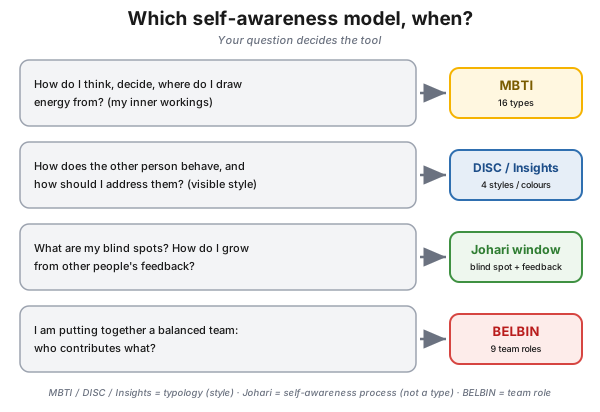
Figure 1 — decision guide: your question decides the tool. The top three are typologies (style/type), Johari is a self-awareness process, BELBIN is a team role.
MBTI describes the inner, cognitive preferences, DISC and Insights the observable behaviour and how to adjust your communication, HBDI the thinking style preference, the Johari window is not a typology but a self-awareness process for uncovering blind spots, and BELBIN describes the role you play in teamwork. The point is not “which one is best”, but to pick the tool that answers your question.
Who is this for?
Section titled “Who is this for?”For anyone who works with people and has already run into “I said the same thing, and yet they understood it differently”. Typical readers:
shift supervisor · plant manager · process engineer · maintenance manager · project manager · team and group leader · HSE colleague · training and HR lead · internal trainer and coach
Learning objectives
Section titled “Learning objectives”After this article you will be able to:
- Decide which model answers your question, instead of forcing the tool you happen to know onto every situation.
- Tell a typology from a process, that is, the “what are you like” models from Johari’s “how do you find out” logic.
- See the origins correctly, for example that DISC goes back not to Jung but to Marston.
- Use BELBIN at team level, tied to the project phase, and know what to do if a role is missing.
- Draw the line, that is, recognize the situations where none of the models should be used.
The essence
Section titled “The essence”- There is no “best” model. Each answers a different question, and your question decides which one to use.
- MBTI: understanding your inner workings (thinking, deciding, energy), 16 types. It measures preference, not ability.
- DISC and Insights: visible behaviour and adjusting your communication, four styles and four colours respectively. The four styles map onto each other well, but their basis and derivation differ.
- HBDI: the thinking style preference, along the “whole brain” logic. Here too it is about preference, not aptitude.
- Johari window: uncovering your blind spots from feedback. This is not a type but a process.
- BELBIN: your team role, that is, what you contribute to the team, 9 roles along three axes.
- Common rule: every one of them is for development and self-awareness, not for selection, and none of them is a pigeonhole.
Why does it matter? (the stakes)
Section titled “Why does it matter? (the stakes)”The wrong lens is not neutral: it does active harm. If you try to predict performance with a type model, you are making a decision about people that the tool is not fit for.
In practice four typical losses occur:
- The wrong tool for the question. In a one-hour weekly meeting you do not need to understand 16 types, but how to speak to the other person. The reverse is also true: a serious leadership development programme does not stop at four colours.
- A label instead of a person. If you close a conflict with the explanation “he is a red”, the real cause, for example unclear responsibility, remains untouched.
- A self-awareness test used for selection. You make a personnel decision on self-reported, situation-dependent data, which is indefensible both professionally and ethically.
- An untreated leadership blind spot. This is the most expensive one. If a leader does not sense that their style suppresses questions, the team will not speak up with the weak signals (doubt, near-miss, “something is not right”). In a process-industry plant it is precisely these signals that prevent serious events.
The models on one page
Section titled “The models on one page”Six models, six different questions. The table below gives what each one describes, in what units, and what it is not good for.
| Model | What does it describe? | Unit | When to use it | What it is NOT good for |
|---|---|---|---|---|
| MBTI | inner, cognitive preference (after Jung) | 16 types | understanding your own thinking, deciding and energy, deeper self-reflection | fast behaviour-reading |
| DISC | observable behaviour in a situation (after Marston) | 4 styles (D/I/S/C) | tuning in to someone’s behaviour, adjusting your communication | explaining the inner “why” |
| Insights | behavioural style with colour energies (after Jung) | 4 colours, dominant + supporting | a shared, fast team language about styles, communication | deep, individual type analysis |
| HBDI | thinking style preference, “whole brain” | 4 thinking styles | understanding differences in thinking, a shared project language | measuring ability or expertise |
| Johari | the structure of self-awareness (blind spot) | 4 areas | uncovering blind spots, growing from feedback, building trust | style or type classification |
| BELBIN | the teamwork role | 9 roles, 3 axes | putting a team together, role balance, covering the project phases | adjusting individual communication |
Which one, when? A decision guide
Section titled “Which one, when? A decision guide”Put your question into one sentence, and the question will pick the tool. The six models answer six different questions, so the choice is not a matter of taste.
- “I want to understand how I work inside.” Why do I recharge alone, why do I decide by logic or by values? This is where MBTI belongs. It gives the deepest self-reflection, in exchange for being slower and inward-facing. To estimate your own type, fill in the MBTI self-test (5 questions per dimension, with figures).
- “Right now I have to tune in to someone and communicate well with them.” This is where DISC or Insights belongs: fast, behaviour-based, for adjusting your communication. If your team learned the colours, use Insights; if the letters, use DISC.
- “We do not understand each other, because we think differently.” When it is not the style but the mode of thinking that differs (we start from facts or from concepts, from structure or from relationships), HBDI gives the language. Importantly, it speaks about preference, not about who is “smarter”.
- “I want to know what I cannot see about myself.” This is where the Johari window belongs. It does not tell you what you are like; it helps you to ask for feedback and to offer self-disclosure.
- “I am putting a team together and I need role balance.” This is where BELBIN belongs. It is not about communication, but about who contributes what (idea, drive, closure).
Where do they come from, and how are they connected?
Section titled “Where do they come from, and how are they connected?”This is not one family. The common root of MBTI and Insights is Jung’s type theory, whereas the root of DISC is independent of it: Marston’s emotion-behaviour model. The similarity of the fourfold structure is not shared origin but parallelism.
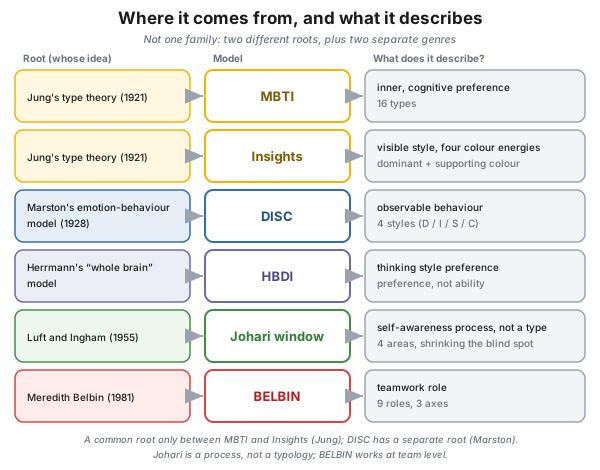
Figure 2 — the root and the subject of the six models. A common root exists only between MBTI and Insights.
- MBTI and Insights. Both build on Jung’s type theory, but at a different level: MBTI describes the inner workings (the “why”), Insights the visible style (the “how it looks”).
- DISC. Marston started from whether a person sees the situation as favourable or unfavourable, and whether they feel stronger or weaker than it. The four combinations give the four styles. This is a completely different derivation from the Jungian axes, even if the result is also four styles.
- HBDI. Herrmann’s “whole brain” model describes the thinking styles, and unlike the others it puts the distinction between preference and aptitude at the centre.
- Johari window. A different genre: not a type but a self-awareness process. That is exactly what makes it the complement of the typologies. The typology tells you what your style is; Johari helps you learn from others how you actually come across.
- BELBIN. It works at the level of the team (role, not style), but it pairs well with the others: style and role together give the full picture of the team.
How much the same are DISC and Insights?
Section titled “How much the same are DISC and Insights?”The four styles map onto each other well, but the two models are not interchangeable: their basis, their axes and the role of colour all differ.
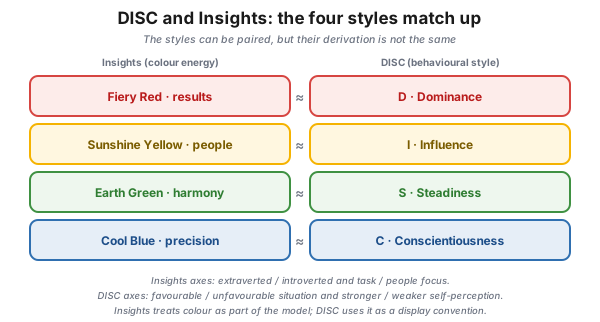
Figure 3 — the mapping of the four styles and the differing axes of the two models.
Three concrete differences that also matter in practice:
- The axes are different. Insights works with the extraverted-introverted and task-people axes, DISC with the favourable-unfavourable situation and the stronger-weaker self-perception axes.
- The role of colour is different. In Insights the colour energy is an internal element of the model; in DISC the four colours are a display convention often used alongside the letters.
- There is an Insights-specific concept. The colour tower, that is, the pair of dominant and supporting colour, is an Insights construct with no exact counterpart in DISC.
That is why the correct formulation is that the four styles map well onto each other (Fiery Red ≈ D, Sunshine Yellow ≈ I, Earth Green ≈ S, Cool Blue ≈ C), rather than that the two models are the same.
How do you use the Johari window in practice?
Section titled “How do you use the Johari window in practice?”The Johari window works if you have one simple decision rule for it: you can only receive feedback on the areas that are known to others, that is, on the Arena and the Blind spot. Of these, it is worth concentrating on the Blind spot, because you and the other person both see the Arena anyway.
The four areas and the step belonging to each:
| Area | Who sees it? | What to do with it |
|---|---|---|
| Arena (open) | both I and others | this is where cooperation happens; this is the area you want to grow |
| Blind spot | only others | ask for feedback, this is the only way to get to know it |
| Hidden (closed) | only I | offer as much self-disclosure as trust requires |
| Unknown (dark) | nobody | not a goal and not plannable; it surfaces in rare, unique situations |
The typical content of the Blind spot is not a secret but manner and impact: someone comes across as boastful or affected without knowing it, and reacts with surprise when confronted with it. That is why feedback has to be asked for; it rarely comes on its own. The practical link to the feedback and trust articles is tightest here.
At team level: which role in which project phase?
Section titled “At team level: which role in which project phase?”BELBIN gives you more than a list of roles if you tie it to the phases of the project: the 9 roles are spread along three axes, and the phases call out different roles.
The three axes: action, reflection (thinking) and relation (people). And the four stages of a project cover the roles almost exactly:
| Project phase | In the improvement / rollout | Who typically carries it |
|---|---|---|
| 1. Getting started | diagnose | Shaper (SH), Coordinator (CO) |
| 2. Creating ideas | design | Plant (PL), Resource Investigator (RI), Team worker (TW) |
| 3. Developing actions | tactical implementation plan | Specialist (SP), Monitor/Evaluator (ME), Coordinator (CO) |
| 4. Completion | implementation | Implementer (IMP), Completer finisher (CF) |
The Coordinator appears twice, because at the start they clarify the goal, and in planning they pull the threads together. The model’s founding sentence carries the same logic: “Nobody is perfect, but a team can be” (Meredith Belbin).
What to do if a role is missing?
Section titled “What to do if a role is missing?”A missing role does not have to be personified: it can be replaced with a structural tool. The table below pairs the typical gaps with the interventions that work for them.
| What is missing or over-represented | Symptom in the team | Intervention |
|---|---|---|
| Lack of Plant (PL) and/or Resource Investigator (RI) | nobody brings a new direction | structured ideation: card-answer method (clustering and voting), silent written round |
| Weakness at Coordinator (CO), Implementer (IMP), Completer finisher (CF) | execution falls apart | provide structure: agenda, frequent team reviews, daily schedules |
| Many Shapers (SH) and/or Specialists (SP) | friction, diverging work | team events, deliberate building of team spirit and cohesion |
| Lack of Shaper (SH) | nobody challenges the status quo | more personal feedback sessions, benchmarking with world-class operations, 360-degree leadership assessment with a personal development plan |
| Lack of Implementer (IMP) and Completer finisher (CF) | deadlines slip, there is no closure | close follow-up: regular review of the implementation plan against timelines, milestones and responsibilities, plus performance management |
| Lack of Monitor/Evaluator (ME) | ill-considered, risk-blind decisions | risk analysis (FMEA, cause-and-effect analysis), figures and facts, a clear project charter |
Rules common to every model
Section titled “Rules common to every model”Whichever model you choose, five rules apply to all of them. Without these, even the best tool turns into a label factory.
- For development, not for selection. No model is suitable for predicting aptitude or performance.
- Self-reported. The classification is based on your own answers, so determining it on someone else’s behalf is inaccurate and offensive.
- The situation matters. Behaviour (DISC, Insights) is situation-dependent, and type (MBTI) is also more nuanced than a label.
- Preference, not ability. MBTI and HBDI both emphasize this: it tells you what you like, not what you are good at.
- Not a pigeonhole. The goal is understanding and growth. The platinum rule is the shared benefit: treat the other person the way they prefer, which requires knowing your own and other people’s patterns.
Plant and team context
Section titled “Plant and team context”In a shift-based, team-oriented process-industry environment the models are most useful together, because they act at different levels.
DISC or Insights gives the fast shared language for daily communication, for example how each person likes to receive information at the shift handover. MBTI and HBDI give deeper self-awareness in leadership development, and a shared language for differences in thinking. Johari strengthens the feedback and trust culture, and this is where the most direct safety stake lies: a leader’s blind spot can suppress questions, and with that the weak signals can be lost. And BELBIN supports the make-up of project and change teams, for example at a turnaround, where the absence of a Completer finisher endangers exactly the critical closing checks.
None of them replaces the others. The question is always the same: what do I need right now?
Common mistakes and pitfalls
Section titled “Common mistakes and pitfalls”| Anti-pattern | Why is it a problem? | Good practice |
|---|---|---|
| “DISC is Jung-based too.” | It blurs two genuinely different derivations, and with them the strengths of the models. | MBTI and Insights are Jung-rooted; DISC comes from Marston’s emotion-behaviour model. |
| “DISC and Insights are interchangeable.” | The axes and the role of colour differ, and there is an Insights-specific concept (colour tower). | The four styles map onto each other; the two models are not identical. |
| Reducing someone to a single letter or colour. | Most people have 1-2 dominant but several active styles. | Talk about a mix and proportions, not an exclusive category. |
| Asking a person to fill a missing team role. | The expectation “you be the Completer finisher” does not create behaviour. | Replace it with structure: agenda, schedule, close plan review. |
| Using Johari as a typology. | Johari does not classify but gives a process; this way its essence is lost. | Use it as the frame for asking for feedback, focusing on the Blind spot. |
| Treating self-awareness as a one-off test. | The blind spot only shrinks from repeatedly requested feedback. | Build it into regular, requested feedback (see feedback). |
When NOT to use them (the limits of the models)
Section titled “When NOT to use them (the limits of the models)”There are situations where none of the models is the right answer, and using them actively does harm. It is worth knowing these in advance.
- In selection and performance appraisal. Aptitude or performance cannot be derived from self-reported, preference-based data. This calls for a structured interview, work sampling and fact-based performance data.
- For labelling a conflict. If the cause of the dispute is unclear responsibility, a scarce resource or a contradictory goal, the “style explanation” covers up the real cause. Look at the system first, and only then at the style.
- Where there is a safety or regulatory question. The style language does not replace risk analysis, the procedure or the permit regime. An emergency response is not a matter of style.
- Determining it on someone else’s behalf. “I think he is a Cool Blue” is not valid data, and it destroys trust.
- After a one-off training, without follow-up. Without being embedded, the typology language quickly becomes a joke or a label. If there is no regular feedback practice behind it, better not to start it.
Take it home (keys)
Section titled “Take it home (keys)”- Formulate the question first, choose the tool second. If your question is “how should I speak to them”, do not start with MBTI.
- Learn the genealogy in one sentence: MBTI and Insights from Jung, DISC from Marston, and Johari is not a typology.
- Between DISC and Insights, map the styles, not the models. This one sentence protects you from most misunderstandings.
- With Johari, concentrate on the Blind spot, because you can only receive feedback on what others see in you.
- Replace a missing team role with structure, not with expectation: agenda, plan review, risk analysis.
- Do not take any of the models into a selection or appraisal decision. This is not caution but the declared limit of the models.
Self-test
Section titled “Self-test”- A colleague says: “DISC and MBTI are the same, just with different letters”. In two sentences, why is this not true?
- Your team keeps slipping deadlines and there is never any closure. Which BELBIN role is probably missing, and with what structural tool would you replace it?
- Which Johari area can you ask for feedback on, and which one is worth concentrating on? Why that one?
Answer key
- Their subject and their root are different. DISC describes observable, situation-dependent behaviour with four styles, along Marston’s favourable/unfavourable and stronger/weaker self-perception axes; MBTI describes the relatively stable inner cognitive preferences with 16 types, after Jung. DISC is the “how it looks”, MBTI the “why”.
- Typically the Implementer (IMP) and the Completer finisher (CF). Structural replacement: close, regular review of the implementation plan against timelines, milestones and responsibilities, plus performance management. The solution is not to “appoint” someone as the Completer finisher.
- You can receive feedback on the areas that are known to others, that is, on the Arena and the Blind spot. It is worth concentrating on the Blind spot, because you already see the Arena yourself, whereas the Blind spot can only be learned from other people’s feedback.
Terminology (HU / EN)
Section titled “Terminology (HU / EN)”| Hungarian | English | Note |
|---|---|---|
| önismereti modell | self-awareness model | collective term for the typologies and the processes |
| tipológia | typology | classifies: “what are you like” |
| viselkedési stílus | behavioural style | observable, situation-dependent (DISC, Insights) |
| kognitív preferencia | cognitive preference | inner workings (MBTI) |
| gondolkodásmód-preferencia | thinking style preference | HBDI, “whole brain” |
| szín-energia | colour energy | Insights, four colours |
| szín-torony | colour tower | Insights: dominant + supporting colour |
| Aréna / nyílt mező | Arena / open area | both I and others know it |
| Vakfolt | Blind spot | only others see it, ask for feedback here |
| Zárt / rejtett mező | Hidden area / façade | only I know it |
| Sötét / ismeretlen mező | Unknown area | nobody knows it (yet) |
| csapatszerep | team role | BELBIN, 9 roles |
| megengedhető gyengeség | allowable weakness | the natural price of a strength |
| platina-szabály | platinum rule | as they prefer, not as you do |
Which is the "best" personality model?
None of them, because they answer different questions. MBTI describes the inner workings, DISC and Insights the visible behaviour and communication, HBDI the thinking style preference, Johari the uncovering of blind spots, BELBIN the team role. Your question decides which one to use.
What is the difference between DISC and Insights?
The four styles map onto each other well (Fiery Red ≈ D, Sunshine Yellow ≈ I, Earth Green ≈ S, Cool Blue ≈ C), but the two models are not identical. Insights builds on Jung’s type theory and works with the extraverted-introverted and task-people axes; DISC comes from Marston’s model and uses whether the situation is favourable or unfavourable and whether self-perception is stronger or weaker as its axes. Insights treats colour as part of the model, DISC as a display convention.
Is it true that DISC also comes from Jung's type theory?
No. The basis of DISC is William Moulton Marston’s emotion-behaviour model, which combines the perception of the situation (favourable or unfavourable) with self-perception (stronger or weaker). MBTI and Insights are what build on Jung’s type theory. The similarity of the fourfold structure is a parallel, not a shared origin.
What is HBDI, and when is it worth using?
HBDI (Herrmann Brain Dominance Instrument) identifies the thinking styles on the basis of the “whole brain” model. It is strongest when it is not the communication style but the mode of thinking that differs within a team. An important feature is that it distinguishes preference from aptitude, so it does not measure ability.
Is the Johari window a personality type too?
No. Johari is not a typology but a self-awareness process: it describes what we know about ourselves and what others see in us (Arena, Hidden, Blind spot, Unknown area), and how conscious self-awareness can be grown through feedback and self-disclosure. You can only receive feedback on the areas known to others, and of these it is worth concentrating on the Blind spot.
Can I use these models for selection or appraisal?
No. Every one of them is for development and self-awareness, not for predicting aptitude or performance. The classification is self-reported and situation-dependent, so using it for selection is wrong both professionally and ethically.
Related concepts
Section titled “Related concepts”MBTI · the MBTI self-test · DISC · Insights · self-awareness (the Johari window) · BELBIN team roles · feedback · the trust model · assertive communication · effective meetings
Next step
Section titled “Next step”- Start with your own style: Insights or DISC. This gives the fastest, immediately usable shared language.
- Deepen it into self-awareness: self-awareness (the Johari window), then estimate your own type with the MBTI self-test.
- Take it to team level: BELBIN team roles for role balance, then feedback for building the feedback routine.
References
Section titled “References”- C. G. Jung: Psychologische Typen (1921). The shared theoretical root of MBTI and Insights.
- Isabel Briggs Myers – Peter B. Myers: Gifts Differing (1980). The foundational work on MBTI.
- William Moulton Marston: Emotions of Normal People (1928). The original source of the DISC model.
- Joseph Luft – Harrington Ingham: The Johari Window, a Graphic Model of Interpersonal Awareness (1955). The original publication of the Johari window.
- Ned Herrmann: The Creative Brain (1988). The foundational work on the “whole brain” thinking model and HBDI.
- R. Meredith Belbin: Management Teams: Why They Succeed or Fail (1981). The foundational work on the team-role model.
- The Insights Group: Insights Discovery, the official methodology of the four colour energy model.