Capability building (skills matrix)
≈ 23 min read · 4,559 words
Give a shift team more responsibility, and two things can happen. If they have the skills for it, self-reliance flourishes: they solve the problems themselves, they catch the weak signals themselves. If they do not, empowerment breeds mistakes and frustration. Capability building closes exactly this gap: it regularly assesses what skills the work requires, where people stand today, and develops them to a plan. Let’s look at what it is, how skill is built, and why it is not decided in the classroom.
Capability building is the Management Infrastructure element that matches workforce skills to needs and roles. Its goal: a capable and flexible workforce.
It is the third of the five Management Infrastructure elements, and it consists of four steps: (1) understand what skills are required to run the operating system; (2) identify the available skills (skills matrix); (3) create a development plan (PDP) to bridge the gap; (4) build talent for the future. Adult learning is effective when it is experiential (learn by doing) and connected back to the actual job, which is why the main instrument is not the classroom but daily coaching and fact-based feedback.
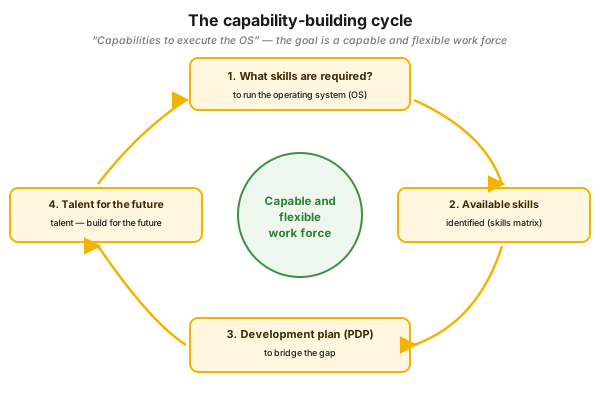 Figure 1 — the closed cycle of capability building along the “Capabilities to execute the OS” logic: from defining the required skills, through identifying the available ones and the development plan, to building talent for the future, with a capable and flexible work force at the centre.
Who is this for?
Section titled “Who is this for?”This article is for those responsible for a team’s performance or development: shift supervisor · plant manager · process engineer · team leader · HR / training lead · Lean/CI specialist · change agent (navigator).
Learning objectives
Section titled “Learning objectives”After reading this article you will be able to:
- list the four steps of capability building, and say which one feeds which;
- explain why knowledge learned from a lecture drops to a fraction within a few months, and what to do instead;
- build a simple skills matrix, and derive a gap analysis from it;
- distinguish empowering from enabling, and justify why they only work together;
- draw the boundary: when formal training is NOT the right answer.
In brief
Section titled “In brief”- The third element of the MI. Of the five Management Infrastructure elements, capability building is the one without which an empowered front line (element 2) cannot live up to its responsibility.
- A four-step cycle: required skills, available skills, development plan, talent for the future.
- The skills matrix is the measuring instrument: it shows, per person and at team level, who knows what, and where the gap is relative to the development plan.
- Learning is experiential. “I hear, and I forget; I see, and I understand; I do, and I remember” (Confucius): retention grows dramatically when learning is tied to doing.
- Daily coaching is the engine. Most of the skill is built not in a classroom but during the work, with fact-based feedback (sit-in, daily brief, problem solving).
- Empower + enable together. Empowerment without skill is a risk, skill without empowerment is frustration; the two work as a pair.
Why it matters (the stakes)
Section titled “Why it matters (the stakes)”The skill gap is not a theoretical problem: on a plant a wrong decision or an unrecognized signal turns expensive or dangerous within minutes. If a team is given more responsibility but does not have the matching competence, the empowerment backfires.
Two faulty extremes can be set side by side, and both lose:
- Empowerment without skill. The front line may decide, but lacks the knowledge for it: wrong interventions, problems suppressed and then escalating, finally a loss of trust and re-centralization.
- Skill without empowerment. People could decide well, but are not allowed to: the good idea stays in the drawer, motivation melts away, the best people leave.
The lesson is simple: responsibility and capability must be grown together. Capability building is the element that puts competence next to empowerment, so that self-reliance becomes a reserve rather than a risk.
What is capability building, and where does it come from?
Section titled “What is capability building, and where does it come from?”Capability building is part of the Management Infrastructure, and it is tied directly to the McKinsey Influence Model. That model describes what makes a behavior change “stick” over time, and lists four levers: fostering understanding and conviction, reinforcing with formal mechanisms, role-modeling, and developing talent and skills (“I have the skills and competencies to behave in the new way”). Capability building is therefore not merely technical training but one of the four levers of change: if people do not know how to do the new thing, even the best intention stalls.
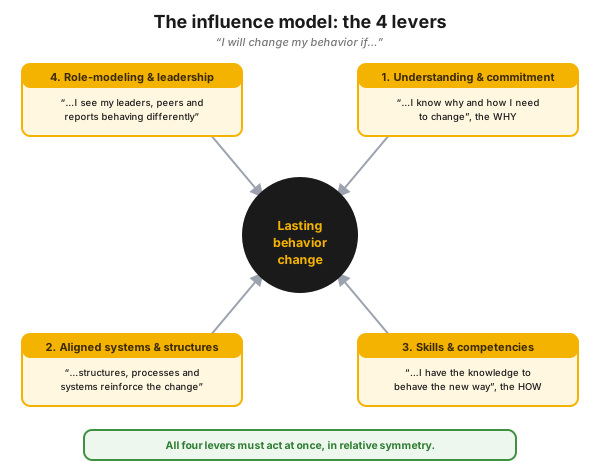 Figure 2 — the four levers of the influence model. A behavior change lasts if all four are present; capability building carries the “I have the skills and competencies” lever. In detail: the influence model.
The method sums this up in a compact frame: “Capabilities to execute the OS”, that is, which capabilities are needed to run the operating system. The goal is a capable and flexible work force, and the road to it is the four-step cycle.
What steps does capability building consist of?
Section titled “What steps does capability building consist of?”Capability building is a closed cycle (see Figure 1): assess what is needed, where we stand, how we bridge the gap, and how we build for the future.
- Understand what skills are required. Which competencies are needed to run the operating system: technical knowledge, problem solving, meeting facilitation, coaching. This is the yardstick you measure everything else against.
- Identify the available skills. The skills matrix shows, per person and at team level, who knows what and at what level. It is worth keeping the matrix in two states, current and target, because the difference between the two is the gap itself. For leadership and expert roles this is joined by an upfront assessment with transparent selection criteria, and a separate, five-level competency evaluation grid (for example communication, customer focus, problem solving) that tracks behavioral competencies alongside the technical skills.
- Create a development plan (PDP) to bridge the gap. An individual Personal Development Plan for every person, with concrete goals and actions, and for line staff together with a career path (what the next step is, and what you need to know for it). A development plan is “mature” when it is formalized and owned by the person themselves, and when the sum of all PDPs covers the skill coverage target set for the team.
- Build talent for the future. Do not only close today’s gap, but build for future needs (talent, build for the future): who is worth training ahead of a planned move or retirement.
The cycle is closed: the matrix and the PDP are updated continuously, they feed performance management, and they also drive capacity management (who can be assigned to what, where there is spare time for continuous improvement).
How do adults learn?
Section titled “How do adults learn?”The key insight of capability building is that adult learning is effective when it is experiential and connected back to the actual job. A classic retention data set shows well how much more durable knowledge acquired through doing is than knowledge acquired through mere listening.
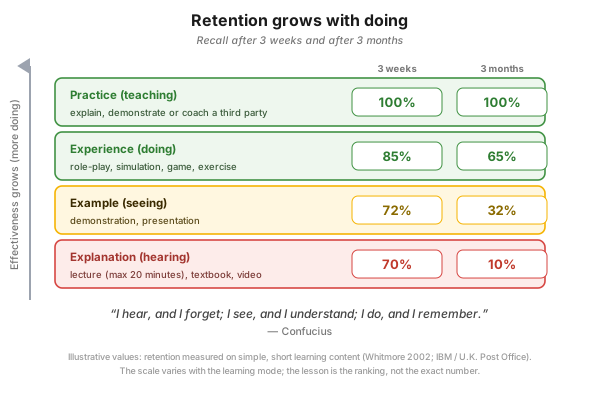 Figure 3 — retention by learning mode: the more the learning is tied to doing, the longer it lasts. The numbers are illustrative (measured on short, simple content); the point is the ranking, not the decimal.
| Learning mode | Retention after 3 weeks | Retention after 3 months | Typical format |
|---|---|---|---|
| Explanation (hearing) | 70% | 10% | lecture, textbook, video |
| Example (seeing) | 72% | 32% | demonstration, presentation |
| Experience (doing) | 85% | 65% | role-play, simulation, game, exercise |
| Practice (teaching) | 100% | 100% | explain, demonstrate or coach a third party |
“I hear, and I forget; I see, and I understand; I do, and I remember.” — Confucius
The practical lesson: put the centre of gravity of training on the job, with role-play, simulation, and the strongest of all, teaching it to somebody else. Keep the lecture short (no longer than 20 minutes), with examples, and always follow it with practice. Feedback works when it is concrete, relevant, insightful, supportive and practically applicable.
What is the skills matrix, and what is it for?
Section titled “What is the skills matrix, and what is it for?”The skills matrix is the measuring instrument of capability building: a simple table with team members in the rows, key skills in the columns, and the level (0–4) reached in the cells. At a glance it shows where the gap is, who can stand in for whom, and who to turn to for help.
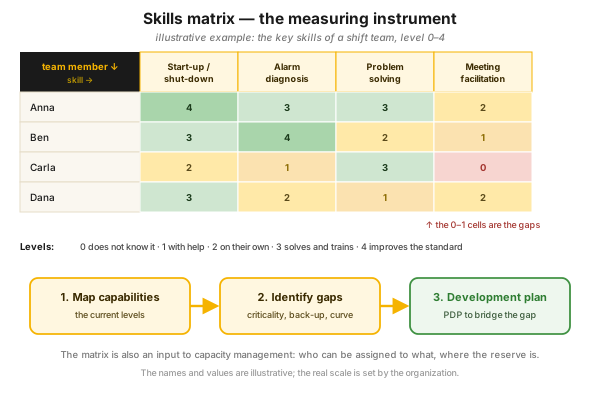 Figure 4 — an illustrative skills matrix of a shift team. The 0–1 cells are the gaps; three steps follow from the matrix: map the current levels, identify the gaps, then the development plan (PDP) to bridge the gap.
The matrix lives in two views at once. The team view is simple (knows it / does not): this is what hangs on the board, and it shows who to turn to. The manager view is detailed, with gradual levels. The levels build on each other like this:
| Level | What it means (with / without an SOP) |
|---|---|
| 0 | does not know the task, does not master the technical skill |
| 1 | can only do it with the support of a more experienced colleague |
| 2 | applies the task without help, recognizes deviations |
| 3 | understands it well enough to identify a problem, solve it, and train others in it |
| 4 | significantly improves the method and the standard |
The gap is marked out by three considerations: how critical the activity is, whether a back-up is needed for it, and what the standard learning curve prescribes. The matrix then does not stop at measuring: it gives every person a learning path and an action plan, and it also feeds capacity management (who can be assigned to what, where the reserve is). An important boundary: the matrix measures competence, not performance, and it is not an instrument of pay bargaining.
Here we stop at the level of the management infrastructure: this article shows how the matrix drives the development cycle. The professional depth of the matrix itself and of on-the-job instruction is carried further by training and instruction: the five-level quarter-circle scale, the eight-step build-up of the matrix, the learning curve and deliberate practice, multi-skill rotation and simulator-based operator training (OTS) are found there.
Daily coaching, where the skill is really built
Section titled “Daily coaching, where the skill is really built”Skill is built not by a one-off training but by daily coaching. Capability building therefore runs on two tracks at the same time, and the two must not be mixed up:
- Capability building for the navigators and the local champions (the carriers of the change): a clear role description, an upfront assessment with transparent criteria, a competency evaluation grid, and daily on-the-job coaching, for example during performance reviews, process mapping or kaizen events.
- Skill development for line staff: a skills matrix with current and target state, a skill-development action plan and a career path, classroom training only where it is genuinely needed.
During the transformation it is the job of the navigator (change agent) team to coach the managers on a day-to-day basis, so that they can then develop their own teams. This work breaks down into concrete routines:
- Defining the key priorities for the week at the start of the week: the few things on which the week will be decided.
- 15 minutes a day with the department head: reviewing progress, surfacing issues and aligning priorities.
- Fact-based feedback. The coach takes notes during the daily brief, the sit-in and problem solving, so that the feedback rests on facts, not on a feeling.
- Tracking development up to the sponsor. Every manager is reviewed all the way up to the sponsor: how are they role modeling? Are they developing skills? Are they developing at the right pace for the transformation to be sustainable at the end?
This kind of coaching often demands a fundamental change of attitude and behavior. Understanding that is one thing, doing it quite another: it requires continuous feedback sustained over weeks and months. The daily “terrain” of skill is a handful of recurring forums, each with its own rhythm:
| Forum | Rhythm | What happens |
|---|---|---|
| Sit-in (structured observation) | weekly, 30–60 minutes per person | the manager sits next to the colleague, observes the work along the procedure, then gives feedback; the matrix is updated right after the session |
| Daily brief, problem-solving session | daily | this is where the facts for the feedback accumulate, and where it shows up where knowledge runs out |
| 1-on-1 coaching | monthly, at least 1 hour per person | in a quiet place, with both sides prepared; a shared development goal and learning path is set on the basis of the skills matrix |
Process-industry context and safety
Section titled “Process-industry context and safety”In a process plant the skills matrix maps the competencies of the shift team: who can start up or shut down a column on their own, who can evaluate a weak signal, who can diagnose a DCS alarm. The gap analysis gives the individual development plan (for example simulator, OTS practice), and the matrix ensures that on every shift there are enough competent people for safe operation. This is the operational meaning of a capable and flexible work force: the step-down model (covering an absence by the level above stepping down) only works if the matrix demonstrates that coverage.
How do you find out whether capability building works? A plant diagnosis (process-industry Lean methodology, anonymized extract) asks four questions, drawing on data analysis and on interviews with shift supervisors and operators:
- Is the number of trainings appropriate? Not more and not less than necessary.
- Is the quality of the trainings right? Does it really prepare the audience for what they have to do.
- Is the skill level of the operators sufficient for the task entrusted to them?
- Are they multi-skilled enough? How many plant sections and how many positions do they actually know.
The ideal state can be described in two sentences: the operators are completely multi-functional, which gives great flexibility within the unit; and the shifts are fully trained, in practice as well, so that they can handle standard and non-standard situations alike. The typical finding, by contrast, is that most trainings remain classroom-based without any on-the-job element, and so do not prepare people for real situations in the field and in the control room.
Three interventions come into play then: rationalizing the training catalogue (dropping the unnecessary trainings and increasing the on-the-job ratio), extending area knowledge to more plant sections, and institutionalizing regular, monthly or weekly rotation, with coaching from experienced colleagues.
Putting it into practice
Section titled “Putting it into practice”Two proven practices can be taken over directly, and they show the principle of experiential learning well:
- Warm-up question: “How did you learn a new skill since you left school?” The team discovers for itself that its real learning was experiential, not lecture-based.
- Group exercise (30 minutes of discussion + 5 minutes of presentation): in small, mixed groups go through which Lean organizational element (including the capability cycle) you already apply in your own area, then brainstorm the quick wins and the obstacles of introducing the full capability cycle; one representative presents the result.
Practical application: how to start tomorrow
Section titled “Practical application: how to start tomorrow”- Draw a simple skills matrix: rows = people, columns = key skills, cells = level 0–4.
- Fill it in together with your team, not on your own; the joint filling-in is itself a conversation about the work.
- Mark the critical skills: the ones without which the equipment cannot be started, shut down or run safely.
- Find the critical skill where there is only a single person at level 3–4 (a one-person dependency, that is, no back-up).
- Assign one on-the-job development action to the biggest gap: a sit-in, instruction by a stronger colleague, rotation.
- Write the goal and the owner into the development plan (PDP) of the colleague concerned, with a deadline.
- Update the cell after the next sit-in, and review at the monthly 1-on-1 coaching what has moved.
Measurement / audit
Section titled “Measurement / audit”The maturity of capability building is auditable; a 0–4 level evaluation grid asks a few concrete questions of the skills matrix and the development plans:
- Is there a matrix? Does a list of the priority skills and the levels exist for every team member?
- Is there a goal for every person? Is a development target set for every skill and every person, and is there a detailed action plan for it?
- Does it add up to the team goal? Does the sum of the PDPs cover the team’s desired skill coverage?
- Is it maintained? Is the matrix updated after every sit-in?
- Does it drive capacity management? Does the matrix serve as an input to assignment and stand-in decisions, even between teams?
- Are people multi-skilled enough? Is the number and the quality of the trainings appropriate, and are the shifts prepared for standard and non-standard situations alike?
The goal is not the “beauty” of the matrix, but that there be enough competent people, with back-up, for the critical activities on every shift.
Common mistakes
Section titled “Common mistakes”Capability building runs aground in six typical ways, and every one of them leads back to the same place: the training becomes detached from the real work or from the measurement. It is worth knowing these anti-patterns by name, because that way they are recognized early.
- Classroom training without doing. Why it’s a problem: the retention of explanation-based learning drops to a fraction within three months. Instead: role-play, simulation, on-the-job practice, and have the learner teach it to somebody else.
- Development without a skills matrix. Why it’s a problem: you do not know where the real gap is, so you train at random. Instead: first measure (matrix), then plan (PDP).
- Empowerment without skill. Why it’s a problem: the front line gets responsibility without the competence for it, so it makes mistakes. Instead: develop it in a pair with element 2 (empower + enable).
- A one-off campaign, no coaching. Why it’s a problem: without daily feedback the skill does not set. Instead: short daily coaching, with fact-based feedback and sit-ins.
- A PDP for the drawer. Why it’s a problem: the development plan stays paper if it is not updated. Instead: update the matrix and the plan after every sit-in, and review them together at the monthly 1-on-1 coaching.
- Using the matrix as a performance appraisal. Why it’s a problem: if the matrix is linked to pay or sanctions, people defend themselves and the mirror starts to lie. Instead: the matrix measures competence and development need, not performance.
When NOT to use it (the limits of the method)
Section titled “When NOT to use it (the limits of the method)”The capability-building apparatus (matrix, PDP, coaching cadence) is strong, but it is not for every situation. Sometimes the right answer is a different one:
| Situation | Why capability building is not (primarily) the answer | The right answer |
|---|---|---|
| The problem is not a lack of knowledge but a bad process or tool | even the best-trained person fails on a bad process | fix the process first (VSM, poka-yoke), then train |
| A one-off, non-recurring task | it is not worth building a durable skill system around it | ad-hoc instruction or an external expert |
| A motivation or leadership problem (they can, but they don’t) | the skill is there, the gap is elsewhere | performance dialogue, role-modeling, removing obstacles |
| A certified safety function is needed | competence is necessary, but it is not a certified protection layer | SIL/LOPA, authorization and permit system |
Rule of thumb: capability building is strongest on recurring, genuine knowledge and skill gaps. Where the gap is in the process, in the motivation or in the certified protection, that has to be put right first.
Take it home (keys)
Section titled “Take it home (keys)”- Measure first, develop second: skills matrix → gap → PDP. Without a matrix, training shoots blind.
- Doing teaches. Retention comes from doing and teaching, from lecturing hardly at all; the centre of gravity is on-the-job practice.
- Coaching is daily, not yearly. Skill is built during the work, with fact-based feedback (sit-in, daily brief).
- Empower + enable together. Empowerment and capability are worth nothing without each other.
- Build for the future too, don’t only close today’s gap; this is what a flexible work force means.
- The matrix is a mirror, not a weapon: measure competence with it, don’t sanction performance.
Self-test
Section titled “Self-test”- Why does knowledge learned from a lecture drop to a fraction within three months, and what would you do instead when teaching a technical operation?
- What is the role of the skills matrix in the capability-building cycle, and beyond the gap analysis, what else does it feed?
- In a plant the classroom training is excellent, yet the front line still does not solve problems on its own. Which element of capability building is missing, and how would you make up for it?
How does this show up in digital practice?
Section titled “How does this show up in digital practice?”Capability building does not stop at the paper matrix and the corridor coaching conversation: the same logic is realized in software too. The cells, the development plans and the feedback can be recorded in a digital system, searched, and linked to the data of daily operations; the mechanism differs, the principle is the same.
| Capability-building element | Digital implementation | What it delivers |
|---|---|---|
| Skills matrix | a live competency matrix, filterable by level and coverage | the gap and the one-person dependency are visible at a glance |
| Gap analysis | an automatic signal if a critical skill has no one at a sufficient level and no back-up | the risk becomes visible before there is a shortage |
| Development plan (PDP) | digital development goals tied to an owner and a deadline | the plan is trackable, it does not stay in the drawer |
| Fact-based feedback | recording the sit-in / daily event that forms the factual basis of the coaching | the feedback is concrete, it points to a documented case |
| On-the-job learning | digital standard work and an instruction trail at the point of the operation | the correct sequence is there where the work happens |
| Review cadence | a reminder to update the matrix after every sit-in and before the monthly coaching | the matrix stays a live mirror, it does not go stale |
Connection to OPEREX (shift log)
Section titled “Connection to OPEREX (shift log)”The daily engine of capability building is coaching and fact-based feedback during the shift. The decisions, events and handovers recorded in the OPEREX shift log supply the facts for the coaching: what the team learned, where the same mistake recurs, which weak signal was handled well. This way the development plan (PDP) is built not on a feeling but on the real events of the shift: the feedback points to a concrete, documented case, and development is trackable from shift to shift.
Terminology (HU / EN / JP)
Section titled “Terminology (HU / EN / JP)”| Hungarian | English | 日本語 / note |
|---|---|---|
| képességépítés | capability building | the 3rd element of the MI |
| készség-mátrix | skills matrix | the measuring instrument |
| egyéni fejlesztési terv | Personal Development Plan (PDP) | bridging the gap |
| képes és rugalmas munkaerő | capable & flexible workforce | the goal |
| tapasztalati tanulás | experiential learning / learn by doing | the effective form |
| helyszíni betanítás | on-the-job training | 現地現物 — at the real workplace |
| strukturált megfigyelés | sit-in / structured observation | the daily terrain of coaching |
| kapacitásmenedzsment | capacity management | one use of the matrix |
What is capability building in Lean?
The element of the Management Infrastructure that matches workforce skills to the needs of the company and to individual roles. Its goal is a capable and flexible work force, in four steps: understand what skills are required, identify the available ones (skills matrix), create a development plan (PDP) to bridge the gap, and build talent for the future.
What is the skills matrix, and what is it for?
The skills matrix shows, per person and at team level, who knows what and at what level (typically on a 0–4 scale). It is the basis of the gap analysis (where we stand relative to what), and at the same time an input to the development plans and to capacity management (who can be assigned to what, where the reserve is). Important: it measures competence, not performance.
Why is classroom training not enough?
Because adult learning lasts when it is experiential and connected back to the actual job. Retention of knowledge learned from a mere lecture can fall to a fraction within a few months, whereas doing and teaching it to somebody else give close to full retention. That is why the centre of gravity of capability building is on-the-job practice and daily coaching.
How does capability building relate to empowerment?
Empowering and enabling work as a pair: responsibility without skill leads to mistakes, skill without decision rights leads to frustration. Capability building gives the empowered front line the competence, so that self-reliance is a reserve rather than a risk.
How often should the skills matrix be updated?
In practice the matrix is updated after every structured observation (sit-in), and the rhythm is set by the weekly sit-in (30–60 minutes per person) and the monthly 1-on-1 coaching (at least one hour per person). That way it stays a live mirror, not a sheet filled in once a year and then forgotten.
Related concepts
Section titled “Related concepts”Management Infrastructure · the empowered workforce · the influence model · the Lean navigator · training and instruction · performance management · the learning organization · gemba-walk
Next step
Section titled “Next step”If you have understood this, from here it is worth going on — in this order:
- Management Infrastructure — the full frame, of which capability building is the third element. Here you see how it fits with the other four.
- training and instruction — the professional depth of the matrix and of on-the-job instruction: competency levels, the step-by-step build-up of the matrix, the learning curve, rotation and simulator training.
- the empowered workforce — the empowered front line, to which capability building supplies the competence (empower + enable).
- performance management — where the development plans, the capacity and the daily coaching come together in the performance dialogue.
References / further reading
Section titled “References / further reading”- John Whitmore: Coaching for Performance. Nicholas Brealey, 2002 — the source of experiential learning and of the retention data set (based on IBM and U.K. Post Office research).
- McKinsey & Company: The Influence Model (Influencing Others / Centered Leadership) — the four levers of behavior change, among them “developing talent and skills”.
- Raymond C. Floyd: Liquid Lean: Developing Lean Culture in the Process Industries. CRC Press, 2010 — the skills needed to reach the goals and the involvement of employees in the process industries.