MOS — Management Operating System
≈ 28 min read · 5,680 words
Imagine you are the captain of a supertanker: it needs twenty kilometers to turn and ten to stop, yet you get word of your own position only once every hundred kilometers. By the time you learn that you have drifted off course, you can no longer turn back. A plant runs exactly like this if its leadership finds out where it stands only from the monthly closing: the need to correct surfaces when it is already expensive. The Management Operating System (MOS) fills this gap: it gives frequent, structured feedback while the intervention is still cheap. Let’s look at what it is, what it is made of, and how to introduce it.
The Management Operating System (MOS) is the leadership system that defines which meetings, KPIs and responsibilities run daily operations. It prescribes the meeting architecture (daily, weekly, monthly), the tracked KPIs, the roles and accountabilities (RACI) and the closed feedback loop: plan, do, measure, correct. Its aim is that leadership rests on facts, not on feelings or guesswork, and that continuous improvement is structurally built into the organization’s daily rhythm.
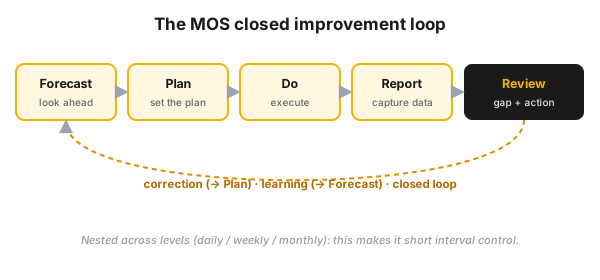 Figure 1 — the MOS closed loop: forecast, plan, do, report, review, then correction to the plan and learning to the forecast. This loop runs nested across several levels (daily / weekly / monthly).
Who is this for?
Section titled “Who is this for?”This article is for those who lead, run or are just introducing such a system: plant manager · asset team leader · shift supervisor · process engineer · maintenance manager · reliability engineer · HSE and process-safety specialist · production planner · OE/Lean specialist · site management.
Learning objectives
Section titled “Learning objectives”After reading this article you will be able to:
- explain what MOS means, and why it is not the same as a KPI dashboard;
- walk through the closed loop (Forecast, Plan, Do, Report, Review) and name where it breaks in practice;
- list the three mandatory outputs of a MOS meeting, and say what is missing if one of them is absent;
- place your own organization’s meetings on the Design, Install, Comply, Use, Adopt maturity scale;
- distinguish the MOS (the general framework) from the asset team’s operating rhythm (a concrete forum set).
In brief
Section titled “In brief”- The MOS defines the management routine by which an organization can be led: scheduled meetings, KPIs, RACI responsibilities and a closed improvement loop.
- Its logical backbone is the Forecast, Plan, Do, Report, Review cycle, nested across several levels (daily, weekly, monthly, quarterly, annual). This is what turns daily management into short interval control.
- Every meeting has its own Terms of Reference (ToR), KPI report and Action & Decision log. Each KPI has an accountable owner, and a plan, baseline, target and actual value.
- Introduction proceeds through five maturity levels — Design, Install, Comply, Use, Adopt; this is measured by the Engagement Level Score (ELS) and a meeting-effectiveness assessment. What matters is not that the system exists, but that it is actually used.
- In a process-industry, Seveso context the MOS is the frame in which the process-safety routine (the operator round, operating envelopes, alarm management, control of interlock bypasses, management of change, risk analyses, autonomous maintenance, FMEA) becomes a daily management rhythm rather than an isolated procedure.
- Introduction happens in waves, with coaching built in; the key to lasting success is developing leadership behavior, not putting up the boards.
- The MOS is the execution layer of the OGSM strategy deployment: OGSM says what to measure, and the MOS says in what rhythm and with whom to work down the gap to target.
Why it matters (the stakes)
Section titled “Why it matters (the stakes)”The absence of the MOS rarely causes a spectacular accident. Far more typical is the slow, silent drift. The chain usually runs like this: the loss is recorded but not analyzed, so no corrective action is born. The weekly meeting therefore softens into an information share, where reports are given but no decision is made. If there is no decision, the next deviation is compared with the plan by no one, and the organization loses its reference point. From there it is only one step to a recurring plant upset sitting in the system for months, because the loop never closes anywhere.
The reverse is also true: where the MOS works, the deviation becomes an action within days, the action has an owner and a deadline, and the next meeting opens by taking these over. The difference is not in diligence, but in the structure of the system.
What is the MOS, and where does it come from?
Section titled “What is the MOS, and where does it come from?”The MOS is a framework that structurally fixes the daily routine of leadership: it determines which meetings there are, how often, who is responsible for them, which indicators they look at, and how the loop closes between the planned and the actual performance.
Within a comprehensive operational excellence frame, the MOS is the governance, i.e. steering layer. It integrates all the other elements (technical foundations, competencies, mindset and behavior) and cascades the operation down to shift and workshop level. In process-industry and petrochemical transformation programs the MOS is typically one of the main pillars: the objective is that, with a properly introduced MOS, along the principles of continuous improvement, supported by digital tools, the plant becomes a sustainable and efficient unit.
Some consulting methodologies use the name Management Control & Reporting System (MCRS) for this same system; this article stays with the name MOS.
Two distinctions deserve special attention:
- The MOS is not an IT system and not a KPI dashboard. The dashboard is only one of its inputs; the MOS itself is the leadership routine: meeting architecture, roles, feedback.
- The MOS is not a one-off project. The system is alive only once it has permanently replaced the old way of working (Adopt level), and continuous improvement has become part of normal operation.
MOS or operating rhythm? Where is the boundary
Section titled “MOS or operating rhythm? Where is the boundary”The MOS is the general operating system, and the operating rhythm is one concrete realization of it at the level of a single asset team. The two are not synonyms, and they do not compete: it is the same logic at two different zoom levels.
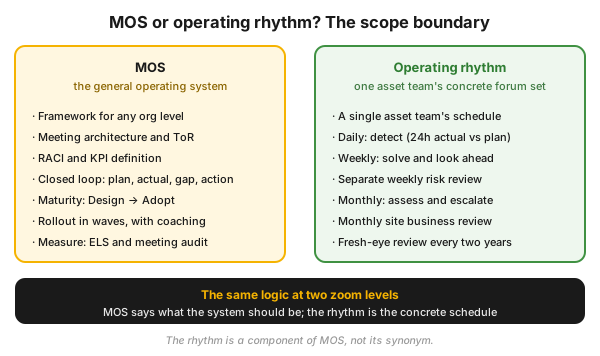 Figure 2 — scope boundary: the MOS is the rule of the system (architecture, RACI, KPI definition, maturity, rollout), the operating rhythm is the schedule broken down for one asset team.
| Aspect | MOS | Operating rhythm |
|---|---|---|
| What it describes | What the operating system should be at any organizational level | One asset team’s concrete daily, weekly and monthly forum set |
| Level of abstraction | Framework and design methodology | Schedule and agenda |
| Main content | Meeting architecture, ToR, RACI, KPI definition, closed loop, maturity scale, rollout waves | Daily (detect), weekly (solve), a separate weekly risk review, monthly asset-team and monthly site business review |
| Its main question | What system should we build, and how do we introduce it? | Which forum handles what, and what carries over to the next? |
| Its measure | Engagement Level Score, meeting-effectiveness audit, maturity level | Holding the forums, the standard report on time, a fresh-eye review every two years |
Practical translation: if you ask what meeting system to build and how to steer it up the maturity levels, the MOS is the answer. If you ask what a specific asset team does from Monday morning, then the operating rhythm is the detailed description. The rhythm is one component of the MOS, and the MOS provides the roles, the indicator definitions and the introduction methodology around the rhythm.
How does the MOS work?
Section titled “How does the MOS work?”The MOS breaks down into four building blocks: the closed loop, the nested levels, the KPI and the mandatory outputs of a meeting. To these come the role order and the design process.
1) The closed loop
Section titled “1) The closed loop”The core of the MOS is a closed-loop logic that can be described as two circles at once:
- Management loop: What did we plan, and did we deliver the plan? Forecast, plan, do, data and report.
- Improvement loop: Do we understand the cause of the deviation, and what is the corrective plan? Analysis, decision, action (data, analysis, decision, action).
The system is good if the loop closes at every level: the recorded loss is actually turned into a corrective action. The typical immature state is exactly that the loss is recorded but not used for intervention, the weekly meeting is only an information share, and there is no daily or weekly short interval control.
2) Nested levels
Section titled “2) Nested levels”The MOS ties several hierarchy levels together with scheduled meetings. A typical three-level arrangement:
| Level | Meeting | Frequency | Focus | KPI character |
|---|---|---|---|---|
| Level 1 | Operational review (shift, daily) | daily, even hourly, tied to the shift handover | short interval control, immediate deviations | leading (preventive) |
| Level 2 | Operational, weekly review | weekly, monthly | weekly plan, trends, deviation actions | leading and lagging |
| Level 3 | Business, monthly review | monthly, quarterly, annual | business goals, result KPI | lagging (after the fact) |
The logic: the lower level frequently looks at leading (influenceable) indicators, the upper level less frequently at the lagging (result) indicators, and there is a structured handover between the levels.
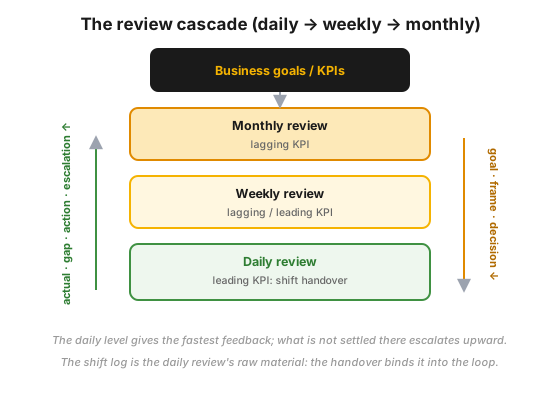 Figure 3 — the review cascade: the actual, the deviation and the escalation go up, the goal, the frame and the decision come down. The daily level gives the fastest feedback.
3) The KPI as the system’s unit of measure
Section titled “3) The KPI as the system’s unit of measure”Every metric of the MOS is a well-defined KPI. A KPI:
- measures the performance of a process or activity,
- is unambiguous and precise, referring to a given point in time,
- is influenceable by the accountable or responsible person.
Every KPI has one accountable owner, one or more responsible executors, plus a baseline and target value, a plan value and an actual value. A useful distinction is between the lagging (result, after the fact) and the leading (influencing, ahead of time) KPI: daily management wins on the leading indicators. For detail see KPI definition and leading and lagging indicators.
4) The three mandatory outputs of a meeting
Section titled “4) The three mandatory outputs of a meeting”Every MOS meeting has three outputs; without them it is not a MOS meeting:
- Terms of Reference (ToR), the founding charter of the meeting: purpose, participants, frequency, input, output, agenda, the tracked KPIs and the rules of behavior.
- KPI report: the tracked indicators with plan, target and actual value.
- Action & Decision log: the trail of actions and decisions, each with an owner and a deadline. The next meeting begins by reviewing these.
5) Roles and responsibility (RACI)
Section titled “5) Roles and responsibility (RACI)”Part of designing the MOS is clarifying the RACI (Responsible, Accountable, Consulted, Informed) for every meeting and every KPI. The meeting is led by an appointed chair, who keeps the agenda, manages the time, and steers with questions: they do not deliver a presentation but pull the analysis and the actions out of the team.
6) The four steps of design
Section titled “6) The four steps of design”MOS introduction always starts with the Design step, then spreads in waves. The four main steps of design:
- Define the OGSM, i.e. the strategy deployment.
- Define the RACI for the meetings and the indicators.
- Define the meeting architecture, i.e. the routine of performance meetings.
- Train and mobilize the players: center, site management, MOS coaches.
Process-industry context and safety
Section titled “Process-industry context and safety”In the process industry, especially in a Seveso-class plant, the MOS is not an abstract management concept but the leadership rhythm in which process safety and reliability become a daily routine. The principle of “operations-driven reliability” is that the owner of reliability is operations (the shift), and maintenance is an equal partner. As with a car: the owner of reliability is the driver, not the mechanic. The MOS provides the frame in which this ownership mindset becomes daily action (see operator-driven reliability).
The following process-industry elements are typically built into the MOS routine:
- Standard operator round. A predefined route and stations where the operator records the off-line parameters and the sensory signals. The shift supervisor validates, discusses the deviations and gives feedback. The goal is the early detection of equipment entering a risk zone, strengthening the ownership mindset and digitizing the manual data; a mobile device is strongly recommended.
- Operating envelopes and the IOW (Integrity Operating Window). The visualization of the permitted operating envelopes in the plant information system. The IOW covers the points most critical from the integrity standpoint (corrosion, high-temperature hydrogen attack), and sustained operation outside the envelope predictably leads to faster degradation. The IOW is an organic part of effective management of change, and deviation monitoring can be automated.
- Alarm management. A lifecycle process from the philosophy through identification, rationalization, plan, implementation, training, operation and monitoring to the audit. It reduces the alarm flood, and is therefore an additional layer of protection in process safety; the modifications must comply with the HAZOP and LOPA/SIL expectations.
- Emergency shutdown systems and the control of interlock bypasses. The bypasses of the protective systems must be registered and controlled daily. Where such a disciplined routine was introduced (a dedicated team with daily checks, a registered bypass status, automatic notification on status change), the number of prohibited interlocks fell measurably. This is a textbook example of the intersection of process safety and the MOS.
- Risk assessment in the daily and weekly routine. The daily meeting focuses on the risk arising from maintenance work, the weekly one on what changed or what is new in the unit. Every change goes through MOC. Tools: HAZOP for high risk, what-if or HAZID for medium and low, a last-minute risk assessment and a job safety analysis before the work. The risks, incidents and actions go into a common register, so that no action is forgotten.
- FMEA. Two levels: the process FMEA (technological analysis, the list of critical equipment and operator actions) and the equipment FMEA (failure modes, maintenance actions). The FMEA is best treated as a never-ending analysis: every technological or equipment change must be fed back into it, and the prioritized risk list is the basis of decision-making.
- Autonomous maintenance. The operator performs simple maintenance (lubrication check, leak search, sealing, valve tightening), thereby dismantling the “I operate it, you repair it” attitude. Its conditions: procedures, risk assessment, a tool list, training and an exam, a written work order from the shift supervisor, and feedback.
- Cross-functional teams, housekeeping and 5S, winterization, shutdown and start-up procedures, checklists. These all live in the MOS meeting and audit rhythm, for example a monthly housekeeping audit on a visualized board, or discussing the pre-season winterization plan and the results of the periodic inspections.
Introduction in practice
Section titled “Introduction in practice”The structure of MOS introduction: Design, then rollout in waves, with coaching built in.
The wave model (cascade learning)
Section titled “The wave model (cascade learning)”- Train a group of practitioners in the first wave. They actively deploy, implement and sustain the MOS routines together.
- Leave a coach on site for the next wave: a few experienced practitioners stay to support the local organization.
- Send the other experienced practitioners on to the next wave, to train new practitioners.
- Build a critical mass: over time an internal practitioner base develops that already spreads the system on its own. A dedicated MOS office builds and monitors the internal capability.
A typical 12-week wave
Section titled “A typical 12-week wave”| Phase | Typical activities |
|---|---|
| Install (roughly weeks 1–4) | Designing the visual boards; setting up the daily meetings; defining the KPIs; roles and the criticality matrix; setting up the daily and weekly plan; skills training |
| Comply (roughly weeks 5–8) | Defining the routines; documenting the procedures; a kaizen week; introducing work preparation and gating; soft-skill workshops; deploying the learning loop |
| Sustain (roughly weeks 9–12) | KPIs on plan; issuing certificates; celebrating success; preparing the next wave; training the local OE lead |
Milestones. The first milestone is setting up the quick-win daily meetings and the design and deployment of the MOS, where every daily and weekly meeting reaches the first maturity status. The second is the appearance of problem-solving techniques at the daily meetings and the design of the leader checklist, at the second status. The third is the introduction of the leader checklist, at the third status. The fourth is the full introduction of the MOS, where every daily, weekly and monthly meeting stands at the fourth status, and the sustainability indicator reaches its target value.
Coaching is a mandatory element. During the introduction the colleagues are coached to develop their leadership behavior and to manage their results proactively. Negative and positive leadership behaviors are distinguished: deriving the target purely from past performance is a negative pattern, setting a realistic, ambitious target based on the real need is positive; avoiding conflict is negative, making the decision and taking responsibility is positive. The time ratio of preparation, meeting and follow-up is also watched.
Hands-on: measure your own loop for two weeks
Section titled “Hands-on: measure your own loop for two weeks”This mini-scenario needs neither software nor external support, and shows exactly the gap that the MOS closes.
- Pick the one forum that is most about daily operation (the daily operational review or the weekly plant meeting).
- For two weeks, after each occasion, note three numbers: how many deviations were named; of those, how many became an action with an owner and a deadline; how many earlier actions were reviewed at the opening.
- Look at the three mandatory outputs: is there a written Terms of Reference, is there a KPI report with plan and actual value, and is there a live action log. Note down whichever is missing.
- Evaluate at the end of the second week. If the first number is high, the second small, and the third zero, then the loop is open: the organization detects the deviation but does not turn it into a correction.
- Start with a single intervention: introduce that the forum opens by reviewing the earlier actions. This is the cheapest step that begins to close the loop.
Measurement / audit
Section titled “Measurement / audit”With the MOS the question is not whether the system exists, but whether it is used. That is why the measurement targets adoption, maturity and the quality of the meeting.
Maturity scale
Section titled “Maturity scale”| Level | Name | What it means | Example observable sign |
|---|---|---|---|
| 1 | Design | designed, deployable | the reports have been filtered; the process steps influencing the KPI are identified; the information-gap plan is ready |
| 2 | Install | deployed, team trained | the first meeting runs by the agenda; an appointed chair; the action log in use |
| 3 | Comply | passive compliance driven by follow-up | the agenda is used consistently; the actions yield traceable KPI improvement; every KPI has a plan and target value |
| 4 | Use | the system drives the desired behavior and result | everyone comes prepared; the great majority of actions close on time; the chair steers with questions |
| 5 | Adopt | the new system has replaced the old | sharing good practices is routine; more ambitious targets; the measured KPIs move sustainably in a good direction |
Engagement Level Score (ELS)
Section titled “Engagement Level Score (ELS)”Adoption is tracked with the Engagement Level Score: every system element (meeting) gets a plan and an actual value on a low, few-step scale, broken down by week. The logic of the scale: deployed, compliance, then the level where the meeting leads to actions that influence the KPI result. In line with this logic, the aggregate indicator relates the sum of the levels reached to the theoretical maximum that follows from the number of system elements and the maximum level, and expresses this as a percentage.
The plan curve shows the targeted ramp-up, the actual curve the reality, and the gap between the two is the focus of the coaching. The typical course is that the actual curve rises visibly already in the first weeks of the introduction but stays below the plan; it is exactly this gap that marks where the leadership behavior needs work.
Meeting-effectiveness assessment
Section titled “Meeting-effectiveness assessment”A separate audit measures the quality of the meeting, in the efficiency and effectiveness dimensions, typically on a three-point scale (none, partly, full):
- Efficiency: did it start and end on time? was everyone present and prepared? was there a goal and an agenda, and did the chair keep it?
- Effectiveness: were the previous actions reviewed and closed? did the content tie back to the business goals? were the negative KPI deviations discussed and actioned? were the necessary decisions made? were the actions recorded with an owner and a realistic deadline?
The meeting score and the maturity level together show whether the meeting merely has the formal attributes, or actually leads to actions that influence the KPI result.
The process-industry routines’ own metrics
Section titled “The process-industry routines’ own metrics”The process-industry elements built into the MOS have their own audit metrics. For alarm management: the list of the most frequent and most disruptive (“bad actor”) alarms, the stuck alarms, as well as the shelved and suppressed alarms, with regular review. For the emergency shutdown systems: the number of prohibited interlocks and its trend. For the operator round: whether the round starts at the scheduled time, and whether the off-spec findings are discussed with feedback.
Common mistakes and their correction
Section titled “Common mistakes and their correction”| Mistake | Why it’s a problem | Correct practice |
|---|---|---|
| The loss is recorded but not corrected | The loop stays open, the measurement becomes an end in itself | Every recorded loss should have an analysis, a decision and an action |
| The weekly meeting is only an information share | Without control and decision it becomes a report-out | Deviation analysis and a decision point built into the agenda |
| No closed loop between the levels | Without a scheduled comparison of plan and actual there is no closed loop | A fixed cascade: what goes up as escalation, what comes down as decision |
| The system existing ≠ being used | Putting up the boards (Install) alone solves nothing | Follow-up and coaching, otherwise the organization gets stuck at passive compliance |
| The improvement holds only for the time of observation | Without coaching it slides back, adoption does not happen | Developing the behavior, not just deploying the process |
| A meeting without ToR, action log or KPI report | Without the three mandatory outputs it is not a MOS meeting | All three outputs in writing, for every forum |
| Weak chairing | The session runs loose, the level of detail drifts | The chair steers with questions, managing time and depth |
| Skipping coaching from the introduction | The system is technically ready but stays lifeless | Coaching built into the full length of the wave |
| FMEA, IOW or a procedure is not updated | The process-safety layer quietly degrades | Feed every technological and equipment change back into the documents |
When NOT to use it (the limits of the method)
Section titled “When NOT to use it (the limits of the method)”The MOS is a strong framework, but it is not the answer to every situation:
| Situation | Why (primarily) not the MOS | The right answer | ||
|---|---|---|---|---|
| There are no goals and indicators | The meeting cannot do a plan–actual comparison, it turns into an exchange of opinions | First the strategy deployment and the indicator definition ([[ogsm.en | OGSM]], [[kpi-definicio.en | KPI definition]]) |
| An acute upset or emergency | The forum order is slower than the event | An incident-handling and escalation order; the MOS processes the lesson afterwards | ||
| A certified safety function is needed | The MOS is a management frame, not a protective layer | Risk analysis and design per [[lopa-sil.en | IEC 61511 / SIL]] | |
| Deep expert analysis (root cause, HAZOP, optimization) | These require a separate, dedicated work form | Let the MOS launch and track them, but not perform them in the review | ||
| Missing decision authority | The forum turns into a status report | First clarify the delegated decision authority, only then the rhythm |
Rule of thumb: the MOS is strongest when there is something to compare against and someone to decide. It does not make up for a missing goal or missing authority.
Take it home (keys)
Section titled “Take it home (keys)”- The MOS is a routine, not software. Without a forum, ToR, action log and owner, even the best dashboard remains just a display.
- Closing the loop is the measure. Every recorded loss should have an analysis, a decision and a named action, otherwise the measurement is an end in itself.
- Three outputs, no exception: ToR, KPI report, action log. If one is missing, it is not a MOS meeting.
- Install is not the goal but the start. After the boards are up, coaching takes the system to the Use and Adopt level.
- Draw the line toward the rhythm. The MOS is the rule of the system, the operating rhythm is the concrete schedule; do not mix them, and do not write them twice.
- In the process industry the MOS is the owner of the safety routine, but not its protective layer: it does not substitute for certified safety.
Self-test
Section titled “Self-test”- At a weekly meeting three deviations are raised, but the minutes hold only a description, no action. Which loop broke, and what is the consequence for the coming week?
- Name the three mandatory outputs of the meeting, and say for each what is lost if it is left out.
- Where does the boundary run between the MOS and the asset team’s operating rhythm? State it in one sentence, then give one example question that each of them answers separately.
Answer key
- The improvement loop (analysis, decision, action) broke: the deviation was recorded but not turned into a correction. In the coming week the same deviation returns, without a reference point and an owner, and the meeting slides into an information share.
- Without the ToR there is no recorded goal, participant set and agenda, so the forum’s scope blurs. Without the KPI report there is nothing to measure the performance against, and the debate becomes an exchange of opinions. Without the action log the decision does not become a traceable task, and the next session has nothing to begin with.
- The MOS is the general operating system (what the meeting architecture, the RACI, the indicator definition should be, how to introduce it and measure the maturity); the operating rhythm is a concrete asset team’s forum set (what the daily, weekly and monthly session handles). A MOS question: “How do we design and introduce the review cascade at this site?” A rhythm question: “What can go to the daily meeting, and what carries over to the weekly forum?”
How does it show up in digital practice?
Section titled “How does it show up in digital practice?”The principle of the MOS does not stop at the meeting table and the wall board: the same logic is realized in software too. The mechanism differs (a database instead of paper), the principle is the same: a fixed cadence, a fact-based agenda, an action tied to an owner, a closed loop.
| Concept | Digital implementation | Value |
|---|---|---|
| Closed loop (plan, actual, deviation, action) | Plan and actual data in one place, with automatic deviation flagging | The deviation does not depend on human attention |
| KPI definition (baseline, target, plan, actual) | A central indicator register with definition and owner | No debate about what we measure and who owns it |
| Terms of Reference | A templated forum profile: goal, participants, agenda, tracked indicators | Every forum starts in the same structure |
| Action & Decision log | An action list with owner, deadline, status, on the opening screen of the next session | The agreement is traceable, not a verbal promise |
| Review cascade | The same data in different aggregations in the daily, weekly and monthly view | No manual report re-making per level |
| Measuring maturity and engagement | Attendance, action-closure rate and trend recorded per forum | Adoption is measurable, not judged by feel |
| Process-safety routines | A digital operator round, an operating-envelope deviation alert, an interlock-bypass register | The safety routine leaves an audit trail |
Connection to OPEREX (shift log)
Section titled “Connection to OPEREX (shift log)”The lowest ring of the MOS (the first level: the daily operational review and the shift handover) sits exactly where the shift log (OPEREX) works. The MOS prescribes that there must be a daily review, a KPI actual, a gap to target, and an action and decision log; the shift log is the digital layer where this actually happens shift by shift. Here the leading KPI actuals are recorded, the deviations with the mandatory comment, the triggered actions with owner and deadline, and the structured content of the shift handover.
With this, the shift log closes the last meter of the MOS: from the abstract rule of the meeting architecture (ToR, KPI report, action log) becomes a daily, auditable data point. The process-industry elements meet here too: the result of the operator round, the operating-envelope deviation, the interlock-bypass status and the autonomous-maintenance feedback all become traceable and escalatable in the shift log. This is how the daily-level input of the Engagement Level Score and the meeting effectiveness becomes measurable.
Terminology (HU / EN / JP)
Section titled “Terminology (HU / EN / JP)”| Hungarian | English | Japanese (romaji) |
|---|---|---|
| Menedzsment-működtető rendszer | Management Operating System (MOS) | — |
| Irányítási és riportrendszer | Management Control & Reporting System (MCRS) | — |
| Zárt hurok | Closed loop | — |
| Rövid intervallumú kontroll | Short Interval Control (SIC) | — |
| Elszámoltatható / felelős | Accountable / Responsible | — |
| Megbeszélés alapokmánya | Terms of Reference (ToR) | — |
| Akció- és döntés-napló | Action & Decision log | — |
| Megelőző / utólagos mutató | Leading / Lagging KPI | — |
| Bevonódási szint-pontszám | Engagement Level Score (ELS) | — |
| Üzemeltetés (az asset team egésze) | Operations | 操業 (sōgyō) |
| Üzemvitel (a szűk funkció, a műszak) | Operations (function) | 運転 (unten) |
| Standard operátori kör | Standard Operator Round | — |
| Integritás-üzemi ablak | Integrity Operating Window (IOW) | — |
| Üzemi paraméter-sáv | Operating envelope | — |
| Vészleállító rendszer | Emergency Shut Down (ESD) | — |
| Változáskezelés | Management of Change (MOC) | — |
| Autonóm karbantartás | Autonomous maintenance | 自主保全 (jishu hozen) |
| Hibamód- és hatáselemzés | Failure Mode and Effects Analysis (FMEA) | — |
What is a Management Operating System (MOS)?
The MOS is the leadership system that defines which meetings, indicators and responsibilities run daily operations. It prescribes the meeting architecture, the KPIs, the RACI and the closed loop (plan, do, measure, correct), so that leadership rests on facts.
What is the difference between the MOS and a KPI dashboard?
The dashboard only shows the data; the MOS is the leadership routine itself: meeting architecture, RACI responsibilities, ToRs and action logs, plus the closed loop that turns a deviation into a corrective action. The dashboard is one input to the MOS, not its substitute.
What is the difference between the MOS and the operating rhythm?
The MOS is the general operating system: a framework that says what the meeting architecture, the RACI, the indicator definition and the introduction methodology should be. The operating rhythm is its concrete realization at the level of a single asset team: the actual schedule and agenda of the daily, weekly and monthly forums. The rhythm is one component of the MOS, not its synonym.
How do I know whether our MOS is alive, or exists only on paper?
Look at the maturity scale: Install alone is not enough. It is alive if it reaches the Use or Adopt level: the participants come prepared, the great majority of actions close on time, the meeting leads to actions that influence the KPI result, and it has replaced the old way of working. The Engagement Level Score and the meeting-effectiveness assessment measure this.
How does the MOS connect to the OGSM?
The OGSM answers what to measure and toward which goal (strategy deployment); the MOS answers in what rhythm, with whom and in what loop to work down the gap to target. The indicators of the OGSM’s lowest level become the KPIs of the MOS’s daily and weekly reviews, and the first step of MOS design is precisely defining the OGSM.
In a Seveso plant, does the MOS replace process-safety management?
No. The MOS does not substitute for the mandatory frameworks (Seveso III, ISO 45001, SIL per IEC 61511, HAZOP and LOPA) but provides their leadership rhythm: it makes sure that the changes, the control of interlock bypasses, the operating-envelope deviations, the audit findings and the incident actions close on scheduled meetings, along the RACI, on deadline.
How long does introducing a MOS on one unit take?
A typical wave is roughly 12 weeks (Install, Comply, Sustain), but the lasting Adopt level requires further coaching and rollout into the next waves. Full site coverage is several successive waves, until a critical-mass internal practitioner base develops.
Related concepts
Section titled “Related concepts”OGSM · operating rhythm · asset team operations · performance management · performance dialogue · performance board · KPI definition · KPI cascade · leading and lagging indicators · shift handover · standard operator round · IOW · alarm management · emergency shutdown systems · operational risk assessment · MOC · HAZOP · LOPA / SIL · FMEA · autonomous maintenance · operator-driven reliability · PDCA · 5S · kaizen
Next step
Section titled “Next step”- OGSM — start here: the first step of MOS design is the strategy deployment, without which there is nothing to measure in the reviews.
- operating rhythm — then look at the concrete realization: one asset team’s daily, weekly and monthly forum set, with scope boundaries.
- performance dialogue — finally, go deeper into how to talk at these forums: the frequency cascade and leadership techniques of the performance dialogue.
References / further reading
Section titled “References / further reading”- Deming, W. E.: PDCA / Shewhart cycle — the methodological ancestor of the MOS closed loop (plan it, do it, check it, act on it).
- ISO 9001 and ISO 45001 — management review — the standard-side requirement of the regular, fact-based management review.
- Seveso III Directive (2012/18/EU) — the requirements for the safety management system of major-accident-hazard establishments, including the regular monitoring and review of performance.
- IEC 61511 / IEC 61508 — the standards of functional safety; the MOS provides these with the testing and bypass-control routine, not the protective layer.