The asset team's operating rhythm — daily, weekly, monthly
≈ 22 min read · 4,348 words
There are weeks when the same five people sit through four meetings, all four of them discussing the same shutdown, yet no decision is made anywhere. Then a fifth forum comes along, where an urgent topic has to be “squeezed in,” at which the daily meeting overruns by an hour and a half, and in the end the shift supervisor never makes it out to the plant. Sound familiar? This is not a shortage of time but a shortage of rhythm: it is not fixed which forum handles what. The operating rhythm puts exactly this in order. Let’s look at what it is, why it works, and what the job of the daily, the weekly and the monthly meeting is, one by one.
The operating rhythm is a fixed system of structured meetings that checks goals against facts at every level, ending friction between meetings and priorities.
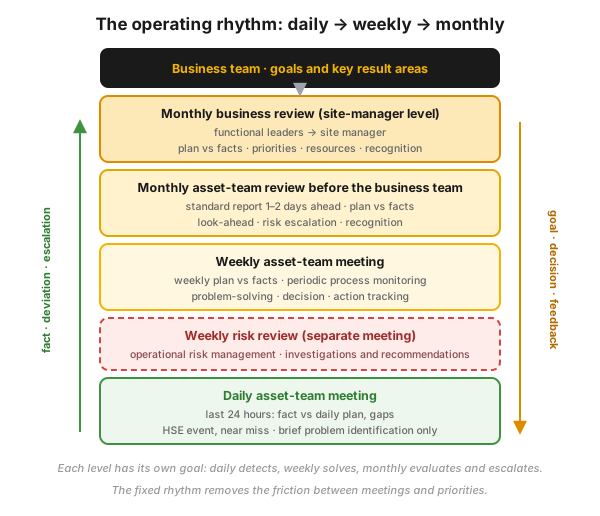 Figure 1 — the levels of the operating rhythm: daily and weekly asset-team meeting, a separate weekly risk review, monthly asset-team review before the business team, and monthly business review at site-manager level.
The operating rhythm is made up of the asset team’s daily, weekly and monthly forums, which carry the fact, the deviation and the escalation from the bottom up, and the goal, the decision, the feedback and the recognition from the top down. Every level has its own job: the daily detects, the weekly solves, the monthly evaluates and escalates. This logical flow of information is the basis for operating the asset safely and efficiently.
Who is this for?
Section titled “Who is this for?”This article is for those who sit in these forums or lead them: plant manager · asset team leader · shift supervisor · process engineer · maintenance lead · process technologist · HSE and process-safety specialist · production planner · plant economist · OE/Lean specialist.
Learning objectives
Section titled “Learning objectives”After reading this article you will be able to:
- say what the operating rhythm means, and why it is not the same as “a lot of meetings”;
- separate the job of the daily, the weekly and the monthly forum, and justify why the daily does not solve a problem;
- explain why it is worth holding the risk review in a separate meeting;
- prepare for a monthly asset-team review with a standard report;
- assess whether your own organization’s rhythm works (a biennial, “cold-eyes” review).
In brief
Section titled “In brief”- The operating rhythm is a system of structured meetings that regularly checks the set goals against the actual result and turns that into action.
- The rhythm is fixed: standardized by dates, participants and content, so the forums and the priorities do not compete with each other.
- Two-way: the fact, the deviation and the escalation go from the bottom up; the goal, the decision, the feedback and the recognition go from the top down.
- The daily forum is fact vs daily plan, HSE events and near misses, plus brief problem identification. It is expressly not for problem-solving, because there is no time for it.
- The weekly forum is the place for the solution: weekly plan vs facts, periodic process monitoring, troubleshooting, decision, action tracking and look-ahead. It strengthens ownership.
- The preferred form of operational risk management is a separate weekly risk review.
- The monthly asset-team review takes place before the superior business team, with a standard report sent out 1–2 days ahead.
- The rhythm should be visualized (published in a simple, familiar form) and accepted by everyone, or it will not hold.
Why it matters (the stakes)
Section titled “Why it matters (the stakes)”The absence of rhythm is not an “inconvenience” but a slow, quiet loss. The chain typically runs like this: the daily meeting overflows into a troubleshooting session, so the other areas are not discussed. The dropped topic does not disappear but wedges itself into an ad hoc meeting that clashes with the weekly forum. The weekly forum thus never reaches a decision, the task is left without an owner, and the next deviation is no longer checked against the plan by anyone. From here it is only one step for a recurring plant upset or an open risk action to stay in the system for months, because no forum feels it is theirs.
The reverse is also true: where the rhythm holds, bad news gets up quickly, the decision comes down quickly, and the organization measures the correction in days, not months.
What is the operating rhythm?
Section titled “What is the operating rhythm?”The operating rhythm (also called the communication system) is the standard for the agreed timings and structure of the meetings held at the professional and managerial levels. It ensures two things at once:
- Logical flow of information from the bottom up — the fact starting from the shift and the plant reaches the decision level;
- Feedback from the top down — the higher level gives back not only a goal and a decision but also feedback and recognition.
The goal of the continuous, orderly flow of information is practical: to have all the important data on hand so that the assets can be operated safely and efficiently, at the required level of availability. The rhythm also increases communication between the players, and enables the sharing of good practices.
The rhythm is not only managerial forums: the meeting structures also build in the professional sub-processes, for example the daily process monitoring, the periodic process monitoring and troubleshooting.
What is the job of the daily asset-team meeting?
Section titled “What is the job of the daily asset-team meeting?”The daily meeting checks the fact of the last 24 hours against the daily plan, names the gaps, and takes over the period’s safety and environmental events and near misses. This is the shortest and most frequent forum, and precisely for that reason its scope is the strictest.
Typical run:
- the shift supervisor or the asset team’s daily staff member reports on the events of the past 24 hours, using a one-page, standard note format (this has proven the most useful in practice);
- the maintenance side’s representative comments on the maintenance matters;
- the process side’s representative comments on the past 24 hours’ process monitoring;
- the team assigns the daily tasks.
At the daily forum no problem-solving or troubleshooting takes place, only brief problem identification, because there is simply no time for it. This is not laziness but a deliberate drawing of a boundary: if the daily meeting becomes a solving forum, it drags on, and people fall out of their plant presence.
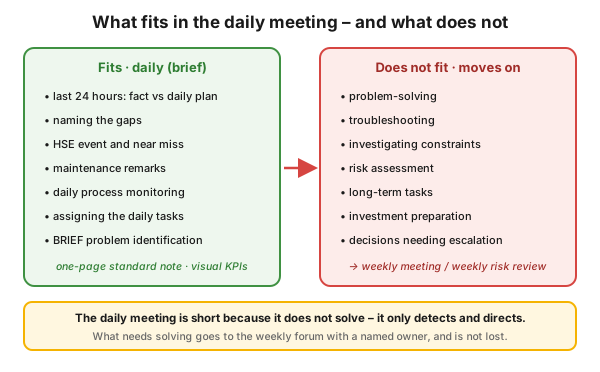 Figure 2 — the scope of the daily meeting: what fits, and what goes to the weekly forum or the weekly risk review with a named owner.
After the daily meeting the asset team leader (or a delegate) reports on the result of the past 24 hours to the production and energy-management area. The leaders of the superior business team may take part in the daily meeting, in person or remotely.
What is the job of the weekly asset-team meeting?
Section titled “What is the job of the weekly asset-team meeting?”The weekly meeting is the forum where problems are actually solved, and where the look-ahead happens. Here there is time for what the daily deliberately skips.
Its content:
- the comparison of the weekly operational performance against the weekly plan, including the periodic process monitoring;
- the week’s safety and environmental events, near misses;
- the review of the plan for the week ahead;
- the identification of new risks, gaps and business-blocking factors, plus the comparison of maintenance costs against the target;
- problem-solving, troubleshooting, decision-making, escalation, the investigation of constraints and agreement on the steps that mitigate the gaps and risks;
- look-ahead: closing the gaps and spotting the new opportunities;
- the review of the longer-term tasks (improvements, investment preparation).
The weekly forum also has a non-quantitative benefit: it strengthens the ownership in the asset team members. Whoever steps up week after week with the fact of their own area and with their own actions also identifies with them.
Effectiveness needs an action-tracking tool (whether a simple table or board, or dedicated software): without it the weekly meeting’s findings do not become trackable actions tied to an owner and a deadline.
Why is a separate weekly risk review needed?
Section titled “Why is a separate weekly risk review needed?”It is worth dedicating a separate weekly meeting to operational risk management, because risks and investigations require a different mindset than steering the daily operation. If we put the risks at the end of the weekly operational forum, they are typically the ones that get dropped when the agenda slips.
- A separate risk review is the preferred solution.
- If the number of investigations and risks is low, the risk review can fit into the regular weekly asset-team meeting as well.
- This forum gathers together the risk events and the recommendations coming from the investigation processes, so that they can be tracked.
Operational risk management is closely linked to process safety and to understanding the hazards arising from operation, so this forum is the natural meeting point of operational risk assessment, near miss and MOC.
What happens at the monthly asset-team review?
Section titled “What happens at the monthly asset-team review?”The monthly review is the forum where the asset team reports to the superior business team on the actual result achieved on the key result areas against the goals, based on a standard report sent out in advance.
Its run and content:
| Element | What it means in practice |
|---|---|
| Standard report | A uniform-format report sent out 1–2 days ahead, so participants arrive prepared |
| Highlights and concerns | The month’s main results and the areas needing attention |
| Plan vs facts | The actual result of all key result areas measured against the goals |
| Status of improvements | The state of the improvement plans and the follow-up of tasks from earlier reviews |
| Look-ahead | Closing the gaps and identifying the new opportunities |
| Risk escalation | Highlighting the asset team’s biggest operational risks and, as needed, escalating them to the business team |
| Priority and support | An opportunity to discuss priorities and to support decisions |
The monthly review is a cross-functional forum for the business team: direct communication between the asset team and the superior level, without intermediate steps. The business team here develops the asset team by giving feedback and recognition. This forum strengthens the asset team’s agility.
It can be organized separately per asset team, or in one large joint group, in person or remotely, as the organization needs.
Where does the loop close? The monthly business review
Section titled “Where does the loop close? The monthly business review”The topmost level of the rhythm is the site-manager-level monthly business review: here the functional leaders of the superior business team report to the site’s production manager on the actual result against the planned goals, and on the quantitative and qualitative objectives, broken down to their own function’s plans and goals. This too is an occasion for feedback and recognition, for discussing priorities and resource questions, for reviewing new opportunities and improvements, and for accepting the steps that mitigate the gaps and risks.
With this the loop closes: the fact starting from the shift reaches the site leadership, and the decision returns along the very same path to the daily operation.
Process-industry and safety context
Section titled “Process-industry and safety context”In process-industry plants, especially Seveso-classified ones, the operating rhythm is not an administrative convenience but safety infrastructure. At two points it is directly that:
- The near miss is a fixed item of the daily agenda. Not a separate campaign, but every morning it is stated what happened in the past 24 hours. This keeps the willingness to report alive (see near miss).
- The risk review is what makes the investigation recommendations trackable. The actions coming from investigations typically stay open because there is no regular forum that asks about them. The dedicated weekly meeting closes this gap.
The daily and weekly forum is, on top of this, the natural owner of the process monitoring: an out-of-plan drift of the operating parameters thus does not come to light from a monthly report, but the next morning.
Introduction in practice
Section titled “Introduction in practice”- Map the current forums. List all the regular meetings: timing, participants, subject, decision authority. The duplications become visible at once.
- Assign the levels to the goals. Decide for each forum which one detects (daily), which solves (weekly), which evaluates and escalates (monthly).
- Draw the boundary of the daily meeting. Fix in writing that the daily forum is not a problem-solving one, and name where the topic to be solved goes.
- Break out a separate risk review. If the volume of operational risks and investigations warrants it, put it into a standalone weekly meeting.
- Standardize the report format. A one-page daily note, and for the monthly review a standard report that you send out 1–2 days ahead.
- Make the KPIs visual. Color-coded, projected metrics at the daily forum, so the bad value is visible at a glance.
- Introduce action tracking. Let every action have an owner, a deadline and a visible status at the next meeting.
- Publish the rhythm and get it accepted. Let the schedule be visible to everyone, and let everyone hold to it.
Measurement and audit
Section titled “Measurement and audit”It is recommended to evaluate the effectiveness of the asset-team operation every two years, because the structure is often fine on paper, while in reality it works quite differently.
| Element | Recommended practice | |
|---|---|---|
| Frequency | Every two years | |
| Team | A small, “cold-eyes” team, 3–4 people | |
| Time needed | About one week | |
| Composition | Led by the site’s production manager or a leader they delegate, alongside 2–3 experienced leaders from the superior business team; experienced asset team leaders can also be invited | |
| Criterion | The team should include people who have real experience of a successful asset-team operation | |
| Method | Along the principles of the [[pdca.en | PDCA]] cycle |
| Use | The experiences of the individual sites must be gathered at group level, and on this basis the process description regarded as the standard must be amended |
At the level of the daily operation, the health of the rhythm can be read from a few simple signs too: whether the time is kept, whether the standard report is sent out on time, whether every action has an owner, and whether the recommendations coming from investigations get closed.
Common mistakes and their correction
Section titled “Common mistakes and their correction”| Mistake | Why it’s a problem | Correct practice |
|---|---|---|
| At the daily meeting they start to troubleshoot | The meeting drags on, the other areas are left out, people don’t make it to the plant | Brief problem identification, then over to the weekly forum with a named owner |
| No separate risk review | The risks and the investigation recommendations regularly slip at the end of the agenda | A dedicated weekly risk meeting; at low volume built in, but as a named agenda item |
| The monthly report comes up at the meeting | Participants read, they do not decide; the review becomes a reading-out | Standard report sent out 1–2 days ahead |
| Only one organizational part keeps the rhythm | The forum and priority clash returns, which dismantles the essence of the system | The whole organization accepts the rhythm, and let it be published |
| Meeting without action tracking | The actions get lost without an owner, the same topic returns for weeks | Every action gets an owner, a deadline and a visible status |
| No visualized KPI at the daily meeting | It turns into a reading-out of data, the deviation does not catch the eye | Color-coded, projected shop-floor KPIs |
| The structure is constant, the review is skipped | The rhythm lives on paper, empties out in practice | A biennial, “cold-eyes” evaluation along PDCA |
When NOT to use it (the limits of the method)
Section titled “When NOT to use it (the limits of the method)”The operating rhythm is a strong frame, but not the answer to every situation:
- During an acute plant upset, emergency or unexpected shutdown we do not wait for the weekly forum. In such a case the incident-management and escalation order takes effect; the rhythm processes the lesson afterward.
- When there is nothing to compare against. If there are no clear goals and measurable key result areas, the meeting cannot do a plan-vs-fact comparison, and it becomes an exchange of opinions. First the goal-setting is needed (see OGSM, KPI definition).
- When the authority is missing. If the asset team cannot make a decision on daily operational questions, the forum will only be a status report. The rhythm does not replace delegated decision authority.
- For deep professional analysis (root-cause analysis, HAZOP, process optimization) the rhythm’s forums are not suited: these require a separate, dedicated work form. The rhythm’s job is to launch and track them.
What this article does NOT cover
Section titled “What this article does NOT cover”This article shows in broad strokes what forums the asset team’s operating rhythm consists of, and what the role of each forum is within the asset team. It does not go into the professional depth of the individual topics. For a deeper treatment:
- MOS — the general operating system (Management Operating System): the full management frame, RACI, maturity levels, rollout waves;
- the performance dialogue — the frequency-cascade principle: how performance dialogues of different frequency build on each other;
- shift handover — the methodology of the structured shift handover;
- the performance board — the build-up and use of the performance board.
How does it appear in digital practice?
Section titled “How does it appear in digital practice?”The principle of the operating rhythm does not stop at the meeting table: the same logic is realized in software too. The mechanism is different (a database instead of a calendar), the principle is the same: a fixed cadence, a fact-based agenda, an action tied to an owner.
| Concept | Digital implementation | Value |
|---|---|---|
| Daily fact vs plan | Automatic comparison of the shift and plant data against the daily plan, with deviation flagging | The agenda assembles itself, it is not gathered by hand |
| HSE event, near miss from the last 24 hours | A digital reporter that, filtered by period, lands on the daily agenda | We miss not a single event, and we do not work from memory |
| Brief problem identification | One-click “carry the topic over to the weekly forum” with an owner and a deadline | The daily meeting stays short, yet the topic is not lost |
| Visualized shop-floor KPI | Color-coded, real-time metric board on a projector | The deviation is visible at a glance |
| Weekly action tracking | Action list with status, responsible person, deadline | The agreement is trackable, it does not stay a verbal promise |
| Monthly standard report | A report generated automatically from a template and data, sent out in advance | The review is spent on decisions, not on reading-out |
| Risk review | A record of risks and investigation recommendations, with due-date alerting | The open recommendations do not slip away quietly |
| Audit trail | Every meeting decision and action recorded retrievably | The working of the rhythm can be proven afterward too |
Connection to OPEREX (shift log)
Section titled “Connection to OPEREX (shift log)”The lowest, most frequent loop of the operating rhythm is the daily asset-team meeting, and its raw material is created in the shift log (OPEREX). The last 24 hours’ fact data, the plant events, the HSE event and near miss entries, and the tasks born of brief problem identification (with an owner and a deadline) are recorded here and retrievable from here. This way the daily meeting does not start from memory, the weekly forum works from the actual weekly history, and the monthly review can issue a standard report built on recorded data. The digital shift log is, in this sense, the bedrock of the operating rhythm: the layer where the fact is first written down.
Terminology (HU / EN / JP)
Section titled “Terminology (HU / EN / JP)”| Hungarian | English | 日本語 (romaji) |
|---|---|---|
| Működési ritmus (kommunikációs rendszer) | Operating rhythm (communication system) | — |
| Üzemeltetés (az asset team egésze) | Operations | 操業 (sōgyō) |
| Üzemvitel (a szűk funkció, operátorok) | Operations (function) | 運転 (unten) |
| Eszköz-csapat | Asset team | — |
| Felettes üzleti csapat | Business team | — |
| Napi megbeszélés | Daily meeting | 朝礼 (chōrei) |
| Heti kockázati review | Weekly risk review meeting | — |
| Operatív kockázatkezelés | Operational risk management (ORM) | — |
| Fő eredményterületek | Key result areas | — |
| Terv vs tény | Plan vs facts | — |
| Előretekintés | Look ahead | — |
| Eszkaláció | Escalation | — |
| Tulajdonlás | Ownership | — |
| Kis, friss szemű értékelő csapat | Cold eyes team | — |
| Majdnem-baleset | Near miss | ヒヤリハット (hiyari hatto) |
What is the operating rhythm?
The operating rhythm is the fixed system of structured meetings that regularly checks the set goals against the actual result. It consists of daily, weekly and monthly forums that carry the fact and the escalation from the bottom up, and the goal, the decision and the feedback from the top down.
Why must you not solve a problem at the daily meeting?
Because there is no time for it. The job of the daily forum is to compare the fact and the plan of the last 24 hours, to take over the gaps, the safety and environmental events and near misses, and to assign the daily tasks. For a problem only brief identification happens; the solution goes to the weekly meeting, with a named owner.
Why is it worth holding a separate weekly risk review?
Operational risk management and the tracking of investigations need a different attention than steering the daily operation, and they regularly slip at the end of the agenda. That is why a separate meeting is the preferred solution; if the risks and investigations are few, it can be built into the regular weekly meeting.
When must the monthly review's report be sent out?
1–2 days before the meeting, in a standard format. This way the participants arrive prepared, and the meeting is spent on decisions, not on reading-out.
How do we measure whether the system works well?
It is recommended to evaluate the effectiveness of the asset-team operation every two years, with a 3–4 person, “cold-eyes” team, over about one week, along PDCA principles. The team should include people who have real experience of a successful asset-team operation.
Who takes part in the daily asset-team meeting?
The asset team’s daily members and the shift supervisor, with the representatives of the operations, maintenance and process sides. The leaders of the superior business team may also take part, in person or remotely.
Take it home (keys)
Section titled “Take it home (keys)”- Fix the scope per forum, do not cut the number of meetings. The friction comes from the unclear scope.
- The daily meeting detects, it does not solve. Draw this boundary in writing too, and name where the topic to be solved goes.
- Do not leave the risk to the end of the agenda. A separate weekly risk review, or at least a named, protected agenda item.
- Let the monthly review report go out 1–2 days ahead. This is the cheapest step that frees up the most decision time.
- Let every action have an owner, a deadline and a visible status, without which even the best rhythm stays a chat.
- Have it reviewed from outside every two years. On paper every structure looks fine; only fresh eyes can disprove this.
Self-test
Section titled “Self-test”- A process deviation requiring troubleshooting comes up at the daily meeting. What does the team do, and why exactly that?
- What are the three different goals that the daily, the weekly and the monthly forum serve? Phrase each with a single verb.
- What justifies the monthly review’s standard report going out 1–2 days ahead, and what happens if this is skipped?
Answer key
- Brief problem identification, then the topic moves over to the weekly asset-team meeting with a named owner. Because at the daily forum there is no time for solving and troubleshooting; if they do start, the meeting drags on, and the discussion of the other areas is left out.
- The daily detects (fact vs daily plan, gaps, HSE events), the weekly solves (problem-solving, decision, action tracking, look-ahead), the monthly evaluates and escalates (plan vs facts on the key result areas, the escalation of the biggest risks, feedback and recognition).
- So that the participants arrive prepared, and the meeting is spent on discussion, priorities and supporting decisions. If it is skipped, the review becomes a reading-out, and the decision slips to the next month.
Related concepts
Section titled “Related concepts”operations (the asset team) · MOS · the performance dialogue · the performance board · shift handover · performance management · the KPI cascade · KPI definition · OGSM · visual management · near miss · operational risk assessment · MOC · PDCA · the standard operator round
Next step
Section titled “Next step”- operations (the asset team) — first understand who sits in these forums: the build-up of the asset team and the logic of the cross-functional line-up.
- MOS — then look at the full operating system, of which the rhythm is one component (RACI, maturity levels, closed loop).
- the performance dialogue — finally, go deep into how to talk in these forums: the frequency cascade of the performance dialogue and its leadership techniques.
References / Further reading
Section titled “References / Further reading”- Deming, W. E.: PDCA / Shewhart cycle — the methodological basis of reviewing the rhythm (plan, do, check, act).
- ISO 9001 and ISO 45001 — management review — the standard-side requirement of the regular, fact-based leadership review.
- Seveso III Directive (2012/18/EU) — the requirements for the safety management system of major-accident-hazard establishments, among which is the regular monitoring and review of performance.