The Lean quality model — the 4 steps of quality (Right First Time)
≈ 20 min read · 4,039 words
Imagine finding out at the end of a shift that the whole day’s batch is off-spec, because one parameter drifted and nobody caught it. The material is spent, the time is gone, the customer is waiting. The Lean quality model is designed to prevent exactly this: it does not screen out the bad product at the end of the process, but builds the work up so that the defect never happens at all, or surfaces where it arises. In four simple, building-on-each-other steps. Let’s look at what it is, why it works, and how to introduce it.
The Lean quality model builds quality into the process in four steps: it prevents the defect rather than screening it out afterwards, so that we get it right the first time (Right First Time). The four steps are: (1) understand the customer, (2) don’t accept poor quality, (3) continuous process control, (4) root-cause problem solving. The model is the philosophy of built-in quality: quality is not the result of after-the-fact inspection, but of every single work step.
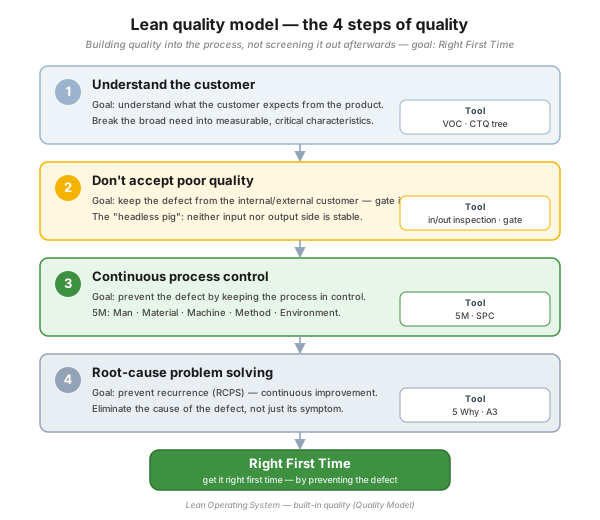 The four building-on-each-other steps of the Lean quality model, each with its goal and its main tool: understanding the customer (VOC, CTQ tree), gating out poor quality (in and out inspection), process control (5M, SPC) and root-cause problem solving (5 Why, A3). The four steps together lead to the “Right First Time” goal.
Who is this for?
Section titled “Who is this for?”This article is for those who are responsible for quality in practice: operator · production and plant manager · process technologist · process engineer · quality engineer · shift supervisor · Lean/CI specialist · HSE.
Learning objectives
Section titled “Learning objectives”After reading this article you will be able to:
- list the four steps of the Lean quality model, and say which tool belongs to which step;
- explain what “Right First Time” means, and why it is cheaper than after-the-fact screening;
- break down a broad customer need into measurable, critical characteristics with a CTQ tree;
- recognize the “headless pig” situation, and say why it is dangerous;
- distinguish the Lean quality model from Six Sigma, and say when each is the right tool.
The essence (TL;DR)
Section titled “The essence (TL;DR)”- 4 steps, building on each other: understand the customer → gate out poor quality → process control → root-cause solving.
- Goal: Right First Time — get it right the first time, by preventing the defect, not repairing it expensively at the end.
- VOC → CTQ tree: you break the broad, hard-to-measure customer need into concrete, easy-to-measure characteristics.
- 5M + SPC: you control the process along five factors (Man, Material, Machine, Method, Environment) so that it stays stable.
- The defect to its root: instead of treating the symptom you eliminate the cause (5 Why, A3), so it does not recur.
- FLOW ↔ QUALITY: a quality defect breaks the flow; improving quality improves the flow, and vice versa.
Why does it matter? (the stakes)
Section titled “Why does it matter? (the stakes)”An uncaught quality defect does not stop where it arose: the further it gets in the process, the more expensive it is. At the operation level it would still be cheap to fix, but one step closer to the customer it has already been built into other operations, and at the end it becomes a complaint, rework, capacity loss or even a safety event. Poor quality moreover breaks the flow: the next operation stops or the part must be remade, which directly increases waste.
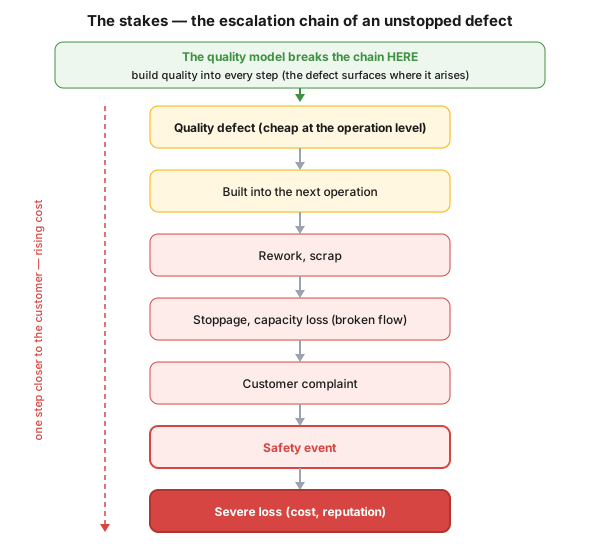 The escalation chain of an uncaught defect: the still-cheap fix at the operation level, one step closer to the customer, gets built into the next operation, then grows into rework, stoppage, complaint, and finally a safety event and severe loss. The Lean quality model breaks it at the very start of the chain, at the point of origin: it builds quality into every step.
That is exactly why the model does not look at a single dimension of quality. “Right First Time” pays off in four directions at once:
| Dimension | What you gain by getting it right first time |
|---|---|
| Safety | less handling, less reprocessing, less exposure |
| Quality | the internal/external customer is satisfied; poor quality moves one step closer to the final customer |
| Delivery | the flow does not break at the next step, no capacity loss, no remaking |
| Cost | the loss from poor quality (scrap, rework, complaint) is avoided |
The lesson: the cheapest defect is the one that never happened. That is why it pays to build quality into the process, rather than inspect it at the end.
What is the Lean quality model, and how does it relate to flow?
Section titled “What is the Lean quality model, and how does it relate to flow?”The Lean quality model is the practical framework of built-in quality: it states that quality is not the inspector’s job at the end of the process, but the result of every single work step. Similar to the jidoka principle, the defect must be recognized and stopped where it arises, so that it is not passed on.
Quality and flow are closely linked, in both directions:
- A quality problem arising in production breaks the flow (the next step stops, the part must be remade). So improving quality improves the flow.
- The reverse is also true: stuttering flow causes quality problems (rushing, congestion, half-finished material sitting). So improving the flow improves quality.
Peter Drucker put this concisely:
“Quality in a product or service is not what the supplier puts in. It is what the customer gets out and is willing to pay for.” — Peter F. Drucker
This gives the model its direction: quality is defined by the customer, so the model also starts with them.
What are the 4 steps of the Lean quality model?
Section titled “What are the 4 steps of the Lean quality model?”The four steps are a logical sequence: first you understand what good quality is (customer), then you don’t let the bad pass on (gate), then you prevent it from arising (process control), and finally you eliminate the cause of the defect at its root (root-cause solving). Each step has its own goal and tool:
| Step | What it means | Goal | Tool | ||
|---|---|---|---|---|---|
| 1. Understand the customer | you break the [[voc.en | VOC]] into measurable characteristics | understand what the customer expects | CTQ tree (Need → Drivers → CTQ) | |
| 2. Don’t accept poor quality | the defect must not reach the (internal/external) customer | stop the defect | in and out inspection, quality gate | ||
| 3. Continuous process control | preventing the defect by controlling the process | let no defect even arise | 5M + SPC | ||
| 4. Root-cause problem solving | preventing recurrence | eliminate the cause | [[5-miert.en | 5 Why]], [[a3-riport.en | A3]] |
Step 1: How do you understand what the customer expects? (VOC → CTQ tree)
Section titled “Step 1: How do you understand what the customer expects? (VOC → CTQ tree)”In the first step we translate the Voice of the Customer (VOC) into measurable characteristics. The customer expectation on its own is broad and hard to measure (“good service”, “reliable product”). The CTQ tree (Critical to Quality tree) breaks this down into concrete, numerical requirements:
Need → Drivers → Critical to Qualities, that is, from the general, hard-to-measure need to the specific, easy-to-measure characteristics.
A classic restaurant example: one driver of “good guest service” (Need) is “minimal waiting”, whose concrete CTQ might be that “the guest is greeted within 2 minutes of being seated”. The CTQ is thus what can already be measured, and what the process can be held accountable for.
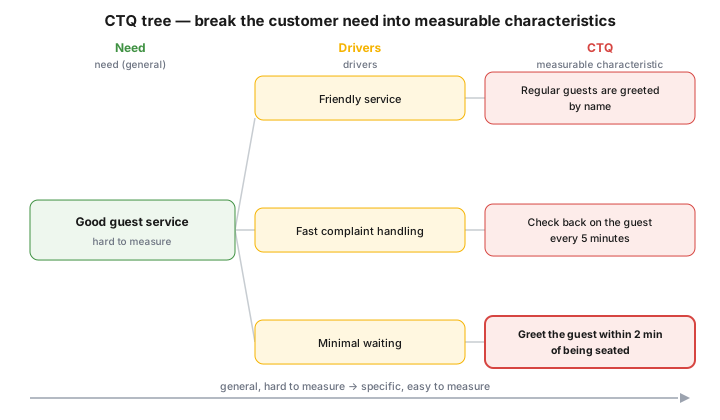 The CTQ tree first breaks the broad, hard-to-measure customer need (Need: “good guest service”) into drivers (friendly service, fast complaint handling, minimal waiting), then into concrete, measurable CTQ characteristics (e.g. “the guest is greeted within 2 minutes of being seated”). Moving from left to right, we go from the general to the specific, easy-to-measure requirement.
In process industries the CTQs are the critical parameters of the product specification (e.g. sulphur content, flash point, density): these are the measurable characteristics that the customer expects, and on which the downstream processing is built.
Step 2: Why should you not accept poor quality? (the “headless pig”)
Section titled “Step 2: Why should you not accept poor quality? (the “headless pig”)”The essence of the second step is that the defect must be gated before it passes on to the internal or external customer. The tool is in and out inspection: you check on both sides of the process, so that no bad raw material goes in and no bad product goes out.
The vivid image of the model is the “headless pig” problem: if neither the input nor the output side is stable, then the output of the process is unpredictable, and it eats up extra resources, time and cost. The combination of input and output quality decides what happens:
| Input quality | Process | Output quality | Result |
|---|---|---|---|
| good | stable | good | good |
| good | unstable / weak | bad | bad |
| bad | stable | bad | bad |
| bad | — | bad | extra resources, time and cost |
The lesson: even a stable process only gives good output from good input, so both gates must be guarded. The goal is not to screen out the defective product, but to keep the defect from passing on down the chain.
Step 3: How can the defect be prevented? (5M + SPC → Right First Time)
Section titled “Step 3: How can the defect be prevented? (5M + SPC → Right First Time)”The third step is prevention: you control the process so that the defect does not even arise. This is the “Right First Time” state, where the number of defects approaches zero over time — not by after-the-fact screening, but by keeping the process in hand.
The tool is 5M and SPC (statistical process control). The 5M organizes the five influencing factors of the process into a system, which together determine the output quality and delivery:
| Factor (5M) | What it takes in hand | Examples |
|---|---|---|
| Man | capability, training | SOP, skill matrix |
| Material | raw-material quality | raw material, additives, auxiliary materials |
| Machine / Assets | equipment condition | setting, calibration, maintenance |
| Method | how the work is done | visual management, accuracy, performance boards |
| Environment | external conditions | temperature, humidity, airflow |
SPC complements this: it monitors the process’s key parameters with control limits, and signals when the process deviates from stable behaviour, before the product goes out of specification. The goal is a predictable, stable process: this is the statistical foundation of built-in quality, and at the same time the shared language of Six Sigma.
Step 4: How can recurrence of the defect be prevented? (root-cause solving)
Section titled “Step 4: How can recurrence of the defect be prevented? (root-cause solving)”The fourth step is root-cause problem solving (Root Cause Problem Solving, RCPS): if a defect does arise, you do not treat the symptom, but eliminate its cause, so that it does not recur. This is where the traditional and the Lean view part ways:
| Traditional approach | Lean approach | |
|---|---|---|
| The problem is… | an obstacle to be removed quickly so production can continue | an opportunity for continuous improvement |
| What do you treat? | the symptom (so production can go on) | the root cause (so it does not return) |
The vivid image is the weed: the symptom is the weed above the surface, easy to cut off, but the root (the real cause) stays below the surface, and the weed grows back. You have to dig to the root.
The main tool is 5 Why: you keep asking “why?” until you reach the real cause. A classic example: the machine stopped → the fuse blew → there was not enough oil on the shaft → the pump does not deliver enough → the filter is clogged → there is no preventive maintenance / weekly cleaning. The fifth “why” points to the real, systemic cause that can be eliminated. It is worth running the 5 Why along the 5M dimensions too (Man, Material, Machine, Method, Environment), so that no blind spot remains.
The solution and the lesson are recorded documentarily on the A3 report, walking through the next steps on a single sheet:
- problem statement — what the observed deviation is;
- analysis of the current situation — what the data show;
- root-cause analysis — uncovering the real triggering cause;
- action plan — what we do, who and by when;
- results — the effect of the intervention;
- new standard — recording the proven solution.
This way the solution is built into the standard, and is not lost.
How is the Lean quality model different from Six Sigma?
Section titled “How is the Lean quality model different from Six Sigma?”The Lean quality model is the sequential philosophy of built-in quality (build quality into every work step), while Six Sigma is a data-driven, statistical variance-reduction methodology for a given improvement project. They do not compete: the quality model provides the culture and the logic of the steps, Six Sigma provides the rigorous toolset where statistical depth is needed.
The two approaches share a few tools (SPC, root-cause analysis, CTQ), but their roles differ:
| Aspect | Lean quality model | Six Sigma |
|---|---|---|
| What | a 4-step philosophy of building quality in | statistical variance-reduction methodology |
| Focus | the quality of every work step, protecting the flow | reducing the process spread (variance) |
| Frame | 4 steps (customer → gate → control → root cause) | DMAIC (Define–Measure–Analyze–Improve–Control) |
| Yardstick | Right First Time | DPMO (≤ 3.4 defects per million opportunities) |
| When | everyday quality culture covering every operation | a targeted project requiring statistical depth |
In practice the two complement each other: the Lean quality model makes quality everyone’s daily responsibility, while Six Sigma deepens where the cause of the variance is not statistically trivial. Lean Six Sigma is precisely the fusion of these two.
Process-industry context
Section titled “Process-industry context”In process industries the four steps translate into keeping the product specification:
- 1. Understand the customer: the CTQs are the critical quality parameters (sulphur content, flash point, density) that the downstream units and the final customer expect.
- 2. Don’t pass on the bad: quality gating of intermediate products before the next process unit (analysis, on-spec check), so that off-spec material does not burden the downstream process.
- 3. Process control: keeping the process parameters (temperature, pressure, raw material, additives, calibration) in hand on a 5M basis, monitoring the key parameters with SPC.
- 4. Root cause: uncovering the triggering cause of the off-spec or the deviation (5 Why + A3), so it does not recur on the next shift.
How would you introduce it? (mini-scenario)
Section titled “How would you introduce it? (mini-scenario)”The model is not a poster but a daily routine. This is how a shift supervisor could start it tomorrow, on a single painful quality problem:
- Choose the customer and the CTQ. Who is the next step (internal or external customer), and what are the one or two measurable characteristics that matter to them? Write them down as a CTQ.
- Put up a gate. Define what “good” is at the input and at the output, and how you check it. Do not let the bad pass on.
- Control along 5M. Go through the Man / Material / Machine / Method / Environment factors: which one fluctuates? Introduce a simple SPC monitoring on the key parameter.
- When there is a defect, dig to the root. 5 Why (along the 5M dimensions), then a short A3: what the cause is, what the action is, what the new standard will be.
- Record it in the standard. The proven solution should be built into the standard work, and look for the same defect pattern at other operations too.
Measurement / audit
Section titled “Measurement / audit”The effect of the quality model shows up in the quality metrics, which is the third factor (Q) of OEE:
- The number / rate of defects at the given operation, before and after introducing process control (target: a decreasing trend, “Right First Time”).
- The rate of defects that reached the customer / the next operation compared to those caught during the process: this is the effectiveness of built-in quality.
- The rate of recurring problems: if the same defect recurs, step 4 (root cause) has not worked.
- CTQ fulfilment: how well the critical characteristics hold the specification (SPC capability).
Common mistakes
Section titled “Common mistakes”- Quality is the inspector’s job at the end. We leave the screening to the end of the process. Why it’s a problem: it is expensive, late, and the inspector can also make mistakes. Instead: build quality into every step (steps 1–3), inspection is only the net, not the strategy.
- The customer need is not broken down into a CTQ. “Let it be good quality”, but unmeasurable. Why it’s a problem: you don’t know whether you’re meeting it. Instead: VOC → CTQ tree, down to concrete measurable characteristics.
- Only one gate is guarded. We check the output, but not the input (or vice versa). Why it’s a problem: the case of the “headless pig”, stable output does not come from unstable input. Instead: in and out inspection on both sides.
- We treat the symptom, not the root cause. We clear it quickly so production goes on. Why it’s a problem: the weed grows back, the defect recurs. Instead: 5 Why + A3, digging to the real cause.
- The solution is not built into the standard. We solve it, but do not record it. Why it’s a problem: the next shift falls into it again. Instead: A3 → new standard → standard work.
When NOT to use it? (limits of the method)
Section titled “When NOT to use it? (limits of the method)”The Lean quality model is the framework of repeatable quality built into the process, but it is not the right answer for every situation:
| Situation | Why (primarily) not the quality model | The right answer |
|---|---|---|
| Statistically complex variance (interaction of many factors) | the 4 steps give the frame, but not the deep statistics | Six Sigma / DMAIC, DOE |
| Safety-critical protection is needed | the quality model is not a certified protection layer | design per LOPA/SIL, IEC 61511 |
| A one-off, non-recurring defect | there is nothing to build durably into the process | one-off root-cause analysis, recording the lesson |
| The problem is really a product-design fault | it is not to be gated but redesigned | DFSS / process redesign |
Rule of thumb: the quality model is the daily, built-into-the-process culture of quality; where statistical depth or a certified safety function is needed, call the appropriate specialist tool. The quality model complements, it does not replace.
Take it home (keys)
Section titled “Take it home (keys)”- Quality belongs to every step, not to the inspector: build it in, don’t screen it out.
- Start with the customer: break the broad need into measurable characteristics with a CTQ tree.
- Guard both gates: no bad in, no bad out (avoiding the “headless pig”).
- Prevention instead of screening: 5M + SPC for a stable, predictable process (“Right First Time”).
- Dig to the root: 5 Why + A3, then build the solution into the standard, so it does not recur.
- For statistical depth call Six Sigma; for safety, the certified protection layers.
Self-test
Section titled “Self-test”- List the four steps of the Lean quality model, and say which tool belongs to which one.
- What does the “headless pig” problem mean, and which step handles it? Why is it not enough to check only the output?
- For a recurring quality defect, which step (and tool) is the right answer, and why is clearing the symptom not enough?
How does it appear in digital practice?
Section titled “How does it appear in digital practice?”The principle of the Lean quality model does not stop at the production line: the same logic is realized in software too, in any well-designed digital workflow. Instead of the physical gate and the paper checklist, here field validation, automatic SPC alerting and a structured problem-solving template keep quality in hand: the mechanism differs, the principle is the same.
| Quality-model principle | Digital implementation | What it delivers |
|---|---|---|
| Understanding the customer (CTQ) | the critical characteristics recorded as measurable fields, with a target value | “quality” becomes a concrete, trackable parameter |
| Don’t pass on the bad (gate) | the step cannot be closed until the quality check is acknowledged | the defect does not reach the next operation |
| Process control (SPC) | automatic trend and control-limit alerting on a deviation | the process signals for intervention before it even leaves the specification |
| Root-cause solving (RCPS) | a structured 5 Why / A3 template, with action tracking | the solution is documented and accountable, not lost |
| Standardization | the proven solution is built into the digital standard work | the next shift does not fall back |
Connection to OPEREX (shift log)
Section titled “Connection to OPEREX (shift log)”The principle of the quality model can be built directly into a digital shift log. In the OPEREX shift log the quality deviation (off-spec product, out-of-specification parameter) and the correction applied to it can be recorded in a structured way: what was detected, what the probable cause was, what intervention was made, and what the assigned action is. This way the quality problem and its solution form an auditable trail across shifts: the next shift sees what happened, and the recurring deviation (the sign of a missing step 4) surfaces before it becomes a trend.
Terminology (HU / EN)
Section titled “Terminology (HU / EN)”| Hungarian | English | Note |
|---|---|---|
| Lean minőségmodell / beépített minőség | built-in quality | quality in every work step |
| Elsőre jót | Right First Time (RFT) | the target state of process control |
| Vevő hangja | Voice of the Customer (VOC) | uncovering the customer expectation |
| Kritikus minőségi jellemző | Critical to Quality (CTQ) | a measurable characteristic defined by the customer |
| CTQ-fa | CTQ tree | Need → Drivers → CTQ breakdown |
| Statisztikai folyamatszabályozás | Statistical Process Control (SPC) | control limits, trend monitoring |
| Öt tényező | 5M (Man, Material, Machine, Method, Environment) | the influencing factors of the process |
| Gyökérok-alapú problémamegoldás | Root Cause Problem Solving (RCPS) | 5 Why, A3 |
The terms are validated from the source material and the established Lean canon. The table is deliberately split HU / EN (without a Japanese column): the model’s concepts (VOC, CTQ, SPC, 5M, RCPS, Right First Time) are of English origin, they do not come from the Japanese Lean vocabulary, so a Japanese term would add nothing here.
What are the four steps of the Lean quality model?
- Understand the customer (VOC → CTQ tree), 2) Don’t accept poor quality (in and out inspection), 3) Continuous process control (5M + SPC), 4) Root-cause problem solving (5 Why, A3). The goal is Right First Time, that is, getting it right the first time.
What does "Right First Time" mean?
That the process delivers a good product the first time, by preventing the defect, not by after-the-fact screening. The number of defects approaches zero over time because the process is stable and in control (5M + SPC), not because the scrap is screened out at the end.
What is the role of the CTQ tree?
The CTQ tree (Critical to Quality tree) breaks the broad, hard-to-measure customer need into concrete, easy-to-measure characteristics (Need → Drivers → CTQ), so that the process actually satisfies the customer, and fulfilment is measurable.
What is the "headless pig" problem?
The situation where neither the input nor the output quality is stable. In that case the output of the process is unpredictable, and it eats up extra resources, time and cost. That is why both gates (input and output side) must be guarded in step 2.
How is the Lean quality model different from Six Sigma?
The quality model is the 4-step, everyday philosophy of building quality in (for every work step), while Six Sigma is a data-driven, statistical variance-reduction methodology (DMAIC, DPMO) for targeted projects. They share tools (SPC, root cause, CTQ), but their roles differ, and they complement each other.
Related concepts
Section titled “Related concepts”voc · 5 Whys · A3 report · jidoka · six-sigma · dmaic · standard work · oee · flow · muda
Next step
Section titled “Next step”If you have understood this, from here it is worth going on — in this order:
- voc — how to uncover and break down the customer need into CTQs (deepening step 1).
- 5 Whys — the practical tool of root-cause analysis, the engine of step 4; then the A3 report for the documented version.
- six-sigma — if statistical depth is needed to reduce the variance, beyond the quality model.
References / Further reading
Section titled “References / Further reading”- W. Edwards Deming: Out of the Crisis. MIT Press, 1986 — the founding ideas of built-in quality and variance reduction (“cease dependence on inspection”).
- Peter F. Drucker: Management. Harper & Row, 1973 — the customer-side definition of quality (the source of the thought quoted in the article).
- James P. Womack – Daniel T. Jones: Lean Thinking. Free Press, 2003 — the Lean principles and the system of built-in quality.
- Kaoru Ishikawa: What Is Total Quality Control? The Japanese Way. Prentice-Hall, 1985 — the classic frame of process control and cause-and-effect (root cause).