Vision workshop: montage to action
≈ 19 min read · 3,769 words
Ask five people from the same team “what is work like here now, and what would you like it to be?”, and you get five different answers. Not because any of them is wrong, but because no one has ever asked them to talk about the same thing in the same words. The vision workshop fills exactly this gap: in a few hours it gives a shared language, a shared picture of the present and a shared vision of the future, then turns it into action. Let’s look at the meaning of the vision workshop, the steps and examples of running it, and when to choose which format.
The vision workshop is a structured group exercise in which, in a few hours, a team frames a shared current- and future-state view. It has two complementary formats. The “soft,” image-montage version works at the level of mindset and behaviour (Mindset & Behaviour): from a picture set the team captures first the current state, then the desired future state with 10–15 jointly agreed pictures, regardless of hierarchy, by common agreement. The “hard,” cross-functional future-state workshop starts from data: it examines load curves and existing ideas, quantifies the loss in euros, and ranks the actions on a benefit × feasibility matrix. Both have the same goal: a shared language, a shared vision, and a shift into action.
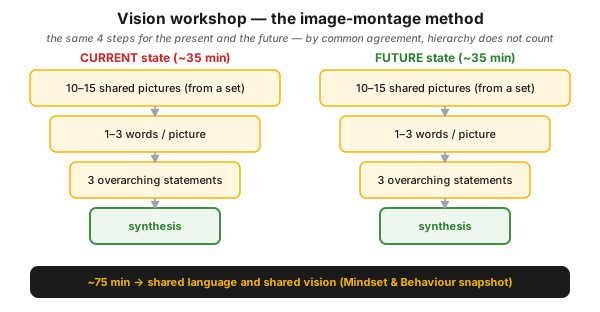 Figure 1: the image-montage vision workshop. The same four-step distillation (10–15 shared pictures, 1–3 words per picture, 3 overarching statements, one synthesis) runs for the CURRENT, then the FUTURE state, in roughly 35 + 35 minutes. Hierarchy does not count; the decision is made by common agreement.
Who is this for?
Section titled “Who is this for?”This article is for those who want to align a team or an organizational unit toward a shared direction: plant manager · shift supervisor · technologist · maintenance manager · process-improvement (Lean/CI) specialist · project and change leader · HR and organizational developer · HSE.
Learning objectives
Section titled “Learning objectives”After reading this article you will be able to:
- distinguish the image-montage and the cross-functional future-state workshop, and say which one is the right choice when;
- run an image-montage workshop with the four-step distillation, together with the facilitation rules;
- assemble the participant circle of the cross-functional workshop so that the feasibility estimate is realistic;
- rank ideas on a benefit × feasibility matrix, with the loss quantified in money;
- recognize when a workshop is NOT the right tool.
In brief
Section titled “In brief”- Two formats, one goal. The image montage creates a shared vision and action at the level of mindset, the cross-functional diagnostic workshop at the level of data.
- The montage method: from a picture set 10–15 shared pictures, then 1–3 words per picture, from these 3 overarching statements, finally one synthesis. Separately for the current, separately for the future state.
- Hierarchy does not count. The goal is genuine common agreement, not pushing through the leader’s opinion; everyone contributes with equal weight.
- Fast and documented: in roughly 75 minutes (35 + 35) a great deal surfaces and is recorded about the team’s mindset and desired vision.
- In the cross-functional workshop the specialists of operations, technology and maintenance and the navigators jointly examine the load curves and the existing ideas.
- Prioritization: the ideas go onto a benefit × feasibility matrix, and the loss is quantified in euros.
- The future-state workshop closes the sequence: based on the current-state results it sets a goal and frames the vision.
Why does it matter? (the stakes)
Section titled “Why does it matter? (the stakes)”Skipping a workshop is not a spectacular loss but a slow, silent friction. If there is no jointly stated picture of the present, in every improvement debate the sides talk about a different reality: operations point to the downtimes, maintenance to access, technology to yield. If there is no jointly stated vision, every idea looks equally important, so the organization starts working on the most easily reachable, not the most valuable, things.
So the stake is twofold. On one hand, loss of direction: parallel, criss-crossing initiatives that drain capacity. On the other, lack of commitment: if the vision is communicated top-down, the team executes it but does not own it, and at the first difficulty the old routine returns. The workshop gives the same answer to both: the team itself states where it stands and where it wants to get to.
What is the vision workshop, and what formats does it have?
Section titled “What is the vision workshop, and what formats does it have?”The vision workshop serves a single goal, creating a shared picture of the present and the future, but reaches it by two sharply different paths. In practice the term “future-state workshop” has stuck to both, so it is worth consciously choosing between them or using them one after the other.
| Image-montage vision workshop | Cross-functional future-state workshop | |
|---|---|---|
| What it works with | pictures, words, feelings | data, load curves, idea lists |
| What it targets | culture, intent, shared language | ranking losses, tests |
| When it is strongest | at the launch of the transformation | after the diagnosis |
| Its output | current- and future-state montage, synthesis | idea list, prioritized tests, goal and vision |
| Typical time frame | approx. 75 min (35 + 35) | 2 + 2 hour blocks |
The two also work in sequence: first the montage gives a shared vision, then the diagnostic workshop turns it into a concrete, prioritized action plan. They follow the same logic (present, future, action), only they speak a different language: the montage in picture and feeling, the cross-functional workshop in data and euros.
How do you run an image-montage vision workshop?
Section titled “How do you run an image-montage vision workshop?”The method consists of two identically structured phases: roughly 35 minutes for the CURRENT (current state), then roughly 35 minutes for the FUTURE (future state) state. In both phases the same four-step distillation runs.
- Select 10–15 shared pictures from a pre-assembled, neutral, mixed picture set. The team jointly decides which pictures express the given state.
- Assign 1–3 words to each selected picture. The aim is brevity: what does not fit in three words is not yet a clear thought.
- Condense into 3 overarching statements. From the pictures and the words, three main findings come together.
- Frame a single synthesis. The three statements come together into one summary sentence, and this is the phase’s output.
Facilitation rules. Everyone may contribute; the decision is made by common agreement; rank does not confer greater voting weight. The facilitator’s task is to enforce these three rules, not to make content suggestions.
The output gives a fast, documented snapshot of the team’s mindset and behaviour (Mindset & Behaviour) and its desired vision. Typically emerging statements: transparency at every level, openness to learning, accepting and initiating change. Experience shows that in roughly 75 minutes surprisingly much can be learned and recorded about the team’s mindset, and the shared language becomes the starting point of the transformation. The iceberg model explains the background of the phenomenon: the pictures open the conversation at the level of the mindset beneath the visible behaviour.
How does the cross-functional, data-based future-state workshop run?
Section titled “How does the cross-functional, data-based future-state workshop run?”This format is the extended meeting of the diagnostic phase, and typically runs in two steps. Its input is data, its output is a prioritized idea list.
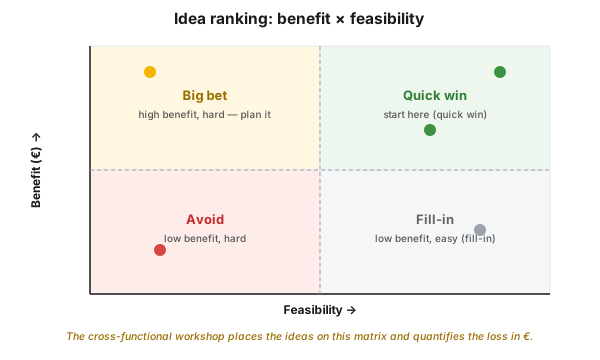 Figure 2: the benefit × feasibility matrix. The cross-functional workshop places the ideas on it: the quick win (high benefit, easy to implement) is the immediate starting point, the big bet requires planning, the “fill-in” is low priority, and the pairing of low benefit and hard implementation is to be avoided.
- Load-curve day (small team). The team selects the most important units and the “interesting” load curves (high variability, fixed processes, parallel lines), quantifies the loss in euros, assembles the first test list, and prepares the KPI/PI/I trees.
- Cross-functional meeting (extended circle). The operations manager and deputy, the specialist responsible for operator training, the shift supervisor, the technologist, the maintenance representative and the navigators together review the existing results, the load curves and the earlier ideas, for example the proposals of previous energy audits and efficiency-improvement programs. From this the first version of the idea list comes together, ordered by benefit × feasibility.
The future-state workshop closes the sequence: based on the current-state results and the efficiency-improvement actions already running, it sets a goal and frames the vision. The structured time frame of the meetings is typically a 2 + 2 hour block.
Process-industry context and safety
Section titled “Process-industry context and safety”The participants of the cross-functional workshop are the key roles of the process-industry shift organization: shift supervisor, operator-training specialist, technologist, maintenance. This is precisely what ensures that operational and safety reality enters the feasibility assessment of the ideas. An energetically attractive idea can fail on feasibility if it carries an operating or safety risk, and this is most often noticed not by the idea’s owner but by the shift supervisor.
The image-montage workshop, in turn, is valuable in a Seveso plant because a hierarchy-independent shared vision (for example “an open error culture,” “transparency”) can be the basis for near-miss reporting willingness and for developing the safety culture: the team itself states that this is what it wants, rather than receiving it as an expectation from above.
Introduction in practice (roadmap)
Section titled “Introduction in practice (roadmap)”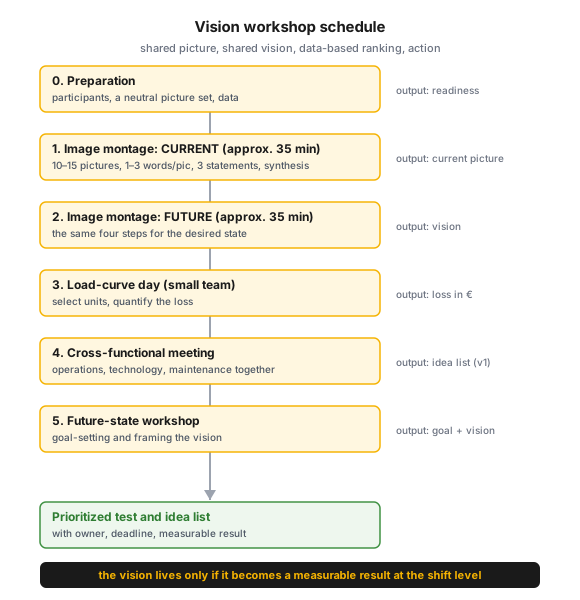 Figure 3: the full schedule from preparation to the prioritized test and idea list. The upper block is the “soft,” image phase, the lower is the data-based phase, and the closing is the list with owner and deadline.
0. Prepare the workshop. Assemble the participant circle (for the montage a real team, for the cross-functional circle the representation of operations, technology and maintenance), gather neutral, mixed picture material, and prepare the data, the load curves and the earlier idea lists.
1. Run the current-state montage (approx. 35 min). Four steps: picture selection, words, three statements, synthesis. The facilitator only guards the rules.
2. Run the future-state montage (approx. 35 min). The same four steps for the desired state. Placed side by side, the two syntheses give the direction of change.
3. Hold the load-curve day with a small team. Select the units and the curves, quantify the loss in euros, and assemble the first test list.
4. Convene the cross-functional meeting. Review the results and the earlier ideas together, then order the idea list on a benefit × feasibility matrix.
5. Close with a future-state workshop. Set a goal based on the current-state results, and frame the vision.
6. Assign an owner and a deadline to every prioritized item. Without this the list is left ownerless, and daily operation soon overwrites it.
Who does what (in brief): the facilitator guards the rules and the time frame; the team members provide the content; the leader takes part but does not decide alone; the navigator or process improver brings the data and leads the quantification; the shift supervisor and maintenance validate the feasibility.
Hands-on task. Choose one of your own teams and run just the current-state montage, in 35 minutes. If most participants find the synthesis sentence surprising, the workshop has already paid off: something surfaced that no one had talked about until then.
Measurement and audit: how do you know it worked?
Section titled “Measurement and audit: how do you know it worked?”The quality of the workshop is measured not by the mood but by the trackable output. Usable check criteria:
| What you look at | Good sign | Bad sign |
|---|---|---|
| Documentation | the two syntheses and the three-plus-three statements exist in writing | only memories and photos remained |
| Commitment | the participants can recite the vision synthesis | “there was some vision, I don’t remember” |
| Quality of prioritization | every idea has an estimated benefit and a feasibility classification | an idea list without ranking |
| Quantification | the loss appears expressed in money | only qualitative labels (“a lot,” “significant”) |
| Turning into action | every prioritized item has an owner and a deadline | an ownerless list |
| Closing the loop | the tests’ results are measurable back from daily operation | no one looked at what came of it |
The last row is the most important. The workshop is successful if, a few months later, you can show which future-state statement and which idea became a measurable operational result.
Common mistakes
Section titled “Common mistakes”The pitfalls almost all stem from the same thing: the workshop is treated as an event, not as the first step of a process. Anti-pattern and correction in pairs:
- Pushing through the leader’s opinion. The essence of the montage is common agreement; if the leader’s “vote” weighs more, the true picture is lost, and the team will also hand over the vision framing to them. Instead: the facilitator states the rule at the start of the workshop, and also enforces it.
- Vision without action. The two montages and the synthesis remain a poster on their own. Instead: from the future-state statements should follow concrete, prioritized actions with an owner and a deadline.
- Prioritization without quantification. The strength of the cross-functional workshop is precisely that it measures the loss in euros and puts it on a matrix; without this it remains an idea-storm. Instead: attach an estimated benefit to every idea, even if only an order of magnitude.
- Mixing up the two formats. The image montage does not replace the data-based diagnosis, and vice versa. Instead: consciously choose the format by phase — a montage at launch, a data-based workshop after the diagnosis.
- The wrong participant circle. The cross-functional workshop is strong precisely because the shift supervisor, the technologist and maintenance are there too; without them the feasibility estimate becomes unrealistic. Instead: rather postpone the meeting than hold it without the implementation side.
- Too large a circle for the montage. If far more people sit in the room than a real team, no common agreement is reached, only a majority vote. Instead: work with a real, team-sized circle, and repeat it in several rounds.
When NOT to use it? (limits of the method)
Section titled “When NOT to use it? (limits of the method)”| Situation | Why a workshop is not (primarily) the answer | The right answer |
|---|---|---|
| The decision is already made | pseudo-participation, the team sees through it, and trust is damaged | honest information and naming the room for maneuver |
| Acute plant upset or safety event | vision-building is not an emergency tool | event handling, then investigation |
| No data for prioritization | the matrix becomes unreliable because the benefit is guessed | first measurement and diagnosis, then a workshop |
| A single, well-bounded technical problem | no shared vision is needed for it | targeted root-cause analysis |
| The organization has just had a previous workshop with no follow-through | the trust capital is spent, participation becomes formal | first close out the earlier promises |
Rule of thumb: the vision workshop is strongest when there is real room for maneuver and someone takes responsibility for the output. If either is missing, it is better not to hold it.
Take it home (keys)
Section titled “Take it home (keys)”- First the present, then the future. The vision mobilizes only if the team has first stated where it stands now.
- Four steps, twice: 10–15 pictures, 1–3 words per picture, 3 statements, 1 synthesis.
- Rank is not voting weight. The facilitator’s most important job is to enforce this rule.
- Ranking only with money. The idea list is an idea-storm until the benefit is estimated in euros.
- The participant circle decides the reality. Without operations, technology and maintenance, feasibility is just an opinion.
- The workshop is the first step, not the last. Without an owner and a deadline the vision remains a poster.
Self-test
Section titled “Self-test”- Why do we start with the current-state montage, and what would happen if we framed the vision straight away?
- An idea promises a large benefit but is hard to implement. Which quadrant does it go into on the matrix, and what is the right thing to do with it?
- The maintenance representative could not come to the cross-functional workshop. What is the concrete risk this absence causes in the output?
Answer key
- The vision mobilizes only if the team has first jointly stated where it stands now: the current-state montage gives that shared starting point against which the vision is measurable. Without a picture of the present, the vision statements remain generic, everyone frames from their own unstated reality, and the two syntheses cannot be placed side by side, so the direction of change cannot be read out either.
- The pairing of large benefit and hard implementation is the “big bet” quadrant. The right thing to do is neither rejection nor immediate launch, but planning: assigning resources, scheduling and an owner, and if it touches equipment, a process parameter or a protective function, through the MOC process.
- The feasibility classification becomes unrealistic. Maintenance validates accessibility, the downtime requirement and workability; without it the matrix classifies as easy some ideas that in practice require downtime or a long lead time, and the prioritized list gets stuck at implementation.
How does it appear in digital practice?
Section titled “How does it appear in digital practice?”Framing a shared vision is a human practice, but sustaining it has long ceased to be one: recording the picture of the present, ranking the ideas and tracking realization also work in software, with the same principles. The mechanism differs, the principle is the same.
| Workshop element | Digital implementation | What it delivers |
|---|---|---|
| Recording the current and future picture | a versioned, dated vision document in the organizational knowledge base | the vision is not lost, and can be compared with the later state |
| Common agreement, equal weight | anonymous voting and ranking on the facilitation surface | hierarchy does not distort the result |
| Benefit × feasibility ranking | a structured idea register with computed priority | the ranking is recomputable when new data arrives |
| Quantifying the loss | a loss value computed automatically from the measurement data | fact data, not an estimate, drives the prioritization |
| Tracking actions | owner, deadline and status for every prioritized item | the list cannot quietly die out |
| Measuring back | daily-operation data placed next to the workshop goals | it is visible which idea became a real result |
Connection to OPEREX (shift diary)
Section titled “Connection to OPEREX (shift diary)”The workshop’s weakest point is tracking realization: the framed vision and the prioritized tests are realized at the shift level, and are easily lost. In the OPEREX shift diary the results of the selected tests and prioritized ideas can be recorded, so the diary closes the loop between the vision and the actual operational impact: it becomes visible which future-state statement or idea became a real, measurable result, and which got stuck. This way the workshop does not remain a poster hung on the wall.
Terminology (HU / EN / JP)
Section titled “Terminology (HU / EN / JP)”| Hungarian | English (canonical) | Japanese | Note |
|---|---|---|---|
| jelen állapot | current state | 現状 (genjō) | the first phase of the montage |
| jövőbeli állapot | future state | 理想状態 (risō jōtai) | the second phase of the montage |
| képi montázs | image / picture montage | – | the method of the vision workshop |
| közös megegyezés | common agreement | 根回し (nemawashi) | a decision made independently of hierarchy; the Japanese equivalent refers to prior consensus-building |
| keresztfunkciós workshop | cross-functional workshop | – | operations, technology and maintenance together |
| haszon × megvalósíthatóság | benefit vs. feasibility | – | the matrix of the idea ranking |
| terhelési görbe | load curve | – | the diagnostic input |
| gyors győzelem | quick win | – | high benefit, easy to implement |
| gondolkodásmód és viselkedés | mindset & behaviour | 考え方 (kangaekata) | the layer targeted by the montage |
How long does an image-montage vision workshop take?
Roughly 75 minutes is enough for it: about 35 minutes to make the montage of the current state and 35 minutes for the future state, in both phases with the same four-step method (10–15 pictures, 1–3 words per picture, 3 statements, one synthesis).
Why does the vision workshop use pictures?
The pictures open the conversation at the level of the team’s mindset and behaviour, more easily — according to facilitation experience — than a framed sentence, and they create a neutral, hierarchy-independent shared language for describing the current and the desired future state.
What is the cross-functional future-state workshop, and who are its participants?
The extended meeting of the diagnostic phase. The operations manager and deputy, the operator-training specialist, the shift supervisor, the technologist, the maintenance representative and the navigators jointly examine the load curves and the existing ideas, rank by benefit × feasibility, then set a goal and vision from the current-state results.
How are the ideas ranked?
On a benefit vs. feasibility matrix. High benefit and easy implementation is the quick win, where it is worth starting; high benefit and hard implementation is the big bet, which must be planned; low-benefit combinations are low priority or to be avoided. The loss is also quantified in euros.
Which format should I choose?
At the launch of the transformation the image montage, because there a shared language and commitment are needed. After the diagnosis the cross-functional, data-based workshop, because there the losses must be ranked and turned into tests. The two are strongest in sequence.
What is the most common reason a vision workshop stays ineffective?
That the output does not turn into actions with an owner and a deadline, and no one measures back what came of it. The second most common reason is the wrong participant circle: in the absence of the roles responsible for implementation, the feasibility estimate becomes unrealistic.
Related concepts
Section titled “Related concepts”the iceberg model · the diagnose phase · load-curve analysis · KPI/PI/I trees · the transformation journey · Lean change leadership · gemba-walk · OGSM · the Lean navigator · near-miss
Next step
Section titled “Next step”If you have understood this, from here it is worth going on — in this order:
- the diagnose phase — the input of the cross-functional workshop: how the data you can prioritize from is produced. Start with this.
- OGSM — how the framed vision becomes a cascaded goal system, measurable at each level.
- Lean change leadership — what keeps the vision alive in the months after the workshop.
References / Further reading
Section titled “References / Further reading”- Mike Rother – John Shook: Learning to See. Lean Enterprise Institute, 1999. — the canonical, practical description of the current-state / future-state pair.
- James P. Womack – Daniel T. Jones: Lean Thinking. Simon & Schuster, 1996. — the conceptual basis of the future state and the improvement sequence.
- John P. Kotter: Leading Change. Harvard Business School Press, 1996. — the role and communication of the vision in change leadership.
- Peter M. Senge: The Fifth Discipline. Doubleday, 1990. — the shared vision as a learning-organization principle.