The three types of activity (value vs. waste) and the 5 questions for a process step
≈ 15 min read · 2,983 words
Pull up at a petrol station and count how many moves it takes to fill up. Pull in, queue for the pump, get out, open the fuel cap, fill up, get back, queue at the till, pay, sign the slip, get back in. Of all those steps, only one is the one you actually pay for: when the fuel flows into the tank. The rest is waiting, movement and administration — useful or unavoidable, but not what you came for. This is exactly one of Lean’s most important insights: look at any process, and most of the steps add no value to the customer. The first step is to see this — and for that, Lean sorts every activity into three types. Let’s look at what these three types are, how you decide which one a step belongs to, and what to do with them.
Lean sorts every activity into three types: value-adding, pure waste, and necessary — but non-value-adding. (1) Value-adding is what the customer is willing to pay for; this you must make flow. (2) Pure waste (non value adding) adds no value and is not needed now either — remove it immediately. (3) Necessary but non-value-adding (necessary non value adding) is unavoidable in the current system but can be designed out with a radical change — this you must reduce. The basis of the classification is a single question: would I, as a customer, be willing to pay for it? The tool for a deeper, step-by-step assessment is the five questions (VCAAF): Valuable, Capable, Available, Adequate, Flexible.
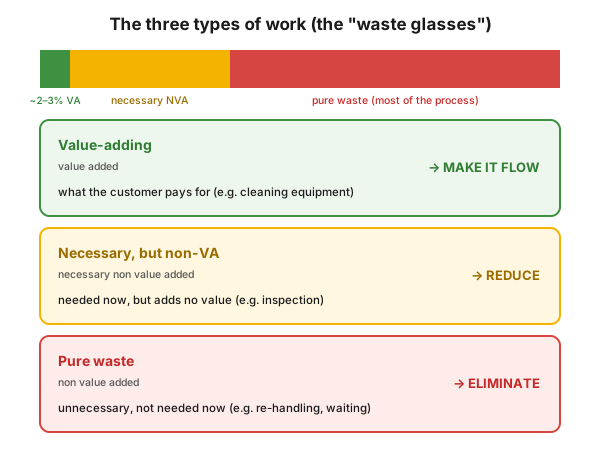 Figure 1 — the three types of work and the action that goes with each; pure waste makes up most of the process. The percentages are illustrative: the real ratio comes from measurement.
Who is this for?
Section titled “Who is this for?”This article is for those who look at, measure or improve processes: operator · production and plant manager · shift supervisor · process engineer · process technologist · Lean/CI specialist · quality engineer · logistics and supply-chain specialist.
Learning objectives
Section titled “Learning objectives”After reading this article you will be able to:
- name the three activity types, and say which action goes with each (make it flow / reduce / eliminate);
- classify any work step with a single question (“would I pay for it as a customer?”);
- distinguish pure waste from the necessary evil, and justify why the action for each differs;
- assess a process step end-to-end with the five questions (VCAAF), and link it to the flow analysis;
- recognize when classification is not the right tool, and what comes instead.
In brief (TL;DR)
Section titled “In brief (TL;DR)”- Three types: value-adding (VA) · necessary but non-VA · pure waste (NVA).
- The test: “would I pay for it as a customer?” — if yes, value; if no, waste or necessary evil.
- Three actions: make it flow (VA) · reduce (necessary NVA) · eliminate (pure NVA).
- Most of the process is typically waste → large, untapped improvement potential.
- Deeper step assessment: the five questions — Valuable, Capable, Available, Adequate, Flexible (VCAAF).
- Classification is the basic operation of value stream mapping (VSM): we color the steps according to it.
Why does it matter? (the stakes)
Section titled “Why does it matter? (the stakes)”If you cannot tell value from waste, you optimize the wrong thing. The typical symptom: we speed up, automate and spend money on a step the customer would not pay for anyway — that is, we produce the waste more efficiently. Meanwhile the “necessary evil” (the redundant inspection, the re-handling, the waiting) stays untouched for years, because no one sets out to design it out radically.
The stakes are high because in most processes the overwhelming majority of the lead time is non-value-adding. Whoever looks only at the value-adding step sees the tip of the iceberg; the mass of waste below the waterline — the space where the real improvement lies — stays invisible.
What are the three types of activity?
Section titled “What are the three types of activity?”Lean sorts every activity by whether it makes the product or service more valuable in the eyes of the end customer. There are three categories, and each comes with a different action — that is exactly what makes the classification useful.
| Type | Definition | Example | Action |
|---|---|---|---|
| Value-adding (value adding, VA) | makes the product more valuable in the eyes of the end customer | turning iron ore (with other materials) into a car; repairing a broken-down car on the road | make it flow |
| Pure waste (non value adding, NVA) | adds no value, and is not needed under current conditions either | transferring the product into a differently sized container just so it can be moved | eliminate it (immediately) |
| Necessary but non-VA (necessary NVA) | adds no value, but is unavoidable without a radical redesign of the process | final inspection of every product because an old, unreliable machine works in the line | reduce it (design it out medium/long term) |
The distinction matters because the time horizon of the intervention differs: pure waste is a target for short-term, immediate removal, while necessary non-VA is a target for long-term, radical change. If we blur the two, we either try to root out the necessary evil immediately (and fail), or tolerate the pure waste forever.
How do you decide which type a step belongs to?
Section titled “How do you decide which type a step belongs to?”With a single question: would I, as a customer, be willing to pay for it? The measure is not internal logic, not “we’ve always done it this way,” but the end customer’s willingness to pay. If the answer is yes, the step is value-adding. If no, one more question follows: is it unavoidable in the current system? If not, it is pure waste (eliminate it); if yes, it is a necessary evil (reduce it).
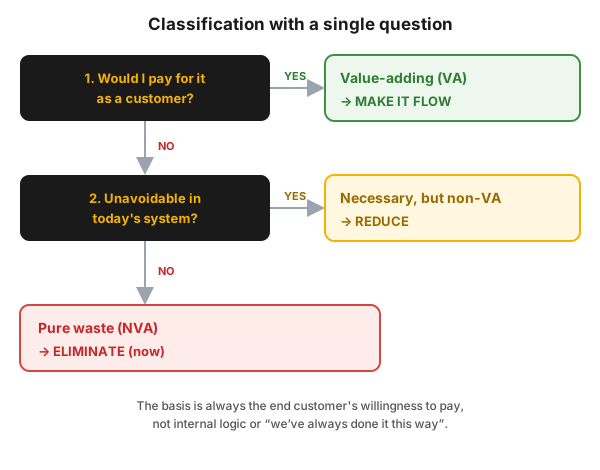 Figure 2 — the classification decision tree: two questions with three outcomes. The starting point is always customer value, not the internal viewpoint.
This question is what links the three types to value stream mapping: on the VSM we color every step according to it, and the value-adding time / lead time ratio (the value-added ratio) shows the real improvement potential. Defining customer value (Voice of the Customer) is therefore not a separate task but a precondition of classification: you must first know what the customer values, and only then can you ask “would I pay for it?”
How do you assess a process step more deeply? The five questions (VCAAF)
Section titled “How do you assess a process step more deeply? The five questions (VCAAF)”If you go deeper than the three-way classification, it is worth examining every step on the Gemba Walk (see gemba-walk) along five dimensions. The mnemonic is VCAAF: every step should be Valuable, Capable, Available, Adequate, Flexible. This is the finer, diagnostic version of the classification: it asks not only whether a step is value or not, but whether it works well.
| Question | What it checks | Related tool | |
|---|---|---|---|
| Valuable | is it value-adding, or [[muda.en | muda]] (waste)? | the 3-type classification |
| Capable | does it give a good result every time? | process capability, SPC | |
| Available | does it work when needed? | [[tpm.en | TPM]], availability |
| Adequate | no bottleneck, but no over-capacity either? | capacity balancing | |
| Flexible | capable of a quick changeover? | [[smed.en | SMED]] |
Alongside the five questions comes the flow analysis, which lifts the step-level view up to the level of the whole process:
- Does value flow? — what is the ratio of lead time to value-adding time?
- What is the share of value-adding steps out of all steps?
- Can the customer pull? How much work-in-process inventory is there?
- Is demand leveled, so that mura and muri disappear?
This way the step-level diagnosis (3 types + VCAAF) and the whole-process result (time, cost, customer experience) together give the improvement map: which step to stabilize, which to improve, in what order, and who owns it.
Process-industry context
Section titled “Process-industry context”At a process-industry unit, the five VCAAF questions take on tangible operational meaning:
| Question | Process-industry meaning | |
|---|---|---|
| Valuable | is on-spec, sellable product made at this step? | |
| Capable | the stability of product quality — on-spec ratio, low variation | |
| Available | equipment availability (availability KPI — see [[oee.en | oee]]) |
| Adequate | the question of the bottleneck unit — neither overloaded nor oversized | |
| Flexible | speed of a feed or operating-mode change, quick changeover |
The typical operational example of “necessary but non-VA” is repeated sampling and inspection: it adds no value to the customer, but as long as the process is unstable, it is unavoidable. The right action is not to abolish the inspection immediately, but to stabilize the process (less variability, better capability) — with which the necessary evil can be gradually reduced, then designed out.
Common mistakes
Section titled “Common mistakes”In anti-pattern ↔ correction pairs, tied back to the article’s own claims:
- Calling everything “useful” value-adding. Internal usefulness is not the same as customer value — so the necessary evil disguises itself as “value.” Instead: the test is always the end customer’s willingness to pay; a useful-but-unpaid activity is necessary NVA.
- The “necessary evil” stays necessary forever. If we never set out to design it out radically, it never disappears and becomes part of the process. Instead: necessary NVA is a target for long-term, radical change — give it an owner and a deadline.
- Classifying from the internal viewpoint. We sort by our own convenience or habit, not by the customer. Instead: ask from the customer’s side — “would they pay for this?” — not by the department’s logic.
- Rooting out the necessary evil immediately. We abolish the final inspection at a stroke, before the process is stable — and scrap reaches the customer. Instead: first stabilize the process (capability, less mura), then reduce the inspection.
- Step assessment without flow. VCAAF can be “green” step by step while the total lead time is catastrophic. Instead: alongside the step diagnosis, always measure the flow ratio (lead time / value-adding time).
When NOT to use it? (the limits of the method)
Section titled “When NOT to use it? (the limits of the method)”The three-way classification is a strong entry point, but not the right answer to every problem. Knowing where it ends is just as important as the method itself:
| Situation | Why (primarily) not classification | The right answer | |
|---|---|---|---|
| The goal is not waste elimination but strategy deployment | the 3 types are the micro-level of the process, not the goal system | [[vsm.en | VSM]] future state + policy deployment / OGSM |
| The root cause is unknown (why the waste is there) | classification shows where the waste is, but not its cause | [[5-miert.en | 5-why]] root-cause analysis, then intervention |
| The step is a safety or regulatory requirement | “the customer wouldn’t pay for it” is no reason to abolish it | keep it; its classification is necessary NVA, not pure waste | |
| A one-off, non-recurring process | there is no point classifying the whole value stream for a single case | one-off problem analysis, recording the lesson |
Rule of thumb: classification is strongest for making waste visible — it classifies the steps of a stable, recurring process. It does not replace strategic direction, root-cause work or safety requirements — it prepares the intervention.
Key takeaways
Section titled “Key takeaways”- Look at the process through the customer’s eyes: most of the steps are not what they pay for — you have to see this first.
- One question decides: “would I pay for it as a customer?” Yes → value; no → waste or necessary evil.
- Make it flow → reduce → eliminate — the action and the time horizon differ across the three types.
- The necessary evil is not eternal: set out to design it out radically, or it stays part of the process.
- Deepen with VCAAF: every step should be Valuable, Capable, Available, Adequate, Flexible — and measure the flow ratio too.
Self-check
Section titled “Self-check”- A step is useful to internal operations, but the customer would not pay for it. Which type does it belong to, and what is the action — why is it not “value-adding”?
- What is the difference between pure waste and necessary but non-VA in terms of time horizon and action? Give an example of each.
- A process step is “green” on every VCAAF point, yet the total lead time is bad. Which metric did you leave out, and why?
How does this show up in digital practice?
Section titled “How does this show up in digital practice?”Classifying activities does not stop at the value stream drawn on paper: the same logic is realized in software too, in any well-designed digital operation. Instead of manual coloring and stopwatch timing, here automatic timestamps, step categorization and flow measurement make visible where the waste arises — the mechanism differs, the principle is the same.
| Element of the concept | Digital implementation | What it delivers |
|---|---|---|
| Step classification (VA / NVA / necessary NVA) | a category label fixed to each workflow step | makes the waste steps visible |
| The “would I pay for it?” test | a digital, colored view of the process map | steps ranked by customer value |
| Value-added ratio | automatic lead time / value-adding time calculation from timestamps | the real improvement potential, quantified |
| VCAAF status | per-step state: capable? available? — an alert on deviation | the weak step reveals itself |
| Designing out the necessary evil | the long-term action with an owner, a deadline, tracked | the “necessary evil” is not forgotten |
Connection to OPEREX (shift log)
Section titled “Connection to OPEREX (shift log)”The classification of process steps and the per-step deviations (e.g. a capable or available criterion dropping out) can be logged in the shift log (OPEREX), so that the Gemba Walk’s diagnosis becomes retrievable and trendable — the progress of reducing the “necessary evil” activities becomes measurable, and at the handover between shifts a pending design-out action is not lost.
Terminology (HU / EN / JP)
Section titled “Terminology (HU / EN / JP)”| Hungarian | English | Japanese / note |
|---|---|---|
| Értékteremtő | Value adding (VA) | what the customer pays for → make it flow |
| Tiszta veszteség | Non value adding (NVA) | not needed now either → eliminate |
| Szükséges, de nem-VA | Necessary non value adding (NNVA) | needed now → reduce |
| Veszteség | Waste / muda | 無駄 (muda) — the umbrella term for non-value-adding activity |
| Öt lépés-kérdés | VCAAF | Valuable, Capable, Available, Adequate, Flexible |
| Értékteremtő idő arány | Value-added ratio | VA time / lead time |
| Vevői érték | Customer value / VOC | the yardstick of classification |
What are the three types of activity in Lean thinking?
(1) Value-adding (value adding) — what the customer pays for; (2) pure waste (non value adding) — adds no value and is not needed now; (3) necessary but non-value-adding (necessary non value adding) — unavoidable now, but can be designed out with a radical change. The actions, respectively: make it flow, eliminate, reduce.
How do I decide whether an activity is value-adding?
Ask the question: would I, as a customer, be willing to pay for it? If yes, it is value-adding. If no, then it is either pure waste (not needed now) or necessary but non-value-adding (still needed now, but can be designed out with a radical change).
What is the difference between pure waste and the necessary evil?
Pure waste can be dropped even under current conditions, so it should be eliminated immediately. The necessary evil is unavoidable in today’s system (e.g. a final inspection due to an unreliable machine), so it should not be abolished but designed out in the long term by transforming the process.
What do the five questions (VCAAF) mean?
A deeper assessment of a process step along five dimensions: Valuable (is it value), Capable (does it give a good result every time), Available (does it work when needed), Adequate (no bottleneck, but no over-capacity either), Flexible (capable of a quick changeover). The five questions are complemented by the flow analysis (lead time / value-adding time).
Why shouldn't every useful activity be called value-adding?
Because internal usefulness is not the same as customer value. Many activities (especially in services, in the office) are useful but only reduce the customer’s potential cost — these should be classified as necessary but non-value-adding, otherwise attention is diverted from designing them out in the long term.
Related concepts
Section titled “Related concepts”muda · muda-mura-muri · vsm · voc · gemba-walk · oee · Lean basics
Next step
Section titled “Next step”If you’ve understood this, from here it’s worth going on — in this order:
- vsm — value stream mapping is the tool on which you draw the three types and measure them (value-added ratio). Here the classification becomes an improvement map.
- muda-mura-muri — alongside waste (muda), the other two “evils”: unevenness (mura) and overburden (muri); together they give the full picture.
- gemba-walk — the on-site walk where you put the five questions (VCAAF) to real steps — classification in practice.
References / further reading
Section titled “References / further reading”- James P. Womack – Daniel T. Jones: Lean Thinking: Banish Waste and Create Wealth in Your Corporation. Simon & Schuster, 1996. — the foundational work on the five lean principles and the distinction between customer value and waste.
- Peter Hines – David Taylor: Going Lean. Lean Enterprise Research Centre, Cardiff Business School, 2000. — a practical introduction to the three activity types and the value stream mapping toolkit.
- James P. Womack (Lean Enterprise Institute): the practice of the Gemba Walk and its step-by-step assessment questions (Valuable / Capable / Available / Adequate / Flexible), see Gemba Walks (LEI) and Womack’s LEI talks.
- Mike Rother – John Shook: Learning to See: Value Stream Mapping to Add Value and Eliminate Muda. Lean Enterprise Institute, 1999. — the handbook of value stream mapping.