Shift handover in process plants
≈ 22 min read · 4,312 words
Shift handover is the structured exchange of information in which the outgoing shift hands the plant status and its open work to the incoming shift.
What is handed over covers, without gaps, the deviations from normal, the work in progress and the work still pending, and the risks as well, so that responsibility and situational awareness cross the shift boundary without loss of information. In the process industry this is one of the most critical activities within a shift: information lost here can lead directly to an upset, a deviation or a safety event, which is why it must be done with standardized content, in a uniform format, at a fixed (joint) place and within a fixed time frame.
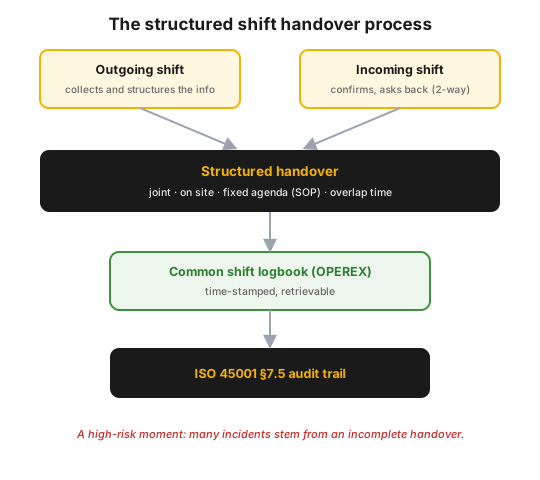
Figure 1 — the logical process of the shift handover, based on the documented good practice.
Who is this for?
Section titled “Who is this for?”This article is for those who work at the shift boundary or supervise it: shift leader · outside and inside (control-room) operator · plant manager · process engineer · maintenance coordinator · HSE / process safety specialist · reliability engineer · Lean/OpEx coordinator. If you are the one responsible for making sure the next shift does not start blind, this is your process.
Learning objectives
Section titled “Learning objectives”After reading this article you will be able to:
- explain why the shift handover is safety-critical, and where most information is lost at the shift boundary;
- recognize the good, the partly good and the pattern to avoid (format, place, duration, content, logbook);
- assemble the mandatory content core of a standardized handover;
- plan the introduction of a joint shift handover: observation → SOP → pilot → coaching;
- select the few metrics with which you measure the quality of the handover.
In brief
Section titled “In brief”- The shift handover is a transfer of responsibility and knowledge between the outgoing and the incoming shift; it is not a formality but a safety-critical process.
- According to the corpus diagnostics the typical failure is: there is no standard content and agenda, the place is unsuitable (a corridor), the timing is poor (10+ minutes during which no operator on the shift is ready), and there is no uniform logbook.
- The joint shift handover is the good practice: the whole shift gets a uniform overall picture together, as opposed to a handover done in pairs, ad hoc.
- Plant observation breaks down the outside operator’s shift time: ~25-30% is directly value-adding, and ~35-40% is “incidental” (activity that does not directly create value but necessarily contributes to it); the shift handover falls into this latter, incidental category, which is why it is worth making it efficient.
- The proven solution: an SOP-based, joint handover split into small groups, a maximum ~10-minute time frame, an HSE 5 minutes safety block and visual board (whiteboard) support.
- Content core: plant status, deviations/operation failures, quality off-spec, the status of maintenance and autonomous maintenance, open work permits, tasks not done.
- Measurable: handover SOP compliance (“is it done according to the standard in every shift”), handover duration, the number of events traceable to the handover.
- OPEREX connection: the digital shift log with mandatory fields gives an auditable trail of the information handed over at the shift boundary.
Why it matters (the stakes)
Section titled “Why it matters (the stakes)”The shift boundary is the point where the situational awareness of a continuous operation can break. If the handover is weak, the chain typically runs like this: an open work permit or a critical parameter (e.g. a drastically falling oil level) is not handed over → the incoming shift starts blind → the deviation is noticed too late → unplanned shutdown, off-spec product or a safety event. A significant part of the shift time is “incidental” activity anyway, and the handover is part of it; if this is unstandardized and variable, you lose time and safety at the same time. A standardized handover closes this gap: less variation, fewer incidents, a faster and more complete starting picture.
What is shift handover, and where does it come from?
Section titled “What is shift handover, and where does it come from?”The shift handover is the basic routine of every plant running in continuous (24/7) mode: the process does not physically stop at the end of the shift, so responsibility and situational awareness must be handed over to the next team. The concept is native to oil-refining and chemical operations, but Lean / Operational Excellence programs explicitly treat it as a process to be standardized and improved.
In a process-industry Lean transformation the shift handover falls under the lens of standardization and information flow: the essence of the area examined is how standardized the exchange of information between successive shifts is, by format and by content. The diagnosis is unambiguous: the joint shift handover must first be improved, then institutionalized.
The approach treats the shift handover as one of the most critical activities of the shift, and therefore something to be done according to a single, correct standard.
Why is it critical? Because the shift boundary is the point where the situational awareness of a continuous operation can break. If the knowledge of the outgoing shift (e.g. “the oil level of 301/1 has fallen drastically, it must be topped up”; “don’t forget to tell the next shift about the critical vibration of P302/1”) does not get across in full, the incoming shift starts blind.
How do you run it safely and in a standardized way?
Section titled “How do you run it safely and in a standardized way?”A good shift handover can be described along four dimensions: format and method, location, duration/timing, content and logbook. The goal is the same for each: reducing variation, so that the incoming shift gets the same complete overall picture every single time. Comparing two real handover practices, the “good vs. partly good vs. to be avoided” pattern emerges clearly.
1) Format and method
Section titled “1) Format and method”- Good practice: a separate (position-by-position) handover, followed by a joint discussion of the whole shift, where everyone gets a uniform overall picture.
- Partly good: only the separate handover, without the joint part.
- The weakest is a handover done entirely in pairs, without a standard format: here the variation in the amount and scope of the information handed over is large.
- A caveat: a fully joint handover, on the other hand, can be long and hard to follow if there are 15+ participants at once. That is why the proven process-industry solution is a joint handover split into small groups (e.g. the operators and the control-room staff separately, plus the shift leader level).
2) Location
Section titled “2) Location”- The joint handover should have a designated, suitable place (control room / shift room), not a building corridor. A recurring sign of the weak practice is precisely that the place of the joint handover is unsuitable, typically a building corridor.
3) Duration and timing
Section titled “3) Duration and timing”- The proven pilot keeps the time frame: a maximum of ~10 minutes.
- A failure to avoid: the handover “slips”, and for ~10+ minutes there is no ready (dressed, in-position) operator on the shift, meaning nobody is meaningfully supervising the process during the handover.
- An observed safety risk of poor timing is the badly timed midnight tank-level check: from a safety viewpoint it is not ideal, even though the level measurement otherwise works.
4) Content and logbook
Section titled “4) Content and logbook”The fixed core of the standardized handover content:
- Operation failures / operating errors (operation failures);
- Quality off-spec, off-spec product (quality off-spec);
- The status of maintenance, and explicitly the status of autonomous maintenance (AM) as well (this was missing from one of the practices examined);
- Condition of equipment, position switches, feed stock properties (condition of equipment, position switches, feed stock), which are typically handed over verbally;
- Open work permits and maintenance work in progress (in practice: the arrival of instrument technicians, the issuing and closing of the permit);
- Pending tasks not handed over to the next shift (tasks not done, for next shift).
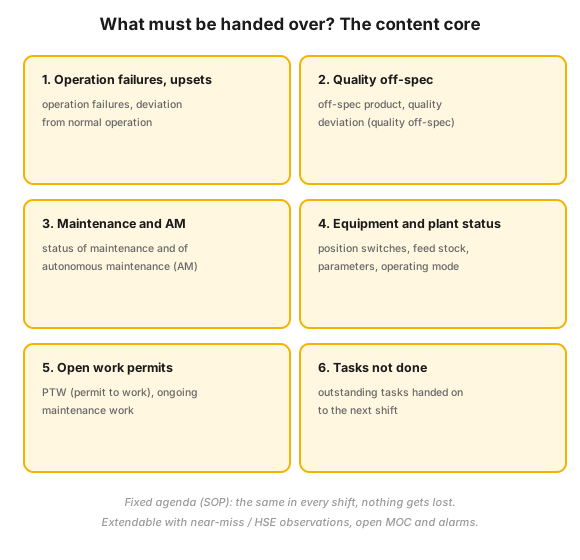
Figure 2 — the mandatory content of the shift handover in six categories (fixed agenda, SOP).
A good handover is logbook-based: the key events are recorded, and at the handover the incoming shift reads back the logbook (a review of the logbook, the trends, the alarm log, the movement log and the lab analyses). The recurring weak point is exactly the absence of uniform logbooks.
How the proven joint shift handover works (pilot experience)
Section titled “How the proven joint shift handover works (pilot experience)”In practice a tailored joint shift handover procedure has proven itself, the essence of which is:
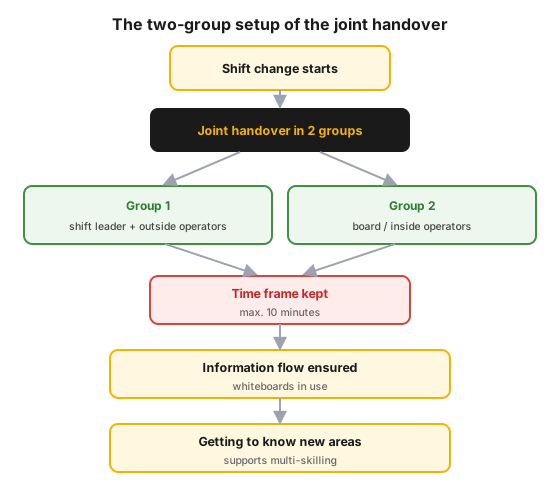
Figure 3 — the two-group setup of the tailored joint shift handover (pilot).
The key lessons of the pilot:
- the fully joint handover became manageable split into two groups (shift leader + outside operators, and the inside/control-room side);
- the time frame (max. 10 minutes) can be kept, the information flow is ensured, and the whiteboards are in use;
- the joint handover also creates a learning platform: during the information flow the operators get to know new areas, which supports multi-skilling (see multi-skill training and rotation).
Field experience confirms this: in the good practice the operators hand over first, then the shift leaders, jointly in the shift room, with an HSE 5 minutes (safety) block, where everyone tells the information received from the previous shift, and the shift leader adds to it and also talks about the expected activities. The handover is followed by shift planning and the first checking round (see the standard checking route). At shift planning the information collected from the outgoing handover, the operational logbook and plant management is aligned, typically in the first ~15 minutes of the shift.
Process-industry context and safety
Section titled “Process-industry context and safety”In the process industry (continuously operating chemical, oil-refining or petrochemical plants) the shift handover is a direct process safety tool, because the information handed over (or lost) at the shift boundary carries risk:
- Standardization means less variation in the handover, and less variation gives fewer incidents through increased reliability. Behind the improvement is the fact that the incoming shift starts with a complete and uniform situational picture.
- The variation of non-standardized activities (the handover among them) is directly linked to unplanned shutdowns, delayed start-ups and HSE events, so standardizing the shift handover is not an administrative but a risk-reducing step.
- During the handover, passing on the open work permits and the maintenance/AM in progress is critical: incomplete handover of these is the most frequent source of operational risk crossing the shift boundary.
Legal and standards framework (as generally known, verifiable facts)
Section titled “Legal and standards framework (as generally known, verifiable facts)”- Seveso III Directive (2012/18/EU; in Hungary: Government Decree 219/2011 on the protection against major accidents involving dangerous substances): upper- and lower-tier establishments are required to operate a safety management system (SMS), part of which is the regulation of the control of operations and the procedures (including normal operation, start-up and shutdown, and the transfer of information between shifts). The shift handover is the natural carrier of the “control of operations” element.
- ISO 45001 (occupational health and safety): it prescribes the handling of documented information (§7.5) and operational control over the processes (§8.1). A recorded, retrievable shift handover provides this audit trail.
- IEC 61511 / IEC 61508 (functional safety, SIL): where a safety instrumented system (SIS) is temporarily in a bypass/override state, this state must be handed over explicitly at the shift boundary: this is typically a mandatory element of the shift handover.
Note: the frameworks above support the mandatory and audited nature of the shift handover; the concrete content core (see above) comes from process-industry practice.
Introduction in practice (roadmap)
Section titled “Introduction in practice (roadmap)”A sequence of steps that follows the logic of a Lean transformation and can be implemented:
- Diagnose / observe. Prepare a shift handover observation sheet (handover observer + handover information sheet). Measure the actual handover: format, place, duration, content, logbook use. Compare several shifts (the good practice emerges from the variation).
- Identify the best practice. Extract from among the shifts the pattern to be followed (e.g. “operators first, then the shift leader”, a joint overall picture, HSE 5 minutes, reading back from the logbook), and make this the basis of the standard.
- Write the SOP. Prepare a Joint shift handover SOP: a fixed agenda, content core, place, max. ~10-minute time frame, responsible people. The SOP should be simple, visual and available on site (a frequent failing of the documentation is that it is too text-heavy, not visualized, and not out in the field).
- Uniform logbook. Introduce or unify the shift log (the information handed over with fixed fields): this is what links the handover to the performance board and the performance dialogue.
- Pilot in one unit. At the start the introduction triggers resistance from the field staff; with the support of plant management, however, adoption is fast, and daily improvement ideas even come in from the field. Split the joint handover into small groups if there are many participants.
- Coaching and gradual handover. The coach first shows the pattern, then switches to supporting coaching, and responsibility gradually passes to the shift.
- Stabilize and check. Introduce the regular check points (see below), and tie them to the performance dialogue and to escalation.
The introduction locks in if you handle the human side of the change: involve the field staff early (ownership), win over the opinion leaders of the team, communicate clearly that the goal of standardization is not headcount reduction, and show the tangible benefit (e.g. less unnecessary paperwork). Leadership support visibly accelerates adoption.
Hands-on: introduce a joint handover within two weeks
Section titled “Hands-on: introduce a joint handover within two weeks”A shift leader can start with this tomorrow:
- Days 1-2 — observation. Sit in on the handover of three different shifts with a simple sheet, and note down: where it took place, how many minutes it lasted, what was handed over, whether the logbook was read back, whether there was any “empty” supervision time.
- Day 3 — best practice. Of the three, pick the best handover and break it down into its elements (sequence, place, HSE 5 minutes, logbook).
- Day 4 — one-page SOP. Write the one-page, visual standard of the joint handover: fixed agenda (the six content categories), place, max. 10 minutes, responsible people. Post it in the shift room.
- Week 2 — pilot + daily micro-feedback. Run the joint handover at every changeover, and at the end ask the team for one improvement idea. Implement the ideas that go up on the whiteboard over the following days.
Measurement / audit (metrics, formula where there is one)
Section titled “Measurement / audit (metrics, formula where there is one)”For the shift handover one concrete, field-level check point follows:
Check: does every shift perform the joint shift handover according to the standard at every changeover (Joint shift handover SOP)?
Practical metrics that fit this:
| Metric | What it measures | How |
|---|---|---|
| Handover SOP compliance (%) | the share of handovers done according to the standard | |
| Handover duration | whether the ~10-minute frame is kept | observation / from the logbook |
| Share of empty fields | how many of the mandatory fields (deviation, permit, AM, pending task) were left blank | logbook check |
| Events traceable to the handover | a deviation/near-miss stemming from a gap in the handover | event trace-back |
| Supervision gap at handover | whether there is “empty” time without a ready operator | observation |
The audit rhythm is typically scheduled: the field quality check of the key improvements is daily/weekly, carried out by the plant manager and the coach, while the check of the shift handover ideally happens in every shift (every shift).
Common mistakes
Section titled “Common mistakes”- There is no standard content and agenda — the handover is ad hoc, every shift does it differently; “an SOP would be required”.
- The handover takes place in pairs, without a joint overall picture → large variation in the amount of information handed over.
- Unsuitable place (a building corridor) — not calm, participation is not complete.
- Poor timing / supervision gap — for ~10+ minutes there is no ready operator on the shift; or routines that are badly timed from a safety viewpoint (e.g. the midnight level check).
- Too large a joint group (15+ people) — long and impossible to follow; the answer is splitting into small groups.
- A missing or non-uniform logbook — the same thing is entered in two places/forms (duplication), or the logbook is in two different places; the key information can be lost.
- Incomplete content — e.g. the status of autonomous maintenance / maintenance does not get across, or the open permits are not handed over.
- A handover done “with new staff, without working clothes, out of the workplace” — according to the real pain-point list this is to be corrected: the handover should take place prepared and in its proper place.
- At introduction: leaving the initial resistance unmanaged — without leadership support and coaching the standard does not lock in.
When NOT to use it (the limits of the method)
Section titled “When NOT to use it (the limits of the method)”You never “skip” the shift handover, but an over-bureaucratized, formal handover can also make things worse. Recognize the limits:
- Do not turn it into paperwork for its own sake. If the handover swells into so many mandatory fields that nobody reads it through, the essence is lost. The content core should be focused; the rare cases should be carried by the logbook, not by the spoken agenda.
- The shift handover does not replace a certified safety function. The bypass state of a SIS/SIL loop must be handed over, but the handover does not substitute for formal management of change (MOC) or for permitting: the handover communicates the state, it does not legalize it.
- For a recurring deviation with an unknown root cause the handover only helps at the symptom level. There you need structured problem solving (e.g. escalation, root cause analysis), not the repeated passing on of the information from shift to shift.
- Do not blindly copy another plant’s SOP. The group split, the time frame and the content emphasis depend on the local technology and headcount; base the standard on your own observation.
Take it home (keys)
Section titled “Take it home (keys)”- Treat it as a safety-critical process, not a formality: the shift boundary is the point where situational awareness is most often lost.
- Fix a one-page, visual SOP: fixed agenda (the six content categories), designated place, max. ~10 minutes, named responsible people.
- Choose the joint format, split into small groups where there are many participants, so that everyone gets a uniform overall picture.
- Rely on the logbook: the incoming shift should read back the entries of the previous shift; the failure log should be visually understandable at a glance.
- Measure it with a few metrics (SOP compliance, duration, share of empty fields, events traceable to the handover), and handle the human side of the change: early involvement, leadership support, a clear message.
How does this show up in digital practice?
Section titled “How does this show up in digital practice?”The principle of the shift handover does not stop at the paper logbook and the spoken discussion: the same logic is realized in software too. The mechanism differs, but the principle is the same: nothing is lost at the shift boundary, and the changeover leaves a retrievable trail.
| Concept (principle) | Digital implementation | Value |
|---|---|---|
| Fixed content core | Mandatory fields on the digital handover form (plant status, deviation, off-spec, maintenance/AM, open permit, pending task) | No category is skipped, variation in what is taken over tends toward zero |
| Logbook-based read-back | Timeline e-logbook, searchable entries, trend/alarm brought in | The incoming shift sees the events of the previous shift in moments |
| Handing over a failure | Visual asset-status view (what is under maintenance) | Understandable at a glance, not the tracing back of a text list |
| Taking over responsibility | Digital signature / acknowledgement with a time stamp | It is unambiguous who took over supervision and when |
| Open permits / MOC | Live e-PTW and MOC status in the handover view | The status of work crossing the shift boundary is always current |
| Auditability | Automatic, immutable audit trail | ISO 45001 §7.5 documented information, Seveso “control of operations” |
Connection to OPEREX (shift log)
Section titled “Connection to OPEREX (shift log)”The weakest point of the shift handover is typically the missing uniform logbook and the variable, ad hoc content. The OPEREX shift log answers exactly this: the shift handover is recorded with mandatory, structured fields (plant status, deviations/operation failures, off-spec, maintenance and AM, open work permits, tasks not done), time-stamped and retrievable. This way:
- no information is lost at the shift boundary (the incoming shift reads back the previous shift’s log);
- the changeover leaves an audit trail (ISO 45001 §7.5 documented information; Seveso SMS “control of operations”);
- the log naturally links the shift handover to shift planning, to the performance board and to the performance dialogue.
Terminology (HU / EN)
Section titled “Terminology (HU / EN)”| Hungarian | English | Note |
|---|---|---|
| Műszakátadás / műszakváltás | Shift handover / shift change | the process as a whole |
| Közös műszakátadás | Joint shift handover | the proven, joint format |
| Átadási szabvány | Handover SOP | fixed agenda + content |
| Műszaknapló / üzemnapló | Logbook / operator logbook | the operational log (e.g. Opralog) |
| EBK 5 perc | HSE 5 minutes | a short safety block at the handover |
| Üzemeltetési hiba / üzemzavar | Operation failure | content to be handed over |
| Minőség-kifutás | Quality off-spec | content to be handed over |
| Pozíció-/szelepkapcsolások | Position switches | handover of equipment status |
| Alapanyag | Feed stock | parameter to be handed over |
| Függő feladat | Tasks not done (for next shift) | work passed on |
| Műszakvezető | Shift leader | coordinator of the handover |
| Kinti / benti kezelő | Outside / inside operator | the two groups in the handover |
| Vezérlő | Control room operator (board operator) | the inside side |
What is the difference between a handover "in pairs" and a "joint" handover?
In the handover done in pairs (position by position) every operator hands over their own area separately, without a standard format, which causes large variation and loss of information. In the joint handover the whole shift gets a uniform overall picture; the proven solution combines the two: a short position-by-position handover, then a joint discussion, split into small groups where there are many participants.
How long should a shift handover take?
In the proven practice the time frame is a maximum of ~10 minutes, and this can be kept. The essential point is that during the handover the process must not be left unsupervised (there should be no “empty” time without a ready operator).
What is the mandatory content core?
Plant status and equipment status (position switches, feed), operation failures, quality off-spec, the status of maintenance and autonomous maintenance, open work permits, and the tasks pending for the next shift. All of this is worth supporting by reading back from the logbook.
Why is the shift handover a safety matter?
Because the shift boundary is the point where situational awareness can break. A standardized handover with low variation gives fewer incidents through increased reliability. In a Seveso establishment the handover is the carrier of the “control of operations” element of the safety management system; and the temporary bypass state of SIL systems must be handed over.
Where do you start the introduction if we have no standard?
With shift handover observation: measure the format, place, time, content and logbook use across several shifts, identify the practice of the best shift, and write from it a simple, visual SOP available on site. Pilot it in one unit, and handle the initial resistance with leadership support and coaching.
Self-test
Section titled “Self-test”Check your understanding (the answers are in the article):
- In the observed breakdown of the outside operator’s shift time, which share is value-adding and which is incidental, and why does the shift handover fall into the latter?
- List the six content categories of a standardized handover. Which two are the most easily left out?
- Why is a joint handover split into small groups better than one done in pairs without a standard format — and what happens if there are 15+ participants at once?
Related concepts
Section titled “Related concepts”- the standard checking route — the standard checking route that starts after the handover
- performance board — the board that visualizes shift planning and shift review
- performance dialogue — the review conversation at the end of the shift
- shift observation and value-adding time — OPE/observation, where the handover appears as an “incidental” activity
- multi-skill training and rotation — the joint handover as a learning platform
- operator and maintainer cooperation — handing over open permits and maintenance
- escalation — when and how a problem raised in the shift is escalated
- standard work — standard work as the basis of the handover SOP
Next step
Section titled “Next step”If you are building the shift handover into daily operation now, this is the suggested reading order:
- Start here: standard work — the handover SOP is a kind of standard work; the principles of writing a standard are here.
- Then: performance board and performance dialogue — the handover log is the input of shift planning and of the end-of-shift review, and these close the loop.
- After that: the standard checking route — the standard round starts after the handover, and fills the content of the next handover.
References / further reading
Section titled “References / further reading”- Seveso III Directive (2012/18/EU), in Hungary Government Decree 219/2011 (X. 20.) on the protection against major accidents involving dangerous substances — the framework of the safety management system (SMS) and of the “control of operations”.
- ISO 45001 (occupational health and safety management system) — documented information (§7.5) and operational control (§8.1); the recorded shift handover is the audit trail of this.
- IEC 61511 / IEC 61508 (functional safety, SIL) — the handling of the bypass/override state of safety instrumented systems (SIS), the handover of which is mandatory at the shift boundary.