Housekeeping (plant order)
≈ 26 min read · 5,132 words
You step into a plant section, and within two seconds you know how people work there. Either the walkways are clear, the hose hangs on its rack and the waste is in its own container, or you have to squeeze past a pile of planks while dust covers the trace of a leak. Housekeeping — workplace order, plant order — means exactly this second glance: not the cleaning itself, but the system that keeps the area in order by itself. Let’s look at what “maintained” order means, how it differs from “achieved” order, and how all this improves reliability.
Housekeeping is the maintained order of a process plant: a clean, tidy work area is the precondition of safe and reliable operation.
Tidiness makes the early signs of equipment failure visible (leaks, corrosion, loosening), and it prevents hidden hazards such as tripping over a protruding object or slipping on a contaminated surface. Its key principle is that order is “maintained,” not “achieved”: cleaning is a regular activity built into the job, not an end-of-shift or monthly campaign. Housekeeping is the everyday plant practice of the 5S method, and at the same time a lever of disciplined operation and ownership culture.
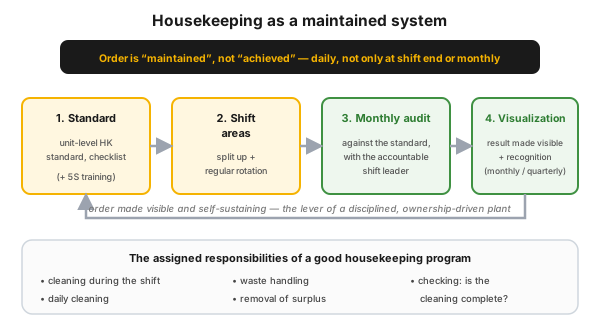 Figure 1 — housekeeping as a maintained, self-sustaining system: standard, shift areas, monthly audit, visualization and recognition.
Who is this for?
Section titled “Who is this for?”This article is for those who live with the condition of their own area, or are answerable for it: operator (panel and field) · shift leader · plant manager · process engineer · maintenance technician · HSE specialist · process safety expert · operational excellence coordinator · turnaround coordinator.
Learning objectives
Section titled “Learning objectives”After reading this article you will be able to:
- distinguish maintained and achieved order, and explain why only the first one lasts;
- list the ten steps of sustainable housekeeping, and say whose job each step is;
- separate the responsible (operator) and accountable (shift leader) role in your own area;
- run a housekeeping audit with 1/0 scoring, and calculate a percentage result from it;
- read and draw up a BATT chart, and fit it into the monthly management cadence;
- design an annual audit plan based on the number of areas and shifts.
In brief
Section titled “In brief”- “Maintained,” not “achieved”: order is sustained daily, built into the job, not “achieved” once at the end of a shift or once a month.
- A safety and reliability tool: a tidy area makes the early signs of failure (leaks, corrosion) visible, and gives a safe workplace.
- 5S is its foundation: the five pillars give the general principles of housekeeping, and housekeeping takes them into the daily practice of continuous operation.
- Standard + zoning: a site-level regulation plus a unit-level standard (checklist); the shift leader area is split into zones, divided among the 4 shifts, and rotated annually.
- Responsible ≠ accountable: the HK activities are performed by the operators (responsible), while the shift leader is personally accountable for their area.
- Monthly audit, permanent auditor: at least monthly, led by a management-level auditor, preferably always the same person, and the accountable shift leader always takes part.
- Binary scoring: 1 or 0 per question, and a 1 only if every element of the question complies; the result is a percentage, perfect order is 100%.
- Visualization + recognition: a BATT chart (base, actual, target, trend) on the shift performance board, a monthly review, and recognition of the best shift.
Why it matters (the stakes)
Section titled “Why it matters (the stakes)”Poor plant order is not an aesthetic question: it creates hidden hazards that lead to accidents, injuries or equipment damage. Three typical mechanisms work against you in an untidy area: you trip over a protruding object left in your way; a badly stored object falls on you; you slip on a wet or contaminated surface. None of them is spectacular on its own, yet each of them arises daily.
The stakes, however, are wider than that. Good workplace order is a series of logical measures based on a practical approach, which companies initiate for four purposes: to increase their productivity, to reduce their costs, to push back the number of near misses and accidents, and to mitigate their negative environmental impact. Order is therefore not a cost centre but one of the cheapest operational tools available.
What is the difference between “maintained” and “achieved” housekeeping?
Section titled “What is the difference between “maintained” and “achieved” housekeeping?”Effective plant order is maintained, not achieved: cleaning is a regular activity built into the job, not an end-of-shift or monthly campaign. “Achieved” order is the result of a one-off blitz that degrades within weeks without a daily routine and an audit; “maintained” order, by contrast, lives in a cycle, and therefore does not slide back.
The method is to integrate housekeeping into jobs. A good housekeeping program assigns defined responsibilities (bottom of Figure 1):
- clean up during the shift;
- day-to-day cleanup;
- waste disposal;
- removal of unused or surplus materials;
- inspection to ensure the cleanup is complete.
How does maintained housekeeping improve reliability?
Section titled “How does maintained housekeeping improve reliability?”By making the early signs visible. In a tidy, clean area a process, utility or lube-oil leak, extensive external corrosion, incomplete flange bolting, insulation ruined by water ingress or an unidentified substance stands out immediately. In an untidy area the same signs are lost in the noise, and only come to light once they have already turned into a failure.
The second mechanism is the transfer of discipline. Where the hose is in its place, the permanently isolated vessel is tagged and locked out (LOTO), and the gas cylinder stands upright with a closed valve, the same discipline is at work that keeps the process parameters on target. That is why the housekeeping result is a good proxy for how much ownership a plant has, and why it also raises the effectiveness of the standard operator round and autonomous maintenance.
What are the 10 Commandments of sustainable housekeeping?
Section titled “What are the 10 Commandments of sustainable housekeeping?”The “10 Commandments” of sustainable plant order is a simplified, ten-step description of the housekeeping process, which carries the full cycle from zoning through to recognition. It was written this way so that the process is at once easy to explain and comprehensively understandable, and so that every step has a clear owner.
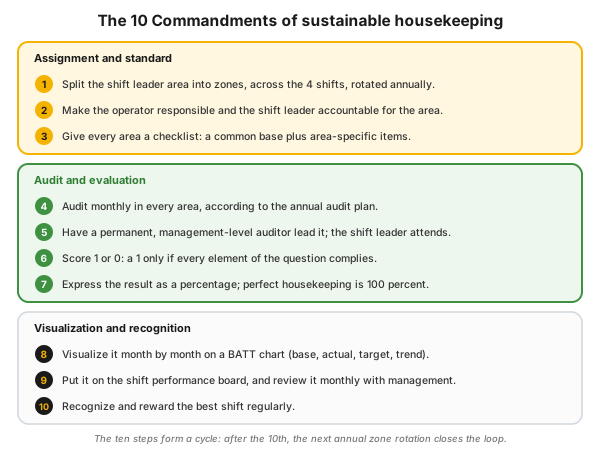 Figure 2 — the ten steps in three stages: assignment and standard, audit and evaluation, visualization and recognition.
- Split the shift leader area into housekeeping zones and assign the 4 shifts to them, by mutual agreement between the shift leaders and the plant supervisors; rotate the zones regularly among the shifts, typically annually, and make the housekeeping goal part of the annual objectives of the shift personnel.
- Assign the roles: the panel and field operators are responsible for performing the housekeeping activities in the area, while the shift leader is personally accountable for the tidying done — or not done — in their area.
- Draw up a checklist for every zone: a common, standardized set of questions, extended with area-specific items (one zone may have a lube-oil store or chemicals, another may not).
- Audit monthly: according to the annual audit plan, at least one audit per month in every housekeeping area and for every shift.
- Have the audit led by a member of the plant leadership team, preferably always the same person, and let the accountable shift leader always take part.
- Score in binary: a question gets a 1 if every element of it complies, otherwise a 0.
- Calculate the percentage result for the area; perfect plant order is 100%.
- Visualize the result for the operators, month by month, on a BATT chart (Base, Actual, Target, Trend), so that the performance of the shifts is comparable.
- Post the chart on the shift performance board (in a well visible spot in the control room), and review it monthly with the shifts and with management; the result should go on into the monthly management report.
- Recognize and reward the best-performing shift regularly.
Who is responsible, and who is accountable?
Section titled “Who is responsible, and who is accountable?”Housekeeping works when the responsible role (who does it) and the accountable role (who answers for it) are sharply separated. Each of the ten steps has a full RACI matrix behind it; the essential cast is the following:
| Role | What they do in housekeeping | RACI |
|---|---|---|
| Operator (panel, field) | performs the housekeeping activities in the zone assigned to the shift | Responsible (R) |
| Shift leader | personally accountable for the tidying done or not done in their area; takes part in the monthly audit; keeps the activity record of plant order | Accountable (A) for their area |
| Management-level auditor (a permanent person) | leads the monthly audit, evaluates and records on the spot | Responsible (R) for the audit |
| Plant manager / plant supervisor | answerable for the plant order of their area, assigns and rotates the zones, evaluates shift-level and individual work, gives recognition | Accountable (A) |
| Process safety and HSE organization | holds regular cross-audits as an independent check | Consulted / by prior agreement |
Where does it apply? The scopes of housekeeping
Section titled “Where does it apply? The scopes of housekeeping”Housekeeping does not stop at the field plant area: the regulation treats the field area, the control room and the turnaround separately, and assigns its own questionnaire to each; on top of these come the plant stores and the laboratories.
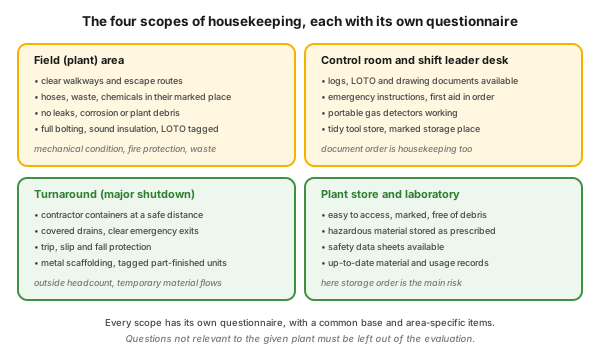 Figure 3 — the four scopes and their characteristic inspection focus.
| Scope | What to look for (inspection blocks) |
|---|---|
| Field (plant) area | general order (clear walkways, sound walking surfaces, free emergency exits, marked pipework, wind sock, restricted ladder access), fire protection, mechanical condition (closed hydrocarbon systems, full flange bolting, no leaks, corrosion, sound insulation, LOTO), waste management, hose storage |
| Control room and shift leader desk | escape route and fire door, first aid and emergency instructions, working gas detectors, plus document order: logs, LOTO documentation, blind list, availability of current drawings and instructions, a tidy tool store |
| Turnaround | contractor containers at a safe distance, covered drains, clear escape routes, trip, slip and fall protection, approved equipment, metal scaffolding, tagged part-finished equipment |
| Plant store and laboratory | accessibility, marking, cleanliness, hazardous materials stored as prescribed, available safety data sheets, up-to-date material records |
Turnaround housekeeping deserves separate attention: at such times a lot of outside headcount, temporary material flows and scaffolding come into the area, which means order deteriorates precisely when it is most expensive. Like winterizing, this too is a seasonal, plannable risk.
How does housekeeping relate to 5S?
Section titled “How does housekeeping relate to 5S?”5S is the foundation of housekeeping: the five pillars (sort, set in order, shine, standardize, sustain) give the general principles, and housekeeping is their daily plant practice in continuous operation. The aim of 5S is a safe, ergonomic workplace that supports efficient work and does not endanger the environment. With concrete plant examples:
| 5S step | Plant housekeeping example |
|---|---|
| 1S Sort (Seiri) | a designated place for waste, hazardous materials and hoses; material in the area only in the necessary quantity and for the necessary time; contractor containers in a hazard-free zone; fire extinguishers and safety equipment exactly in their predefined place |
| 2S Set in order (Seiton) | proper labelling of equipment; expired equipment labelled and segregated; the storage place of the fire extinguisher marked and protected; emergency exits clearly marked and unobstructed |
| 3S Shine (Seiso) | no visible spillage; plant debris (refractory material, thermal insulation, planks) removed and taken to the waste collection point; the plant free of vegetation; no unidentified substance in the work area |
| 4S Standardize (Seiketsu) | issuing and regularly updating the plant order regulation; splitting the responsibility for areas among plant personnel; standardizing the cross-audits; working out operator documentation |
| 5S Sustain (Shitsuke) | personal responsibility for the work environment; area rotation among the shifts; regular audits initiated by managers; recording and visualizing the results; continuous training |
The “maintained, not achieved” principle mirrors exactly the 4S and 5S steps: without a standard and an audit the condition slides back. This is also why the program organizes 5S training for the operators: housekeeping is not “cleaning” but a maintained system.
Process-industry and safety context
Section titled “Process-industry and safety context”In a continuously operating hazardous facility, order is a direct safety tool, as the 5S article also sets out: clear traffic and escape routes, always accessible firefighting and emergency equipment, tidy chemical and tool storage, and — through 3S (cleaning = inspection) — leaks, corrosion and loosening detected early. The risk of tripping and falling objects decreases, and the risk of a wrong intervention and of a loss of primary containment (LOPC) is mitigated.
How can housekeeping be introduced?
Section titled “How can housekeeping be introduced?”A housekeeping program is introduced in a repeating, audited cycle (Figure 1): first the standard and the responsibilities fall into place, then the measurement starts, and visualization plus recognition close the loop.
- Issue a site-level housekeeping regulation, and update it regularly.
- Organize 5S training for the operators, because housekeeping is the plant-level form of 5S.
- Work out a unit-level housekeeping standard (a checklist or another format), per scope: field, control room, turnaround.
- Split the shift leader area into zones, divide them among the 4 shifts by mutual agreement between the shift leaders and the plant supervisors, and rotate the zones annually.
- Schedule monthly audits in every area: led by a permanent, management-level auditor, with the accountable shift leader taking part, and measure the result against the unit-level standard; on top of that, schedule independent cross-audits as well.
- Visualize the monthly result on a BATT chart on the shift performance board, and review it monthly with the shift and with management.
- Give recognition for good housekeeping regularly, at both unit and site level.
Putting it into practice — this is how you start next month
Section titled “Putting it into practice — this is how you start next month”A working program can be launched within the next four weeks, with no separate investment:
- Week 1: baseline. Walk the area with the future auditor, fill in the checklist once together, and record the result. This becomes the base on the BATT chart. Take photos, because next month this is what you will compare against.
- Week 2: zones and names. Draw up the area, split it into four zones, and assign the four shifts to them together with the shift leaders. Post the zone map in the control room, so that nobody can say: “this is not my area.”
- Week 3: the questionnaire. Tailor the common checklist: strike out the questions that are not relevant to the given plant (a non-relevant question must not be counted in the evaluation either), and add the area-specific items.
- Week 4: first audit and board. Run the first scored audit with the shift leader, calculate the percentage, draw the BATT chart, and post it on the performance board. At the end-of-month review, state the target for the next month.
Daily obligations at shift level
Section titled “Daily obligations at shift level”The program does not live without a daily routine. The shift-level obligations are:
- every employee takes part in maintaining order, including reporting the safety risks they identify and cleaning up spillages;
- if somebody notices the early signs of a problem, they must report it;
- before the end of the shift the workers walk through and tidy up their area and their office;
- the shift leader keeps the activity record of plant order, notes down the activities performed, and reports the shortcomings.
How do you score a housekeeping audit?
Section titled “How do you score a housekeeping audit?”The scoring of the audit is binary and all-or-nothing: a question gets 1 point if every element of it complies, otherwise 0. The classic example is the hoses: 1 point is given only if the area shows exclusively assembled hoses connected to the system, and all the ones out of use are in the designated storage place. If even a single hose is not in its place, that point is 0.
The area result follows from this as a percentage: the ratio of compliant questions to evaluated questions. Worked example: if the questionnaire contains 100 questions and 80 of them are in order, the housekeeping result is 80%. Perfect plant order is 100%. Whatever is not relevant to the given plant must be left out of the evaluation, otherwise the number is not comparable.
What to check? The skeleton of the questionnaire
Section titled “What to check? The skeleton of the questionnaire”A usable housekeeping questionnaire breaks down into thematic blocks. This skeleton is enough as a starting point for assembling your own, brand-free checklist; and for the mechanics of scoring, the 5-question, scored 5S Audit Sheet is a ready template that you can also use for a housekeeping audit.
| Block | A few typical items |
|---|---|
| General plant order | unobstructed walkways, sound walking surfaces, plant debris removed, plant free of vegetation, free emergency exits, marked safety signs and pipework, closed-off ladder step-offs, tagged and locked out (LOTO) permanently isolated vessels |
| Fire protection | marked and protected firefighting equipment, combustible material only in the quantity needed for the job, spark-free storage, unobstructed fire doors, covered drains around hot work |
| Mechanical condition | closed hydrocarbon systems, complete flange bolting, no process, utility or lube-oil leak, no extensive external corrosion, sound insulation free of water ingress |
| Waste and storage | marked waste containers, segregated waste collection, accurate labels, clean storage places, hoses sorted by medium and temperature with a valid pressure test |
| Control room and desk | available logs and documentation, work permit board, current emergency instructions, a tidy and dust-free tool store |
What to measure? KPIs and the annual audit plan
Section titled “What to measure? KPIs and the annual audit plan”The key control of the process in a single sentence: the fulfilment of the annual housekeeping audit plan. For that you first have to size the plan, then track its delivery.
The formula of the site-level annual audit plan:
Site-level annual plan (number of audits) = number of shift leader areas × 4 shifts × 12 months
If, for example, you have five shift leader areas, the annual plan is 5 × 4 × 12 = 240 audits (the number is illustrative; use your own number of areas). This is the number that makes housekeeping plannable, and it gives the most important indicator, the planned/actual audit count (%).
| Indicator | What it measures | Note |
|---|---|---|
| Fulfilment of the annual audit plan (planned/actual, %) | whether the system works at all | the key control of the process |
| Area housekeeping result (%) | the tidiness of the given zone | monthly, from the questionnaire |
| Annual housekeeping target (%) | the challenging goal among the annual objectives of shift leaders, panel and field operators | it must be set above the previous year’s average |
| An honest evaluation of the ten steps | the adaptation of the process, not the number | management self-assessment |
The housekeeping performance indicators are defined within the strategy deployment system, in the OGSM framework, which means order is not a separate little program but part of the cascaded goals.
How do you visualize and report the result?
Section titled “How do you visualize and report the result?”The canonical tool of visualization is the BATT chart: Base, Actual, Target, Trend. It shows the area result to the operators month by month, so that the performance of the shifts becomes comparable, which in itself motivates improvement.
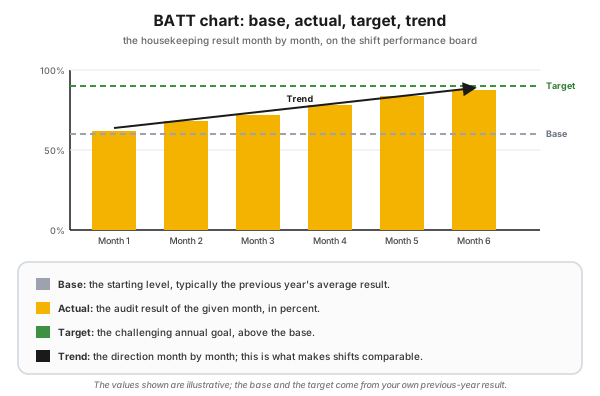 Figure 4 — the four elements of the BATT chart: base, the actual monthly result, target and trend. The values are illustrative.
The place of the chart is the shift performance board, at a well visible spot in the control room. The reporting chain starts from there: the shifts and the plant leadership team review the result monthly, the plant manager presents it at the monthly report to the business unit leadership, and the operations director reports it at the regular monthly business review. This is how housekeeping becomes part of the management cadence, i.e. of the MOS, instead of a private matter of the shift.
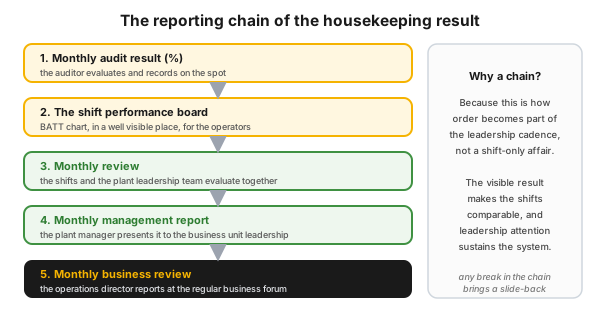 Figure 5 — the reporting chain from the on-site audit result to the monthly business review.
Common mistakes
Section titled “Common mistakes”- Only an end-of-shift or monthly “big clean” instead of built-in, daily order — that is “achieved,” not “maintained.” (The end-of-shift walkthrough is an obligation, but on its own it is not a program.)
- An audit without a standard: with no unit-level yardstick the audit is subjective and disputable.
- Partial scoring instead of binary: the half point for “four hoses out of five in place” covers exactly the remaining risk.
- No zone owner: if the area belongs to “everybody,” it belongs to nobody; zoning, the split among the 4 shifts and the rotation are the key.
- Blurred responsibility: if it is not separated that the operator is responsible and the shift leader is accountable, nobody will really own the area.
- Self-audit: if the shift evaluates its own area without a permanent, management-level auditor, the results will not be comparable.
- A regulation issued without commitment: neither the regulation on its own nor the physical cleaning activity on its own guarantees performance. Success or failure depends on management commitment, on the involvement of the shift personnel, on strict adherence to the process steps, and on changing the existing organizational culture.
- No visualization and no recognition: without measurement and feedback, order withers away.
- Treating 3S as “just cleaning”: the early fault signal is lost, even though cleaning is inspection too.
When NOT to use it (the limits of the method)
Section titled “When NOT to use it (the limits of the method)”The housekeeping program is a strong and cheap tool, but it is not the right answer to every problem:
| Situation | Why housekeeping is not the answer | The right answer |
|---|---|---|
| The root cause is a process or reliability fault (a recurring seal, bearing or corrosion problem) | tidying makes the symptom visible, but does not fix the root cause in the asset | root cause analysis, FMEA, condition-based maintenance |
| A certified protection function (barrier) is needed | good housekeeping is not a certified, audited layer of protection | SIL / LOPA, design to IEC 61511 |
| The area is untidy because the resource or the storage infrastructure is missing | a weekly audit does not create a storage place, it only produces zeros | first a designated storage place, container, headcount — then the audit |
| There is no management commitment, only a box-ticking campaign | the program fails on the culture, not on the regulation | first the management cadence and involvement, then the measurement |
| A one-off, project-type upheaval (construction, demolition) | the monthly-cycle program is slower than the event | a turnaround / contractor housekeeping regime, with more frequent walkthroughs |
Rule of thumb: housekeeping is the strongest, cheapest tool for the maintained condition of the work area. For a reliability or safety-critical problem it does not replace the proper tool, it complements it by making the problem visible early.
Take it home (keys)
Section titled “Take it home (keys)”- Do not organize a campaign, build a system. The goal is order maintained daily, not a big clean before a visit.
- Split the area and put names on it: zones, four shifts, annual rotation, by mutual agreement. What belongs to everybody belongs to nobody.
- Separate the responsible and the accountable: the operator does it, the shift leader answers for it.
- Measure in binary, and post the number. 1 or 0, percentage, BATT chart on the performance board.
- Provide a permanent, management-level auditor, and go along yourself: management presence is the sustaining energy itself.
- Close the loop with recognition. Public recognition of the best shift is cheaper than any new regulation.
Self-test
Section titled “Self-test”- Why is the end-of-shift walkthrough not enough for an area’s housekeeping to be “maintained”?
- Out of a 60-question area questionnaire, 9 questions are not relevant to the given plant, and 41 of the remaining ones scored a 1. What is the housekeeping result, and what do you enter in the “Actual” column of the BATT chart?
- Who leads the monthly audit, who must take part in it, and why does the shift not evaluate itself?
Answer key
- Because order is “maintained,” not “achieved”: cleaning is an activity built into the job, done during the shift and day to day. The end-of-shift walkthrough is an obligation, but on its own it is campaign logic, which slides back without an audit, a standard and a daily routine.
- The non-relevant questions must be left out of the evaluation, so you calculate with 60 − 9 = 51 questions: 41 / 51 = 80.4%, rounded 80%. This goes into the “Actual” column of the given month, referenced to the base and the target line.
- The audit is led by a member of the plant leadership team, preferably always the same person, and the accountable shift leader always takes part in it. The permanent, independent auditor keeps the yardstick identical, which is what makes the results of the shifts comparable; a self-audit would destroy that comparability.
How does this show up in digital practice?
Section titled “How does this show up in digital practice?”The housekeeping principle does not stop at the whiteboard and the paper questionnaire: the same logic is realized in software too. Instead of the printed checklist there is a mobile questionnaire, instead of the camera a photo attached to the entry, instead of the felt-tip-drawn chart an automatically refreshing trend makes the condition visible; the mechanism differs, the principle is the same.
| Housekeeping element | Digital implementation | What it delivers |
|---|---|---|
| Area checklist | mobile questionnaire per scope, with the non-relevant question skipped | the same yardstick everywhere, a faster walkthrough |
| 1/0 scoring and percentage | automatic score calculation from the completed form | no calculation error and no later dispute |
| Photo evidence | an image attached to the anomaly, with a timestamp | the finding is not hearsay but fact |
| Corrective action | an action with what / who / by when fields, with deadline tracking | the fault found does not get lost after the walkthrough |
| BATT chart | an automatically refreshing trend, broken down by shift | visualization is not manual work, and is always current |
| Annual audit plan | planned/actual tracking, with a reminder | the key control (plan fulfilment) shows up by itself |
Connection to OPEREX (shift log)
Section titled “Connection to OPEREX (shift log)”Sustaining housekeeping depends on handing over one’s “own area” from shift to shift, and a digital shift log records exactly that in a structured way. In OPEREX the outgoing shift documents the tidiness condition of the area (with a photo if needed) and the incoming shift acknowledges it; the result of the monthly audit and the corrective actions assigned to the anomalies found (what / who / by when) can be tracked with a timestamp, an owner and full retrievability. The shift leader has to keep the activity record of plant order and report the shortcomings anyway, so the shift log is not extra administration but the searchable form of that same obligation. This way “maintained” order does not depend on the conscientiousness of one or two people: it leaves an auditable trail, and the visualized result is visible shift by shift.
Terminology (HU / EN / JP)
Section titled “Terminology (HU / EN / JP)”| Hungarian | English (canonical) | 日本語 (rōmaji) |
|---|---|---|
| munkahelyi rend / üzemi rend | housekeeping | — |
| fenntartott (nem elért) | maintained (not achieved) | — |
| területi ellenőrzőlista / kérdéssor | housekeeping checklist / questionnaire | — |
| műszakvezetői terület / zóna | shift leader area / zone | — |
| housekeeping-audit | housekeeping audit | — |
| keresztaudit | cross-audit | — |
| BATT-diagram | BATT chart (Base, Actual, Target, Trend) | — |
| „10 parancsolat” | 10 Commandments (of sustainable housekeeping) | — |
| felelős / számonkérhető | responsible / accountable | — |
| elismerés | recognition | — |
| válogatás (szelektálás) | sort | Seiri (整理) |
| rendszerezés (elrendezés) | set in order | Seiton (整頓) |
| takarítás (tisztítás, ellenőrzés) | shine | Seiso (清掃) |
| szabványosítás | standardize | Seiketsu (清潔) |
| fenntartás | sustain | Shitsuke (躾) |
What is the difference between "maintained" and "achieved" order?
Maintained order is the result of regular, daily cleaning and inspection built into the job, which does not slide back by itself. Achieved order is the result of a one-off campaign, which degrades quickly without an audit and a daily routine.
How does housekeeping improve reliability?
By making the early signs of failure (leaks, corrosion, a loosened joint, unusual contamination) immediately visible in a tidy, clean area, so the fault can be dealt with before it develops; on top of that, the work itself is safer.
What does the BATT chart mean?
Base, Actual, Target, Trend. It shows the area housekeeping result month by month on the shift performance board, so that the performance of the shifts is comparable.
How is a housekeeping audit scored?
With 1 or 0 points per question, and a 1 only if every element of the question complies (if even one hose is not in its designated place, that point is 0). The result is the percentage share of compliant questions; perfect order is 100%, and non-relevant questions must be left out.
Who leads the housekeeping audit?
A member of the plant leadership team, preferably always the same person, and the accountable shift leader always takes part. On top of that, the process safety and HSE organization, as well as managers and experts, hold regular cross-audits.
How does housekeeping relate to 5S?
5S is the foundation of housekeeping: the five pillars give the principles (sort, set in order, shine, standardize, sustain), and housekeeping is their daily plant practice — which is why the program organizes 5S training for the operators.
Related concepts
Section titled “Related concepts”production reliability program · 5S · autonomous maintenance · standard operator round · winterizing · shift handover · MOS · OGSM
Next step
Section titled “Next step”If you have understood this, from here it is worth going on — in this order:
- 5S — the methodological foundation of housekeeping, the five pillars in detail, with a ready audit sheet.
- standard operator round — how the walkthrough becomes a scheduled, standard operator round that also catches the anomaly.
- MOS — how to fit the monthly housekeeping review into the management cadence, so that the chain does not break.
References / further reading
Section titled “References / further reading”- ISO 45001:2018 Occupational health and safety management systems — the international standard of occupational safety management; the requirements of regular inspection, hazard identification and continuous improvement give the standard frame for housekeeping audits.
- OSHA 29 CFR 1910.22 Walking-Working Surfaces — General requirements (Housekeeping) — the mandatory rule of the US occupational safety authority on clean, orderly and unobstructed working surfaces.
- CCOHS: Workplace Housekeeping — Basic Guide — the plain-language, public summary of the Canadian occupational safety centre on the elements and benefits of housekeeping.
- Hiroyuki Hirano: 5 Pillars of the Visual Workplace: The Sourcebook for 5S Implementation. Productivity Press, 1995 — the canonical handbook of 5S implementation.
- Takashi Osada: The 5S’s: Five Keys to a Total Quality Environment. Asian Productivity Organization, 1991 — the foundational work on 5S as a total quality environment.