Turning quality loss into money
≈ 18 min read · 3,518 words
In the morning the lab calls back: the batch made overnight slipped out of specification on a single parameter. In the shift log there will be a line saying “off-spec, 200 tonnes,” and the operation solves it somehow: it reprocesses, blends or sells it cheaper. In the accounts, though, it leaves no visible trace, even though that batch was money all the same. Until you turn quality loss into money, good quality always loses out to the visible production pressure. Let’s look at what an off-spec batch, a piece of scrap, a rework and a downgrade really cost, and why you count with contribution, not the full product price.
Turning quality loss into money prices off-spec, scrap, rework and downgrade by lost contribution plus the direct cost you cannot recover.
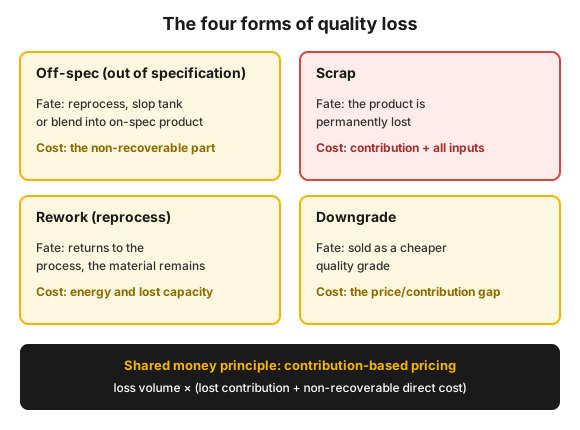
Figure 1 — the four forms of quality loss and their money paths.
Who is this for?
Section titled “Who is this for?”For those who make the daily quality decisions and have to defend an improvement or a tighter way of running with a number: plant manager · shift supervisor · process technologist · quality engineer · process engineer · controlling partner · Lean/CI coordinator.
Learning objectives
Section titled “Learning objectives”After reading this article you will be able to:
- name the four operational categories of quality loss, and say where the product goes in each;
- price a quality loss in your own plant, from lost volume and contribution;
- separate the recoverable and the non-recoverable direct cost, and charge only the latter to the loss;
- recognize quality giveaway, and say why quality produced above the spec is a loss;
- decide when pricing is NOT the right answer, but root-cause analysis or redesign is.
In brief
Section titled “In brief”- Quality loss appears in four operational forms: off-spec, scrap, rework and downgrade — each takes money, only differently.
- The shared money principle: you price on a contribution basis, not with the full product price, because the fixed cost is incurred even without the defective batch.
- You charge only the non-recoverable direct cost to the loss; if the material can be reprocessed, the material cost is not lost.
- Scrap is the most expensive: not only the product but also the labour, material and energy spent on it are lost.
- Giveaway is a hidden loss: quality produced above spec is not paid for by the customer, yet it costs money.
- An uncaught defect escalates: cheap at the operation, expensive at the customer; that is why it pays to catch it up front, where it arises.
- Measurable: off-spec rate, first pass yield and the trend of quality loss (COPQ) in money.
Why it matters (the stakes)
Section titled “Why it matters (the stakes)”Poor quality is not just scrap but a chain that gets more expensive the longer it runs: the same defect is a trifle at the operation level, but at the customer it can take the order, the trust and the future business as well.
At first only one parameter slips, which could be corrected in the plant at once and cheaply. If it goes unnoticed, it builds into the product, and can then only be handled by rework or downgrade; in the worst case it turns into a complaint: investigation, replacement delivery, penalty, lost order. Scrap, on top of that, breaks the flow and takes capacity, and moving and storing the defective product is itself a loss.
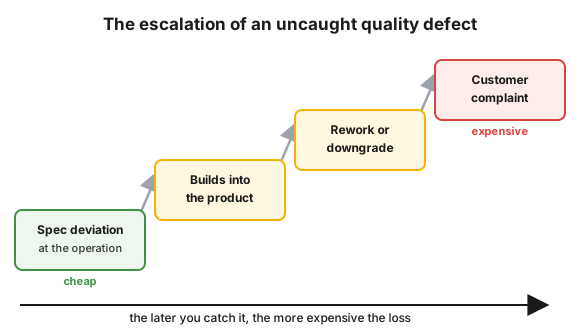
Figure 2 — the escalation of a quality defect: the later you catch it, the more expensive. This is why the jidoka principle stops the process where the defect arises.
What is quality loss, and why does it cost money?
Section titled “What is quality loss, and why does it cost money?”Quality loss is every expenditure that is incurred because the product was not made right first time and not exactly to specification. The literature calls this the cost of poor quality (COPQ), and it means the part of the quality cost that stems from defects, not from prevention.
The classic framework splits the quality cost into four buckets: prevention and appraisal cost (what you pay to make it good and to know that it is good), plus internal and external failure cost (the price of a defect still in the plant, or already at the customer). Off-spec, scrap and rework are typically internal failure cost; a complaint is external. This is the part to be priced, and it is exactly what traditional accounting captures worst: the true price of a customer return or lost future business is rarely quantifiable cleanly.
The key to pricing is the contribution (contribution margin): the product’s price minus its variable (direct) cost. The contribution margin is the right basis because the fixed cost (rent, administration, depreciation) you would pay even without the defective batch. What you really lose with a lost batch is the contribution, plus the direct expenditure you have already put in and do not get back. Every quality loss ultimately lands on the income statement (P&L).
What are the four categories of quality loss?
Section titled “What are the four categories of quality loss?”There are four operational forms, according to what happens to the defective product. Naming them is at the same time the input to pricing.
| Category | What happens to the product | The main cost |
|---|---|---|
| Off-spec (out of specification) | temporary storage, then reprocessing, slop tank or blending | the non-recoverable part of the operation |
| Scrap | permanently lost (flaring, disposal) | contribution + all expenditure |
| Rework (reprocess) | returns to the process, the material remains | extra energy, catalyst, lost capacity |
| Downgrade | sold as a cheaper quality grade | the price and contribution difference |
Off-spec is the most common starting point in the process industry. By definition it is a product that fails one or more parameters of the specification. Off-spec material must be identified, marked and segregated, its root cause investigated, and a corrective and then a preventive action taken. Only then is its fate decided, and with it its real cost.
Scrap is the most expensive, because here it is not only the product that is lost. The classic Lean teaching says that making a defective product means the labour, material and energy spent on it are lost too, not only the piece itself. So it is not enough to see it as “scrap”: the whole expenditure must be treated as a loss.
How do you turn it into money? (the money formula by category)
Section titled “How do you turn it into money? (the money formula by category)”With a simple formula: multiply the loss volume by the sum of the lost contribution and the non-recoverable direct cost. The key is the second term: from the direct cost you charge to the loss only what is NOT recoverable if the bad product is reprocessed or blended. If the material returns to the process, its material cost is not lost — only the extra energy, the catalyst and the lost capacity.
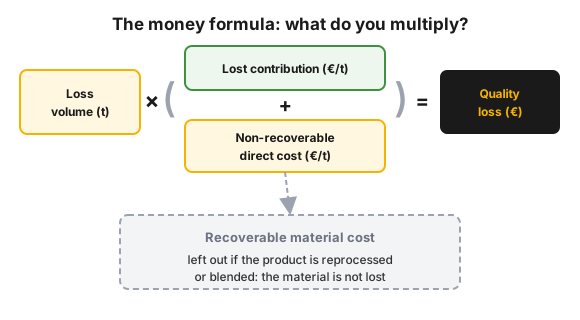
Figure 3 — the money formula: loss volume × (lost contribution + non-recoverable direct cost); the recoverable material cost drops out.
By category this formula gives something different: for a downgrade the price or contribution difference; for a rework only the extra processing and the lost capacity; for scrap the whole lost contribution and the whole non-recoverable direct cost. Off-spec leads to one of these, according to whether it is reprocessed, downgraded or scrapped.
The month’s quality losses are worth summing up in a benefit waterfall, alongside the volume, waste and changeover buckets, so you can see how big the quality bucket is relative to the others.
What is quality giveaway, and why is it a loss?
Section titled “What is quality giveaway, and why is it a loss?”Giveaway is the hidden loss where you hand over for free the “extra” quality produced above spec: the customer pays only for the specification, not for the reserve above it. This is the mirror image of quality loss: nothing is missing from the quality, there is a surplus in it.
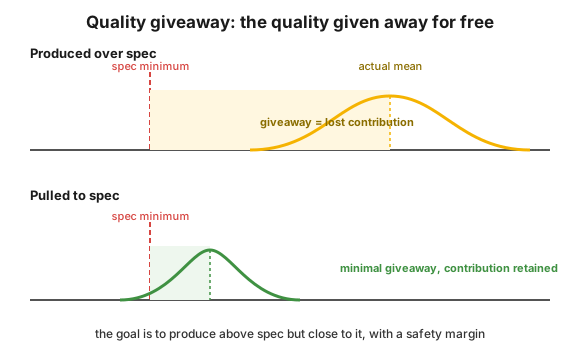
Figure 4 — giveaway: the band between the spec minimum and the actual quality mean is lost contribution; the goal is to produce above spec but close to it.
This shows up when the process mean sits well above the specification: every tonne carries more additive, more processing or more energy than the customer requires and pays for. The goal is not to breach the spec but production pulled to spec: keeping the process mean close to the specification, with a sufficient safety margin. This is the financial side of product-quality management, and it hinges on improving process capability: the smaller the variation, the closer you can pull the target to the spec without generating off-spec.
Process-industry and safety context
Section titled “Process-industry and safety context”In the process industry, quality loss is physically tangible too. Off-spec intermediate is sent to a segregated (slop) tank, from where it is reprocessed once the plant state is restored, or fed back into the feed by internal recirculation. If neither is possible, the last resort is flaring, which is a total loss. Blend-down (blending into on-spec product) is a common direction too, within the technological and quality limits.
The physical loss is captured by the material balance: the loss is the difference between the input processed and the product dispatched, plus own fuel, corrected for the change in opening and closing inventory. Because of measurement uncertainty, a distinction is drawn between apparent and real loss, and the slop system (the sources of slop, its segregation, its measurement) is managed separately. More on this in production accounting and material balance.
Introduction in practice
Section titled “Introduction in practice”Pricing quality loss is a repeatable routine, not a one-off calculation:
- Identify the loss at the place and time it arises (which batch, how much, which parameter slipped).
- Classify it into one of the four categories: off-spec, scrap, rework or downgrade.
- Price it with contribution: multiply the volume by the lost contribution, not by the full price.
- Separate the recoverable and the non-recoverable direct cost, and charge only the latter to the loss.
- Investigate the root cause, and assign a corrective and then a preventive action to it.
- Track in trend the quality loss and the off-spec rate, in a management report.
Measurement / audit
Section titled “Measurement / audit”Three metrics keep the topic alive: the off-spec rate (how much product fails the specification), first pass yield (FPY), into which a scrapped or reworked batch does not count, and the trend of quality loss (COPQ) in money.
At the audit, check not the existence of the number but its correctness:
| Audit point | Good practice |
|---|---|
| On what basis do you price? | with contribution, not the full product price |
| Which direct cost do you count? | only the non-recoverable, not the reprocessable |
| Is there a category? | every batch classified (off-spec / scrap / rework / downgrade) |
| Is there a baseline and trend? | time-series COPQ and off-spec rate, not a one-off number |
| Is giveaway included? | quality produced above spec is also measured |
What do you see of this in the management report?
Section titled “What do you see of this in the management report?”Quality loss lands on several report lines, and reading them together shows where the biggest stake is: the off-spec rate shows the how much, the COPQ line and the materials share show the same thing from the how much money side.
| Report line | What drives it | What you can do with it |
|---|---|---|
| trend of the off-spec rate | the share of batches failing the specification over time, tied to a customer-satisfaction target | you decide whether quality is improving or worsening; non-conformance monitoring triggers corrective action from here |
| COPQ line in money | the priced quality loss (downgrade, rework, scrap) in one figure | you rank the quality problem against the other improvements |
| materials share (Materials / COGS) | the share of material within the direct cost | if high, cutting scrap is the highest-impact intervention — this is the priority signal |
| quality bucket in the benefit waterfall | the quality part among the volume, quality, waste and changeover buckets | you see the share of the quality stake, tied directly to the income statement |
Part of the loss cannot be traced item by item, which is why a good report splits it into identified and unidentified loss; a large unidentified part is itself a signal that the measurement or the process is faulty. The rule: the off-spec rate flags the problem, the COPQ line and the materials share prioritize it.
Common mistakes
Section titled “Common mistakes”- Pricing with the full product price. Why it’s a problem: you overstate the loss, because you also count the fixed cost. Instead: price with contribution.
- Counting reprocessable material as a total loss too. Why it’s a problem: the material of a returning batch is not lost, only the extra processing. Instead: charge only the non-recoverable direct cost.
- Ignoring giveaway. Why it’s a problem: quality produced above spec quietly takes the contribution. Instead: measure the band between the spec and the actual mean.
- Double counting. Why it’s a problem: if a batch appears in both the off-spec and the downgrade bucket, you duplicate the loss. Instead: one batch, one category, according to its final fate.
- Confusing quality scrap with asset write-off. Why it’s a problem: the book write-off of an asset is a different concept from the defective product. Instead: handle the two separately.
When NOT to use it (the limits of the method)
Section titled “When NOT to use it (the limits of the method)”Pricing is a powerful tool for making quality loss visible, but it is not the right answer to every situation:
| Situation | Why pricing is not primary | The right answer |
|---|---|---|
| A one-off, non-recurring deviation | pricing a single unique batch teaches nothing | document it, but do not build a trend on it |
| A certified safety or legal reason | economics may not decide here | SIL/LOPA, the precedence of the law |
| A design flaw (the spec is wrong to begin with) | pricing the loss does not fix the root cause | redesign, review of the spec |
| An unknown root cause | the number alone does not eliminate the defect | root-cause analysis, jidoka, muda hunting |
Rule of thumb: pricing is a decision-support, not an investment advice. It tells you how big the stake is, but the real solution is preventing the defect where it arises.
Take it home (keys)
Section titled “Take it home (keys)”- Price with contribution, not the full price: the fixed cost is incurred even without the defective batch.
- Count only the non-recoverable: if the material can be reprocessed, the material cost is not lost.
- The category decides the price: the same volume as scrap, as downgrade and as reprocessing is three different amounts of money.
- Giveaway is a loss too: quality produced above spec is not paid for by the customer.
- Catch it up front: a defect is cheap at the operation, expensive at the customer; pricing makes this visible.
- Track in trend: off-spec rate, first pass yield and COPQ in money, not a one-off number.
Self-test
Section titled “Self-test”- An off-spec batch is fully reprocessed back into the feed. When does its material cost NOT count into the loss, and what does count anyway?
- The same 100 tonnes: once it is downgraded, once it is scrapped. Which is the bigger loss, and why?
- The process mean sits well above the spec, there is no off-spec. Where is the loss, and what do we call it?
Answer key: 1) The material cost does not count, because the material returns to the process; the extra processing cost (energy, auxiliaries) and the lost capacity do count. · 2) The scrap, because there the whole lost contribution + the whole non-recoverable direct cost are lost, while for a downgrade only the price or contribution difference. · 3) In the giveaway: the “extra” quality produced above spec is contribution given away for free.
How does this show up in digital practice?
Section titled “How does this show up in digital practice?”Pricing quality loss does not stop at the monthly Excel sheet: the same logic lives in a digital logging and reporting system, where the loss is recorded as it arises, with a category and a quantity. The mechanism differs, the principle is the same.
| Concept | Digital implementation | What it delivers |
|---|---|---|
| Creation of an off-spec batch | recording at the place and time it arises, with a category | the pricing is source-faithful, not an after-the-fact estimate |
| Category and fate | structured field (reprocessing / slop / downgrade / scrap) | the correct cost can be associated automatically |
| Contribution-based pricing | a maintained contribution parameter tied to the volume | a uniform, auditable money conversion |
| Off-spec rate, FPY | automatic KPI calculation from the recorded batches | the trend arises by itself, not by manual collection |
| Root cause and action | action list with owner and deadline | the loss does not recur unnoticed |
Connection to OPEREX (shift log)
Section titled “Connection to OPEREX (shift log)”The weakest point of pricing quality loss is typically the source data: when, how much and what kind of off-spec arose, and what became of it. A digital shift log (OPEREX) records this at the moment of creation: the handing-over shift documents the off-spec batch (quantity, cause, fate), the receiving shift acknowledges it, and the root cause and the corrective action (what / who / by when) are retrievable. This way the quality loss can be traced back afterwards to the concrete event and the responsible person, summed on a plan-vs-actual basis, and it gives an audit trail per ISO 45001 §10.2.
Terminology (HU / EN / JP)
Section titled “Terminology (HU / EN / JP)”| Hungarian | English (canonical) | 日本語 / note |
|---|---|---|
| Minőségi veszteség / a rossz minőség ára | Cost of poor quality | COPQ |
| Minőségköltség | Cost of quality | prevention, appraisal, internal/external failure |
| Specifikáción kívüli | Off-spec / off-specification | fails one or more parameters |
| Selejt | Scrap | 不良 (furyō) — defective product |
| Újrafeldolgozás / visszadolgozás | Rework / reprocess | the material returns to the process |
| Leértékelés / átminősítés | Downgrade | cheaper quality grade |
| Minőségi giveaway | Quality giveaway | the extra quality produced above spec |
| Fedezet | Contribution margin | price − variable cost |
| Elsőre jó arány | First pass yield (FPY / FTT) | scrap and rework do not count in |
| Beépített minőség | Built-in quality | jidoka (自働化): we do not pass a defect on |
What does an off-spec batch cost?
As much as the contribution lost, plus the non-recoverable direct cost, multiplied by the quantity of the batch. If it is reprocessed, only the extra processing and the lost capacity; if it is downgraded, the price or contribution difference; if it is scrapped, the whole contribution and expenditure.
Why do we count with contribution, not the full product price?
Because the fixed cost (rent, administration, depreciation) you would pay even without the defective batch. What you really lose with a lost batch is the contribution, that is the price minus the variable cost, plus the direct expenditure already put in that cannot be recovered.
When is the material cost of scrap not a loss?
When the defective product is not scrapped but reprocessed or blended, because then the material is not lost, only returned to the process. In that case only the extra processing cost (energy, auxiliaries) and the lost capacity are the loss.
What is quality giveaway, and why is it bad?
The “extra” quality produced above spec that the customer does not pay for. It is bad because it quietly takes the contribution: every tonne carries more additive, processing or energy than the specification requires. The goal is to produce above spec, but close to it.
Related concepts
Section titled “Related concepts”cost structure and contribution margin · downtime and lost contribution · benefit calculation of improvements · the Lean quality model · jidoka · muda · oee · profit per hour · product-quality management · production accounting and material balance
Next step
Section titled “Next step”If you have understood this, from here it is worth going on — in this order:
- cost structure and contribution margin — the exact concept of contribution and fixed/variable cost, on which the pricing rests.
- benefit calculation of improvements — once you have priced the quality loss, here you learn how to compute the full benefit of an improvement.
- the Lean quality model — built-in quality and jidoka, that is, how you prevent the loss at its source.
References / further reading
Section titled “References / further reading”- Joseph M. Juran (ed.): Juran’s Quality Handbook. McGraw-Hill — the canonical framework of the cost of quality.
- Philip B. Crosby: Quality Is Free. McGraw-Hill, 1979 — the price of poor quality and the “zero defects” mindset.
- Armand V. Feigenbaum: Total Quality Control. McGraw-Hill — the origin of the quality-cost categories (prevention, appraisal, internal/external failure cost).
- Taiichi Ohno: Toyota Production System: Beyond Large-Scale Production. Productivity Press, 1988 — scrap as a loss, together with the labour and energy spent on it.