SD/SU procedures and checklists
≈ 13 min read · 2,590 words
The SD/SU procedure describes the safe shutdown and start-up of equipment; the checklist is its simplified form with only the steps you must not skip.
SD/SU is the abbreviation of shutdown and start-up; the checklist carries only the steps that must not be skipped or forgotten, in the correct order. An up-to-date procedure prevents damage to the equipment during shutdown and start-up, and enables smooth, safe operation. Because every SD/SU and every turnaround (TA) brings new experience and often new equipment, the procedures, the P&ID and the checklists have to be updated continuously, so that they do not drift away from reality.
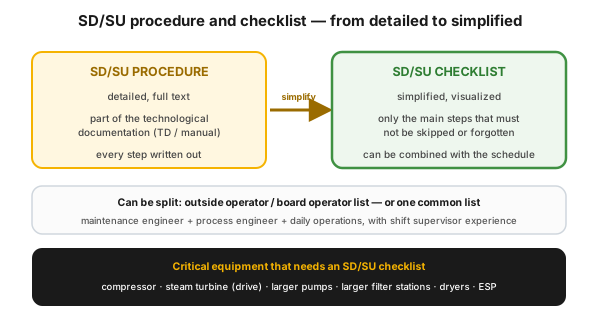 Figure 1 — the relationship of the SD/SU procedure (detailed, part of the technological documentation) and the checklist simplified from it, the split, and the critical equipment.
Who is this for?
Section titled “Who is this for?”This article is for those who write, maintain or use shutdown and start-up documentation on site.
Board and outside operator · shift supervisor · process engineer (technologist) · reliability (maintenance) engineer · plant manager · HSE
Learning objectives
Section titled “Learning objectives”After reading this article you will be able to:
- distinguish the SD/SU procedure from the checklist simplified out of it;
- recognize when and how shutdown and start-up documentation must be updated;
- decide which critical equipment needs its own SD/SU checklist;
- build the loop that keeps the procedure and the checklist up to date, with the annual TD audit.
In brief
Section titled “In brief”- Two levels: the detailed SD/SU procedure (part of the technological documentation) and the simplified, visualized SD/SU checklist derived from it.
- The checklist contains only the main steps, the ones that must not be skipped or forgotten, in the correct order.
- Keeping it current: every SD/SU brings new knowledge; the procedure must be compared with reality and the differences built back in.
- Annual TD audit: audit the technological documentation at least once a year; close the gaps with a SMART action.
- TA = new equipment: equipment installed at a turnaround must be entered into the documentation and the P&ID.
- Can be split: an outside and a board operator checklist, or one common list; it can be combined with the schedule.
- Joint work: the checklist is prepared by the maintenance engineer, the process engineer and daily operations, with the shift supervisor’s experience.
Why does an up-to-date SD/SU procedure matter?
Section titled “Why does an up-to-date SD/SU procedure matter?”An up-to-date SD/SU procedure helps to avoid damage to the equipment during shutdown and start-up, thereby improving reliability, and it enables smooth, safe and reliable operation. The risk arises because every SD/SU brings new knowledge and experience that is not written in the current technological documentation; on top of that, when a unit shuts down or during a TA (turnaround), new process equipment is often installed, which has to be entered into the documentation and the P&ID. If the procedure does not follow these, the next SD/SU runs on an outdated recipe, which is especially dangerous in the most critical, most error-prone phase of shutdown and start-up.
How can the SD/SU procedure be kept up to date?
Section titled “How can the SD/SU procedure be kept up to date?”Keeping it current is continuous work: the procedure and the drawings are always aligned to the as-built state.
- always keep the valid SD/SU procedures up to date (the next update is easier that way);
- always keep the P&ID up to date;
- check whether the technological documentation has been updated after the SD/SU.
SD/SU procedures apply at two levels:
- SD/SU procedures of process units (the more complex ones): these are generally part of the technological documentation (TD/manual) and usually exist, but they need updating from time to time according to the changes implemented;
- SD/SU procedures for critical / important equipment. The question is: do we have an SD/SU procedure for every critical piece of equipment? If yes, it must be checked and actualized; if not, a new one must be created.
The updating loop
Section titled “The updating loop”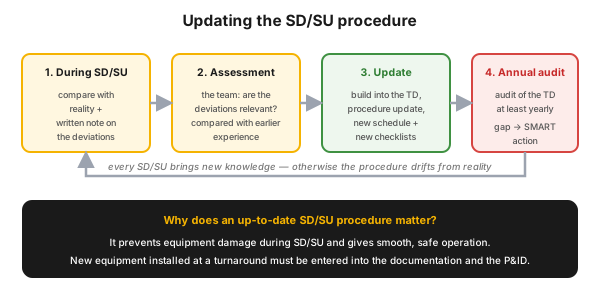 Figure 2 — the loop for updating the SD/SU procedure, with the annual TD audit.
- During the SD/SU, compare and confront the valid procedure with reality (the actual execution), and make written notes about the new experience and the discrepancies.
- After the SD/SU the team evaluates the discrepancies: are they relevant, and how do they compare with previous SD/SU experience?
- If they are relevant, the team builds them into the technological documentation: it updates the procedures and prepares a new, actualized schedule and checklists.
- The technological documentation must be audited at least once a year; if the audit finds a gap between the TD and reality (the latest experience), it initiates actions in SMART format to close the gap and to actualize the procedures as soon as possible.
What is the difference between the SD/SU procedure and the checklist?
Section titled “What is the difference between the SD/SU procedure and the checklist?”The SD/SU procedure is the detailed, full-text description and part of the technological documentation; the checklist is its simplified, visualized form, carrying only the main steps that must not be skipped, in the correct order. The documentation stays up to date because the experience of every SD/SU is built back into the procedure and the checklist.
The checklist is created to ensure that the work is done in the correct order and sequence, guaranteeing safety and reliability. Checklists are the standardized, simplified forms of the SD/SU procedures: the knowledge and experience in them is the same, but they contain only the main activities, the ones that must not be skipped or forgotten. Visualized main steps are easier to use than a full written textual procedure, and the checklist can be combined with the SD/SU schedule. The checklist can be split into the activities of the outside operators and those of the board/panel operators, or it can be one common list for all activities.
Preparing the checklists is the common work of the maintenance engineer, the process engineer (technologist) and the daily operational staff; it is also worth inviting the shift leaders, because their opinion on execution is valuable thanks to their huge practical experience. Once a checklist has been agreed, it has to be followed; during the SD/SU make notes on the checklist for the later evaluation, then update it into the next version. The critical / important equipment that needs an SD/SU checklist: compressors, steam turbine (as a driver), bigger pumps, bigger filtration stations (e.g. the MCB of the FCC), dryers, electrostatic precipitators (ESP).
Normal shutdown and emergency shutdown
Section titled “Normal shutdown and emergency shutdown”It is worth separating the normal and the emergency shutdown, because their logic differs. A normal shutdown is a planned, sequenced process: the feed is stopped gradually, the parameters are brought down in a controlled way, and the necessary cooling time is allowed. The aim of an emergency shutdown, by contrast, is to bring the equipment to a safe state immediately: critical depressurizing, isolation and blocking happen quickly, in a pre-defined order. Its backbone is the certified ESD (emergency shutdown) system, which also handles the hazardous state automatically. This is exactly the difference behind the need for both a detailed procedure and an “instantly usable” checklist: a calm, plannable shutdown needs the detailed recipe, the critical moment needs the few steps that must not be skipped.
Process-industry and safety context
Section titled “Process-industry and safety context”Shutdown and start-up are among the most dangerous phases in a process plant: unstable states, rapidly changing temperature and pressure, frequent manual intervention. Process safety practice has long treated start-up, shutdown and abnormal (transient) operation as a priority risk phase (see the CCPS and CSB sources under References). This is why the exact sequence and the “step that must not be skipped” are life protection here: one missed depressurizing, one valve operation in the wrong order can bypass a layer of protection. The checklist reduces the cognitive load at the most critical moment, just as it does in aviation. SD/SU is related to the mindset of SMED (quick changeover) in terms of preparation and standardization, but here the main goal is not speed but safety and reliability. New equipment enters the documentation and the P&ID through MOC.
Common mistakes
Section titled “Common mistakes”- Outdated procedure. The experience of the SD/SU is not built back into the technological documentation. Why it’s a problem: the next shutdown runs on an outdated recipe, in the most critical phase. Instead: after every SD/SU, evaluate the discrepancies and update the TD.
- No checklist for critical equipment. The compressor, the steam turbine, the ESP are started or shut down “from memory”. Why it’s a problem: a single missed step can damage the equipment. Instead: prepare a checklist for every critical piece of equipment.
- A checklist that is too detailed or too textual. The list repeats the whole procedure. Why it’s a problem: the essence is lost and it is unusable on site. Instead: only the main steps that must not be skipped, visualized.
- No note-taking during the SD/SU. The discrepancies are not recorded. Why it’s a problem: there is nothing from which to update the next version. Instead: take notes on the checklist and in the log as you go.
- No annual TD audit. The documentation is not compared with reality. Why it’s a problem: the gap between documentation and reality grows unnoticed. Instead: audit the TD every year, with a SMART action for the gaps.
- New equipment without MOC and a P&ID update. The machine installed at the TA is not entered into the documentation. Why it’s a problem: the documentation is outdated from day one. Instead: every new piece of equipment should reach the TD and the P&ID through MOC.
When NOT to use it? (the limits of the method)
Section titled “When NOT to use it? (the limits of the method)”The SD/SU procedure and the checklist are made for plannable, repeating shutdowns and start-ups. They are not the right tool for every situation:
- They do not replace the certified safety system. Emergency shutdown is performed by the certified ESD/SIL layer, automatically. The checklist does not substitute for this, it only complements it; never entrust a protective function to a human list.
- A unique, never-seen situation. In an unknown, non-routine state a rigid list can mislead. Then expert judgement and risk assessment are needed, not a pre-written sequence; non-routine work calls for a separate special operating procedure.
- An outdated or untrained list. If the checklist is not up to date, or the team has not practised it, the false sense of security is worse than having no list. First actualize and train, and only then rely on it.
Take it home (keys)
Section titled “Take it home (keys)”- Two levels, one body of knowledge. The detailed procedure and the checklist simplified from it carry the same knowledge; the checklist only carries the steps that must not be skipped, in the correct order.
- Every SD/SU teaches. Take notes as you go, evaluate afterwards, and build the experience back into the documentation, otherwise the next shutdown follows an outdated recipe.
- Mandatory for critical machines. Do not start or shut down a compressor, a steam turbine, a big pump or an ESP “from memory” — have a checklist.
- Audit every year. The annual TD audit catches the gap between documentation and reality, with a SMART action for the gaps.
- New equipment through MOC. Enter the machine installed at the TA into the TD and the P&ID before you use it for the first time.
Self-test
Section titled “Self-test”- What is the difference between the SD/SU procedure and the checklist, and which one do you use on site at the critical moment?
- What are the steps of the loop that keeps the procedure up to date, from the SD/SU to the annual TD audit?
- Why does the checklist not replace the certified ESD/SIL system, and where is the boundary between the two?
How does this show up in digital practice?
Section titled “How does this show up in digital practice?”The logic of the SD/SU checklist does not stop at paper: the same “correct order, step that must not be skipped, recorded completion” principle is realized in software too. The mechanism differs, the principle is the same.
| Concept | Digital implementation | What it delivers |
|---|---|---|
| Checklist in the correct order | forced-sequence digital checklist (the next step opens only after the previous one is ticked) | no critical step can be left out |
| Note-taking during the SD/SU | e-log, an entry attached to the step | the discrepancies are collected in a structured way for the update |
| Who ticked what and when | time-stamped audit trail | the completion of the critical steps is auditable |
| Procedure versions | versioned digital technological documentation | the valid procedure is always at hand |
| Gaps from the annual TD audit | action tracker with the SMART actions | closing the gap is traceable |
Connection to OPEREX (shift log)
Section titled “Connection to OPEREX (shift log)”The key step of updating the SD/SU procedures (confronting the procedure with reality, taking notes) fits into the shift log. In OPEREX it can be recorded and retrieved what deviated from the description during the SD/SU, what new experience came up, and which checklist item was completed, by whom and when. The log is therefore doubly useful: on the one hand it collects the raw material for the procedure update (the next version builds on the recorded experience), on the other hand it gives an audit trail showing whether the critical steps that must not be skipped were completed. The outgoing and incoming shift also hand over the SD/SU status in the log.
Terminology (HU / EN)
Section titled “Terminology (HU / EN)”| Hungarian | English (canonical) | Note |
|---|---|---|
| leállítás / felfutás | shutdown / startup (SD/SU) | the two critical phases |
| nagyleállás | turnaround (TA) | planned maintenance shutdown |
| technológiai dokumentáció | technological documentation (TD) | the home of the procedures |
| checklist | checklist | simplified, main steps |
| kinti / panel-operátor | outside / board (panel) operator | the split of the checklist |
| SMART akció | SMART action | closing the TD gap |
What is the difference between the SD/SU procedure and the SD/SU checklist?
The SD/SU procedure is the detailed, full-text description that is part of the technological documentation. The checklist is its simplified, visualized form: it contains only the main steps that must not be skipped or forgotten, in the correct order, quickly usable on site.
Why do SD/SU procedures have to be actualized continuously?
Because every shutdown and start-up brings new experience that is not written in the existing documentation, and during a turnaround (TA) new equipment is often installed. If the procedure and the P&ID do not follow these, the next SD/SU runs on an outdated recipe, at increased risk.
Which equipment needs an SD/SU checklist?
The critical, important equipment: compressors, steam turbine (as a driver), bigger pumps, bigger filtration stations, dryers, electrostatic precipitators. Shutting down or starting these must not be left to memory.
What is the difference between a normal shutdown and an emergency shutdown?
A normal shutdown is a planned, sequenced process (the feed is stopped gradually, the parameters are brought down in a controlled way, the cooling time is allowed). The aim of an emergency shutdown is to bring the equipment to a safe state immediately; its backbone is the certified ESD (emergency shutdown) system, which also handles the hazardous state automatically. Each has its own procedure and its own checklist.
Related concepts
Section titled “Related concepts”production reliability program · special operating procedures · standardized work · SMED · management of change · the standard operator round · operational risk assessment
References / further reading
Section titled “References / further reading”- CCPS (Center for Chemical Process Safety): Guidelines for Process Safety During the Transient Operating Mode — the risks of start-up, shutdown and other transient operating modes, and how to manage them.
- U.S. Chemical Safety Board (CSB) — public plant investigation reports that repeatedly highlight the role of start-up, shutdown and abnormal operation in serious events.
- Atul Gawande: The Checklist Manifesto (2009) — why a well-written checklist reduces error in high-stakes, complex work (aviation, surgery, the process industry).