Winterizing in the process industry
≈ 22 min read · 4,484 words
After the first serious frost the garden tap cracks, the water meter is ruined, and only in spring does it turn out what it cost. At home this is an annoyance; in a process plant the same physics means a frozen measurement loop, a split pipe, a spill and an unplanned shutdown. The difference is not in the cold, but in whether we prepared for it. Let’s look at what winterizing is, what happens if it is left out, and how it becomes a planned, checkable routine.
Winterizing prepares a process plant for winter: it keeps water from freezing and heavy hydrocarbons from solidifying in the equipment.
Winter weather makes the operation more difficult, and at low ambient temperature the water freezes and the heavy hydrocarbons solidify in the pipe or in the equipment. From this can come blockage, a process safety event (LOPC, spill), unplanned shutdown and significant asset damage. Non-sufficient winterizing can cause upsets and unplanned shutdowns, so freeze protection must be treated as a planned, standardized and checked activity, not as an ad hoc reaction to the first frost.
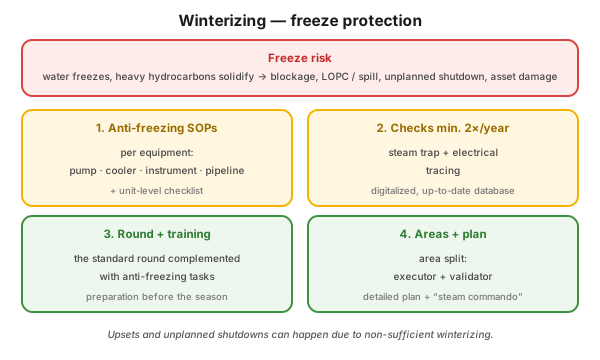 Figure 1 — the freeze risk and the four main protective measures.
Who is this for?
Section titled “Who is this for?”This article is for those responsible for winter operation and for the condition of the equipment: operator, shift leader, plant manager / asset team leader, process engineer, maintainer and reliability engineer, plus the HSE / process safety (PSM) and fire protection functions that oversee the integrity of the protective systems.
Learning objectives
Section titled “Learning objectives”After reading this article you will be able to:
- explain what winterizing is, and through what chain frost leads to an unplanned shutdown;
- list the four basic tools of freeze protection, and decide which one to use where;
- distinguish the application cases of steam and electrical tracing, and name the target temperature of winterizing;
- put together a season calendar in which the preparation happens before the frost, not after it;
- recognize that winterizing touches not only the process, but the protective barriers (fire water, tank vent) as well.
In brief
Section titled “In brief”The essence of winterizing in a single sentence: at every freeze-prone point there should be a measure thought out in advance, written down, assigned to an owner and checked, still before the season. In practice this means the following.
- The physics of frost: water freezes, heavy hydrocarbons solidify in the pipe or in the equipment, and from this come blockage, LOPC or spill, unplanned shutdown and asset damage.
- Four basic tools: heat input (tracing and heat insulation), keeping in motion (circulation), removal (draining, blowing out), freezing-point depression (dosing antifreeze or alcohol).
- Planned, not reactive: winterizing needs a detailed anti-freezing plan before the season; we do not start thinking at the first frost.
- Anti-freezing SOPs per equipment: pump, cooler, instrument, pipeline, plus a unit-level checklist as part of the technological documentation.
- Steam trap and tracing checks at least 2×/year, with a digitalized, up-to-date database.
- The standard operator round is complemented with anti-freezing tasks, and the training happens before the season.
- Area split between the shifts, with an executing and a validating owner, plus fast steam repair (“steam commando”).
- The other half of winterizing is snow, ice and icicles: this is a formal maintenance work category, not “someone will shovel it away.”
- The protective barriers freeze too: winterizing the fire-water system and the tank vents is a pre-season task with a deadline.
- A weekly review and lessons learned close the learning loop.
Why it matters (the stakes)
Section titled “Why it matters (the stakes)”The winter period requires increased effort and care for the proper operation of the equipment. Winter conditions make the operation more difficult, and may even lead to the shutdown of a device or of the whole unit. Non-sufficient winterizing can cause upsets and unplanned shutdowns: at low temperature the water freezes, the heavy hydrocarbons solidify in the pipe or in the equipment, and they can trigger various process safety events (LOPC, spills) which endanger safe and reliable operation, causing significant asset damage and increased operational cost.
The stakes are high because frost is not a single failure event but the first link of a chain (Figure 2). The plug on its own is cheap; the pipe rupture, spill and shutdown that follow from it are not.
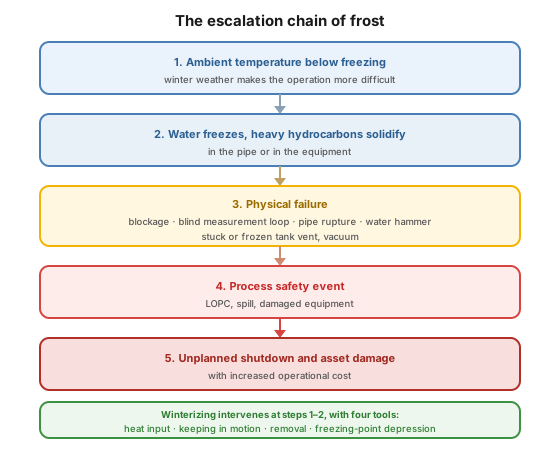 Figure 2 — the escalation chain of frost: the further down you catch it, the more expensive it gets. Winterizing intervenes at the start of the chain.
What is winterizing, and how does it prevent unplanned shutdowns caused by frost?
Section titled “What is winterizing, and how does it prevent unplanned shutdowns caused by frost?”Winterizing is the systematic survey and protection of the freeze-prone points, still before the season starts. It has four physical tools, and the anti-freezing plan is essentially nothing else than deciding which one to assign to which point.
| Tool | What it does | Typical application |
|---|---|---|
| Heat input | keeps the medium above the pour point or the freezing point | steam or electrical tracing, heat insulation, tempered building |
| Keeping in motion | flowing liquid does not freeze up | continuous circulation, recirculation, running the spare pump |
| Removal | what is not in the pipe cannot freeze | low-point draining by gravity or by blowing out, emptying dead legs |
| Freezing-point depression | the liquid freezes at a lower temperature | antifreeze seal liquid, dosing alcohol into a gas system |
Prevention works because each tool intervenes at the first two links of the chain: either it does not let the temperature fall below the critical value, or it leaves no freezable medium in the dangerous section. If, however, we get as far as the third link (blockage, pipe rupture), we are no longer talking about freeze protection but about damage control.
What does winterizing contain?
Section titled “What does winterizing contain?”Freeze protection is a regulated, multi-level activity:
- site and unit level winterizing operating procedures and regulations;
- site level regulation or procedure for the checks of the steam traps and electrical heatings;
- an equipment-level checklist to avoid freezing events, and anti-freezing SOPs for pumps, coolers, instruments and pipelines;
- the complementing of the SOP of the standard operator round with anti-freezing activities;
- training modules about the anti-freezing activities;
- the steam trap and electrical heating checks at least twice a year, plus a comprehensive, digitalized, up-to-date database about the steam traps and the heatings;
- an appropriate process for the quick repair of steam leakages (for example a “steam commando” or another solution).
What heats a freeze-prone line: steam or electricity?
Section titled “What heats a freeze-prone line: steam or electricity?”In short: we heat with steam when heat has to be brought in or heat loss substituted for process reasons; we heat electrically when the point is specifically to prevent freezing on a section that cannot be drained. The choice is therefore not a matter of energy taste, but follows from the purpose of the heating (Figure 3).
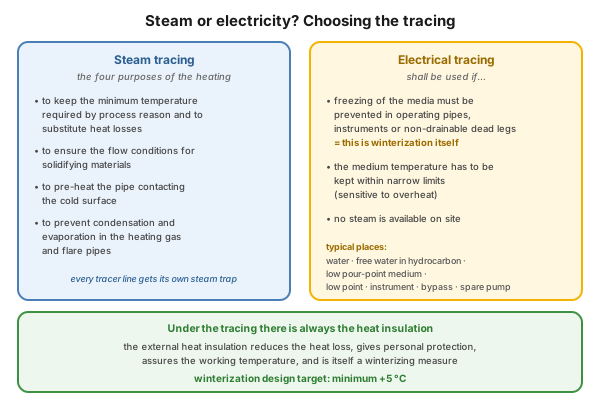 Figure 3 — the application cases of steam and electrical tracing, with the role of heat insulation below them.
Steam tracing has four purposes: keeping the minimum temperature required by process reason and substituting the heat losses; ensuring the flow conditions for solidifying materials; pre-heating the pipe that contacts the cold surface, where the medium would otherwise solidify; and finally preventing condensation and evaporation in the heating gas and flare pipe networks.
Electrical tracing shall be used when freezing of the media has to be prevented in an operating pipe, in an instrument or in a slack pipe section that may not be drained: this is winterization itself. Furthermore, when the temperature of the medium has to be kept within narrow limits (material sensitive to overheat), or where no steam is simply available at that place. Typical electrically traced places: water, free water in hydrocarbon, low pour-point medium, the low points, the instruments, the bypass lines and the spare pumps.
Under the tracing there is always the external heat insulation, which reduces the heat loss, gives personal protection, assures the working temperature, and is itself a winterizing measure. The most quotable number belongs here too: in case of frosting medium, of materials segregating from the steam or gas phases, and in case of water, the winterization design target is minimum +5 °C. Real anti-freezing work instructions prescribe the same target temperature for tempered plant spaces.
How can it be introduced?
Section titled “How can it be introduced?”It is worth introducing top-down: first the regulation and the plan, then the checklist, and finally the training and the field execution. The following seven steps give the frame.
- Work out the site (and/or unit) level winterizing regulation.
- Work out unit-level winterizing standards, for example a checklist of the anti-freezing activities as part of the technological documentation.
- Organize unit-level training for the operators, a repetition of knowledge and experience before the winter season.
- Discuss the weekly results with the staff.
- Capture lessons learned, share knowledge and experience.
- Split the plant into smaller areas between the shifts, and determine the persons executing the activities and the persons validating (checking) the work done.
- Work out a detailed anti-freezing plan before the winter season.
Projecting these seven steps onto the calendar is what really shows that winterizing is a preventive activity: the bulk of the work is due before the frost (Figure 4).
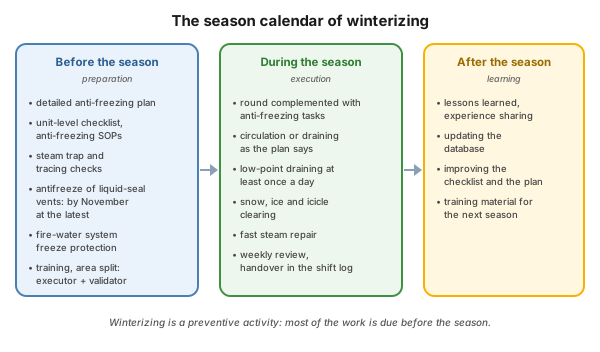 Figure 4 — season calendar: what should be ready before the frost, what runs during the season, and what closes the loop afterwards.
What does a real anti-freezing work instruction look like?
Section titled “What does a real anti-freezing work instruction look like?”Real anti-freezing work instructions prescribe a concrete measure per location and per equipment, and separately for normal operation and for shutdown. This duality is the most important lesson: the same line can be protected by circulation while running, but in a shutdown only by draining or blowing out.
| Area | Measure in normal operation | Measure at shutdown |
|---|---|---|
| Tempered building, machine hall | closed doors, target temperature +5 °C, mobile electric heater if needed | closed doors, target temperature +5 °C, mobile electric heater |
| Outdoor line carrying a solidifying medium | continuous heat maintenance with tracing | draining at the low points and/or blowing out |
| Steam and condensate line | continuous heat maintenance, regular emptying of the dead legs | draining at the low points and/or blowing out (the low point can be opened by dismantling the steam trap strainer) |
| Water line, cooling water, process water | regular circulation, emptying of the siphoned sections | complete draining or recirculation |
| Product line (solidifying product) | heat maintenance and blowing out | thorough blowing out of the whole system |
| Tank, basin | circulation or heat maintenance | circulation or complete draining |
Beyond this, the instruction handles case-by-case settings in a separate category (for example when a heat source is standing for a long time, but product dispatch and the tempering of the storage area continue), and it gives the procedure for the loss of the heat source: a back-up heat source (for example a diesel hot-air blower) may only be used in intermittent operation, with adequate ventilation and continuous supervision, and the maintenance duty service and the responsible managers must be notified immediately. The document lives with a 3-year review cycle, and the place designated for documenting the execution is explicitly the shift log.
The point is not the concrete list but the principle: at every freeze-prone point there should be a measure thought out in advance, written down and assigned to an owner, for both operating states.
The other half of winterizing: snow, ice, icicles
Section titled “The other half of winterizing: snow, ice, icicles”When we think of freeze protection, pipes usually come to mind, yet winterizing is also a formal maintenance work category with its own work list, recorded in the CMMS. This includes:
- knocking down the icicles to prevent damage to the equipment and so that the operator and the maintainer can move safely (the work is preceded by a risk assessment);
- snow clearing, so that operating the production equipment and the movement of people stay safe;
- de-icing the cooling-air grilles of the electric motors and the protective grilles of the fans (an iced-up grille leads to a motor fault just as a frozen pipe does in the process);
- anti-slip treatment and de-icing on the walking surfaces.
This part is the meeting point of winterizing and housekeeping, and in its execution it typically falls within the scope of autonomous maintenance. The logic is the same as in process freeze protection: designated area, designated owner, documented work.
Process-industry and safety context
Section titled “Process-industry and safety context”In a process plant frost is not a comfort question but a safety one. A line that freezes and then thaws can split, a plugged measurement loop makes the operator blind, and a frozen water pocket can cause water hammer, and the hazardous material released is LOPC.
Storage tanks deserve separate attention. Tanks are built with a shell that is thin relative to their diameter, and the vents open already at a pressure difference of a few millibars. If the vent valve plugs, the valve seat sticks or the structure freezes up, a vacuum can arise during draw-down, and the shell or the roof structure buckles. That is why, in case of freeze risk, a heated vent valve and flame arrester must be used, and in the case of liquid-seal vents the seal liquid must be winterized: depending on the weather forecast, but by November at the latest, the freezing point must be checked, and a complete replacement with antifreeze of −25 °C freezing point must be carried out if the system has become dirty, or if the freezing point of the liquid in it is above −25 °C.
Frost, however, reaches not only the process but the protective barriers themselves. That is why the fire protection operating tasks include the freeze protection of the dry risers, the winter freeze protection and periodic exercising of the water cannons, the periodic operation of the fittings and the inspection of the fire-water pits, all with a pre-season deadline and on a regular, monthly rhythm. A frozen fire-water system is not an operational inconvenience but a loss of barrier: it fails to work at exactly the moment when it would be needed most.
Winterizing thus connects to the other elements of the reliability program: the winter complement of the operator round is the early detection (an iced section, a tracing that is not running), the steam trap check is autonomous maintenance, and the fast steam repair is the ground of the operator–maintainer collaboration. Winterizing is therefore at once a safety barrier and a defence of availability: the winter shutdown that was prevented is the cheapest shutdown.
Measurement / audit
Section titled “Measurement / audit”Winterizing is measurable and auditable: the completion of the steam trap and tracing checks (min. 2×/year) can be followed in the digitalized database; the weekly anti-freezing review and the lessons learned close the learning loop; and the area owner and validator system ensures that someone checks the work done. The bar: at the end of the season it should be demonstrable that the protection was carried out and checked at every freeze-prone point.
Common mistakes
Section titled “Common mistakes”The typical mistakes stem not from a lack of professional knowledge, but from a lack of timing and follow-up.
- Reactive winterizing: we start acting at the first frost, without a plan.
- No up-to-date database about the steam traps and the heatings, so we do not know what has to be checked.
- A missed 2×/year check: the faulty steam trap or the tracing that is not running comes to light in winter, at the worst possible moment.
- The round is not complemented with anti-freezing tasks, so nobody notices the iced or solidified section.
- No validator: nobody checks the anti-freezing work done, and one point gets left out.
- Slow steam repair: the tracing lost to a persistent steam leak freezes up a whole section.
- We think only of the process: the fire-water system, the tank vents and the walking surfaces are left out of the plan.
- Draining is not scheduled: the low-point condensate is emptied only when “there is a lot of it already”, whereas in a freeze-prone period it must be done at least once a day, regardless of how full it is.
When NOT to use it (the limits of winterizing)
Section titled “When NOT to use it (the limits of winterizing)”Winterizing is an operational package of measures, not a cure-all, and there are cases where it is expressly the wrong answer.
- Do not use it as a substitute for design. If a section cannot be drained in the first place, it has to be provided with heat insulation and electrical tracing at the design level. Improvisation by the shift cannot make up for this.
- Do not drain or blow out everything by reflex. The choice between circulation and draining is decided in the anti-freezing plan, per medium and per operating state, not in the field, in the cold, from memory.
- Do not knock down icicles or clear snow without a risk assessment. Ice removal at height is a dangerous job in itself; the rule expressly ties it to weighing the possible safety risks.
- Do not improvise when the heat source fails. The back-up heat source may only be used in intermittent operation, with adequate ventilation and continuous supervision, and the event carries an immediate reporting duty.
- Do not treat the safety barriers as operator improvisation. The freeze protection of the fire-water system and of the certified safety functions (LOPA and SIL) runs by its own inspection regime with its own deadlines.
- Freezing-point depression is not universal. Antifreeze or alcohol may only be dosed where the medium, the product quality and the technology allow it.
Take it home (keys)
Section titled “Take it home (keys)”- Freeze protection has four tools: heat input, keeping in motion, removal, freezing-point depression. The plan is which one you assign to which point.
- Write down every measure for two operating states: normal operation and shutdown. The shutdown is the more dangerous, because the flow stops.
- +5 °C is the quotable target temperature of winterizing for solidifying media and for water; the same value applies to tempered spaces.
- The calendar is the point: the bulk of the work is due before the season. What is not ready in November is damage control in January.
- The protective barriers must be winterized too: fire water, dry risers, tank vents. Their freezing up is a loss of barrier.
- The steam trap is the most vulnerable element of freeze protection, because there is a separate one for every tracer line; that is why the up-to-date database and the twice-yearly check are needed.
Self-test
Section titled “Self-test”- An outdoor water line is protected by circulation in normal operation. What changes if the plant shuts down, and why?
- When must electrical tracing be chosen instead of steam, and what is the typical winterizing case of electrical tracing?
- Why can a frozen tank vent be more expensive than a frozen process line?
Answer key: 1) In a shutdown the flow stops, so keeping in motion drops out as a tool; the section then has to be drained at the low points or blown out, or continuous heat maintenance has to be provided. · 2) When freezing of the medium has to be prevented in an operating pipe, in an instrument or in a non-drainable dead leg (this is winterization itself), and furthermore when the temperature has to be kept within narrow limits, or when there is no steam at the location; typical places are water, the low points, the instruments, the bypass lines and the spare pumps. · 3) Because the freezing of a tank vent gives no signal, yet during draw-down it lets a vacuum build up in the thin shell structure, which can lead to permanent deformation of the shell and the roof structure.
How does this show up in digital practice?
Section titled “How does this show up in digital practice?”Winterizing is classically paper-based, checklist work, but every element of it can be mapped digitally, and this is exactly what makes it auditable.
| Concept | Digital implementation | Value |
|---|---|---|
| Steam trap and tracing register | comprehensive, digitalized, up-to-date database | we know what has to be checked, and what was left out |
| Pre-season check | scheduled CMMS work order with a deadline | the pre-season task does not slip into the season |
| Anti-freezing round | mobile operator round with an anti-freezing checklist | observation recorded on the spot, with a timestamp |
| Handover of the daily freeze-protection status | e-log / digital shift handover | the outgoing shift’s status is passed on acknowledged |
| Winter maintenance work (snow, ice, icicles) | work category recorded in the CMMS | the effort is visible, and the work does not get left out |
| Weekly review, lessons learned | structured report from the database | the lesson goes into the plan of the next season |
Connection to OPEREX (shift log)
Section titled “Connection to OPEREX (shift log)”Winterizing is typically a status to be handed over from shift to shift, which is exactly why it fits the shift log. It is no accident that real anti-freezing work instructions designate the shift log explicitly as the place of documentation. In OPEREX it can be recorded and handed over which line is circulating, which tracing is running, which steam trap was checked; the completion of the anti-freezing round, the weekly review and the work of the executor/validator appointed per area can be followed with a timestamp and an owner. The outgoing shift hands over the freeze-protection status and the incoming shift acknowledges it, so winterizing does not depend on one person’s memory, and it leaves an auditable trail through the whole length of the season.
The same topic is also good material for the start-of-shift briefing: Lean diagnostics bring it as an example of a good shift handover message, when the topic of the short HSE briefing (“HSE 5 minutes”) is precisely winterizing, as opposed to a vacuous “everything is fine” handover.
Terminology (HU / EN / JP)
Section titled “Terminology (HU / EN / JP)”The established English terms around winterizing are the following:
| Hungarian | English (canonical) | 日本語 (rōmaji) | Note |
|---|---|---|---|
| téliesítés | winterizing / winterization | — | preparation for winter |
| fagyvédelem | anti-freezing / freeze protection | — | the concrete measure |
| gőzös kísérőfűtés | steam tracing | — | heat input with steam |
| elektromos kísérőfűtés | electrical (heat) tracing | — | anti-freezing heating |
| gőzcsapda | steam trap | — | a separate one per tracer line, to be checked min. 2×/year |
| külső hőszigetelés | external heat insulation | — | winterization target: min. +5 °C |
| mélyponti leürítés | low-point draining | — | removal of the liquid |
| kifúvatás | blowing (with air) | — | emptying before a shutdown |
| pangó szakasz | dead leg | — | requires regular emptying |
| gyors gőzjavító csoport | “steam commando” | — | fast repair of steam leakages |
| LOPC | Loss of Primary Containment | — | the typical outcome of freeze damage |
Why does frost cause a shutdown in a process plant?
At low temperature the water freezes and the heavy hydrocarbons solidify in the pipelines and equipment, which can cause blockage, loss of a measurement loop, pipe rupture and a process safety event (LOPC, spill), and from these come unplanned shutdown and significant asset damage.
What is the most important element of winterizing?
The detailed, pre-season anti-freezing plan assigned to owners, together with the standards, SOPs and checklists that belong to it. Winterizing is a planned, preventive activity, not a reaction to the first frost.
When should steam and when electrical tracing be used?
Steam when, for process reasons, a minimum temperature has to be kept, heat losses substituted, the flow of a solidifying material ensured, or condensation prevented in the heating gas and flare pipes. Electrical when freezing specifically has to be prevented in an operating pipe, in an instrument or in a non-drainable dead leg, when the temperature has to be kept within narrow limits, or when there is no steam at the location.
To what temperature does one have to winterize?
In case of frosting medium, of materials segregating from the steam or gas phases, and in case of water, the winterization design target is minimum +5 °C. The anti-freezing work instructions prescribe the same target temperature for tempered plant spaces.
Why do the steam traps and the tracing have to be checked twice a year?
Because a faulty steam trap or an electrical tracing that does not work causes freezing in winter, at the worst possible moment. Since every tracer line has its own steam trap, the number of failure opportunities is large; the min. 2×/year check and the up-to-date, digitalized database ensure that the freeze protection is operational for the season.
How does winterizing connect to the operator round?
In winter the SOP of the standard operator round is complemented with anti-freezing tasks (for example the early detection of iced sections, of a tracing that is not running, of a frozen measurement loop), so the round becomes the daily field check of freeze protection.
Is snow clearing also part of winterizing?
Yes. As a formal maintenance work category, winterizing includes knocking down icicles, snow clearing, de-icing the cooling grilles of electric motors and anti-slip treatment; these serve both the protection of the equipment and the safe movement of people.
Related concepts
Section titled “Related concepts”production reliability program · standard operator round · autonomous maintenance · operator–maintainer collaboration · special operating instructions (SOP) · housekeeping
Next step
Section titled “Next step”- Start with the standard operator round: the winter complement is built in here, and this is where freeze risk is detected earliest.
- Look at autonomous maintenance: the steam trap check, the de-icing and the snow clearing fall within the scope of this frame.
- Fit the picture into the production reliability program, to see where winterizing connects to the other elements.
- From the side of housekeeping, go through the walking surfaces and the winter housekeeping tasks.
References / further reading
Section titled “References / further reading”- IEC/IEEE 62395-1 Electrical resistance trace heating systems for industrial and commercial applications: the international standard for the design, installation and testing of electrical tracing.
- EN ISO 12241 Thermal insulation for building equipment and industrial installations: Calculation rules: the calculation rules for sizing heat insulation, including the freeze-protection (winterization) case.
- NFPA 25 Standard for the Inspection, Testing, and Maintenance of Water-Based Fire Protection Systems: the inspection of water-based fire protection systems, including protection against cold weather and the handling of dry systems.
- API Standard 2000 Venting Atmospheric and Low-Pressure Storage Tanks: the sizing of tank venting; background to why a frozen vent causes vacuum damage on the tank shell.