Special operating procedures (SOP)
≈ 22 min read · 4,499 words
A special operating procedure (SOP) is the precise written description of a non-routine, critical operation that plant personnel follow during execution.
It has to be documented precisely because in a rarely performed activity a single mistake can directly jeopardize safety and reliability. The SOP is not a paper written once and left on a shelf but a living document: at every use it must be confronted against reality, the discrepancies must be noted, the procedure must be updated, and the operators must be seriously trained from the new version.
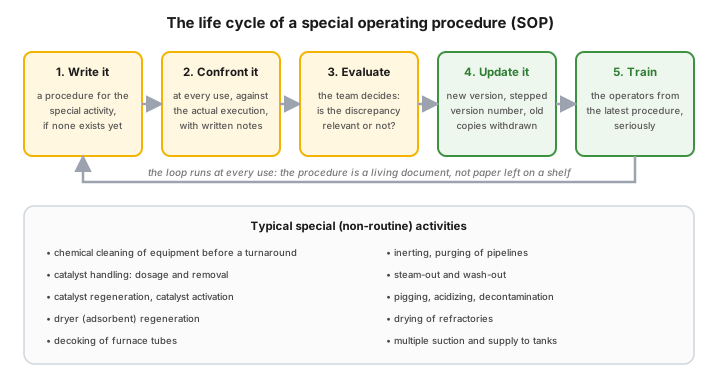 Figure 1 — the life cycle of the SOP. Write it, confront it against reality, evaluate, update, train, and the loop runs again at every use.
Who is this for?
Section titled “Who is this for?”This article is for those who write, approve or use on site the description of rarely performed, critical plant operations.
Field and panel operator · shift supervisor · process engineer · plant manager · reliability engineer · HSE
Learning objectives
Section titled “Learning objectives”After reading this article you will be able to:
- decide which activities need a special operating procedure;
- list the operating phases and the content elements an operating procedure must cover;
- run the life cycle of the procedure from writing it to training on it;
- say how often it must be reviewed, who writes it and who approves it;
- untangle the three different meanings of the abbreviation SOP.
The essence (TL;DR)
Section titled “The essence (TL;DR)”- The precise, written description of a non-routine, critical operation. Precisely because it is done rarely, it is easy to make a mistake.
- A living document: at every use it must be confronted against reality, and the discrepancy must be noted.
- It is updated as a team: the team evaluates the discrepancies (are they relevant?), then a new version is issued.
- Serious training from the new version, not “you read it, you signed it.”
- Typical examples: chemical cleaning before a turnaround, catalyst dosage or removal, catalyst and dryer regeneration, decoking of furnace tubes, inerting, steam-out or wash-out, pigging, acidizing, decontamination.
- A fixed cadence: a thorough review at least once a year, and reauthorization at intervals not exceeding three years.
- A relative of standard work: the SOP is the standard for critical, non-daily operations.
What is a special operating procedure (SOP)?
Section titled “What is a special operating procedure (SOP)?”There are sequences of operations in a plant that an operator may carry out perhaps three times in an entire career. They are not hard because they are more complicated than the daily work, but because there is no routine behind them: no muscle memory, no “last week” experience to calibrate against. The special operating procedure fills exactly this gap.
A special operating procedure is the step-by-step recipe of a non-everyday, critical activity, which the plant’s personnel follow while performing it. The plant’s staff carry out many activities that are not part of the daily routine, so they need to be described precisely, in order not to make a mistake that could jeopardize safety and reliability.
Why write down what we do only rarely?
Section titled “Why write down what we do only rarely?”A rarely performed operation is doubly risky: on the one hand there is little routine, on the other it is often complex and critical (high pressure, high temperature, hazardous medium). The precise, up-to-date procedure is the collective experience put on paper, so that the operation does not have to be “reinvented” every time, and so that nobody has to rely on memory or on oral tradition.
Without a written procedure the knowledge stays inside one person’s head. When that person retires, is on holiday or happens to be on another shift, the operation turns into improvisation at the worst possible moment.
Which activities need a special procedure?
Section titled “Which activities need a special procedure?”A special procedure is needed for operations that are not performed daily, but where a mistake has a direct safety or reliability consequence. Several kinds of special (non-standard) operating procedure can describe the operators’ activities, for example:
| Activity group | Typical operations |
|---|---|
| Equipment cleaning | chemical cleaning of equipment when shutting the unit down to a turnaround (TA); steam-out and wash-out; acidizing; decontamination |
| Catalyst and adsorbent | catalyst dosage or removal from the technological system; catalyst activation; catalyst regeneration; dryer (adsorbent) regeneration |
| Furnace and piping | decoking of furnace tubes; pigging; purging of pipelines outside the battery limits; drying of refractories |
| Inerting and storage | inerting; multiple suction and multiple supply to storage tanks |
The list is not closed: every plant has its own few dozen rare, critical operation sequences. The question is not “is it on the list,” but do we do it rarely, and do we risk a lot if we get it wrong.
What must an operating procedure contain?
Section titled “What must an operating procedure contain?”An operating procedure is complete when it covers every operating phase of the process, contains the safety, health and environmental information, and gives the band of standard operating conditions for every process step. The procedure is not only a description of “what to do,” but also of “what happens if you leave the band.”
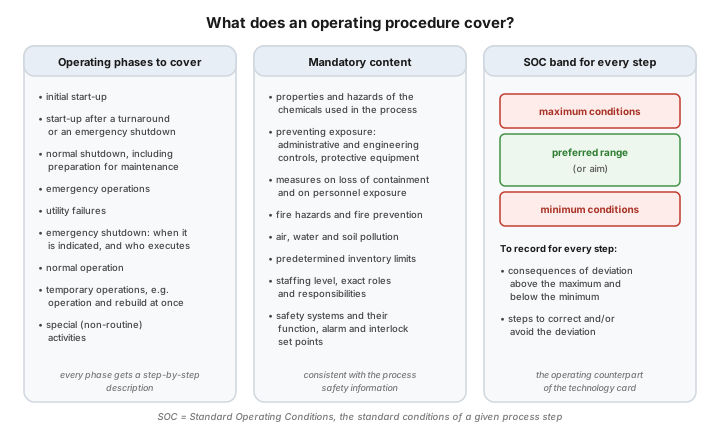 Figure 2 — the operating phases to be covered, the mandatory content elements, and the SOC band (maximum, preferred range, minimum) for every process step.
The phases to be covered. The procedures must address the process steps of the following phases: initial start-up; start-up following a turnaround or an emergency shutdown; normal shutdown (including the preparation of the equipment for maintenance); emergency operations; utility failures; emergency shutdown (recording the conditions under which it is indicated, and that its execution is assigned to a qualified operator); normal operation; temporary operations (for example when the plant produces while a reconstruction is under way); and finally the special, non-routine activities. The details of the shutdown and start-up phases are covered by the SD/SU procedures and checklists.
The mandatory content. The procedure must contain a comprehensive safety, occupational health and environmental section: the properties of, and the hazards presented by, the chemicals used; the prevention of exposure (administrative controls, engineering controls, personal protective equipment); the measures to be taken if loss of containment or personnel exposure occurs; the special hazards (reactivity, thermal load, stored energy); the fire hazards and fire prevention; air, water and soil pollution; the predetermined inventory limits; and the staffing level with the exact roles and responsibilities of the positions. This also includes the description of the safety systems and their function (isolation valves, emergency dump valves, scrubbers, flares), as well as the alarm and interlock set points.
The SOC band. For every process step the standard operating conditions (SOC) must be listed: the maximum, the preferred range or aim, the minimum, the consequences of deviation above the maximum and below the minimum, and finally the concrete steps to correct and avoid it. This is the same logic as the integrity operating windows (IOW) technology card, only seen from the operating-procedure side.
How do you introduce it and keep it current?
Section titled “How do you introduce it and keep it current?”The life cycle of the SOP has five steps, and it runs again after every single use. This loop is what makes the procedure a living document (Figure 1).
- Write the procedure for the particular special activity, if it does not exist yet.
- Confront the current valid procedure at every use against reality, that is, against the actual execution, and make written notes about the new experiences and the actual discrepancies.
- Evaluate the discrepancies within the team: are they relevant or not?
- Update the current version to a new one.
- Train the operators from the latest procedure, seriously.
What format should it be written in?
Section titled “What format should it be written in?”Format is not an aesthetic question but a usability one: a procedure that can be read on site, in protective gloves and a helmet, is a different animal from an office policy. The elements of good practice:
- the preferred format is visualized, with photographs;
- piping and equipment sketches, so that the point described can also be identified in reality;
- the inclusion of checklists and log sheets in the procedure;
- special attention to valve positioning (feed, drain, transfer) and to the possible consequences of mis-manipulation;
- for the phases outside normal operation, an explicit separation of what the automation does, what the field operator does and what the panel operator does;
- a list of trouble-shooting guides which are triggered from the action limits.
How do you manage the versions?
Section titled “How do you manage the versions?”Version control decides whether the procedure actually in hand on site is the valid one. The proven discipline:
| Element | Practice |
|---|---|
| Place of the version number | in the header of the procedure, in a fixed, clearly visible field |
| Small change (a figure, a typo) | the version number increases by 0.1 |
| Larger change (content, target values) | the version number increases by 1 |
| Issuing a new version | the old copies must be withdrawn from circulation, so that there is no confusion |
| Register | a list kept with “latest version / printed / implemented in the plant” columns |
How often must it be reviewed, and who approves it?
Section titled “How often must it be reviewed, and who approves it?”Procedures must be reviewed as often as the change of practice makes it necessary, but they have to be thoroughly reviewed at least once a year, and reauthorized at intervals not exceeding three years. Who owns and who authorizes the procedure is not a formality: this is what gives it authority on site.
- Who writes it? A qualified person trained for this, who also has a technical and an operational background. The ownership must be indicated on the procedure, and it is always written by the owner of the process.
- Who authorizes it? The manager of the plant or of the location.
- Who validates it? Operators must be involved in the preparation and validation of the procedure, not only in the later evaluation, so that the description reflects the current operating practice and so that their suggestions are built in.
- What is it based on? The original process guidelines of the licensor or the contractor and the original equipment manuals of the equipment vendor, consistent with the process safety information.
- How does it change? Changes to the procedure must undergo an authorization process, preferably a management-of-change (MOC) process, before any change to chemicals, technology or facilities. Smaller, “subtle” changes require a similarly strict authorization.
- Where is it? The latest version must always be readily accessible to the operating staff, and it also serves as a training tool.
Special, standard or safe: which SOP?
Section titled “Special, standard or safe: which SOP?”The abbreviation SOP can stand for three different things, and mixing them up causes real misunderstandings in the plant. It is worth clarifying which one we are talking about.
| What SOP stands for | What it is for | Who prepares it |
|---|---|---|
| Special operating procedure | the description of a rarely performed, non-routine plant operation (chemical cleaning, catalyst handling, decoking) | the owner of the process, together with the operating team |
| Standard operating procedure | a repetitive, optimizable intervention with fixed target values (for example setting an energy consumption to the load) | process engineering and operations, updated continuously |
| Safe operating procedure | the step-by-step, safe performance of a high-risk task or activity; its use is mandatory in the activities it covers | the central occupational health and safety organization, with the involvement of the local organizations and in view of the local legal requirements |
Standard-operating-procedure type sheets typically have a fixed structure: the name and number of the equipment, the form of use, the frequency of the change, the manpower needed to perform it, the aim of the activity, the steps of the optimization process, and finally the table of target values. This structure works well as a template for special procedures too, because it forces an answer to the “who, what, when, to which target value” questions every time.
What are safe work practices?
Section titled “What are safe work practices?”Safe work practices are the sibling concept of operating procedures: the system of ultimate basic requirements for non-routine work, applying to site and contractor employees alike. If they are missing, both the safe operation of the plant and the safe performance of non-routine work are compromised.
The typical activities to be described separately are: the workplace handover; the opening of process equipment and piping; the lock-out / tag-out of hazardous energy sources; the mechanical isolation of equipment; the control of ignition sources with a hot work permit; entry into confined spaces; the movement of heavy equipment relative to equipment containing hazardous materials; the integrity check of equipment at turnover from maintenance, before acceptance; the temporary bypass (override) of safety systems; continued operation with an activated process safety alarm; the shift handover; and the logging of field parameters.
What it looks like in practice: chemical cleaning
Section titled “What it looks like in practice: chemical cleaning”Equipment vendors’ chemical cleaning procedures show well what level of detail a real special operation demands, and why it cannot be performed “from memory.”
For the chemical cleaning of a heat exchanger the cleaning agent is determined by the type of deposit: ammonium salts, light gums and polyaromatics, and iron oxides each call for a different solution. The vendor’s procedure describes two methods, the fill-and-drain and the circulation procedure, giving for both the connection points, the necessary equipment, the duration and the valve steps. During draining, samples must be taken at the beginning, in the middle and at the end. The cleaning is considered finished when the analysis of the drained solution conforms to the acceptance criteria: no change in pH, no change in the iron concentration, the chloride content stays below the given limit, and the solution is clear and free of foreign materials. If the solution becomes dirty or saturated, it has to be refreshed and the cleaning restarted. Rinsing with demineralized water is mandatory before opening the equipment and entering it.
With decoking the requirement reaches back into the design: the design of the furnace must take into account from the outset the needs following from the technological procedures for regenerating (decoking) the furnace tubes and for regenerating the reactor catalyst. The procedure is therefore not written at the last minute, but is part of the equipment’s life cycle.
How would you introduce it tomorrow?
Section titled “How would you introduce it tomorrow?”If you are starting from zero, the first procedure can be in place within a week. The pattern carries over to any rare operation.
- List with the team the non-routine operations due in the next quarter, and mark which of them has a valid procedure.
- Pick the one that is due soonest and where the consequence of a mistake is the most severe.
- Have it written by the owner of the process, based on the licensor’s guideline and the vendor’s manual, involving two operators who performed the operation most recently.
- Take it out to the site in print on the day of execution, and assign one person to note the discrepancies on the sheet as the work goes on.
- Sit down with the team for half an hour after the operation: which discrepancy is relevant, which was a one-off. Issue the new version with the relevant discrepancies, and withdraw the old copies.
- Set the date of the next review before you disperse.
Process-industry and safety context
Section titled “Process-industry and safety context”The operations listed (chemical cleaning, catalyst handling, decoking) are among the most hazardous plant activities: they typically involve high temperature, high pressure, toxic or flammable media, and they often take place in the context of a shutdown or start-up or of a turnaround. A botched catalyst handling or decoking can cause a fire, an explosion or a loss of primary containment (LOPC).
That is why the SOP here is not bureaucracy but the protection of life: the precise sequence, the safety precautions and the risk assessment (see LMRA and JSA) built into the description. Serious training before the rare operation and standardized execution reduce the chance of a mistake. Reliability here is primarily safety reliability.
Measurement / audit
Section titled “Measurement / audit”The quality of an SOP is measured by two kinds of indicator: whether the cadence is met and whether it is alive.
| What we measure | The bar |
|---|---|
| Thorough review | at least once a year, for every valid procedure |
| Reauthorization | at intervals not exceeding three years |
| Coverage | is there a valid procedure for every identified non-routine operation |
| Confrontation | how many times it was confronted against reality, and how many discrepancies were noted |
| Incorporation | what percentage of the noted discrepancies appeared in the next version |
| Version discipline | is a single version in circulation on site, and were the old copies withdrawn |
| Training | did the operators concerned receive training from the latest version |
An outdated procedure, not updated for years, is worse than none at all, because it gives false confidence. The bar is simple: every use should leave a trace, and the version of the procedure should follow reality.
Common mistakes
Section titled “Common mistakes”- “We wrote it, we’re done.” The procedure goes on the shelf and slowly drifts away from reality. Why it’s a problem: without regular review and update, the gap between the description and the practice grows unnoticed. Instead: a fixed cadence, a thorough review at least once a year, reauthorization at intervals not exceeding three years.
- No confrontation against reality. The operator does it differently from the description, but nobody notes it. Why it’s a problem: what is really the symptom of an outdated procedure turns into a disciplinary issue and improvisation. Instead: a written note about the discrepancy at every use, followed by a team evaluation.
- Ambiguous wording. The step can be understood in more than one way, the valve position is not unambiguously given. Why it’s a problem: the misunderstanding leads to mis-manipulation and loss of containment. Instead: unambiguous, single-meaning sentences, with special attention to valve positions and to the consequences of mis-manipulation.
- A format that is not transparent. Dense, unstructured text without figures or sketches. Why it’s a problem: it is unusable on site, so it does not get used. Instead: a visualized format with photographs, piping and equipment sketches, a built-in checklist and log sheet.
- Missing important details. The procedure covers normal operation, but not start-up, utility failure or emergency shutdown. Why it’s a problem: there is no recipe for exactly the most critical phases. Instead: check the coverage against the phase list in Figure 2.
- No version control. Nobody knows which procedure is valid. Why it’s a problem: two versions are in circulation, and the old one may be the one at hand on site. Instead: a version number in the header, stepped numbering, withdrawal of the old copies, a register.
- Formal “you read it, you signed it” training. Why it’s a problem: missing or inadequate training is a risk item in its own right; a rare, critical operation cannot be learned from paper. Instead: serious, practical training from the latest version, before the operation.
- A change without change management. Somebody rewrites the procedure “just a little.” Why it’s a problem: a change affecting the technology or the facility gets into practice without authorization. Instead: every change goes through MOC or an equivalently strict authorization.
When NOT to use it (the limits of the method)
Section titled “When NOT to use it (the limits of the method)”The special operating procedure is a powerful tool, but it is not for every situation.
- It does not replace a certified protection layer. The automatic handling of a hazardous state is done by the certified ESD and SIL layer. The procedure complements this, it does not substitute for it; never entrust a protective function to a human sequence of steps.
- An unknown, never-seen state needs something other than a rigid recipe. If the situation falls outside what the procedure was written for, “we follow the list” is not the right answer. Then a risk assessment and an expert decision are needed before anyone touches the system.
- Daily routine does not call for an SOP. Repetitive, everyday work has to be organized with standard work and the standard operator round. If you write a special procedure for everything, the concept loses its value and nobody will take the genuinely critical ten seriously.
- An outdated or untaught procedure. A description that is not updated and not practiced gives false confidence. Update it and train on it first; only then rely on it.
Take it home (keys)
Section titled “Take it home (keys)”- Pick the list. Go through the non-routine operations and mark which of them has no valid procedure. That coverage gap is the starting point.
- Have it written by the process owner, validated by the operator. Indicate the ownership, the authorization belongs to the plant manager, and the validation to those who perform the operation.
- Take notes as you go. The gap between the procedure and reality only feeds back into the next version if somebody writes it down on site.
- Keep the cadence. A thorough review at least once a year, reauthorization at intervals not exceeding three years, and every change through change management.
- Let a single version circulate. Issuing a new version is finished when you have withdrawn the old copies.
- Train, don’t collect signatures. A rare, critical operation needs practical training from the latest version, not a reading declaration.
Self-test
Section titled “Self-test”- Which operating phases must a complete operating procedure cover, and which one is typically missing from your own plant’s documentation?
- What does the SOC band contain for a process step, and why is it not enough to give only the target value?
- What is the difference between the special, the standard and the safe operating procedure, and who prepares each?
How does this show up in digital practice?
Section titled “How does this show up in digital practice?”The life cycle of a procedure does not stop at the printed sheet: the same logic (valid version, recorded discrepancy, verified training) is realized in software too. The mechanism differs, the principle is the same.
| Concept | Digital implementation | What it delivers |
|---|---|---|
| The valid procedure on site | a versioned digital procedure library where only the current version can be opened | an old copy cannot turn up |
| Step-by-step execution | a forced-sequence e-checklist (the next step opens after the previous one is acknowledged) | a critical step cannot be skipped |
| Deviation from reality | an e-log, an entry attached to the step | the discrepancies pile up in a structured way for the next version |
| Who did what and when | a time-stamped audit trail | the course of the operation can be reconstructed afterwards |
| Version-bound training | a training register that refers to the version | it is visible who was trained from which version |
| Review cadence | an automatic reminder for the annual review and the reauthorization | the deadline does not slip unnoticed |
Connection to OPEREX (shift log)
Section titled “Connection to OPEREX (shift log)”The key step of the SOP life cycle, confronting the procedure against reality and noting the discrepancy, fits naturally into the shift log. OPEREX can record who, when, during which special operation observed what, and where the description departed from reality. The log thus collects the raw material for updating the procedure: the actual course of the rare operation is retrievable, and the discrepancies that came up stand in one place, with an owner and a time stamp, available to the team for writing the next version. This is what keeps the procedure a living document. Without the log the experience stays inside one person’s head, and is lost by the next use.
Terminology (HU / EN)
Section titled “Terminology (HU / EN)”| Hungarian | English (canonical) | Note |
|---|---|---|
| speciális üzemeltetési utasítás | special operating procedure (SOP) | a non-routine, critical operation |
| standard üzemeltetési eljárás | standard operating procedure (SOP) | a repetitive intervention with fixed target values |
| biztonságos üzemeltetési eljárás | safe operating procedure (SOP) | the safe performance of a high-risk task |
| üzemeltetési eljárás | operating procedure | part of the operating documentation |
| biztonságos munkavégzési gyakorlat | safe work practice | the basic requirements for non-routine work |
| szabványos üzemeltetési feltételek | Standard Operating Conditions (SOC) | maximum, aim, minimum per process step |
| ütköztetés a valósággal | confront against reality | the basis of the update |
| katalizátor-regenerálás | catalyst regeneration | a typical special operation |
| dekokszolás | decoking | cleaning of furnace tubes |
| zártság-vesztés | loss of primary containment (LOPC) | the medium escaping from the system |
| szabványmunka | standard work | the broader concept |
What is a special operating procedure (SOP)?
The precise, written description of a non-everyday, critical operation (for example chemical cleaning, catalyst handling, catalyst regeneration, decoking of furnace tubes) that the plant’s personnel follow. It has to be documented precisely because a rarely performed operation carries a high risk of error, and the error jeopardizes safety and reliability.
Why is the SOP a "living document"?
Because at every use it must be confronted against reality: the discrepancies are noted, the team evaluates them, the procedure is updated, and the operators are trained from the new version. An outdated procedure gives false confidence, so updating and version control are indispensable.
How often must operating procedures be reviewed?
As often as the change of practice makes it necessary, but they have to be thoroughly reviewed at least once a year and reauthorized at intervals not exceeding three years. Every change to a procedure goes through an authorization process, preferably a management-of-change (MOC) process.
What is the difference between an SOP and the standard operator round?
The round is the regular, daily field check; the special operating procedure is the description of a rarely performed, critical operation. The round is continuous monitoring, while the SOP is the recipe for performing one concrete, non-routine task correctly.
Related concepts
Section titled “Related concepts”the production reliability program · SD/SU procedures and checklists · standard work · management of change (MOC) · integrity operating windows (IOW) · autonomous maintenance · the standard operator round · operational risk assessment
Next step
Section titled “Next step”- SD/SU procedures and checklists — the shutdown and start-up phase has its own procedure and checklist system, with the same updating loop.
- Management of change (MOC) — the gate every change to a procedure has to pass through.
- Integrity operating windows (IOW) and the technology card — the detailed treatment of the SOC band and of deviation handling.
References / further reading
Section titled “References / further reading”- OSHA Process Safety Management, 29 CFR 1910.119(f) “Operating Procedures” — the requirements of the public US process safety regulation for operating procedures (content, phases, review, accessibility).
- CCPS (Center for Chemical Process Safety): process safety guidelines on operating procedures and safe work practices — the relevant element of the risk-based process safety framework.
- Seveso III Directive (2012/18/EU) — the European framework for the prevention of major accidents, which treats operating procedures as part of the safety management system.