Effective meetings
≈ 19 min read · 3,846 words
Nine invitations in your weekly calendar, every one of them well over an hour. By the third you are already looking at your phone, and at the end of the fourth nobody knows who is taking what forward. Your colleagues are not sloppy: what is missing is the handful of rules that turn a discussion into work. Let’s look at how a meeting becomes effective, and what rules cut the time wasted on it.
An effective meeting has a goal you can state in one sentence, only the relevant people attend, and it ends with actions tied to an owner and a deadline.
It starts with a clear agenda, begins and ends on time, the debate is fact-based, and what remains at the end are recorded decisions and actions tied to an owner and a deadline, whose status is reviewed at the next occasion. A meeting is an expensive resource: in large-company surveys a quarter to a third of working time goes on meetings, and roughly half of that is not effective. Three mandatory questions stand before every discussion: is it needed at all, who really must be there, and what will I do to make it focused and interactive?
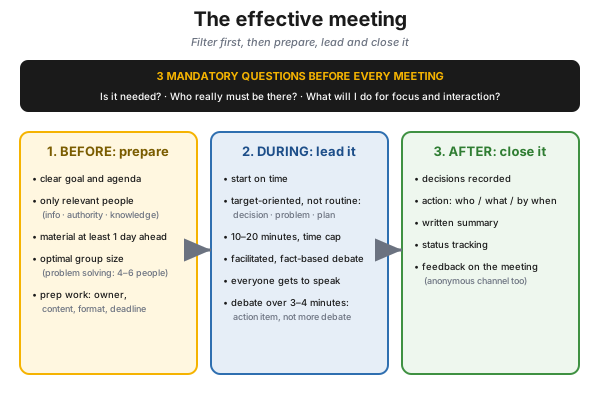
Figure 1 — first the three filter questions, then the key steps of preparation, leading and closing.
Who is this for?
Section titled “Who is this for?”For anyone who leads or sits through several discussions a week and feels that this time does not pay off: shift supervisor · plant manager · process engineer · project manager · maintenance planner · HSE specialist · team leader.
Learning objectives
Section titled “Learning objectives”After this article you will be able to:
- decide whether a meeting is needed at all, and who belongs in the room;
- put together a meeting template (TOR) with a minute-by-minute agenda;
- state and enforce the ground rules;
- score a discussion with a 5/3/1 scorecard;
- decide when a meeting is not the right tool.
In brief
Section titled “In brief”- A meeting is expensive. 9.4 discussions per person per week, 1 hour 15 minutes on average: close to 30% of working time. Roughly half of that is not effective.
- Three mandatory questions before every meeting: Is it needed at all? Who really must be there? What will I do to make it focused and interactive?
- The biggest pain is the decision and the follow-up. 28% of the improvement requests fell here, well ahead of the agenda (15%) and the tools (7%).
- Target-oriented, not routine: decision, problem solving, planning or brainstorming, with a tight time box (10–20 minutes for the compact format).
- Group size has an optimum: 4–6 people for problem solving, 10–15 people for brainstorming.
- Close with action: recorded decisions, actions tied to an owner and a deadline, a written summary, a status review at the next occasion.
- Discipline and equipment go together: rules and a leadership expectation, alongside a usable meeting room, a working web conference and training.
Why it matters (the stakes)
Section titled “Why it matters (the stakes)”Short answer: the meeting is the organization’s largest yet invisible time item, and half of it goes to waste.
According to a survey run in a large corporate group, there are 9.4 discussions per person per week, the average duration is 1 hour 15 minutes, and this takes up 29.7% of working time. Roughly half of the discussions are not effective. The loss can be calculated: the annual cost of meetings is roughly the number of participants × the time spent in meetings × the hourly cost, and half of that is the wasted part, on top of the cost of travel and preparation.
According to a well-known HBR compilation, 91% of meeting participants daydreamed during the discussion, 73% did other work, 45% felt overloaded, and 47% considered the meeting the office’s number one time thief. An overcrowded meeting on top of that pushes toward “social loafing.”
What characterizes a bad meeting?
Section titled “What characterizes a bad meeting?”Short answer: it starts late, too many people sit in it with the wrong authority, and it ends without a decision.
According to a group-level survey (19 questions, 248 usable responses out of some 500 invitations, 95% confidence level, ±6.2% margin of error), fewer than half of the meetings were well managed.
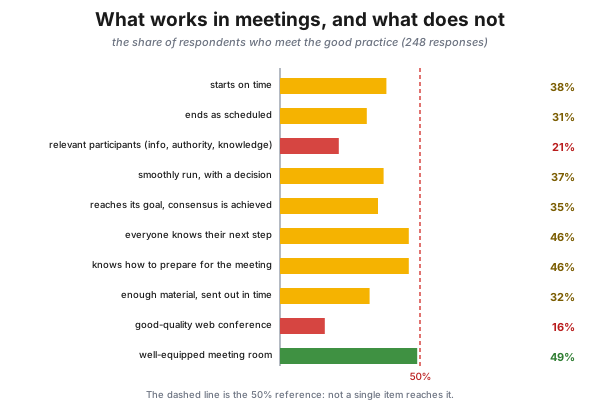
Figure 2 — the key numbers of the survey. Not a single item reaches 50%; the closest is the equipment of the meeting rooms.
The 21% is the worst: this is the share of discussions attended by people who had the right information, decision-making authority and knowledge at the same time. The lack of authority explains why only 35% reach consensus or their goal. 46% of participants knew how to prepare, and only 32% received enough material early enough to form an opinion.
The trouble is partly the lack of discipline and structure, partly the missing equipment and training background. The proposals also fell into two groups: culture-side requests (rules, preparation, leadership expectation) and investment-side requests (modern meeting rooms and IT tools, training). The latter is not a side issue: only 16% used a good-quality web conference, and one fifth of the improvement requests concerned tools.
How does a meeting become effective?
Section titled “How does a meeting become effective?”Short answer: three mandatory questions before the invitation, then conscious preparation, facilitated leading and closing with action.
The methodology puts three mandatory questions before every discussion:
- Is the meeting needed at all? Look for a solution that takes less time: a message, a newsletter, a feedback line, an internal platform. 78% of employees prefer to give feedback anonymously, so where honest opinion is needed, an anonymous channel delivers more than yet another discussion.
- Who really must be there? The invitation should not be an “everyone concerned” circular. Invite the minimum number of people, and clarify the roles. The reason for attendance is always concrete: information, decision-making authority or knowledge.
- What will I do to make it focused and interactive? Three things are needed together: a clear agenda, material sent out in advance and engaged participants. The document to be read should go out at least one day earlier, and the preparation should be specified exactly: owner, content, format, deadline.
The rest of the practice builds on these. Before: the goal can be stated in one sentence, and you also record the expected outcome in advance. During: start on time, do not wait for the latecomers, appoint a facilitator, and let everyone get at least a minute for their opinion. After: record the decisions, assign an owner and an estimated date to every action, produce a written summary, and from time to time ask the participants about the quality of the discussion.
What rules cut the time wasted on meetings?
Section titled “What rules cut the time wasted on meetings?”Short answer: a short list of ground rules, stated out loud and posted on the wall, that governs time, the quality of the debate and the actions.
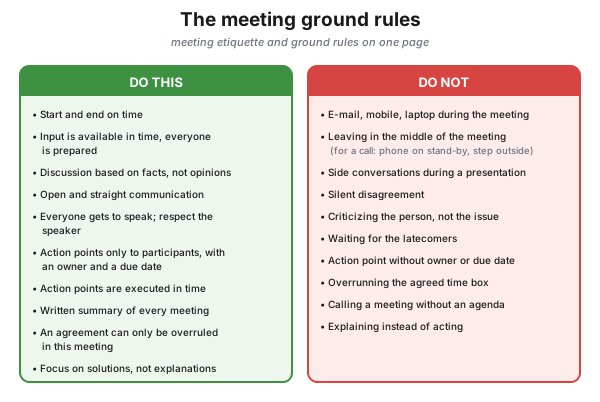
Figure 3 — the left column is the practice to keep, the right one is the named prohibition.
The list governs three things. Time: start and end on time, do not wait for the latecomers, do not overrun the time box. The quality of the debate: fact-based argument, open communication, everyone gets to speak, we criticize the issue instead of the person, and there is no silent disagreement. The actions: an action point can only be assigned to a participant, with an owner and a due date, a written summary is produced of every discussion, and an agreement can only be overruled in this meeting.
Two rules turn the conversation into work. The first: if a debate goes on for more than 3–4 minutes, do not continue it, but assign an action point to obtain the missing information. The second: the action log should contain not only the task, but also who will deliver the feedback, by when, and what additional information is needed, while the comments column should say how it was delivered, whether it was understood, and what the next step is.
How big and how long should a meeting be?
Section titled “How big and how long should a meeting be?”Short answer: the group size depends on the purpose, and the time box should be tight: the recommendation for the target-oriented format is 10–20 minutes.
| Meeting type | Optimal group size | Why this many |
|---|---|---|
| problem solving, decision | 4–6 people | authority and focus are needed; a large circle dilutes responsibility |
| brainstorming | 10–15 people | here the diversity of viewpoints is the value |
For less complex matters use a stand-up or walking meeting, with a single agenda item: the body position keeps it short by itself.
What should the meeting template contain?
Section titled “What should the meeting template contain?”Short answer: every recurring discussion needs a common template (meeting TOR) that records the frame, the minute-by-minute agenda, the ground rules and the inputs and outcomes.
| Field of the template | What it records |
|---|---|
| frequency, day, start time, duration, location | the cadence, so that it need not be reorganized |
| leader, mandatory and optional attendees | who facilitates, and whose authority or knowledge is needed |
| objectives | progress, due dates, actions and decisions, blocking points, escalation |
| minute-by-minute agenda | so that the time box can actually be kept |
| KPIs | which indicators are reviewed at every occasion |
| ground rules | the rules posted on the wall, not stated verbally |
| inputs | updated action log, milestones, deliverables |
| outcomes | escalation decision, updated action log, status report |
The minute-by-minute agenda is the most useful part, because this is what makes the time limit feasible. A proven agenda for a weekly progress meeting: safety message (1 min), action log review (5 min), last week’s activities (3 min), the next three weeks (3 min), status report (2 min), and finally a repetition of the actions and decisions taken during the meeting (1 min). The last item is the most important: this is what prevents participants from leaving with different recollections.
Introduction in practice
Section titled “Introduction in practice”Short answer: measure first, then introduce, then measure again with the same method.
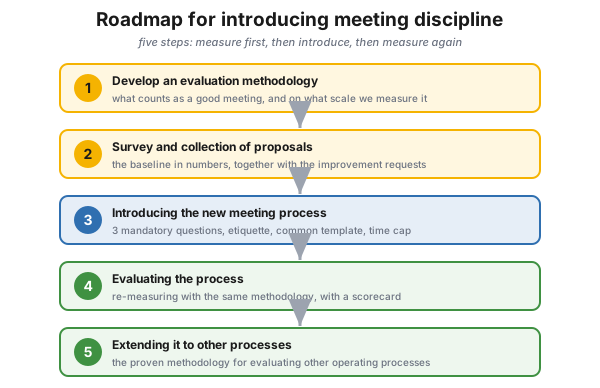
Figure 4 — the five-step roadmap. The introduction only holds if the evaluation is part of it.
- Develop an evaluation methodology. For preparation, for instance, three levels are enough: at the lowest the goal is unknown, at the middle one the goal is known but the participants do not know what and how to prepare, and at the top the goal is clarified, everyone knows in advance what is expected of them, and is able to prepare.
- Survey the baseline, together with the improvement requests. The weighting is telling: 28% of the requests targeted decision making and follow-up, 19% preparation time, 17% meeting management, 15% the agenda, 13% IT support and 7% the location and the equipment.
- Introduce the new meeting process: the three mandatory questions, the posted ground rules, the common template and the time box all at once.
- Evaluate the process with the same methodology, using a scorecard.
- Extend the methodology to the evaluation of other processes.
Hands-on: a shift supervisor’s first week (mini-scenario)
Section titled “Hands-on: a shift supervisor’s first week (mini-scenario)”- List your recurring discussions (15 minutes), and write the goal next to each in one sentence. Whichever resists this is a candidate for deletion or merging.
- Pick the most painful one, and fill in a template for it (30 minutes): frame, participants, minute-by-minute agenda.
- Post the ground rules, and read them out at the first occasion. A rule lives because it was stated.
- Keep an action log with an owner and a due date, and let the first agenda item of the next occasion be the review of this.
- Score yourself on the three rows of the scorecard across four occasions, and see whether the action-item row moves.
How can the effectiveness of a meeting be measured?
Section titled “How can the effectiveness of a meeting be measured?”Short answer: you give 5, 3 or 1 point to three focus areas, then after the discussion you assign actions in a short debrief.
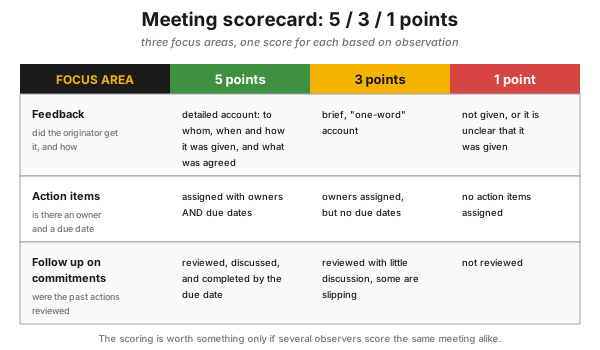
Figure 5 — the meeting scorecard. The description of the levels is needed so that two observers see the same thing in the same meeting.
| Focus area | 5 points | 3 points | 1 point |
|---|---|---|---|
| Feedback | a detailed account of to whom, when and how it was given, and what was agreed | a brief, “one-word” account | it did not happen, or it is unclear that it happened |
| Action items | assigned with an owner and a due date | owner assigned, without a due date | no action item assigned |
| Follow up on commitments | reviewed, discussed, completed by the due date | reviewed, with little discussion, some of them slipping | not reviewed |
Scoring on its own improves nothing. The coaching cycle has four steps: the observer prepares with those concerned, assesses and fills in the scorecard, after the meeting debriefs what was observed and assigns actions, and finally updates the improvement tracker and the action log. This loop is what turns the scorecard from measurement into improvement, in the same way as in the performance dialogue.
The plant and shift context
Section titled “The plant and shift context”Short answer: in continuous operation a meeting is not a standalone event but a link in a daily and weekly rhythm.
The shift handover, the daily plant meeting, the performance dialogue and the weekly problem-solving round form a single operating rhythm: each has its input, its output and the next link it hands over to. Maintenance and the operations team have separate rhythms, but the two meet, for example where a technological problem raised at the daily meeting moves into the weekly problem solving. If you do not design the rhythm, the same topic comes up in three places and is closed nowhere. The wider frame is the management operating system.
The recipe applies to these formats too. The standard operator round and the shift handover are structured, “built-in” discussions from the start, whose quality is raised by the agenda, the time box and the recording of actions. The actions of a well-closed discussion are exactly the content worth recording in the trackable log, and reviewing at the next occasion.
Common mistakes
Section titled “Common mistakes”- A meeting even where a message would do. Instead: if the goal cannot be stated in one sentence, do not call it.
- An overcrowded set of participants. It dilutes responsibility. Instead: 4–6 people for problem solving, with stated roles.
- The experts are present, but there is no authority. The worst item of the survey. Instead: clarify in advance who can decide.
- Late start, overrunning close. Instead: start without the latecomers, and break the agenda down to minutes.
- Closing without a decision and an action. Instead: the last agenda item is always the repetition of the actions and decisions.
- Dragging out the debate while information is missing. Instead: after 3–4 minutes, an action point for the missing data.
- Arriving unprepared. Instead: the reading material should go out one day earlier.
When NOT to use it? (the limits of the method)
Section titled “When NOT to use it? (the limits of the method)”Short answer: there are cases where a discussion is not the right tool, and cases where shortening it and cutting the number of participants is outright harmful.
- For one-way information transfer. Without debate and decision, the meeting format is a waste. Instead: a written briefing or a newsletter.
- Where the decision is an individual authority. A discussion here is a blurring of responsibility. Instead: let the holder of the authority decide, and communicate the reasoning.
- In crisis and emergency communication. The sequence is set by the alarm and the emergency procedure. Instead: escalation according to the procedure.
- In incident investigation, a HAZOP or a risk assessment workshop. These are deliberately long and broad, because completeness is the goal; the “10–20 minutes, minimum headcount” rule is a safety risk here. Instead: the composition and time frame prescribed by the methodology. The same holds for the safety-critical content minimum of the shift handover.
- In a matter of trust or a personal matter. Performance feedback or a conflict is not a group agenda item. Instead: a one-to-one conversation (assertive communication).
How does it show up in digital practice?
Section titled “How does it show up in digital practice?”Meeting discipline does not live in the rulebook, but in a system making good practice harder to bypass and measurable afterwards.
| Element of the method | Digital implementation | The value |
|---|---|---|
| the three mandatory questions | mandatory goal and outcome field in the invitation | there is no invitation without a goal, and it can be filtered afterwards |
| meeting TOR | a template attached to the recurring discussion, with a minute-by-minute agenda | the frame is not an ad-hoc decision but a setting |
| action item | a logged task recorded with an owner and a due-date field | the action is trackable, it is not lost in the notes |
| status review | an automatic list of the open actions from the previous occasion | the first agenda item generates itself |
| scorecard and feedback | an assessment sheet as a time series, with an anonymous questionnaire | progress is measurable, and the answer is honest |
Take it home (keys)
Section titled “Take it home (keys)”- Start with deletion. The first question is not how the meeting could be better, but whether it is needed.
- One sentence, or no meeting. If you cannot state the goal in one sentence, do not call it.
- Invite authority, not headcount. The weakest item of the survey was the lack of authority.
- A minute-by-minute agenda. The time box is not kept by willpower, but by a plan broken down into minutes.
- An action only with an owner and a deadline. Without this, the discussion remains a memory, not a result.
- The first agenda item is always the last occasion’s action, otherwise the follow-up dies out.
- Measure it, don’t feel it. Four occasions of scorecard scoring say more than any impression.
Self-test
Section titled “Self-test”- What are the three mandatory questions before every meeting, and which threefold requirement does the third one cover?
- What is the optimal group size for problem solving and for brainstorming, and why do the two differ?
- In a discussion the debate is still going in the fourth minute, and the action point is created without an owner. Which two rules were breached, and how many points is this worth on the action-item row of the scorecard?
Answer key
- (1) Is it needed at all, or is there a less time-consuming solution? (2) Who really must be there because of information, authority or knowledge? (3) What will I do to make it focused and interactive? The third covers three things together: a clear agenda, material sent out in advance, engaged participants.
- 4–6 people for problem solving, 10–15 people for brainstorming. A decision needs focus and authority, so the tight circle is the advantage; in idea generation, on the other hand, the diversity of viewpoints is the value.
- The “an action point instead of a debate longer than 3–4 minutes” and the “an action point only with an owner and a due date” rules were breached. On the action-item row of the scorecard this is 1 point, because without an owner there is no valid assignment.
Terminology (HU / EN)
Section titled “Terminology (HU / EN)”| Hungarian | English | Note |
|---|---|---|
| napirend | agenda | the objectives and items of the meeting, broken down to minutes |
| moderálás | facilitation | keeping the focus and the time |
| célorientált meeting | target-oriented meeting | decision, problem, plan, brainstorming |
| akciópont | action item | owner + due date |
| akciónapló | action item log | the open actions and the trace of the feedback |
| értekezlet-sablon | meeting terms of reference (TOR) | frame, agenda, inputs and outcomes |
| játékszabályok | ground rules | the posted behavioural rules of the discussion |
| meeting-scorecard | meeting scorecard | a 5/3/1 point assessment sheet |
| social loafing | social loafing | the dilution of responsibility in a large circle |
What makes a meeting effective?
A goal that can be stated in one sentence and a minute-by-minute agenda, the presence of only the relevant participants with the right information, authority and knowledge, starting and ending on time, a facilitated, fact-based conduct, and closing with concrete decisions and actions tied to an owner and a deadline.
What are the three mandatory questions before every meeting?
(1) Is the meeting needed at all, or is there a less time-consuming solution? (2) Who really must be there, that is, whose presence is needed because of information, decision-making authority or knowledge? (3) What will I do to make it focused and interactive, that is, is there a clear agenda, did the material go out in advance, and are the participants engaged? If any of them has no good answer, do not call it.
How many people are ideal in a discussion?
It depends on the purpose. For problem solving and decision making the recommendation is 4–6 people, because focus and decision-making authority matter here; for brainstorming 10–15 people, because there the diversity of viewpoints is the value. Too large a circle reduces individual responsibility (social loafing), and encourages pointing at others instead of solving the problem.
What rules are worth posting in the meeting room?
Start and end on time; the input is available in time and the participants are prepared; fact-based debate; everyone gets to speak; an action point can only be assigned to a participant, with an owner and a due date; an agreement can only be overruled in this meeting. On the prohibition side: no e-mailing and no mobile phone during the discussion, no leaving in the middle, no side conversations, no silent disagreement, and we do not criticize the person.
How can the effectiveness of a meeting be measured?
By observation and a scorecard, with 5, 3 or 1 point given to three focus areas. Feedback scores 5 points if there is a detailed account of to whom, when and how it was given; the action items if they also have an owner and a due date; the follow-up on commitments if the actions were reviewed and completed by the due date. A debrief and the assignment of actions belong to the scoring, otherwise it remains mere data.
Related concepts
Section titled “Related concepts”time management · eisenhower-matrix · assertive communication · feedback · shift handover · performance dialogue · mos · leading project teams
Next step
Section titled “Next step”From here it is worth going on, in this order:
- shift handover — the most important recurring discussion in the process industry.
- performance dialogue — linking measurement and conversation, the big brother of the scorecard logic.
- mos — the system that strings the discussions into a single daily and weekly rhythm.
References / further reading
Section titled “References / further reading”- Harvard Business Review meeting research: the ratios cited in the article (91%, 73%, 47%) come from this body of work.
- The Ringelmann effect and social loafing: Max Ringelmann’s tug-of-war experiments, then Latané, Williams and Harkins (1979) on individual effort diluting within a group.
- Stephen R. Covey: The 7 Habits of Highly Effective People. Free Press, 1989: the meeting as a typical “time thief,” in the Q3 quadrant.