Asset management and ISO 55000
≈ 14 min read · 2,774 words
“Who is responsible for the perimeter fence?” A question this simple can stall an investment debate: if the boundaries of the asset base, the accountabilities and the decision rules are not written down, every decision turns into an individual bargain.
Asset management (AM) is the coordinated activity by which an organization realizes value from its assets (ISO 55000). It is a verb, not a noun.
Applying it requires an asset management system, whose requirements are set out in ISO 55001. The backbone of the framework is a document hierarchy: the policy (AMP), the strategic plan (SAMP), the objectives, and then the plans that cover the whole life cycle.
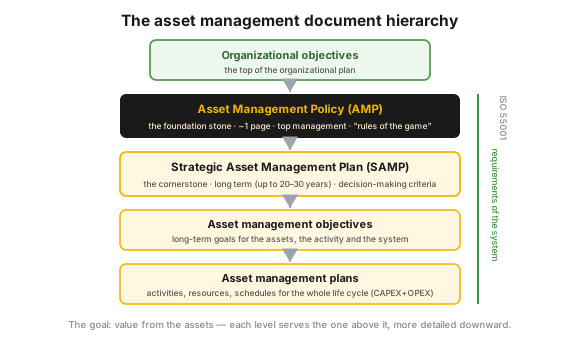 Figure 1 — the AM document hierarchy: each level serves the one above it and is more detailed going down.
This is the base article of the chapter’s yellow (Asset Management) domain: the elaboration of the “AM” knowledge domain of the long-term reliability program.
Who is this for?
Section titled “Who is this for?”For those who decide on the life cycle of assets, or live with the consequences of those decisions: plant manager · process engineer · maintenance manager · reliability engineer · asset management specialist · capital project engineer · controlling · HSE.
Learning objectives
Section titled “Learning objectives”After reading this article you will be able to:
- distinguish asset management, the asset management system and ISO 55001;
- draw the AMP–SAMP–objectives–plans hierarchy, and say what belongs on which level;
- derive the objectives from the stakeholder values, and assign measures to them;
- recognize when the AM system is not the right tool.
The essence
Section titled “The essence”- AM = coordinated activity to realize value from the assets (ISO 55000). “A verb, not a noun.”
- Four main areas: strategy and plans · risk management · decision-making · asset knowledge; their purpose is transparent and consistent decision-making.
- The backbone: AMP → SAMP → AM objectives → AM plans. The AMP is the foundation stone (~1 page, top management), the SAMP is the cornerstone (up to 20–30 years, decision-making criteria).
- The AM plans cover the whole life cycle (CAPEX+OPEX); the main challenge is alignment.
- The requirements of the system are described by ISO 55001 (PDCA/Annex SL); its predecessor is PAS 55.
Why it matters (the stakes)
Section titled “Why it matters (the stakes)”What is at stake in AM is whether you make the decision about an asset from an informed position, or on the basis of the purchase price. If only the capital cost counts, the high maintenance demand, the separate certification requirement and the operating constraint only become visible years later, when changing them is already expensive.
What is asset management?
Section titled “What is asset management?”Asset management is a philosophy: a collection of principles serving the more effective delivery of the tasks. Applying it consistently requires an asset management system: a set of policies, processes and procedures that supports risk management and PDCA-based continual improvement (Plan–Do–Check–Act).
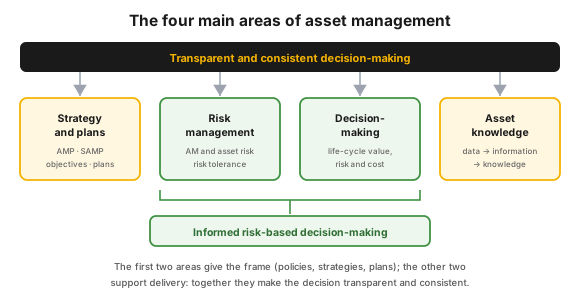 Figure 2 — the four main areas of asset management; the middle two together serve informed risk-based decision-making.
AM breaks down into four main areas: strategy and plans, risk management, decision-making and asset knowledge. The policies, strategies and plans answer the questions of the first two areas and support the delivery of the other two; risk management and decision-making together give informed risk-based decision-making (see risk management), and the purpose of the frame is transparent and consistent decision-making.
How is the AMP–SAMP–objectives–plans hierarchy built up?
Section titled “How is the AMP–SAMP–objectives–plans hierarchy built up?”On four levels, each more detailed than the one above. The AMP states the principles and the decision-making “rules of the game”, the SAMP translates the organizational objectives into AM language and sets out the long-term strategy, from which the AM objectives are derived, and these are delivered by the AM plans (Figure 1).
The asset management policy (AMP)
Section titled “The asset management policy (AMP)”The AMP is the foundation stone of the system: the organization’s official asset management intentions and direction, formulated by top management. It contains the organizational objectives, the AM principles, the commitment to continual improvement and the frame for setting the AM objectives.
The AMP is typically a single page or shorter, and is a useful tool in communicating the principles internally and externally. The commitment of top management is critical: skimming it out of politeness is not enough, it has to be owned visibly to everyone (see leadership support).
The strategic asset management plan (SAMP)
Section titled “The strategic asset management plan (SAMP)”The SAMP (or AM strategy) is the cornerstone of the system: the long-term strategy for managing the asset base. Here the long term means up to 20–30 years (as against the 1–3 years of maintenance and business planning), and it must reflect the life of the asset (from creation to disposal) and the organization’s AM life cycles; the two may differ (Figure 4).
The SAMP is derived from the organizational plan, sets out the AM objectives and their link to the organizational goals, along with the operating rules and decision-making criteria. Its development contains four elements for certain:
- Starting point — what asset base we have, where it is, with what function; where the boundaries run and who is accountable; and where we stand in AM maturity, where we want to get to, and how we get there.
- Results to be achieved — carrying the stakeholder needs over into the aligned objective hierarchy (financial, safety, environmental, people, physical).
- Scope of the SAMP — schedules, the boundaries of the asset base, accountabilities, the asset management system.
- Rules of the game — ISO 55001 requires decision-making criteria; the SAMP records and communicates them.
Asset management objectives and the vision
Section titled “Asset management objectives and the vision”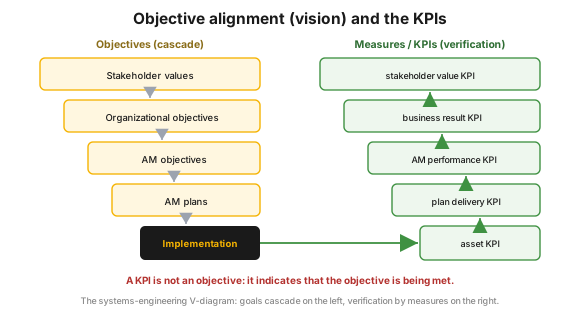 Figure 3 — the vertical alignment of the objectives and the KPIs as indicators of delivery.
The AM objectives are the long-term goals for the assets, the AM activity and the AM system: if the AMP is the organization’s “lifestyle”, these are the “life goals”, and the SAMP is the road that leads there. The vertical link runs from the stakeholder values through the organizational objectives and the AM objectives to the AM plans, and finally to the implementation goals (Figure 3).
Measures are needed at every level to assess the status. One thing matters, though: KPIs are not objectives but indicators (see reliability KPIs). On the left arm of the systems-engineering V-diagram stands the cascade of the goals, on the right their verification by measures.
Asset management plans and the life cycle
Section titled “Asset management plans and the life cycle”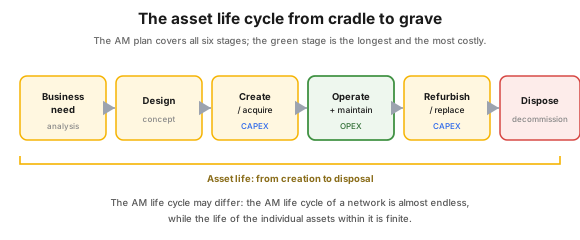 Figure 4 — the asset life cycle from cradle to grave.
The AM plan details the activities, resources and schedules needed to deliver the objectives, for the whole life cycle. It therefore carries both CAPEX and OPEX spend, and lives in different systems (a Gantt chart for the new facility, CMMS work orders for maintenance).
The greatest challenge is alignment: how often is a capital plan drawn up without the maintenance planning requirements? Breaking down the organizational silos is a cultural challenge, resolved by top-management support and collaborative processes. The AM plans have to be underpinned by financial, HR, IT, communication and HSE plans.
The ISO 55000 family of standards
Section titled “The ISO 55000 family of standards”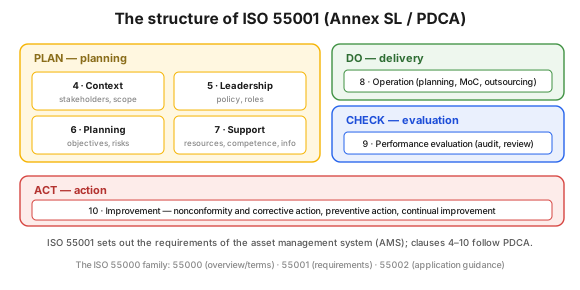 Figure 5 — ISO 55001 follows the PDCA cycle (Annex SL).
The ISO 55000 family consists of three standards: ISO 55000 (overview, principles, terminology), ISO 55001 (the requirements of the system), ISO 55002 (application guidance). Its predecessor is the British PAS 55.
ISO 55001 follows the structure of ISO Annex SL (the common management system structure) and the PDCA cycle (Figure 5). Clauses 4–7 are the planning side: context and scope, leadership and the policy (AMP), risks and AM objectives, support (resources, competence, information). Clauses 8–10 are execution and feedback: operation and management of change (MoC), performance evaluation and internal audit, and finally nonconformity and continual improvement.
Asset knowledge and corporate responsibility
Section titled “Asset knowledge and corporate responsibility”Asset knowledge is the fourth main area of AM and the basis of risk-based decision-making: the organization’s collective knowledge about the asset base and the AM system. It is managed not by the systems but by the people, and it only becomes real knowledge if it is accessible. It comes in two forms: codified (explicit) knowledge, which can be captured in a document or a database, and tacit knowledge, which comes from experience and intuition. The latter is hard to transfer, but it is about the work as actually done rather than the documented process, which is why it matters as much in a decision as the hard data. Identifying the asset information requirements is a cross-functional task (finance, procurement, operations, engineering, HR), not the responsibility of the IT department.
Corporate responsibility (CR) is also part of AM; its typical areas are business ethics and ethical procurement, community investment, human rights, sustainability and stakeholder relations.
Industrial and safety context
Section titled “Industrial and safety context”ISO 55000 is industry-independent: it applies to any asset-intensive organization (energy, manufacturing, chemicals, utilities, transport). The safety and environmental stakeholder values belong among the SAMP’s decision-making criteria: that is where the balance between safety, environment and finance has to be struck. In a process-industry (for example Seveso) plant the AM system is what ties criticality, the reliability strategy and risk management into a single, auditable value-creation chain.
Common mistakes
Section titled “Common mistakes”- Reading AM as “maintenance”. Correctly: tie the investment and disposal decisions to the AM objectives too; AM coordinates the whole life cycle.
- An AMP without top-management commitment — the policy stays paper. Correctly: top management owns it visibly and refers to it in its decisions.
- A short-horizon SAMP. Correctly: the horizon should follow the life of the asset (up to 20–30 years), not the business cycle.
- Narrowing the AM decision to life-cycle cost. It is a common error to think the decision revolves only around life-cycle cost (LCC, TCO); the value gained from the asset and the risk taken over the life cycle are commensurable with it. Correctly: identify the life-cycle value, risks and costs, then choose the simplest possible evaluation method.
- Silo planning — misaligned capital, maintenance, HR and HSE plans. Correctly: cross-functional plan review with supporting plans.
- Missing decision-making criteria — without them every decision is an individual bargain. Correctly: let the SAMP record and communicate them, as ISO 55001 requires.
Introduction in practice
Section titled “Introduction in practice”- Write the short (1-page) AMP, and secure the visible commitment of top management.
- Develop the SAMP: starting point, results to be achieved, scope, rules of the game.
- Align the objectives from the stakeholder values down to the AM plans, and assign measures to them.
- Plan for the whole life cycle (CAPEX+OPEX), and connect the supporting plans.
- Align to ISO 55001 (clauses 4–10, PDCA), then audit and improve.
Hands-on
Section titled “Hands-on”- A 90-minute decision-criteria workshop: 15 minutes to collect the stakeholder values, 30 minutes to formulate the criteria (safety, environment, finance, reliability), 25 minutes for weighting and resolving conflicts, 20 minutes to write the decision rule on a single page. The output is the “rules of the game” chapter of the SAMP.
- Homework: write the 1-page AMP in five blocks (organizational objectives, AM principles, commitment to continual improvement, the frame for setting objectives, accountabilities).
When NOT to use it? (the limits of the method)
Section titled “When NOT to use it? (the limits of the method)”An AM system under ISO 55001 gives an organizational frame; it does not answer a single technical question.
| Situation | Why the AM system is not the answer | The right tool |
|---|---|---|
| A decision is needed for a single machine | the AM system is a frame, not an asset-level analysis | FMEA, criticality analysis |
| There is no top-management mandate | without commitment the AMP and the SAMP stay paper | first leadership support |
| There is no demonstrable asset data | a decision criterion does not work without data | first asset knowledge, a CMMS base |
| A certified safety function is needed | the AM system is not a protective layer | LOPA/SIL, HAZOP |
Take it home (keys)
Section titled “Take it home (keys)”- Asset management is a verb. You are not introducing a document but a way of deciding: the paper is worth something only if the decisions follow it.
- The rule first, the project second. Write the decision criteria into the SAMP before the first contested investment lands on your desk.
- Long term here means 20–30 years. If the SAMP’s horizon is the business plan’s, you do not have a SAMP.
- Value and risk alongside cost. The cheapest purchase is often the most expensive to operate.
- Data is not an IT matter. The asset information requirement is formulated by the business, cross-functionally.
Self-test
Section titled “Self-test”- What is the difference between asset management and the asset management system, and which one does ISO 55001 describe?
- What are the SAMP’s decision-making criteria good for, and what happens if they are missing?
- A manager says: “the essence of AM is the lowest life-cycle cost.” What does this leave out?
Answer key: 1) Asset management is the coordinated activity by which value is realized from the assets; the system is the set of policies, processes and procedures that supports this, and it is the requirements of that system that ISO 55001 describes. · 2) Competing demands are weighed by the same rule; without them every decision is an individual bargain. · 3) The value gained from the asset and the risk taken over the life cycle.
How does this show up in digital practice?
Section titled “How does this show up in digital practice?”The AM framework works on paper too, but it becomes auditable in software.
| AM element | Digital implementation | What it delivers |
|---|---|---|
| Asset base and boundaries | asset register, hierarchical asset records | clarified scope and accountability |
| AM plan (maintenance) | scheduled work order in the CMMS | execution is logged, not merely intended |
| Asset knowledge | data dictionary, metadata, asset taxonomy | the data is searchable and comparable |
| Decision-making criteria | criteria matrix in the investment approval | every proposal is measured by the same rule |
| Delivery of the AM objectives | asset condition and performance dashboard | the measure is visible tied to its objective |
Connection to OPEREX (shift log)
Section titled “Connection to OPEREX (shift log)”The AM plans — the maintenance plan in particular — live in the CMMS; the shift log (OPEREX) makes the delivery of the AM objectives measurable at shift level (availability, events, plan vs. actual deviation), and gives the daily trail of the stakeholder values (safety, environment). This creates feedback between the SAMP goals and execution: the daily shift event flows back as data into the objective hierarchy.
Terminology (HU / EN)
Section titled “Terminology (HU / EN)”| Hungarian | English (canonical) | Note |
|---|---|---|
| Eszközgazdálkodás | Asset Management (AM) | a verb, not a noun |
| Eszközgazdálkodási politika | Asset Management Policy (AMP) | the foundation stone |
| Stratégiai eszközgazdálkodási terv | Strategic Asset Management Plan (SAMP) | the cornerstone |
| Eszközgazdálkodási stratégia | Asset Management Strategy (AMS) | a synonym of the SAMP |
| Eszközgazdálkodási rendszer | Asset Management System | the subject of ISO 55001 |
| Életciklusköltség | Life-cycle cost (LCC / TCO) | CAPEX + OPEX |
| Döntéshozatali kritérium | Decision-making criteria | the “rules of the game” |
The terminology follows the usage of Uptime Elements and ISO 55000.
What is asset management under ISO 55000?
A coordinated set of activities by which the organization realizes value from its assets. The emphasis is that this is a verb: continuous action, not a static thing.
How do the AMP, the SAMP, the objectives and the plans relate to each other?
As a hierarchy: the AMP (policy) is the foundation stone, the SAMP is the cornerstone (long-term strategy and decision rules), from these the AM objectives are derived, and then the life-cycle AM plans that deliver them.
What does ISO 55001 require?
The requirements of the asset management system, following the PDCA/Annex SL structure: 4 context, 5 leadership, 6 planning, 7 support, 8 operation, 9 evaluation, 10 improvement.
What is the difference between the life of an asset and the AM life cycle?
The asset life runs from the creation of the physical asset to its disposal, whereas the AM life cycle is the time frame of the organization’s AM activity; the two may differ.
Is a KPI the same as an objective?
No. The objective is the goal; the KPI is an indicator of its delivery. On the left arm of the V-diagram stands the cascade of the goals, on the right their verification by KPIs.
Related concepts
Section titled “Related concepts”long-term reliability program | risk management | reliability KPIs | reliability strategy | criticality analysis | FMEA | CMMS | preventive maintenance | operational excellence | root cause analysis
Next step
Section titled “Next step”If you have understood this, from here it is worth going on — in this order:
- risk management — how risk becomes an input to decisions.
- reliability KPIs — the measures with which you verify the delivery of the AM objectives.
- long-term reliability program — how all of this becomes a led program.
References / further reading
Section titled “References / further reading”- ISO 55000:2014 — Asset management. Overview, principles and terminology.
- ISO 55001:2014 — Asset management. Management systems. Requirements.
- ISO 55002:2014 — Management systems. Guidelines for the application of ISO 55001.
- ISO 31000:2009 — Risk management. Principles and guidelines. The basis of the risk management area of AM.
- BSI PAS 55 — the British specification for the optimal management of physical assets, the predecessor of ISO 55000.
- Institute of Asset Management (IAM) — the professional institution behind PAS 55 and ISO 55000.
- Reliabilityweb.com — Uptime Elements — a public reliability framework; AM is a standalone domain there.