Assertive communication
≈ 17 min read · 3,477 words
Assertive communication is the healthy middle way of self-assertion: you state what you want openly and respectfully, weighing the other’s interest too.
The passive style sacrifices its own interest for the other’s, so the need is suppressed and tension builds up; the aggressive style forces its own above the other’s, so it breeds resistance and damages the relationship. The assertive style turns both parties’ interests toward the shared problem, and so looks for a joint solution. Its main tools are the I-statement, active listening (mirroring the content and the emotion) and the deliberate calming of emotional flooding.
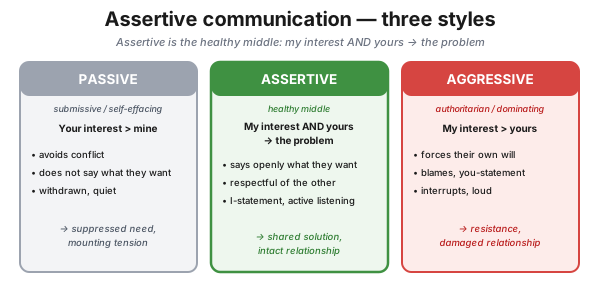
Figure 1. The three communication styles. Assertive is the healthy middle: my interest AND yours, turned toward the shared problem.
Who is this for?
Section titled “Who is this for?”For those who regularly have to raise an uncomfortable topic, where the outcome of the conversation affects others as well. shift supervisor · plant manager · process engineer · control room operator · maintenance manager · HSE specialist · dispatcher · project manager · Lean/CI coordinator.
Learning objectives
Section titled “Learning objectives”After reading this article you will be able to:
- distinguish the three styles by whose interest prevails;
- build a four-step assertive message (behaviour, impact, feeling, request);
- mirror on two levels, and recognize when the emotion has to be handled first;
- receive criticism aimed at you assertively, and place yourself on a five-level assertiveness scale.
In brief
Section titled “In brief”- At the shift handover a colleague hands over half-finished work. You have three possible reactions: you swallow it, you blow up (“you always…”), or you say what happened, what the consequence is for you, and what you are asking for. Only the third solves the problem with the relationship intact.
- Three styles: passive (your interest > mine), aggressive (my interest > yours), assertive (both, turned toward the problem). The assertive style does not attack the person; it handles the problem.
- I-statement, not you-statement. “The way I see it…”, “what matters to me is…”, not “you always…”.
- Active listening: pay attention, and mirror back the content AND the emotion. Receiving is assertiveness too: with criticism, being defensive is the receiving-side twin of the you-statement.
- Emotional flooding blocks thinking. The emotion has to be calmed first, and only then comes the solution (gear-shifting).
- The safety stake: a “say it out loud” culture is the basis of speaking up; a passive and an aggressive climate alike suppress doubt and the near-miss signal.
Why it matters (the stakes)
Section titled “Why it matters (the stakes)”Assertiveness is easy to dismiss as a soft extra. Process industry practice shows the opposite: among the fitness requirements for plant roles, assertiveness is a named competence, specified with levels and measured with a dedicated instrument. Shift supervisor, control room operator, dispatcher and laboratory roles have an expected level for it, and a separate assertiveness test serves to measure it.
In a control room the missing half-sentence (“I am not sure this valve really closes”) is not a question of politeness. Whoever is passive swallows it; whoever works in a dominating climate does not dare say it. The weak signal therefore never reaches the place where it would still be cheap.
What is assertive communication, and what are its tools?
Section titled “What is assertive communication, and what are its tools?”Short answer: confident expression in an emotionally difficult situation, without becoming passive or aggressive. It consists of three tools: the I-statement, which conveys your own viewpoint without judgement, active listening (mirroring the content and the emotion) and the deliberate handling of emotional flooding.
The second half is the point: assertiveness is measured where someone has made a mistake or the other person is louder than you. Even then the assertive person expresses themselves freely and without tension, in a way that does not offend others, while asserting their own rights. It is not a personality trait but a learnable script.
How do the passive, the aggressive and the assertive style differ?
Section titled “How do the passive, the aggressive and the assertive style differ?”Short answer: in whose interest prevails. With the passive style it is the other’s, with the aggressive style it is mine, and with the assertive style it is both, turned toward the shared problem.
- Passive (submissive): I sacrifice my own interest for the other’s. I avoid conflict, do not say what I want, I am withdrawn and quiet. In the short term it is “peaceful”, but my need is suppressed, and the tension builds up.
- Aggressive (dominating): I force my will above the other’s, I blame, interrupt, raise my voice. In the short term it is “fast”, but it breeds resistance: the other person shuts down.
- Assertive: I say my own interest out loud and take the other’s into account, then turn the two toward the shared problem. Openly, but respectfully, with the relationship intact.
How do I say it? The four steps of the assertive message
Section titled “How do I say it? The four steps of the assertive message”Short answer: in four elements: the concrete behaviour, its personal consequence, the emotion it raises in me, and finally the request. The first three describe the situation without attacking; the fourth makes it actionable.
The tool is the I-statement: I formulate from my own viewpoint, without judgement. The “you-statement” attacks, which is why the ground rule of good feedback is to avoid the “you always…” and “you never…” turns of phrase, to bring concrete, factual data instead, and to name the impact on yourself or on the work.
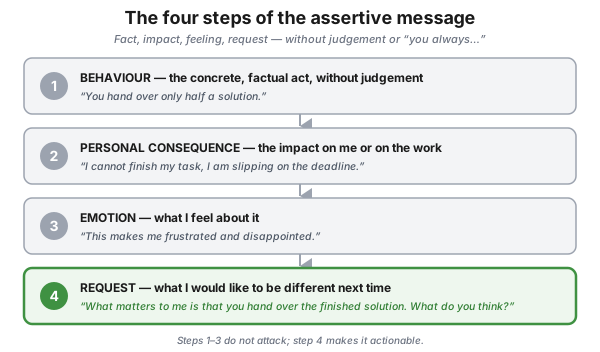
Figure 2. The four steps of the assertive message, on the example of a half-finished handover.
- Behaviour. The concrete, factual act, without judgement. “You hand over only half a solution.”
- Personal consequence. What concrete effect it has on you. “I cannot finish my task, I am slipping on the deadline, and the next day I have to pick it up again.”
- Emotion. What you feel because of it. “This makes me angry, frustrated and disappointed.”
- Request. What the other person should do differently next time, closed with a question. “What matters to me is that you hand over the finished solution. What do you think about that?”
Without the fourth step the guessing is left to the other person. The closing question matters because the goal is not for me to be right, but for the other person to hear my viewpoint. This frame is shared with giving feedback, and the outcome hinges on it:
| If you do it badly | If you do it well |
|---|---|
| provokes defensiveness and opposition, blames | creates trust and cooperation, focuses on the fix |
| undermines confidence, does not improve capability | increases capability and the belief in one’s own capability |
| generalizes, leaves the other guessing | clarifies “exactly where I stand” and “what the next step is” |
How should I receive criticism aimed at me?
Section titled “How should I receive criticism aimed at me?”Short answer: just as structured as when you give it. Being defensive is the receiving-side twin of the you-statement: it shuts the conversation down in exactly the same way. The seven steps of receiving:
- Listen to the end without interrupting.
- Pause, and listen to the clarifying questions.
- Acknowledge their viewpoint (“I understand that this is how it looked to you”).
- Ask: what exactly the situation was, what they saw.
- Do not argue and do not defend yourself. This is the hardest step, and it decides the outcome.
- Weigh to what extent and in what way it applies to you.
- Say thank you.
How do I listen actively?
Section titled “How do I listen actively?”Short answer: first really pay attention, then mirror: say back in your own words what you heard, on two levels, the content and the emotion. Assertiveness is not only speaking up: listening is a tool of the same weight.
- Attention. You are not composing your next argument, you are following the other person.
- Mirroring on two levels. The content (“so the problem is that on the afternoon shift there are not enough people for sampling”) and the emotion (“and this annoys you, because you are the one left with it”).
Mirroring is powerful because the other person feels understood, which soothes the tension and makes the misunderstanding visible. It is not agreement: the fact that I say it back still leaves room for a different opinion.
What to do when emotion floods over?
Section titled “What to do when emotion floods over?”Short answer: shift down a gear. While the other person is flooded by emotion, the rational argument does not get through, so the emotion has to be calmed first and only then can you turn to the solution.
Strong emotion blocks thinking, so arguing rationally is futile. The solution is the gear shift (gear-shifting): first we calm the emotion with active listening, mirroring and a calm tone, and only at a lowered intensity do we turn to the substantive solution. Breaking the tension down step by step is faster than handling a conflict that has already erupted, and it chimes with the handling of emotional energy.
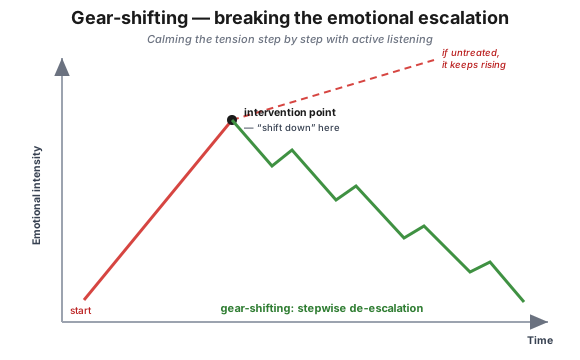
Figure 3. Gear-shifting. Emotional intensity rises up to the intervention point; “shifted down” there, it can be calmed step by step, in contrast with untreated escalation (dashed line).
Plant and safety context: the “say it out loud” culture
Section titled “Plant and safety context: the “say it out loud” culture”In the process industry assertiveness is a safety competence: safety depends on the front line daring to say the doubt out loud, reporting the near miss, and using the right to stop work even when it is inconvenient for their superior. This is not a question of individual courage. It is a named expectation of HSE management systems that everyone understand their responsibility to “Stop and Intervene”, and apply Stop Work Authority during any activity in which risk is not adequately controlled; the reporting and handling of near misses and unsafe conditions is an expectation in the same way.
The style decides whether this expectation works. The dominating style suppresses speaking up, the passive climate silences the weak signals; the assertive culture brings the problem to light before harm is done. That is why assertiveness is the shared foundation of trust, feedback and near-miss reporting, and that is why a good shift handover is assertive too: fact-based, open, but not attacking.
Measurement: where do you stand? The five levels of assertiveness
Section titled “Measurement: where do you stand? The five levels of assertiveness”Short answer: assertiveness can be measured on a scale. At the bottom of the scale stands open abuse or strong uncertainty, at the top the person who not only says their piece but also works toward solving the problem.
The scale below comes from a process-industry competence-assessment practice (anonymized extract). Find the row that most faithfully describes your behaviour in an emotionally difficult situation.
| Level | What you see in the behaviour |
|---|---|
| 1 | Open abuse or strong uncertainty in an emotionally difficult conflict situation. |
| 2 | Expresses their thoughts and feelings freely and without tension, but sometimes offends others. |
| 3 | Expresses themselves so as not to offend others, but asserts their own rights only partially. |
| 4 | The same, and asserts their rights too, while keeping other people’s rights in view. |
| 5 | The same, and in addition works toward solving the problem. |
Between levels 2 and 3 the difference is not courage but avoiding offence: loud self-assertion is not yet assertiveness. Between levels 4 and 5 the intent to solve the problem decides. The self-control scale of the same practice ends at the same place: at the highest level a person can put their anger into an assertive form as well.
Putting it into practice: a 20-minute role-play round
Section titled “Putting it into practice: a 20-minute role-play round”Assertiveness is learned in conversation. The script below follows the structure of a communication training.
- Groups of three. One person practising, one partner (who brings the difficult situation) and one observer.
- Role card (2 minutes). The person practising gets a short situation description (a half-finished handover, a task not closed out, a request turned down), and builds their four-step message.
- Practice (at most 10 minutes). The observer does not interrupt, only takes notes.
- What does the observer watch? The structure (were all four steps there, did it slip into a you-statement) and the technique (did they mirror, did they recognize the gear-shift point).
- Debrief. First the person practising says how it went, then the observer gives feedback. Swap, and the next round can start.
One round is at most 20 minutes; in three rounds everyone has been in all three roles. For the toolkit of persuasion, see the influence model.
Common mistakes
Section titled “Common mistakes”- Mistaking passivity for politeness. The need left unspoken does not disappear, it turns into tension. Instead: say it with the four-step message, while it is still cheap.
- Mistaking aggression for firmness. In the long run the dominating style breeds resistance and silence. Instead: the same content, without offending the person.
- Formulating in a you-statement, without a request. Instead: concrete data, naming the impact, then the request. The goal is not for you to be right, but for the other person to hear your viewpoint.
- Arguing at the peak of emotional flooding, or preparing your own answer instead of listening. Instead: mirroring first, the solution only after.
- Being defensive about criticism received. This is the receiving side’s you-statement. Instead: acknowledge, ask, weigh, say thank you.
When NOT to use it (the limits of the method)
Section titled “When NOT to use it (the limits of the method)”Short answer: it is the wrong tool when there is no time for a joint solution, or when the other person’s state means it will not get through yet.
- In an acute emergency. During an alarm, an emergency shutdown, a fire or a leak the correct communication is directive: a short instruction, with read-back. Assertiveness has its place after the situation.
- With a mandatory safety instruction. Where the expectation is not negotiable (protective equipment, work permit), there is nothing to shape jointly: the form is respectful, the content is not a negotiation.
- When the other person is in emotional flooding. Even a well-built message bounces off them: gear-shift first, content after.
- When the question is not a communication one. If the resource is missing, the process is bad or responsibility is unclear, even the most assertive conversation only postpones the real intervention.
How does this show up in digital practice?
Section titled “How does this show up in digital practice?”The principle of assertive communication does not stop at the conversation: the same structure is realized as a template and as a log too.
| Element | Digital implementation | What it delivers |
|---|---|---|
| Four-step message | feedback form: observation, impact, request in separate fields | the “you always…” does not fit in, the request does not get left off |
| Fact-based handover and agreed step | shift handover template, logged action with owner and deadline | sensitive information does not depend on courage, the conversation does not stay “just a chat” |
| Doubt spoken out loud | near-miss report form, with a low threshold | the weak signal gets in even when it is uncomfortable |
Take it home (keys)
Section titled “Take it home (keys)”- Ask: whose interest prevails right now? If only the other’s, you are passive; if only mine, aggressive; if both turn toward the problem, assertive.
- Write down the four steps before you go in. Behaviour, consequence, feeling, request; the fourth is the one most often left out.
- Mirror before you solve. In emotional flooding this is the only step that works.
- Receive criticism the same way: listen to the end, acknowledge, ask, weigh, say thank you.
- Measure yourself on the five-level scale, and name what is missing for the next level. In an emergency, switch to directive.
Self-test
Section titled “Self-test”- A colleague regularly hands over half-finished work. Formulate the four-step message. Which step is most often missing, and what is the consequence?
- Levels 4 and 5 of the competence scale are almost identical. What is the single difference, and why is this the most important rung?
- A shift supervisor says: “I don’t need assertiveness, I give the instruction and that’s that.” Name one situation where they are right, and one where this generates risk.
Answer key
- “You hand over only half a solution” (behaviour), “I am slipping on the deadline” (consequence), “this makes me frustrated” (emotion), “what matters to me is that you hand over the finished solution; what do you think about that?” (request). Most often the fourth, the request, gets left off, and then the other person guesses: they heard the complaint, but do not know what to do differently.
- At level 4 a person says their piece and asserts their rights too, but works toward the solution only often, not always; at level 5 they work toward solving the problem. Without this, the well-formulated message is an end in itself: the form is there, yet the situation does not change.
- They are right in an acute emergency and with a mandatory safety instruction: there the directive order is the correct form. It generates risk in everything else: an instruction-based default setting suppresses speaking up.
Terminology (HU / EN)
Section titled “Terminology (HU / EN)”| Hungarian | English | Note |
|---|---|---|
| asszertív | assertive | self-asserting and respectful |
| passzív | passive | sacrificing one’s own interest |
| agresszív / domináló | aggressive / dominating | forcing above the other |
| én-üzenet | I-statement | one’s own viewpoint, without judgement |
| aktív hallgatás / tükrözés | active listening / mirroring | attention, then giving back the content and the emotion |
| fokozatváltás | gear-shifting | breaking down the emotional intensity |
| visszajelzés fogadása | receiving feedback | listening to the end, acknowledging, asking |
| munkamegállítási jog | stop work authority | stopping risky work |
What is assertive communication?
The healthy middle way of self-assertion: I express my own needs openly and respectfully, while taking the other person’s into account too, and focusing on the shared problem. It works in emotionally difficult situations as well, where offending the other person or submitting would be the obvious move.
How do the passive, the aggressive and the assertive style differ?
In whose interest prevails. The passive style sacrifices its own for the other’s (suppressed need, building tension); the aggressive style forces its own above the other’s (resistance, damaged relationship); the assertive style turns both toward the shared problem, with the relationship intact.
What is an I-statement, and why is it better than a you-statement?
The I-statement describes the situation from my own viewpoint, without judgement, in four steps: the concrete behaviour, the personal consequence, the emotion it raises in me, and finally my request (“what matters to me is that…”). The you-statement (“you always…”) attacks and provokes defensiveness.
What does mirroring mean in active listening?
That you give back in your own words what you heard, on two levels: the content (“so the problem is that…”) and the emotion (“and this annoys you”). This makes the other person feel understood. Mirroring is not agreement.
How should I receive criticism assertively?
Listen to the end without interrupting, pause, acknowledge the other person’s viewpoint, ask about the details, do not argue and do not defend yourself, weigh to what extent it applies to you, and say thank you. Being defensive shuts the conversation down just as the you-statement does.
Can assertiveness be measured?
Yes. The five-level scale of a process-industry competence-assessment practice: at level 1 open abuse or strong uncertainty; at level 3 the person no longer offends, but asserts their rights only partially; at level 4 they assert their rights while keeping other people’s rights in view; at level 5 they also work toward solving the problem.
Related concepts
Section titled “Related concepts”feedback · self-awareness · MBTI · the influence model · effective meetings · the trust model · near miss · energy management · Lean leadership and coaching
Next step
Section titled “Next step”If you have understood this, from here it is worth going on — in this order:
- feedback — the same structure for a leadership situation: the seven principles of feedback and how it runs.
- the influence model — for when the situation is not a conflict but persuasion.
- effective meetings — the frame in which most of a team’s assertive conversations take place.
References / further reading
Section titled “References / further reading”- Thomas Gordon: Parent Effectiveness Training. Peter H. Wyden, 1970 — the original elaboration of the “I-statement”.
- Robert E. Alberti – Michael L. Emmons: Your Perfect Right. Impact Publishers, 1970 — the foundational work of assertiveness training, the source of the passive/assertive/aggressive triad.
- Carl R. Rogers – Richard E. Farson: Active Listening. University of Chicago, 1957 — the method of active listening and mirroring.
- Daniel Goleman: Emotional Intelligence. Bantam Books, 1995 — the psychological background of emotional flooding (“amygdala hijack”).
- Max Landsberg: The Tao of Coaching. HarperCollins, 1996 — the step sequence of giving and receiving feedback.