Insights — the four colour energies
≈ 16 min read · 3,115 words
The four Insights colour energies (Fiery Red, Sunshine Yellow, Earth Green, Cool Blue) describe behavioural style: everyone holds all four in a unique blend.
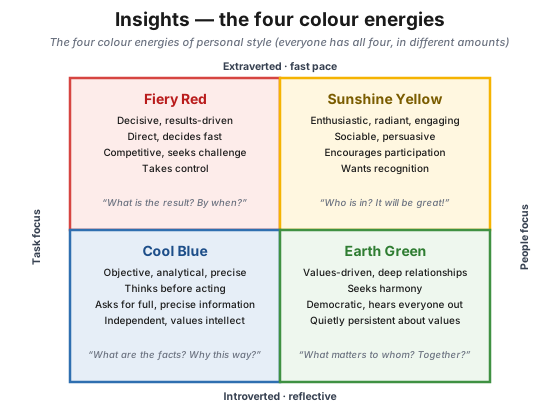
Figure 1 — the four colour energies along two axes. The top row is extraverted, the bottom introverted; the left column is task-focused, the right people-focused.
Who is this for?
Section titled “Who is this for?”This article is for those who work day in, day out with people of a different style, and who do not want to solve the misunderstandings by making them personal: shift supervisor · plant manager · team leader · project manager · process engineer · maintenance planner · HR and training specialist · in-house trainer and coach.
Learning objectives
Section titled “Learning objectives”After reading this article you will be able to:
- name the four colour energies, and say which combination of axes each one comes from;
- recognize your own dominant and supporting colour, and draw your colour tower;
- decide, before a conversation, how to “flex” to the other person’s colour (the platinum rule);
- distinguish Insights from MBTI and from DISC;
- justify why the model must not be used for selection or for rating people.
The essence
Section titled “The essence”- Four colour energies: Fiery Red (results), Sunshine Yellow (people), Earth Green (harmony), Cool Blue (objectivity).
- Two axes: extraverted ↔ introverted, and task focus ↔ people focus. The four fields = the four colours.
- Everyone has all four, in differing proportions: a unique “colour tower,” with one dominant and one supporting colour.
- There is no good or bad colour. Each has its strength and its blind spot; the goal is understanding, not rating.
- The benefit is communication: by the platinum rule, speak to the other person’s colour, not the way you would like it.
- The best style is the style fitted to the situation: a good leader acts from choice, not from habit.
- A relative of MBTI and DISC (all Jung-based, four-quadrant); the colours map almost 1:1 onto the DISC styles (red≈D, yellow≈I, green≈S, blue≈C).
What is the four colour energy (Insights) model?
Section titled “What is the four colour energy (Insights) model?”The four colour energy model is a behaviour- and style-centred self-awareness framework that uses four colours to describe where you draw your energy from and what you pay attention to. It builds on Carl Jung’s theory of psychological types (as MBTI does too), and spread under the name Insights Discovery (© The Insights Group Ltd, 2009).
The four colours are spanned by two Jungian axes: where you draw your energy from (extraverted / introverted) and what you pay attention to (the task / the people). The four combinations give the four colours:
- extraverted + task → Fiery Red
- extraverted + people → Sunshine Yellow
- introverted + people → Earth Green
- introverted + task → Cool Blue
The model is not a pigeonhole: all four colours are present in everyone, only in differing proportions. The classic way of showing this is the “make your own colour tower” exercise: everyone is a unique blend, typically with one dominant and one supporting colour.
What do the four colours mean?
Section titled “What do the four colours mean?”Each colour describes a characteristic behaviour pattern: Fiery Red drives for the result, Sunshine Yellow draws people in, Earth Green protects harmony and values, and Cool Blue looks for the facts and for precision. The descriptions below say what you primarily do with the given energy.
Fiery Red — results and decisiveness
Section titled “Fiery Red — results and decisiveness”Fiery Red is active, and moves in a positive, determined direction; its strong resolve influences those it comes into contact with; it approaches others in a direct and straightforward way; it looks for a concrete, tangible result; and it drives for the result purposefully, concentrating on a single goal.
Sunshine Yellow — people and enthusiasm
Section titled “Sunshine Yellow — people and enthusiasm”Sunshine Yellow radiates enthusiasm and encourages participation; it enjoys and seeks the company of others; it wants to be involved; it likes its contribution to be noticed and recognized; and it approaches others in a persuasive, winning, engaging way.
Earth Green — harmony and relationships
Section titled “Earth Green — harmony and relationships”Earth Green looks at the world through what is important and valuable to it; it seeks harmony and deep relationships; it prefers a democratic approach that respects the individual; it makes sure that every point of view is heard in the decision; and it protects its values with quiet determination and persistence.
Cool Blue — objectivity and precision
Section titled “Cool Blue — objectivity and precision”Cool Blue wants to get to know and understand the world around it; it holds an objective, detached point of view; it thinks things through before acting; it asks for precise and complete information before moving on; and it values independence and intellect.
Strength and blind spot by colour
Section titled “Strength and blind spot by colour”It is established practice in style models to put the other side next to every colour too: what the given energy gives to the team, and what the price is when there is too much of it. This no longer follows from the behaviour descriptions above, but comes from the training experience of the colour models (the same logic as the “tension” column of DISC):
| Colour | Strength | Blind spot |
|---|---|---|
| Fiery Red | drive, decision, focus | can be impatient, too forceful |
| Sunshine Yellow | energy, relationship building, motivating | the details and the deadlines can slip |
| Earth Green | patience, loyalty, cooperation | avoids conflict and change |
| Cool Blue | thoroughness, analysis, quality | over-analysis can lead to paralysis |
Everyone has all four — the colour blend
Section titled “Everyone has all four — the colour blend”The key to the model is that nobody is “single-coloured.” Everyone has a dominant colour (the one they have the most energy from), but the other three are present too, and depending on the situation a different colour may come to the fore: under stress, for instance, the “shadow side” of a less used colour may emerge. Self-awareness here means knowing which is your dominant colour, where your blind spots are, and recognizing other people’s colour too.
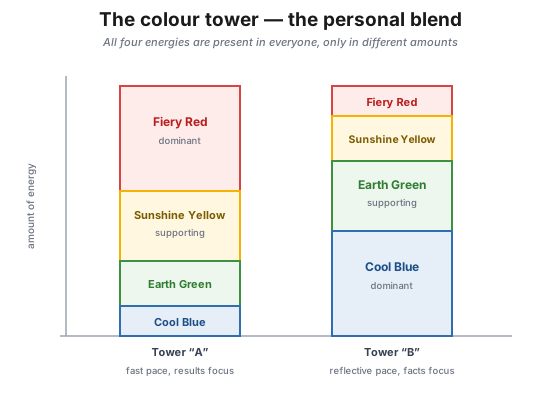
Figure 2 — the colour tower. The same four energies, in different amounts: in tower “A” Fiery Red is dominant and Sunshine Yellow is supporting, in tower “B” Cool Blue is dominant and Earth Green is supporting. (Conceptual figure.)
Why does it matter? (the stakes)
Section titled “Why does it matter? (the stakes)”Most everyday misunderstandings do not come from intent but from a difference in style. The brief, results-driven shift supervisor experiences it as their colleague “beating around the bush”; the detailed, fact-based process engineer experiences it as their leader “not listening.” Neither is true: two different colour energies are talking past each other.
This has a price. A badly timed style slows the decision down, takes away the appetite for asking questions, and holds back important information too: someone who fears an impatient answer would rather say nothing. That is why colour energy is not a “personality game” but a practical communication tool: two minutes of thinking about the other person’s colour saves you one botched conversation.
How do you communicate with the four colours?
Section titled “How do you communicate with the four colours?”The real benefit of colour energy is communication fitted to the style, that is, the platinum rule: do not treat the other person the way you would like it, but the way it suits their colour.
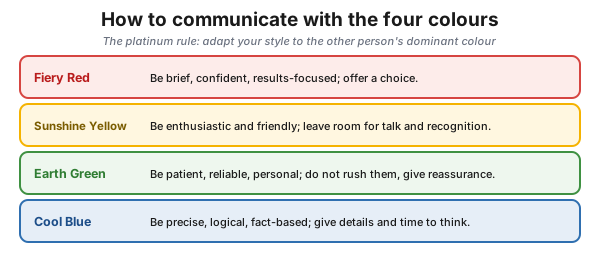
Figure 3 — the communication “handling guide” for the four colours.
- To Fiery Red: be brief, confident, results-focused; offer a choice, not a lengthy explanation.
- To Sunshine Yellow: be enthusiastic and friendly; leave room for the conversation and for recognition.
- To Earth Green: be patient, reliable, personal; do not rush them, give time and safety for the change.
- To Cool Blue: be precise, logical, fact-based; give details, data and time to think it over.
This is the update of the golden rule: “treat others the way THEY would like to be treated”, because the other person’s colour is different from yours (see self-awareness).
Which is the best style?
Section titled “Which is the best style?”None of them. The model gives an unambiguous answer to the question: the best leaders, even if they do have a clear dominant style, are able to fit it to the situation and to the people. They develop themselves beyond their instinctive reactions, and act from choice, not from habit.
Style flexibility is best practised on leadership situations. At all five cases, ask: whose style’s strength and limit shows up here, and how should you flex?
- Taking over an underperforming, oversized team, where it is not clear whether the people cannot or will not do the work.
- Crisis management: an accident has happened at the site, the press is banging on the door, and the team does not know what to do.
- Taking over a group of technical experts who work independently of one another.
- A team member’s performance is deteriorating because of a personal problem, and the others are impatient, because they are doing their work as well.
- A team that clings rigidly to procedures and is unwilling to try anything new, even though there is an expectation of innovation from senior management.
The lesson is not which colour “wins,” but that a different situation calls for a different energy: case 2 calls for a fast, directive appearance, while case 3 calls for a patient approach built on professional authority.
Plant context: shift handover and crisis
Section titled “Plant context: shift handover and crisis”In a process-industry, shift-based environment, colour energy pays off immediately in two places.
Shift handover and briefing. The Fiery Red handing over is done in three sentences, while the Cool Blue taking over is curious about the details (when, at what parameter, what the result of the intervention was). If nobody handles the style difference, the handover will either be too terse, or drag on and seem unnecessary. The solution is not to change the style but the structured handover (see shift handover): the form guarantees the content, and the style then only sets the tone.
Crisis. Situation 2 above (an accident at the site) shows the safety relevance: in a crisis, style rigidity delays. The Cool Blue reflex of chewing over the details, or the Earth Green reflex of hearing everyone out, loses time here, while the decisive, directive mode is the right one. The reverse is true too: if the style of a strongly Fiery Red leader suppresses the questions, the weak signals, the doubts and the near-miss reports get lost, even though prevention depends on exactly these.
Practice: how to use it tomorrow
Section titled “Practice: how to use it tomorrow”Three ready exercises, which can be done individually and as a team alike:
- Build your own colour tower. Draw four bands stacked on top of one another (red, yellow, green, blue), and set their heights according to how much energy you have of the given colour. Mark the dominant and the supporting one. Compare it with Figure 2.
- Same-style groups. In the team, form “style-kin” small groups by the highest colour energy. Collect the characteristics of your own colour, and present them in a picture (a drawing, a symbol, an object). Laid out side by side, the pictures immediately show how differently the four groups see the same work.
- Homework: talk to your leader. Ask them how they see your personal style, and what effect this has on your work with them, with your colleagues, with your subordinates and with partners. This question narrows the blind spot of the Johari window: it gives you information about yourself that you cannot see.
Insights vs MBTI vs DISC — three related lenses
Section titled “Insights vs MBTI vs DISC — three related lenses”All three models are descendants of Jung’s theory of types, and they are often confused:
| Model | Unit | Focus |
|---|---|---|
| Insights (4 colours) | 4 colour energies (+ blend) | behavioural style + communication |
| DISC | 4 styles (D/I/S/C) | observable behaviour in a situation |
| MBTI | 16 types (4 dichotomies) | inner, cognitive preferences |
Insights and DISC are particularly close: they use the same four colours, and the styles are almost mappable onto each other: Fiery Red ≈ Dominance (D), Sunshine Yellow ≈ Influence (I), Earth Green ≈ Steadiness (S), Cool Blue ≈ Conscientiousness (C). (This is why you also meet the “red/yellow/green/blue personality” naming on DISC-based trainings.) MBTI, by comparison, describes the inner workings (the “why”), not the visible behaviour.
When NOT to use it? (the limits of the model)
Section titled “When NOT to use it? (the limits of the model)”The colour model is quick, visual and easy to remember, an excellent common language in a team. But its limits are the same as those of the other typologies: the four colours are simplifying, style is situation-dependent, and the classification is self-reported. That is why it is meant for self-awareness, communication and team development, and there are a few situations where it is a distinctly bad tool:
| Situation | Why the colour model does not belong here | The right answer |
|---|---|---|
| Selection, hiring decision | colour describes style, not ability or performance; it is self-reported | a structured, job-based competency interview and a work sample |
| Performance appraisal, rating | a result does not follow from a style; the label is unfair | measurable goals and hard data (feedback on concrete behaviour) |
| A conflict where there is a real breach of interest or of the rules | the “we just have different colours” explanation hides the substantive issue | fact-finding, assertive confrontation, and a formal procedure if needed |
| A clinical or mental-health question | the model is a development tool, not a diagnostic | involve a professional |
| The cause of a specific technical or process fault | behavioural style is not a root cause | root-cause analysis, the 5 whys |
Rule of thumb: the colour model is good when you want to make the conversation better. If you would make a decision about people with it, put it aside and use a job- and fact-based tool.
Common mistakes
Section titled “Common mistakes”- Taking yourself or someone else as “single-coloured.” Everyone is a blend of all four colours; the dominant colour is not the only one.
- Taking your own colour as the norm. Whoever communicates only in their own colour loses the other three colours.
- Using it as a pigeonhole. Colour describes style, not worth or ability, and on top of that it is situation-dependent.
- Using it for selection. Like MBTI and DISC, the colour model is not suitable for predicting suitability either.
- Confusing the models. Insights/DISC describes the behaviour (the “how it looks”), MBTI the cognitive preference (the “why”).
Terminology (HU / EN)
Section titled “Terminology (HU / EN)”| Hungarian | English | DISC equivalent |
|---|---|---|
| Tüzes Piros | Fiery Red | Dominance (D) |
| Napsárga | Sunshine Yellow | Influence (I) |
| Földzöld | Earth Green | Steadiness (S) |
| Hűvös Kék | Cool Blue | Conscientiousness (C) |
| szín-energia | colour energy | — |
| szín-torony / keverék | colour tower / blend | — |
| platina-szabály | platinum rule | — |
| stílus-rugalmasság | style flexing | — |
The colour names and the behaviour descriptions follow the terminology of the Insights model (© The Insights Group Ltd); the DISC mapping comes from the established professional consensus.
Take it home (keys)
Section titled “Take it home (keys)”- Know your own tower. Know which is your dominant and which your supporting colour, and what its blind spot is under pressure.
- Ask about the other person’s colour before the conversation. Two minutes of thinking is cheaper than one botched meeting.
- Platinum, not gold. Do not treat the other person the way you would like it, but the way it suits them.
- The situation decides which colour is needed. In a crisis, direct; with a team of experts, be patient — that is style flexibility.
- From choice, not from habit. The essence of development is to choose your style consciously instead of your instinctive reaction.
- Yes for a conversation, no for a decision. Never base a decision about people on colour.
Self-test
Section titled “Self-test”- Which two axes give the four colours, and which colour belongs to which combination? Draw it from memory.
- A colleague of yours brings detailed background material to every meeting, and takes it badly when “we just have to decide.” Which colour energy is dominant in them, what is its strength, what is its blind spot, and how would you flex to them?
- Why can the colour model not be used for selection or for performance appraisal, and what has to be used instead?
What is the four colour energy (Insights) model?
A Jung-based, behaviour- and style-centred self-awareness model that uses four colours to describe style: Fiery Red (results, decisiveness), Sunshine Yellow (people, enthusiasm), Earth Green (harmony, relationships), Cool Blue (objectivity, precision). All four are present in everyone, in differing proportions.
What do the four colours mean?
Fiery Red: direct, results-driven, decisive. Sunshine Yellow: enthusiastic, sociable, persuasive, wants recognition. Earth Green: patient, harmony-seeking, democratic, loyal. Cool Blue: objective, thorough, precise, independent. The colours come from two axes: extraverted/introverted and task/people focus.
How should I communicate with the different colours?
Fitted to the other person’s dominant colour: with Fiery Red be brief and results-focused; with Sunshine Yellow enthusiastic and engaging; with Earth Green patient and reliable; with Cool Blue precise and fact-based. This is the platinum rule: treat the other person the way it suits THEM.
Which is the best colour energy?
None of them. The best leaders, even if they do have a clear dominant style, fit it to the situation and to the people: they develop themselves beyond their instinctive reactions, and act from choice, not from habit. The goal of the model is style flexibility, not a ranking.
What is the connection between the colour model and DISC?
They are almost identical: they use the same four colours, and the styles are mappable: Fiery Red ≈ Dominance (D), Sunshine Yellow ≈ Influence (I), Earth Green ≈ Steadiness (S), Cool Blue ≈ Conscientiousness (C). This is why DISC is also often called a “colour” personality model.
Next step
Section titled “Next step”If you have understood this, from here it is worth going on — in this order:
- self-awareness — the Johari window: how to narrow the blind spot with feedback, so that you get a true picture of your own colour too.
- DISC — the same four colours as a behaviour model, with Marston’s two dimensions; a good complementary lens.
- assertive communication — the practical skill of style flexing: how to say your piece so that the other person’s colour hears it too.
References / further reading
Section titled “References / further reading”- Carl Gustav Jung: Psychologische Typen (Psychological Types). Rascher, Zürich, 1921. — the theoretical basis of the model: the typology of attitude (extraversion / introversion) and of the psychological functions.
- The Insights Group Ltd: Insights Discovery (insights.com). — the official, commercial methodology of the four colour energies; the naming of the colours and the behaviour descriptions come from here (© The Insights Group Ltd).
- Tony Alessandra – Michael J. O’Connor: The Platinum Rule: Discover the Four Basic Business Personalities and How They Can Lead You to Success. Warner Books, 1996. — the “update” of the golden rule: treat others the way THEY would like to be treated.
- Joseph Luft – Harrington Ingham: The Johari Window, a Graphic Model of Interpersonal Awareness. 1955. — the self-awareness framework on which the style feedback builds (see self-awareness).
Related concepts
Section titled “Related concepts”DISC · MBTI · the MBTI self-test · self-awareness · assertive communication · feedback · Belbin team roles · effective meetings