Lockout/tagout (LOTO): isolation, locks and tags
≈ 8 min read · 1,617 words
When a technician works inside a machine and someone outside presses the start button by accident, the machine does not ask questions. LOTO rules out that moment: it separates the machine from its energy sources and secures the isolation with a lock and a tag so that nobody can switch it back on by mistake. Let’s look at what LOTO is, how a system is built, and how it connects to the permit to work.
Lockout/tagout (LOTO) isolates equipment from its energy sources during maintenance and secures it with locks and tags. Residual energy is released and the zero-energy state is verified before anyone starts the work. The lock physically prevents; the tag only warns.
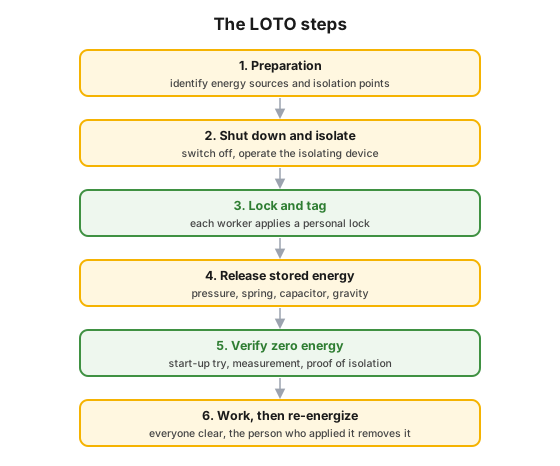 Figure 1: the six LOTO steps. The fifth, verifying zero energy, matters most, because a lock proves nothing, only a test or a measurement does.
Who is this for?
Section titled “Who is this for?”maintenance technician · electrician · machine operator · shift supervisor · plant manager · occupational-safety and HSE specialist · contractor.
Learning objectives
Section titled “Learning objectives”- explain the difference between a lock and a tag;
- list the six LOTO steps and justify the order;
- tell a personal lock from a group lockout;
- connect LOTO to the permit to work.
In brief
Section titled “In brief”- LOTO is isolating and securing energy, not just “switching off”.
- A lock physically locks, a tag only signals. Where a lock is possible, use a lock.
- Each worker applies their own lock, and only they remove it.
- Stored energy (pressure, springs, capacitors, gravity) must be released, and zero energy verified.
- LOTO is a condition of the permit: ready before issue, removable after hand-back.
Why does it matter? The stakes
Section titled “Why does it matter? The stakes”The most common accident pattern is that a stopped machine is restarted by someone who does not know about the work, or that the machine’s stored energy (a compressed spring, a pressurized line) keeps moving after shutdown. LOTO protects the technician against both.
What is the difference between a lock and a tag?
Section titled “What is the difference between a lock and a tag?”A lockout device is a positive mechanism, such as a lock, that holds an energy-isolating device in a safe position. A tagout device is a warning that does not restrain physically, so it can only be defeated deliberately. Under the US OSHA standard (29 CFR 1910.147), where an energy-isolating device can be locked out, lockout is required unless a tag gives equivalent full protection.
How is a LOTO system built?
Section titled “How is a LOTO system built?”The OSHA standard expects an energy control program to include: written, machine-specific procedures (shut-down, isolation, securing, conditions for applying and removing locks), training (authorized, affected and other employees at different levels), a periodic inspection at least once a year by an authorized employee who is not using the procedure under inspection, and a certification of the training. In Hungary the internal LOTO rule and the risk assessment carry the equivalent content; in the sources we reviewed, Hungarian law does not name LOTO as a system, and the duty derives from the general employer’s responsibility (Mvt. § 2 (2), risk assessment § 54). This article uses Hungarian law as an example, not as a universal rule.
The six steps in detail
Section titled “The six steps in detail”- Preparation: identify all energy sources (electrical, hydraulic, pneumatic, mechanical, thermal, chemical) and isolation points.
- Shut down and isolate: stop the machine the usual way, then operate the isolating devices.
- Lock and tag: each authorized worker applies their own lock and tag, with name and date.
- Release stored energy: release pressure, relax springs, discharge capacitors, support suspended weight.
- Verify zero energy: try to start the equipment, or measure; this is the proof.
- Work, then re-energize: at the end inspect the area, make sure everyone is clear, notify affected staff; the person who applied a lock removes it.
Group lockout
Section titled “Group lockout”When several people work on the same equipment, personal protection can be provided by a group lockout: one authorized employee carries primary responsibility, the key goes into a lock box, and each worker puts a personal lock on the box when starting and removes it when leaving. The protection level is the same as a personal lock.
How does LOTO relate to the permit to work?
Section titled “How does LOTO relate to the permit to work?”LOTO is the means of isolation; the permit is the decision that work may start after the isolation. As a condition of the permit to work, isolation is ready before issue, holds during the work, and may be removed after hand-back. One important rule: the expiry of a permit does not remove the isolation. If the work continues, the isolation stays and the permit is renewed. The reverse also happens: isolation left in place may go unnoticed at close-out, so close-out needs a specific check.
Implementation in practice: do this tomorrow
Section titled “Implementation in practice: do this tomorrow”Mini-scenario: pick a machine or pipe section and write its LOTO procedure so that a new colleague could carry it out. Ask the maintenance staff: who does not know about this isolation and could still start it? Where anyone says yes, locking and informing is the missing link.
Common mistakes
Section titled “Common mistakes”| Mistake | Why it is a problem | Correct practice |
|---|---|---|
| A tag without a lock | a tag does not restrain | a lock wherever possible |
| One shared lock for everyone | nobody knows who is inside | personal locks or a group lock box |
| Zero energy not verified | stored energy remains | start-up try or measurement |
| Someone else removes the lock | the person inside does not know | only the applier removes it; exceptions by documented procedure |
| The permit expires and the isolation is lifted too | work continues unprotected | isolation has a lifecycle independent of the permit |
When NOT to use LOTO alone?
Section titled “When NOT to use LOTO alone?”| Situation | Why it is not enough | What is needed alongside |
|---|---|---|
| Process line under pressure | the isolating valve may leak | blind or double block and bleed |
| Confined space entry | isolation is only one condition | atmosphere test, attendant, rescue |
| Routine operator intervention | LOTO can be excessive | the simplified protection in your rule |
| Insufficient competence | a lock does not teach | training, inspection |
Take it home
Section titled “Take it home”- A lock locks, a tag warns.
- Every worker applies their own lock, and only they remove it.
- Releasing stored energy and verifying zero energy is the point.
- Isolation is a condition of the permit and does not dissolve with it.
- Inspect the procedures annually, by someone who does not use them.
Self-test
Section titled “Self-test”- What is the difference between a lock and a tag, and when is a tag enough?
- Why does the lock itself not prove zero energy?
- What should happen to the isolation if the permit expires but the work is not finished?
How does this show up in digital practice?
Section titled “How does this show up in digital practice?”| Principle | Digital implementation | What it prevents |
|---|---|---|
| Identified isolation point | points recorded (method, tag, location) and tied to the permit | “something is isolated” |
| Who and when | applying and restoring with name and time | unknown isolation |
| Verification | a separate isolation certificate with signature | unverified isolation |
| Check at close-out | isolation left open is flagged | isolation left in place |
Connection to OPEREX
Section titled “Connection to OPEREX”In the OPEREX Permit to Work module, isolation points are tied to the permit: method (blind, lock, valve, electrical, drain/vent, other), label, reference, planned, applied and restored states, by who and when, with an audit trail. The separate isolation certificate is a signature in the chain, and the gate before issue looks at the certificate, not at the points. Isolation left open at hand-back or close-out gives a warning, not a block. There is no lock register, group lock box, equipment or CMMS link, and no cross-permit isolation register. Details: isolation and LOTO in the permit, Permit to Work.
Terminology (HU / EN)
Section titled “Terminology (HU / EN)”| Hungarian | English | Note |
|---|---|---|
| LOTO, lezárás és megjelölés | Lockout/Tagout | lock and tag |
| Leválasztás | Isolation | from energy or material source |
| Lezáró eszköz (lakat) | Lockout device | physical barrier |
| Címke | Tagout device / tag | warning |
| Nullenergia-állapot | Zero energy state | verified de-energization |
| Csoportos lezárás | Group lockout | with a lock box |
| Jogosult dolgozó | Authorized employee | the person who applies the lock |
What is a LOTO system?
The system by which, during maintenance, equipment is isolated from all energy sources, the isolating device is locked and tagged, residual energy is released, and the zero-energy state is verified.
Is LOTO mandatory in Hungary?
In the sources we reviewed, Hungarian law does not prescribe LOTO as a named system. The obligation can be derived from the general employer’s responsibility (Mvt. § 2 (2)) and the risk assessment (§ 54); check the current text and your internal rule.
What is the difference between a lock and a tag?
A lock physically prevents re-energizing; a tag only warns. Where the device can be locked, a lock is required.
Who may remove a lock?
As a rule, the person who applied it. Exceptions only under a documented procedure.
How does it relate to the permit to work?
Isolation is a condition of the permit: ready before issue, holding during the work, removable after hand-back. A permit’s expiry does not remove the isolation.
Related concepts
Section titled “Related concepts”permit to work | confined space | hot work | CMMS | operational risk assessment
Next step
Section titled “Next step”- Permit to work: the system of which LOTO is a condition.
- Confined space entry permit: where isolation saves lives.
- CMMS: the maintenance work the isolation belongs to.
References / further reading
Section titled “References / further reading”- OSHA 29 CFR 1910.147: The control of hazardous energy (lockout/tagout).
- Mvt.: Hungarian Act XCIII of 1993, § 2 (2), § 54 (njt.hu).
- ISO 45001:2018, clause 8.1.
- HSE (UK): Guidance on permit to work systems (HSG250).