Confined space entry permit: working safely in confined spaces
≈ 8 min read · 1,569 words
Inside a tank you cannot see that the air has run out. A confined space is among the most dangerous workplaces because the hazard is not perceptible to the senses: missing oxygen does not sting, and a would-be rescuer often becomes the second victim. The entry permit is therefore not a formality, but the point where testing, isolation and a rescue plan land on one sheet before anyone enters. Let’s look at what counts as a confined space, what the permit contains, and what a safe entry looks like.
A confined space is not designed for continuous occupancy, has limited entry and exit, and its air or another hazard can be life-threatening. The entry permit is the signed decision that isolation is in place, the atmosphere is tested and safe, an attendant is assigned, rescue is prepared, and only then may anyone enter.
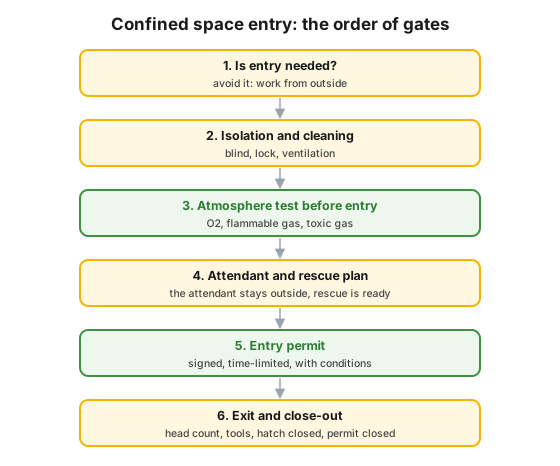 Figure 1: the gates of entry. The permit is the fifth, but without the third (atmosphere test) and the fourth (rescue) it is worth nothing.
Who is this for?
Section titled “Who is this for?”maintenance technician · tank-cleaning contractor · shift supervisor · entry permit issuer · HSE specialist · rescue and fire-safety officer.
Learning objectives
Section titled “Learning objectives”- decide whether a space counts as a confined space;
- list the mandatory elements of an entry permit;
- explain the role of the attendant and the rescue plan;
- distinguish confined space control from other workplace hazards.
In brief
Section titled “In brief”- The first question is whether entry is needed at all. Many tasks can be done from outside, with a camera or a robot.
- Isolation and cleaning come before entry; atmosphere testing right before and during entry.
- The attendant stays outside with continuous contact; rescue is ready in advance.
- The attendant must not enter to rescue without their own protection.
- The permit is time-bound, and the close-out includes checking the head count and tools.
What counts as a confined space?
Section titled “What counts as a confined space?”A confined space has three hallmarks: it is not designed for human occupancy, its entry and exit are limited, and the conditions inside can be dangerous. Typical examples: tank, boiler, pit, sewer, silo, reactor, narrow duct. The US OSHA standard 29 CFR 1910.146 defines a “permit-required confined space” as a confined space with at least one of: a hazardous atmosphere or the potential for one, material that could engulf an entrant, an internal configuration that could trap or asphyxiate an entrant, or any other recognized serious hazard.
What does the law say?
Section titled “What does the law say?”The Hungarian Act on occupational safety (Mvt., XCIII of 1993) makes no separate reference to confined spaces in the part we reviewed; the word “closed” appears only in “closed technology”. Entry requirements are therefore built from the employer’s general duties (§ 2 (2): responsible for implementing safe working requirements; § 54: risk assessment) and the company’s own rules. International frameworks are well illustrated by OSHA 29 CFR 1910.146 and the UK Confined Spaces Regulations 1997 (with the accompanying HSE guidance). Hungarian professional checklists and company rules exist as well; always compare their content with the current regulation.
What does an entry permit contain?
Section titled “What does an entry permit contain?”Under OSHA 1910.146 paragraph (f) the permit must identify: the space, the purpose of the entry, the date and authorized duration, the entrants and attendants, the entry supervisor (with signature), the hazards of the space, isolation and hazard-control measures, acceptable entry conditions, the results of initial and periodic tests (who tested, when), rescue and emergency services and how to summon them, communication between entrants and attendant, required equipment, and other permits (for example hot work). The permit may not run longer than the task requires, and when the work is complete or a condition not allowed by the permit arises, it must be cancelled.
This list is a compass, not Hungarian law: your internal rule may be stricter, but should not be weaker.
What does a safe entry look like?
Section titled “What does a safe entry look like?”Three people, three tasks: the entrant works, the attendant stays outside and counts, and the issuer (or the responsible person) keeps the permit in hand. The attendant is on site for the whole entry, keeps track of the head count, maintains contact, and on any sign of danger has the entrant removed and calls rescue. They do not enter to rescue unless prepared and equipped for it.
Before entry: isolation (LOTO), blinds on the lines, cleaning, ventilation. Atmosphere testing: oxygen, flammable gas, toxic gas (for example H₂S, CO), before entry and during it, because the atmosphere changes.
Implementation in practice: do this tomorrow
Section titled “Implementation in practice: do this tomorrow”Mini-scenario: take a closed entry permit and check (1) does it show the time and value of the test, (2) is there a named attendant, (3) is there a rescue plan the attendant knows, and (4) was the head count checked at close-out. If any is missing, start improving the template.
Common mistakes
Section titled “Common mistakes”| Mistake | Why it is a problem | Correct practice |
|---|---|---|
| One atmosphere test before entry | the atmosphere changes | continuous or repeated testing |
| The attendant steps in to help | a second victim | the attendant stays out, rescue is separate |
| No rescue plan ready | rescue is not organized afterwards | rescue arranged and practised in advance |
| Isolation is “done” verbally | no evidence | identified points, verified isolation |
| The permit is not closed | person or tools left inside | head count and tool check at exit |
When NOT to use entry (the limits)?
Section titled “When NOT to use entry (the limits)?”| Situation | Why it is dangerous | What to do instead |
|---|---|---|
| It can be done from outside | every entry is a risk | camera, robot, external inspection |
| The atmosphere cannot be tested or is unsafe | entering blind | ventilation, cleaning, respiratory protection |
| No rescue plan | rescue is not organized afterwards | pre-arranged rescue |
| Not enough competence | a signature does not make anyone prepared | trained, practised crew |
Take it home
Section titled “Take it home”- Is entry needed? That is the first question.
- Isolation, cleaning, testing, attendant, rescue, then the permit.
- The attendant never goes in after: rescue is organized separately.
- Test before and during entry.
- Close-out includes the head and tool count.
Self-test
Section titled “Self-test”- Which three hallmarks make a space a confined space?
- Why must the attendant not enter after an entrant in trouble?
- Why is one atmosphere test before entry not enough?
How does this show up in digital practice?
Section titled “How does this show up in digital practice?”| Principle | Digital implementation | What it prevents |
|---|---|---|
| Test and validity | the atmosphere test is recorded with value and time; the gate looks at the latest | a permit issued on an old test |
| Proof of isolation | the isolation certificate is a condition of the permit | entry without isolation |
| Extension | a new test can be required on extension | work continuing on expired conditions |
| Audit trail | signature chain with time stamps | after-the-fact “filling in” |
Connection to OPEREX
Section titled “Connection to OPEREX”In the OPEREX Permit to Work module confined space entry is a main type of its own. Isolation points (blind, lock, valve, electrical, drain/vent) can be followed in planned, applied, restored states; the issue gate builds on the separate isolation certificate; the atmosphere test (O₂, LEL, H₂S, CO, toxic gas) is recorded with value and validity. The module has no lock register or group lock box, and the isolation points themselves are not issue gates; the page states this limit. Details: Permit to Work, isolation and LOTO in the permit.
Terminology (HU / EN)
Section titled “Terminology (HU / EN)”| Hungarian | English | Note |
|---|---|---|
| Zárt tér | Confined space | limited entry/exit, not designed for occupancy |
| Beszállási engedély | Confined space entry permit | the signed decision on entry |
| Figyelő | Attendant / standby person | stays outside |
| Belépő | Entrant | the person who goes in |
| Légtérmérés | Atmospheric testing | O₂, flammable, toxic gas |
| Mentési terv | Rescue plan | arranged in advance |
What counts as a confined space?
A space not designed for continuous human occupancy, with limited entry and exit, in which the air or another condition can be hazardous. Typical: tank, pit, sewer, boiler, silo.
Is an entry permit mandatory?
The Hungarian Act makes no separate reference to confined spaces in the text we checked. The entry-permit system is built by the employer from general duties and the risk assessment; international practice (for example OSHA 1910.146) expects such a system.
What does an entry permit contain?
The space, the purpose, the duration, the entrants and attendant, the hazards, the isolation, the test results, the rescue arrangement, the communication, the equipment and the signature.
What does the attendant do?
Stays outside, tracks who is inside, maintains contact, and on any sign of danger has them removed and calls rescue. Does not enter to rescue.
How often must the atmosphere be tested?
Before entry and during it, because the atmosphere changes. The exact frequency comes from the company rules and the risk assessment.
Related concepts
Section titled “Related concepts”permit to work | LOTO | hot work | operational risk assessment | near-miss
Next step
Section titled “Next step”- Lockout/tagout: the isolation that is a precondition of entry.
- Hot work permit: when welding is also done inside.
- Permit to work: the general system.
References / further reading
Section titled “References / further reading”- OSHA 29 CFR 1910.146: Permit-required confined spaces.
- HSE (UK): Safe work in confined spaces (L101) and the Confined Spaces Regulations 1997.
- Mvt.: Hungarian Act XCIII of 1993, § 2 (2), § 54 (njt.hu).
- HSE (UK): Guidance on permit to work systems (HSG250).