BELBIN team roles
≈ 18 min read · 3,697 words
You sit four excellent professionals down at one table for an important project, and three weeks later you are still arguing about which solution is the better one. Nobody is lazy and nobody is incompetent: all four are doing the same thing, analysing and arguing. What is missing from among them is someone who closes the debate, and someone who actually starts the work the next morning. The Belbin model is what makes exactly this gap nameable. Let’s look at what the nine team roles are, why every one of them is needed, and how you make up for the one that is missing.
In the Belbin team-role model a well-working team needs not identical “stars” but different roles that complement each other.
Meredith Belbin identified eight team roles in his 1981 book Management Teams, and later completed them with a ninth, the Specialist. The nine roles arrange themselves around three axes: action (Shaper, Implementer, Completer-Finisher), relation (Coordinator, Teamworker, Resource Investigator) and thinking (Plant, Monitor Evaluator, Specialist). Every role comes with a valuable contribution and an “allowable weakness”: an accepted downside that the contribution amply outweighs. The guiding principle of the model: “Nobody is perfect, but a team can be.”
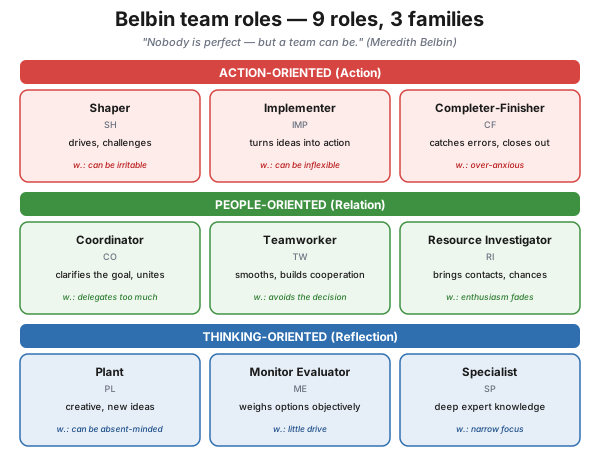
Figure 1 — the 9 Belbin roles in three families (on the axes), with the contribution and the allowable weakness.
Who is this for?
Section titled “Who is this for?”This article is for those who put a team together or work in a team, and can see that the make-up decides the fate of the project: project manager · team leader · shift supervisor · plant manager · process engineer · maintenance manager · Lean/CI coordinator · HR and training staff.
Learning objectives
Section titled “Learning objectives”After reading this article you will be able to:
- name the nine Belbin roles, their contribution and their allowable weakness;
- sort the roles into the three axes (action, thinking, relation), and say which axis is critical in which project phase;
- recognize which role is missing or over-represented in your own team;
- choose a concrete tool to make up for the missing role, without having to swap people;
- separate the team role from the personality type, and say when the model must not be used.
In brief
Section titled “In brief”- “Nobody is perfect, but a team can be.” The strength of a good team lies in the balance of the roles, not in uniform excellence.
- 9 roles, 3 axes: action (moves the work), relation (connects the people), thinking (supplies the idea and the judgement).
- Every role comes with a contribution AND an “allowable weakness”, an accepted downside that its usefulness outweighs.
- A missing role weakens the team, and too many of the same role collide. Without a Plant there is no innovation, without a Completer-Finisher the details slip away, while a team made up purely of Shapers goes to war.
- The role demand changes by phase: getting started needs a Shaper and a Coordinator, idea generation a Plant and a Resource Investigator, closing needs a Completer-Finisher and an Implementer.
- The gap can be filled with a tool too, not only with a new person: an agenda, review discipline, risk analysis, structured idea collection.
Why it matters (the stakes)
Section titled “Why it matters (the stakes)”Knowing the team roles is good for five concrete things: building productive working relationships, putting together and developing high-performing teams, raising self-awareness and personal effectiveness, building mutual trust and understanding, and supporting the selection process.
The stake becomes visible where the make-up of the team is wrong. If there is nobody to close the debate, the project slips by weeks; if there is nobody guarding the details, the three missing documents come to light on the day of the roll-out. Neither is a personal failing: both are consequences of the role make-up, and can therefore be handled in advance.
What is the Belbin team-role model, what are the 9 roles, and why is every one of them needed?
Section titled “What is the Belbin team-role model, what are the 9 roles, and why is every one of them needed?”The model comes from the research of Meredith Belbin (Cambridge, Henley Management College), which the 1981 book Management Teams: Why They Succeed or Fail made widely known. Belbin examined why one management team wins and another loses, and found that success depends not on individual IQ but on the balance of the team roles. The Apollo syndrome belongs here too: a team made up purely of excellent analysts often underperforms, because everyone argues and nobody executes.
The model was originally taught under the name “8 + 1 personalities”. The team role is not a personality type (MBTI) and not a job, but a behavioural contribution: the way a person typically takes part in teamwork. And teamwork itself is “the process of working collaboratively with a group of people in order to achieve a goal.”
The nine roles in one table
Section titled “The nine roles in one table”| Role | Axis | Its strength in the team | Its allowable weakness |
|---|---|---|---|
| Shaper (SH) | action | Focuses on the task, provides challenge, fights inaction and complacency | Prone to irritation and impatience, may seem forceful while driving |
| Implementer (IMP) | action | Good organizer, practical, disciplined; turns the idea into action completed on deadline | Inflexible, slow to respond to new ideas, gives up their own plan reluctantly |
| Completer-Finisher (CF) | action | Precise, conscientious; leaves nothing unfinished, checks the accuracy of the end result | Worries about trifles, cannot “let go”, the perfectionism can turn extreme |
| Coordinator (CO) | relation | Calm, self-confident; sees the big picture, judges on merit, goal-oriented, delegates well | Creative only to an average degree, and may delegate so much that little work is left for them |
| Teamworker (TW) | relation | Sociable, a good listener; defuses conflict, strengthens team spirit | Indecisive in the critical moments, especially on an unpopular decision |
| Resource Investigator (RI) | relation | Extraverted, communicative; an excellent networker, brings ideas and opportunities from outside | As the initial enthusiasm fades, loses interest and drops the thread they raised |
| Plant (PL) | thinking | Individualist, imaginative; supplies ideas and innovative solutions to the hard problem | Has their head in the clouds, does not care about detail or formalities, can be forgetful |
| Monitor Evaluator (ME) | thinking | Deliberate, dispassionately level-headed; far-sighted, sees all the options impartially | Under-motivated, does not inspire others either, can be over-critical and slow to move |
| Specialist (SP) | thinking | Purposeful, self-reliant, committed; outstanding, deep expert knowledge in a narrow field | Follows a single line of thinking, gets lost in the detail, does not see the whole picture |
Three axes: action, thinking, relation
Section titled “Three axes: action, thinking, relation”The nine roles arrange themselves along three axes: action (Action), thinking (Reflection) and relation (Relation). The axis is not decoration but the fastest diagnosis. All action axis: you do a lot and think little. All thinking axis: you analyse for months. All relation axis: the mood will be good, only there will be no result.
What is an “allowable weakness”, and why should you not fix it?
Section titled “What is an “allowable weakness”, and why should you not fix it?”The allowable weakness means that every strength has a downside which naturally comes with it, and which we accept, because the contribution amply outweighs it. The Plant’s absent-mindedness is the price of creativity; the Completer-Finisher’s anxiety the price of flawlessness.
Which role is critical in which project phase?
Section titled “Which role is critical in which project phase?”Not every role is needed at once. A project goes through four phases, and each has its own critical trio of roles: this is the Belbin wheel, which also maps exactly onto the steps of an improvement initiative.
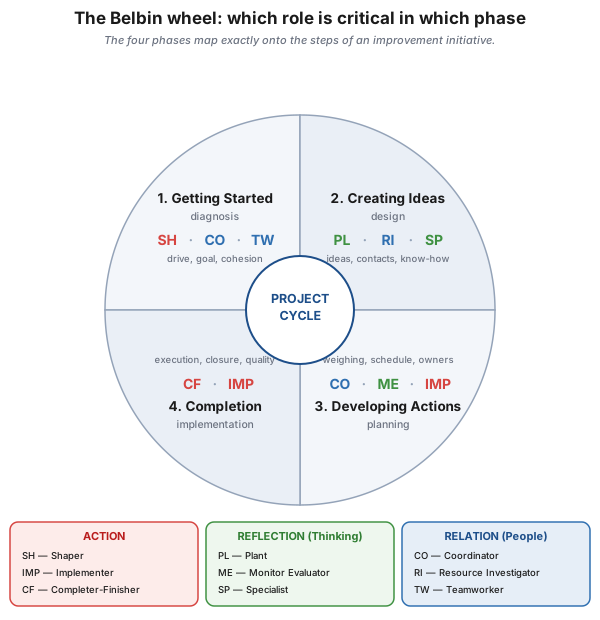
Figure 2 — the Belbin wheel: the four phases of the project and the roles critical in each phase, coloured by the three axes.
| Phase | What happens | Critical roles |
|---|---|---|
| 1. Getting Started | diagnosis: where we stand, what the real problem is, who is involved | Shaper, Coordinator, Teamworker |
| 2. Creating Ideas | design: what the future state should look like | Plant, Resource Investigator, Specialist |
| 3. Developing Actions | putting together the implementation plan, with milestones and owners | Coordinator, Monitor Evaluator, Implementer |
| 4. Completion | roll-out, checking, closing | Completer-Finisher, Implementer |
The benefit shows immediately: if your project is stuck in phase 2, the trouble is probably not “laziness” but that the Implementer and the Monitor Evaluator are missing, the ones who would turn the pile of ideas into a schedule. The same holds in a plant environment: a turnaround project needs the Shaper (drive), the Implementer (execution), the Monitor Evaluator (weighing the risk) and the Completer-Finisher (closing out the details and the safety checks). At a turnaround, the absence of the Completer-Finisher endangers precisely the critical closing checks.
How do you make up for a missing or over-represented role?
Section titled “How do you make up for a missing or over-represented role?”A missing role can be made up not only with a new person: a large part of the gap can also be substituted with a tool, that is, you build the behaviour of the role into the team’s way of working.
| What is missing or over-represented | What to do |
|---|---|
| Weak Plant and/or Resource Investigator (no visionary) | Structured idea collection: brainstorming, card-answer method (clustering and voting), silent letter-writing |
| Weak Coordinator, Implementer, Completer-Finisher | Provide structure: meeting agendas, frequent team meetings and reviews, daily schedules |
| A lot of Shapers and/or Specialists | Team events, deliberate work on team spirit and cohesion |
| The Shaper is missing (nobody challenges the status quo) | More frequent personal feedback sessions, benchmarking with world-class operations, 360-degree leadership assessment with a personal development plan |
| The Implementer and the Completer-Finisher are missing | Close follow-up: regular review of the implementation plan for timelines, milestones and responsibilities, a performance management rhythm |
| The Monitor Evaluator is missing | Risk analysis (FMEA, cause-and-effect analysis), insisting on figures and facts, a clear project charter |
What makes a team a good team?
Section titled “What makes a team a good team?”One frequent use of the Belbin model is putting together the team that carries a change through (within Kotter’s “8 steps to successful change” framework). The question then is “what (who) is needed in a good team?”, and the answer points precisely to different roles: leadership capability, credibility, communication skills, authority, analytical capability and a “sense of urgency”. A single person rarely brings all of this, which is why the balanced team is needed.
The same is reinforced by the research on Formula 1 teams (Richard West, What Makes a Winning Team). A present-day F1 team is the coordinated work of 550–1000 people, and in the culture of the winning teams five recurring traits were found:
- common goals and objectives,
- clearly understood roles,
- clear responsibilities,
- people who identify with the team’s ideals and identity,
- knowledge of the customers and the stakeholders.
This culture is kept alive by six personal behaviours: active listening · open questions · building and supporting · constructive challenge · frequent summarising · agreeing with each other. Neither of the two works without the other.
Its third element is the plan-do-review cycle. A sentence of Michael Schumacher’s shows well what this means: “even if we win a race, we spend an hour and a half on what went wrong.” The review should happen at the moment of the success or the failure, and the lesson should reach everyone. This is a textbook case of continuous improvement: despite the speed-limiting rules the cars get faster year by year, while protecting the driver has become one of the guiding considerations of the design.
The fourth is trust, which we earn rather than receive: others judge us on our credibility (what is our track record?), our connection (are we liked and respected?) and our availability (are we approachable?). The guiding principle of recruitment reflects the same: “we hire people who think as individuals but act as team players.” In more detail: the trust model.
How do you assess your own roles?
Section titled “How do you assess your own roles?”The structure of the classic Belbin self-assessment questionnaire is simple. It consists of seven sentence groups, each with eight statements from (a) to (h), for example “I take part in teamwork by…” or “In teamwork it may be a drawback that…”. You rate every statement on a 0–4 scale (0 = not characteristic at all, 4 = extremely characteristic). You copy the points over into an eight-column scoring table, add them up column by column, and the highest columns give your profile. The evaluation typically records the top 3 roles: most people have not one but two or three dominant roles.
A few characteristic statements, with the role they belong to:
- “I quickly notice and seize the opportunities that offer themselves” → Resource Investigator
- “I never run out of ideas” → Plant
- “I bring out of the others what they can do for the team” → Coordinator
- “I finish everything I have started” → Completer-Finisher
- “If the expected end result justifies it, I am ready to become temporarily unpopular” → Shaper
- “I make alternative proposals without prejudice or bias, and I can justify them” → Monitor Evaluator
The questionnaire measures the weaknesses in the same way. The Plant’s downside: “if something new occurs to me, I muse on it at length and miss what is happening meanwhile.” The Resource Investigator’s: “when new ideas can be brought up, I talk more than I should.” The Shaper’s: “I look forceful and high-handed when I try to get some problem solved.”
Putting it into practice
Section titled “Putting it into practice”A 60–90 minute team workshop is enough for the model to start working. The steps:
- Have everyone fill in the questionnaire, individually, in advance. Add it up column by column, and write down everyone’s top 3 roles.
- Think through which Belbin role best describes your main contribution to a concrete, running project of yours, and share it with the people sitting next to you. This ties the model to real work, not to a theoretical self-image.
- Draw up the team’s role map. The three axes on a board, and below them the names at their dominant role. Within a minute you can see which axis is empty and which is crowded.
- Pick two work packages from the work breakdown of your project, and identify which of at least three Belbin roles are needed to complete them successfully.
- Compare the role map with the project phase. If you are at developing actions, are the Coordinator, the Monitor Evaluator and the Implementer present?
- Choose a tool for the gap from the table above, with an owner and a deadline. If there is no Completer-Finisher, let someone deliberately take on this role to guard the deadlines and the quality.
- Name the friction as a role, not as a person. Two Shapers colliding is not a personal matter; saying it out loud defuses the tension on its own.
When NOT to use it (the limits of the method)
Section titled “When NOT to use it (the limits of the method)”- For selection, promotion or dismissal. The questionnaire is self-reported and was made for development purposes.
- To infer the Specialist role from the eight-role, paper-based test. The instrument does not contain it.
- If you determine the role for others instead of them. “I think he is a Plant” is not measurement but labelling.
- As a one-off, static picture. The role preference is context-dependent: it is one thing in a crisis and another in calm planning work.
- To measure thinking style or decision preference. The HBDI (Herrmann Brain Dominance Instrument) and the MBTI are for that; Belbin is about the behavioural role.
Common mistakes
Section titled “Common mistakes”- Choosing people all of one kind. The “comfortable”, uniform team either argues constantly (many Shapers) or never decides (many Teamworkers).
- Wanting to eradicate the weakness. The allowable weakness is the price of the strength; another role in the team counterbalances it, not “fixing”.
- Taking the role for a job. The team role is a behavioural contribution, not a position or a profession.
- Ignoring the phase. The make-up of a starting team is not good for closing, and vice versa.
- Using the model for pigeonholing. The aim is awareness and complementarity, not labelling.
Take it home (keys)
Section titled “Take it home (keys)”- Nine roles, three axes. If one axis is empty in your team, that is where your next problem will be.
- The allowable weakness is not a fault. It is the price of the strength, covered by another role in the team.
- The role demand depends on the phase. Look at which phase you are in, and who is missing for exactly that.
- The gap can be filled with a tool too: an agenda, review discipline, risk analysis, structured idea collection.
- Friction dissolves once named. “Two Shapers are colliding” can be said; “X is being obstructive” cannot.
- For development only. For team building, self-awareness and project planning yes; for selection never.
Self-test
Section titled “Self-test”- Your team generates ideas brilliantly, but the project is in its third month without moving on from planning to roll-out. Which axis and which two roles are most probably missing, and with what tool do you make up for them if you cannot bring in a new person?
- A colleague says: “we have to break our Completer-Finisher of the constant worrying”. Why is this approach wrong, and what would be the right step instead?
- You had your team fill in the classic Belbin questionnaire with the seven sentence groups. Nothing in the profile of your deeply expert process engineer points to the Specialist role. What is the most probable reason for this?
Answer key
- The action axis is empty: the Implementer and the Completer-Finisher are missing, and quite probably the Monitor Evaluator too. Tools: close follow-up on the implementation plan (timelines, milestones, responsibilities), a performance management rhythm, and for the decision, risk analysis (FMEA, cause-and-effect analysis), figures and facts, a clear project charter.
- Because the Completer-Finisher’s anxiety is an allowable weakness: it comes together with their strength. If you “break them of it”, there is a good chance the strength goes too, and it is exactly the closing checks that weaken. The right step is counterbalancing: the Shaper or the Coordinator keeps the pace, while the Completer-Finisher gets the focus and the deadline for guarding the quality.
- The classic questionnaire with the seven sentence groups measures the eight roles of the 8 + 1 model, and the Specialist is not in it. The ninth role has to be identified separately, for example in the conversational part of the role map.
Terminology (HU / EN)
Section titled “Terminology (HU / EN)”| Hungarian | English | Other Hungarian name | Axis |
|---|---|---|---|
| Serkentő | Shaper (SH) | — | action |
| Megvalósító | Implementer (IMP) | Vállalatépítő | action |
| Befejező | Completer-Finisher (CF) | Megvalósító | action |
| Koordinátor | Coordinator (CO) | Elnök, vezető | relation |
| Csapatjátékos | Teamworker (TW) | — | relation |
| Forrásfeltáró | Resource Investigator (RI) | Promóter | relation |
| Palánta | Plant (PL) | Ötletgyártó | thinking |
| Helyzetértékelő | Monitor Evaluator (ME) | — | thinking |
| Szakértő | Specialist (SP) | Specialista | thinking |
| megengedhető gyengeség | allowable weakness | elnézhető hiba | the price of the role |
What is the essence of the Belbin team-role model?
That a well-working team needs not identical “stars” but different roles that complement each other. Belbin identified eight team roles, which he later completed with a ninth; the nine roles arrange themselves around three axes (action, thinking, relation). Its guiding principle: “Nobody is perfect, but a team can be.”
What are the 9 Belbin roles?
Action: Shaper, Implementer, Completer-Finisher. Relation: Coordinator, Teamworker, Resource Investigator. Thinking: Plant, Monitor Evaluator, Specialist.
What is the "allowable weakness"?
Every team role’s strength comes with a natural downside, which we accept because the contribution amply outweighs it (for example, the price of the Plant’s creativity is absent-mindedness). The weakness should not be eradicated but counterbalanced with another role in the team.
Which role is needed in which stage of a project?
At getting started (diagnosis) the Shaper, the Coordinator and the Teamworker; at creating ideas (design) the Plant, the Resource Investigator and the Specialist; at developing actions the Coordinator, the Monitor Evaluator and the Implementer; at completion (roll-out) the Completer-Finisher and the Implementer.
What is the difference between a Belbin role and an MBTI type?
The MBTI describes the cognitive preferences (thinking, deciding, energy), Belbin the behavioural role played in teamwork (how you contribute to the team). Belbin is for team make-up and team dynamics, the MBTI for self-awareness; both are development tools, not pigeonholes. A third lens is the HBDI, which describes the “whole brain” thinking styles.
Related concepts
Section titled “Related concepts”leading project teams · MBTI · self-awareness · the trust model · Lean change management · Lean leadership and coaching · effective meetings
Next step
Section titled “Next step”If you have understood this, from here it is worth going on — in this order:
- leading project teams — the stages of team development and the allocation of responsibility, that is, the frame into which the role map fits.
- effective meetings — the practical part of the “provide structure” tool family, with which the missing Coordinator and Completer-Finisher can be substituted.
- MBTI — the other lens on the same person: alongside the behavioural role, the cognitive preference.
References / further reading
Section titled “References / further reading”- R. Meredith Belbin: Management Teams: Why They Succeed or Fail. Heinemann, 1981 — the foundational work of the model, with the eight original team roles.
- R. Meredith Belbin: Team Roles at Work. Butterworth-Heinemann, 1993 — the ninth role (Specialist) and the workplace application of the roles.
- belbin.com — the official site of the model’s owner, the source of the role definitions and of the official self-assessment tool.
- Mark Jenkins – Ken Pasternak – Richard West: Performance at the Limit: Business Lessons from Formula 1 Motor Racing. Cambridge University Press, ISBN 978-0-521-44963-2 — the public foundational work behind the F1 material used in this article (winning team culture, the six personal behaviours, plan-do-review, trust).
- John P. Kotter: Our Iceberg Is Melting. St. Martin’s Press, 2006, together with the 8-step change leadership model — the frame of the “putting together the team that carries the change” step.