Leading successful project teams
≈ 20 min read · 4,036 words
Twelve people dial into the kickoff call, everyone introduces themselves, and forty minutes later they hang up without anyone knowing exactly what the goal is, who decides, and what they themselves are supposed to do on Monday. The project still starts; it only emerges along the way that “scope” means something different to the client than it does to the team. Let’s look at what a project is, how to handle its stakeholders, and what makes a project team successful.
A project is a temporary team undertaking that creates a unique result inside the cost–time–scope iron triangle. Leading it is leading people, not only tasks.
Success depends on a clear goal, on managing the stakeholders, on an integrated plan, on communication, on risk management and on team dynamics. The team travels along a development arc (forming, storming, norming, performing), and the leader’s role changes from stage to stage: from directing, through handling conflict, to coaching and delegating.
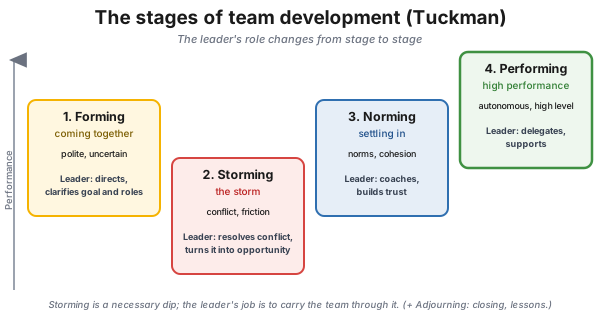
Figure 1 — the four Tuckman stages of team development. Storming is a necessary dip; the leader’s job is to carry the team through it, up to high performance.
Who is this for?
Section titled “Who is this for?”For those who see time-bound work through with other people: project manager · functional lead · shift supervisor · process engineer · capital-project and turnaround engineer · HSE specialist · project team member · executive acting as sponsor.
Learning objectives
Section titled “Learning objectives”After reading this article you will be able to:
- distinguish a project from routine operation, and derive the trade-offs of the iron triangle;
- build a stakeholder register, and assign a strategy to everyone on a power–interest basis;
- produce the project’s core documents: charter, WBS, RACI, risk register;
- recognize which Tuckman stage your team is in, and match your leadership behaviour, your conflict handling and your influencing to it.
In brief
Section titled “In brief”- A project is temporary and unique. “Plan the work, then work the plan.” Its constraint is the iron triangle: cost, time, scope.
- The “P” in PM is as much about managing people as about managing the project. The plan on its own will not carry you through the hard stages.
- Two leadership threads: engaging (goal, roles, stakeholders, plan, risk) and collaborating (team dynamics, conflict, influence, motivation).
- An unmanaged stakeholder is the most expensive hidden risk. The register and the power–interest classification prevent this.
- The team travels a development arc (Tuckman): Forming → Storming → Norming → Performing; the leader’s role shifts stage by stage (directs → resolves conflict → coaches → delegates).
- Risk is not only a threat: it can be an opportunity too, with its own set of response strategies.
Why it matters (the stakes)
Section titled “Why it matters (the stakes)”A badly started project does not fail spectacularly; it slowly gets more expensive. First the scope is vague, so everyone understands the same word differently. Then, because the roles are unclear, two people do the same thing and nobody does a third. Meanwhile the strongest stakeholder is not kept informed, and at the halfway point vetoes all the work done so far. The bill is rework, slippage and a worn-out team. The tools of project management all do the same thing: they turn the expensive, late surprise into a cheap, early conversation.
What is a project, and what makes it one?
Section titled “What is a project, and what makes it one?”A project is a temporary undertaking, carried out in a group, whose purpose is to create a unique product, service or result. It has five characteristics: a team with a shared goal, a unique result, a strategic aim, stakeholders, and the constraint of the iron triangle. The guiding principle is one sentence: “plan the work, then work the plan” — first the plan, then disciplined execution.
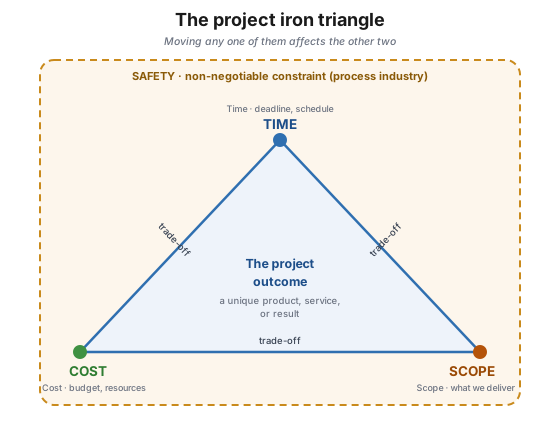
Figure 2 — the iron triangle: cost, time and scope. Moving any one of them affects the other two; in the process industry safety surrounds the three as a fourth, non-negotiable constraint.
What is the project life cycle?
Section titled “What is the project life cycle?”A project can be thought through in three modules:
- Foundations and initiation: defining the project, identifying the stakeholders, the project charter.
- Planning and execution: the integrated project plan, team communication, building the team (Belbin team roles), execution.
- Tracking and closing: monitoring and controlling progress, risk management, and finally closing.
Project closing has six elements: quality control, process improvement, closing out procurement, stakeholder handling, lessons learned, and the team retrospective. Quality here comes in two forms: QA acts on the process (process improvement, PDCA, metrics), while QC examines the deliverable (testing, sampling, Ishikawa diagram, Pareto analysis; see root-cause analysis).
Who is the sponsor, and who is the project manager?
Section titled “Who is the sponsor, and who is the project manager?”The sponsor authorizes and provides resources, the project manager plans and gets it executed. The allocation has to be revisited across the whole life cycle.
| Sponsor (the owner of the project) | Project manager |
|---|---|
| initiating and approving the project | fixing the project management methodology |
| budget and financial resources | developing and managing the iron-triangle plans |
| selecting and appointing the project manager | resource and task allocation, progress monitoring |
| strategic alignment | status, risk management, project communication |
| progress review | partnership with the business units, managing customer and stakeholder expectations |
| developing the team, influencing the stakeholders |
How do you manage the project’s stakeholders?
Section titled “How do you manage the project’s stakeholders?”Start by identifying everyone up front, then classify them by power and interest, and assign to each a management strategy and a desired engagement level. A stakeholder is an individual or group directly or indirectly affected by the project’s result, or who has an interest in it. Four typical groups: the client (external or internal), senior management (the sponsor), project management and the working team. The stakeholder register turns this into a list:
| Stakeholder | Project role | How does the project affect them? | Interest (1–4) | Power (1–4) | Engagement |
|---|---|---|---|---|---|
| Stakeholder 1 | client | … | 3 | 1 | S (supportive) |
Mark engagement on a five-point scale (U unaware, R resistant, N neutral, S supportive, L leading), and always write two values: the current (C) and the desired (D) level. The difference is the to-do.
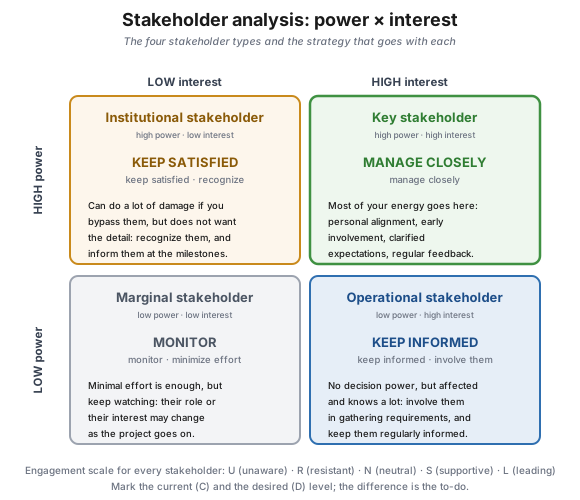
Figure 3 — the stakeholder analysis matrix: crossing power with interest gives the four stakeholder types and their management strategies.
What the register buys you: you identify the stakeholders up front; you capture the expectations early; you collect their requirements; you give feedback; you manage risk; and you ground the strategy. The communication plan is built on this, with five elements: stakeholders, type of information, channel, frequency, owner.
What tools lead a project?
Section titled “What tools lead a project?”Six tools carry a project through:
- The project charter, the project’s letter of authority, with eight mandatory contents: the business case and the proposed solution; the sponsor as owner; high-level scope and objectives; the out-of-scope requirements; the benefits of the project; the assumptions and risks; the stakeholders; and the approvals. The most frequently omitted line is the out-of-scope part.
- Kickoff checklist: who are the mandatory, the optional and the to-be-informed participants; the agenda sent out in advance; the presentation (overview, objectives, team, expectations); and the minutes with action points, owners and deadlines.
- Work breakdown structure (WBS): the hierarchical decomposition of the project into phases, deliverables and work packages. This is what turns the project into manageable pieces.
- RACI matrix: for every task it clarifies who is Responsible (does the work), Accountable (answerable for it), Consulted and Informed. This prevents the “I thought you were doing it” kind of mess.
- Project plan: per PMBOK, a “formal, approved document used to guide project execution and project control”. Importantly, it is not the Microsoft Project schedule, not set in stone, and it does not end with planning.
- Lessons learned: gathering the critical knowledge to improve the next projects, across the whole life cycle, with a joint review at closing.
What makes a project successful?
Section titled “What makes a project successful?”Six factors decide it: a clear goal and scope, managed stakeholders, an integrated plan, good team communication, risk management applied to every project, and a balanced, well-led team. The harder half is the human one: as Cornelius Fichtner puts it, “the ‘P’ in PM is as much about managing people as it is about managing the project”. So it is worth thinking about it along two threads: Leading to Engage sets the project up for success (roles, stakeholders, plan, risk), while Leading for Collaboration is about respect for the team, leadership credibility, team dynamics and motivation.
What are the four stages of team development (Tuckman)?
Section titled “What are the four stages of team development (Tuckman)?”A team does not perform straight away; it goes through a development arc. The four stages of the Tuckman model:
- Forming: members are polite, cautious, uncertain. Leader: directs, clarifies the goal, the roles and the frame (charter, RACI).
- Storming: differences of view and questions of power surface, and performance dips. Leader: handles the conflict and turns it into an opportunity, rather than suppressing it. This stage is necessary.
- Norming: shared norms and trust take shape, cohesion grows. Leader: coaches, builds capability and trust (GROW/OILS).
- Performing: the team performs autonomously, at a high level. Leader: delegates and supports.
The model is often closed by a fifth stage (Adjourning): the team disbands, and the leader celebrates and captures the lessons. The model also shows what you can ask for and when: creative contribution after norming, autonomous decisions in the performing stage. In a virtual team every stage takes longer, so clarifying the roles in writing matters even more there.
How do you communicate in the project team?
Section titled “How do you communicate in the project team?”Start from the fact that communication is lossy by default: of what is said to us we take in only 25%, and the remaining 75% we distort, filter, misunderstand or forget. 50% of an employee’s working time goes on communication, 45% on listening. 85% of business success depends on effective communication, and 70% of workplace errors can be traced back to poor communication.
How do you handle conflict?
Section titled “How do you handle conflict?”Handle it proactively: with planning, communication, stakeholder management, listening to the team and managing expectations. The reactive answer to an argument that has already broken out is only the second line of defence. The five typical sources of conflict:
- Facts: interdependence, performance and rewards.
- Behavior: communication problems, dissatisfaction with roles, culture.
- Personality: the clash of personal traits.
- Beliefs: differences in perception, culture.
- Core values: organizational and personal goals pulling apart.
On the reactive side there are five modes (Thomas–Kilmann), according to the degree of assertiveness and cooperativeness:
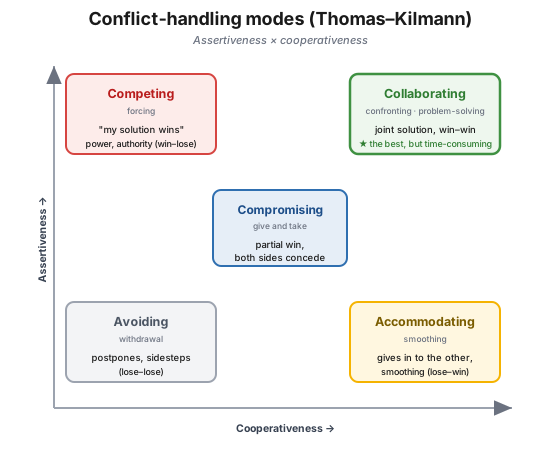
Figure 4 — the five conflict-handling modes. There is no “single right” mode: collaborating (win–win) is the most valuable, but it takes time.
The same thing in the language of project practice, with typical sentences:
| Strategy | How it sounds in the meeting |
|---|---|
| Forcing | “The more senior colleague is right, we’ll go with their solution.” |
| Compromising | “Let’s take a bit from both sides.” |
| Smoothing | “Let’s smooth it over, it’s not that big a deal.” |
| Withdrawal | “I’m out, do it the way that suits you.” |
| Confronting (problem-solving) | “Let’s put our heads together, go round the problem, and look for the best solution.” |
Influence: push or build?
Section titled “Influence: push or build?”Influence is “the overt changing of other people’s attitudes, beliefs and behaviour in a way that preserves their right to decide freely”. There are two basic strategies, and the situation decides which one works.
| PUSH (you talk more than you listen) | BUILD (you listen more than you talk) | |
|---|---|---|
| Your credibility | high | low |
| The problem | clear, with one good answer | ill-defined, complex |
| Resistance | unlikely | likely |
| The culture | accepts being pushed | accepts being built with |
| Tools | confident voice, structured argument, concise presentation, a ready solution | building the relationship, asking questions, common ground, modifying your proposal with their ideas |
What motivates the team (and you)?
Section titled “What motivates the team (and you)?”Motivation is “an energizing force that stimulates arousal, direction and persistence of behavior” (A. J. DuBrin). What arouses it is framed by Maslow’s hierarchy of needs: physiological needs at the bottom, then safety, social and esteem needs, with self-actualization at the top. The lower levels are deficiency needs: as long as they are unmet, the ones above them do not motivate. In a project this is a practical matter, because an uncertain role or a sense of threat pulls back harder than any vision pulls forward.
Self-motivation can be learned: create a personal vision; set challenging goals, but break them into manageable pieces; record and celebrate your successes; take responsibility for your choices; increase your autonomy; keep your energy level high; build small daily rituals. As a leader you create the conditions for the same things through a clear goal, real responsibility and regular feedback.
What ruins a team? The 5 dysfunctions (Lencioni)
Section titled “What ruins a team? The 5 dysfunctions (Lencioni)”Patrick Lencioni’s model (The Five Dysfunctions of a Team) describes five dysfunctions built on one another, from the bottom up:
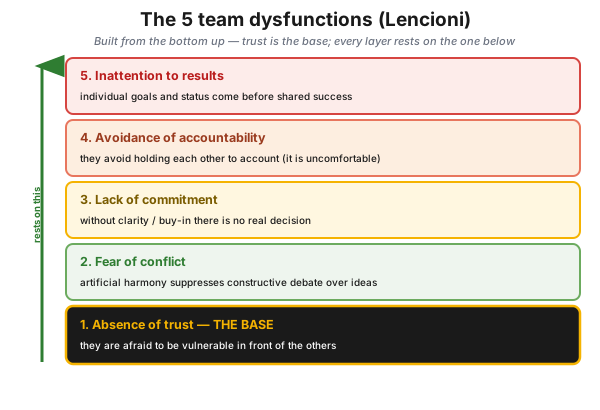
Figure 5 — the 5 dysfunctions according to Lencioni. Trust is the base; the layers above it can only be dealt with if the one below is in place.
- Absence of trust: the fear of being vulnerable prevents trust from building. This is the base.
- Fear of conflict: the desire for artificial harmony suppresses productive, ideological debate.
- Lack of commitment: without clarity and buy-in there is no decision the team will stand behind.
- Avoidance of accountability: to dodge the awkwardness, people do not hold each other to account.
- Inattention to results: individual goals and status take precedence over shared success.
The model also gives the correction. The leader should do six things: focus on the collective results; put the hard issues openly on the table; force clarity and closure; mine for conflict; go first; and lead by example. Drawing out the conflict is precisely what carries the team through the storming stage.
Collaboration, after all, is not an event but a process: it requires trust, mutual respect and the commitment of everyone involved. “You can’t mandate what matters”: what really counts cannot be ordered into existence.
How do you manage the project’s risks?
Section titled “How do you manage the project’s risks?”In five steps: (1) identify the risks, (2) qualitative analysis, (3) quantitative analysis, (4) plan the responses, (5) monitoring and control. Risk, in PMI’s definition, is “an uncertain event or condition that, if it occurs, has a positive or negative effect on the project’s objectives” — so it is not only a threat, it can also be an opportunity.
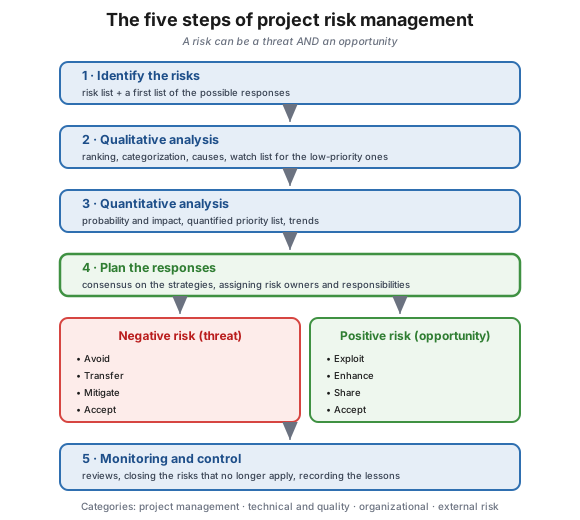
Figure 6 — the five steps of risk management, with the response strategies for negative and positive risk.
The typical risk categories: project management (poor allocation of time and resources), technical and quality (unproven technology, unrealistic expectations), organizational (missing support, faltering funding, internal politics) and external risk (legal, labour, change of priorities, force majeure).
In the process industry a project is often a capital project, an upgrade or a turnaround, where safety joins the iron triangle as a fourth, non-negotiable constraint: optimizing cost, time and scope can never come at its expense. In a turnaround project it is precisely the mishandling of storming (rushing, suppressed doubts) that can lead to dangerous short-cutting, which is why open communication is worth a lot (effective meetings, handovers), along with the Completer Finisher role, the guardian of the closing safety checks.
Putting it into practice
Section titled “Putting it into practice”These six steps are the exercise sequence of a two-day project management workshop:
- Recall a project run without a plan (15 minutes): how you felt, what the result was. This is your reference point.
- Identify at least 5 stakeholders (25 minutes): fill in the register columns for them, and place them in the power–interest matrix.
- Assign a strategy to each (25 minutes): mark the current (C) and the desired (D) engagement level, then write down what you will do about the difference.
- Write a project charter and a roadmap (20 minutes): one sentence for each of the eight charter elements.
- Draw the WBS (15 minutes), then build a RACI table for it (10 minutes). Every work package should have exactly one “A” owner; for two of them, also look at which Belbin roles are needed.
- Build a risk register (45 minutes): risks, categories, probability and impact estimates, response strategies.
The closing is always the same: write down three things you will actually introduce on Monday, and also put into words: what I feel, what I think, what I will do.
Common mistakes
Section titled “Common mistakes”- Suppressing the storming. Conflict that is pushed down either explodes later or distorts into alibi agreement (groupthink). Instead: draw it out, and steer it into a fact-based debate.
- Leading only the task, not the people. The plan on its own will not carry you through the hard stages. Instead: split your leadership time between the plan and the team.
- Changing one element of the iron triangle without the others. Extending the scope with no time and no cost is unrealistic. Instead: state the time and cost impact out loud.
- Not managing a stakeholder. The unmanaged stakeholder steps in at the worst possible moment. Instead: register, classification, engagement level.
- A team made up of identical roles. Without drive or without closure the project either falls apart or never finishes. Instead: deliberate complementary roles.
- Collecting lessons only at closing. By the time the project ends, the details are lost. Instead: lessons learned across the whole life cycle.
When NOT to use it (the limits of the method)
Section titled “When NOT to use it (the limits of the method)”Classic, plan-driven project management is not for every situation:
| Situation | Why this is not the right tool | The right answer |
|---|---|---|
| Routine, repetitive operation | there is no unique result and no end date, so it is not a project | an operating system and a daily cadence: MOS, standard operator round |
| Volatile requirements | the waterfall logic is inflexible, and there is no delivery for a long time | an iterative (agile) route: sprints, incremental delivery, scope change goes into the next iteration |
| A certified safety function or technical change | this is not decided by project-team consensus | a formal procedure per HAZOP, LOPA/SIL, MOC |
| Strong documentation and phase approval are required | iterative working leaves an incomplete trail here | a phased, stage-gate logic |
Rule of thumb: if the result can be defined up front and documentation is critical, the phased route is the right one. If the requirements clarify along the way, iterate, and treat the scope change as the input to the next iteration.
Take it home (keys)
Section titled “Take it home (keys)”- Do not start with the kickoff, start with the charter. The out-of-scope part saves the most arguments later.
- List the stakeholders in the first week, classify them by power and interest, and mark the desired engagement level.
- Give every work package one “A” owner. RACI is the fastest-paying half hour in the project.
- Expect the storming, and do not suppress it. Mine for conflict, go first, lead by example.
- Handle risk in both directions: for a threat, avoid/transfer/mitigate/accept; for an opportunity, exploit/enhance/share/accept.
- Collect the lessons as you go, not only at closing.
- With low credibility and a complex problem, listen more than you talk (build, not push).
Self-test
Section titled “Self-test”- What are the eight elements of the project charter, and which omission causes the most later scope arguments?
- What strategy do you use with a high-power but low-interest stakeholder, and how does this differ from handling a key stakeholder?
- Why is the storming stage necessary, and what does the leader do instead of smoothing it over?
Answer key
- Business case and proposed solution; the sponsor as owner; scope and objectives; out-of-scope requirements; benefits; assumptions and risks; stakeholders; approvals. The most frequently omitted one is the out-of-scope part.
- Keep the high-power, low-interest (institutional) stakeholder satisfied: recognize them, inform them at the milestones. Manage the key stakeholder closely: early involvement, clarified expectations, regular feedback.
- Because without clarifying the differences of view there is no real collaboration. The leader draws the conflict out, steers it into debate, and forces closure.
How does this show up in digital practice?
Section titled “How does this show up in digital practice?”The tools of project management were born on paper, but their principle is realized best in software: there the document not only exists, it is versioned, searchable, and reminds you of itself.
| Project management principle | Digital implementation | What it delivers |
|---|---|---|
| Clear goal and scope | versioned charter template with mandatory fields | the scope change is retrievable |
| Stakeholder management | register with classification and engagement level | nobody is left out, and it is visible what needs doing with whom |
| Clarifying the roles | digital RACI for the work packages | no ownerless task and no task done twice |
| Tracking the action points | action list with owner, deadline and status | the reminder does not fall asleep in the inbox |
| Risk management | risk register with scoring and a risk owner | the risk is ranked and tracked |
| Lessons learned | a continuously written, searchable lessons log | the next project does not repeat the same thing |
Connection to OPEREX (shift log)
Section titled “Connection to OPEREX (shift log)”The plant-floor footprint of a project is created not in the project software but in the shift: equipment shut down, a temporary condition, an area handed over. A digital shift log (OPEREX) records this shift by shift: the daily action points with owner and deadline, the risks that came up, and the lessons captured at closing. This way the plant-level execution of project decisions remains retrievable in an auditable way.
Terminology (HU / EN)
Section titled “Terminology (HU / EN)”| Hungarian | English | Note |
|---|---|---|
| projekt | project | temporary, with a unique result |
| vasháromszög | iron triangle | cost · time · scope |
| projektcharter | project charter | the project’s letter of authority, with 8 mandatory elements |
| érintett-regiszter | stakeholder register | name, role, impact, interest, power, engagement |
| elkötelezettségi skála | U-R-N-S-L | unaware · resistant · neutral · supportive · leading |
| viharzás | storming | the conflictual, necessary stage of team development |
| munkalebontási struktúra | WBS (Work Breakdown Structure) | decomposition into work packages |
| felelősség-mátrix | RACI | Responsible · Accountable · Consulted · Informed |
| tanulságok | lessons learned | collected across the whole life cycle |
What makes a project successful?
A clear goal and scope (charter), managing the stakeholders, an integrated plan, good team communication, adequate risk management, and a balanced, well-led team. Project management is as much about leading people as about leading tasks.
What are the four stages of team development (Tuckman)?
Forming: a polite, uncertain start. Storming: conflict and a temporary dip. Norming: shared norms and trust. Performing: autonomous, high-level working. A fifth stage, Adjourning, often closes it. The leader’s role shifts stage by stage: directs, resolves conflict, coaches, delegates.
What is the iron triangle?
The project’s three interlocking constraints: cost, time and scope. Changing any one of them affects the other two. In the process industry safety is a fourth, non-negotiable constraint.
What does the stakeholder register contain?
The stakeholder’s name and project role, the project’s impact on them, their interest and their power (on a 1–4 scale), and their engagement level (U-R-N-S-L), split into current (C) and desired (D).
Related concepts
Section titled “Related concepts”Belbin team roles · Lean leadership and coaching · assertive communication · effective meetings · feedback · Lean change leadership · self-awareness · the trust model
Next step
Section titled “Next step”From here it is worth going on:
- Belbin team roles — how to build the team out of complementary roles.
- effective meetings — the kickoff and the status meeting run so that they do not burn time.
- Lean leadership and coaching — the toolkit of the norming and performing stages: questioning, GROW, delegation.
References / further reading
Section titled “References / further reading”- Project Management Institute: A Guide to the Project Management Body of Knowledge (PMBOK Guide) — the canonical definitions of the project plan and of risk.
- Bruce W. Tuckman: Developmental Sequence in Small Groups. Psychological Bulletin, 1965 — the original of the forming–storming–norming–performing model (adjourning was added in 1977).
- Patrick Lencioni: The Five Dysfunctions of a Team. Jossey-Bass, 2002.
- R. Meredith Belbin: Management Teams: Why They Succeed or Fail. 1981.
- Kenneth W. Thomas, Ralph H. Kilmann: Thomas-Kilmann Conflict Mode Instrument, 1974.
- Abraham H. Maslow: A Theory of Human Motivation. Psychological Review, 1943, and Andrew J. DuBrin: Human Relations — the sources of the motivational frame.
- PMI certifications (PMP, CAPM, PMI-ACP, PfMP) and the Certified Scrum Master (CSM).