Hot work permit: authorizing fire-hazardous work in a plant
≈ 9 min read · 1,763 words
A welder’s spark can be half a metre from the vapour of a leaked solvent, and the welder cannot see it. Hot work is special because it brings the ignition source itself to a place where the hazard may already be present. Knowing how to weld is therefore not enough: the plant must decide in advance whether it is allowed at that place, at that minute, and under which conditions. Let’s look at what counts as hot work, what the rules say, and how the permit is built.
Hot work is any work that brings an ignition source (open flame, sparks, hot surfaces) near combustible material: welding, flame cutting, grinding, soldering. Occasional hot work in a plant may be carried out only under a written permit and defined precautions. The “written permit” requirement stems from the company’s own fire safety regulation, which, under Hungarian law, must contain the rules of regular and occasional hot work.
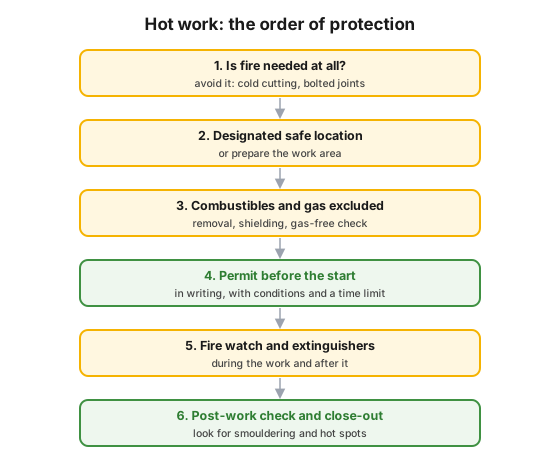 Figure 1: the order of protection. The permit is the fourth step, but without the first three it is only paper.
Who is this for?
Section titled “Who is this for?”maintenance technician · welder and contractor supervisor · shift supervisor · fire-safety officer · occupational-safety and HSE specialist · plant manager.
Learning objectives
Section titled “Learning objectives”- tell regular and occasional hot work apart;
- list the content of a hot work permit;
- explain the role of the fire watch and the purpose of the post-work check;
- decide when other permits (isolation, confined space) are needed alongside.
In brief
Section titled “In brief”- The first question is whether fire is needed at all: cold cutting or a bolted joint often solves it.
- The permit is made before the start, on site, and is bound to time, place and job.
- The conditions separate ignition source and combustibles: removal, shielding, gas-free testing.
- The fire watch and the extinguishers stay on site during the work and afterwards.
- The regulatory frame is the company’s fire safety regulation, which the law prescribes with mandatory content.
What do the rules say?
Section titled “What do the rules say?”Hungarian regulation captures hot work through the fire safety regulation. Decree 101/2023 (XII. 29.) BM on the fire safety regulation, the fire safety house rules and fire safety training states, in the text we checked:
- the fire safety regulation must contain the rules for performing regular and occasional hot work (§ 2 d);
- the fire safety house rules must also contain the rules of occasional hot work (§ 5 (2) b);
- under the General Fire Safety Regulation (Annex 1), regular and occasional hot work may be carried out only at a location and in a manner suitable from a fire-safety standpoint (Chapter II, point 5).
The decree text does not name who issues the permit, nor does it prescribe its exact content. These are set by the company’s own fire safety regulation, so the right answer to “who can issue a hot work permit” is: whoever the organization’s fire safety regulation and permit system designate. The Hungarian National Fire Safety Code (OTSZ, Decree 54/2014 BM) contains further building- and facility-related requirements; a fire-safety specialist knows their details. This article describes Hungarian rules as an example, not as a universal rule.
Internationally the best-known professional standard is NFPA 51B (Fire Prevention During Welding, Cutting, and Other Hot Work), which details the fire watch, the inspection of the work area and the post-work check. Always verify concrete durations (for example the fire watch’s post-work observation period) in the current edition and the local rules.
What counts as hot work?
Section titled “What counts as hot work?”| Activity | Ignition source |
|---|---|
| Welding, flame cutting | flame, arc, molten metal |
| Grinding, cut-off wheel | sparks |
| Soldering, hot-air tool | flame, hot air |
| Bitumen torch-applied roofing | open flame |
| Non-sparking tools not used in a flammable atmosphere | mechanical spark |
Whether work is “hot” in a plant depends on the place as well as the activity. The same welding in an office and next to a tank farm is a different risk: the classification of the place (explosive zone, presence of combustibles) decides which conditions are required.
What does a hot work permit contain?
Section titled “What does a hot work permit contain?”On top of the general elements of a permit to work:
- the exact place and job (equipment, tag, type of welding);
- removal or protection of combustibles (shielding, spark catchers, covering, neighbouring openings);
- gas and vapour freedom (test, time and value of the test, repeat for longer jobs);
- a named fire watch and extinguishers on site;
- validity (short, shift-bound) and the time of the post-work check;
- related permits: isolation (LOTO), entry (confined space).
How does hot work run in practice?
Section titled “How does hot work run in practice?”The key is the order: first why (is fire needed?), then where, then what is around it, and only then the permit. The issuer checks gas-freedom and combustibles on site, so the permit cannot be issued “from the desk”. At the end of the work the fire watch does not leave at once: embers or hidden hot spots can ignite hours later.
Implementation in practice: do this tomorrow
Section titled “Implementation in practice: do this tomorrow”At the next welding job go to the work site and check: (1) who is the fire watch, and do they know it? (2) when was the last gas test and who took it? (3) what is under and beside the welding spot (cable duct, leaking pipe, corner)? If you cannot answer any one immediately, extend the permit template with it.
Common mistakes
Section titled “Common mistakes”| Mistake | Why it is a problem | Correct practice |
|---|---|---|
| The gas test is missing or old | concentration changes within minutes | test right before the start, repeat |
| The fire watch also works | they do not watch | the fire watch has only that task |
| The neighbouring room is not inspected | sparks travel | inspect the immediate surroundings |
| One permit for a whole week | conditions change | short validity, daily renewal |
| No post-work check | embers ignite later | mandatory post-work check and signature |
When NOT to use a hot work permit as the solution?
Section titled “When NOT to use a hot work permit as the solution?”| Situation | Why it is not enough | What to do instead |
|---|---|---|
| A cold-work alternative exists | the permit manages the risk, it does not remove it | bolted joint, cold cutting, mechanical solution |
| Gas-freedom cannot be proven | a signature cannot replace a test | shutdown, cleaning, purging |
| Explosive atmosphere in operation | special protection is needed | Ex-zone rules, a special permit |
| Routine workshop work in a designated area | the designated area and the rules may suffice | the simplified regime in the company’s regulation |
Take it home
Section titled “Take it home”- First avoid the fire, then the permit.
- The permit is made before the start, on site.
- No hot work permit without a gas test, fire watch and post-work check.
- Who issues is set by the company’s fire safety regulation, not by the decree.
- “Permit” can mean three things: an in-plant permit to work, open-air burning, or an authority building permit. Do not mix them up.
Self-test
Section titled “Self-test”- Why can a hot work permit not be issued “from the desk”?
- What does Decree 101/2023 BM say about occasional hot work, and what does it not say?
- When is isolation needed alongside the hot work permit?
How does this show up in digital practice?
Section titled “How does this show up in digital practice?”| Principle | Digital implementation | What it prevents |
|---|---|---|
| Test before the start | the atmosphere test is recorded with value and validity | a permit based on an old test |
| Short validity | expiry is visible, extension asks for a new test | the “whole week” permit |
| Related permit | the isolation certificate is a condition of the permit | welding without isolation |
| Audit trail | signature chain with time stamps | after-the-fact “filling in” |
Connection to OPEREX
Section titled “Connection to OPEREX”In the OPEREX Permit to Work module hot work is a main type of its own. The atmosphere test (O₂, flammable gas, H₂S, CO, toxic gas) is recorded, the classification comes from the instrument, validity is set in minutes, the issue gate looks at the latest measurement, and a new test can be required on extension. The module does not replace the company’s fire safety regulation: it enforces it. Details: Permit to Work module.
Terminology (HU / EN)
Section titled “Terminology (HU / EN)”| Hungarian | English | Note |
|---|---|---|
| Tűzveszélyes tevékenység | Hot work | work bringing an ignition source |
| Alkalomszerű tűzveszélyes tevékenység | Occasional (non-routine) hot work | term of Decree 101/2023 BM |
| Tűzőr | Fire watch | on site during and after the work |
| Gázmentesség-mérés | Gas test / gas-free certificate | before the start |
| Utóellenőrzés | Post-work inspection | looking for embers, hidden heat |
What counts as hot work?
Any work that brings an ignition source near combustible material: welding, flame cutting, grinding, soldering, use of an open flame.
Who can issue a hot work permit?
The Hungarian decree, in the text we checked, names no person. The company’s fire safety regulation and permit-to-work system designate the issuer, so look there.
Is a written permit mandatory?
Under Decree 101/2023 BM the fire safety regulation must contain the rules for occasional hot work, and the activity may be carried out only at a suitable location and in a suitable manner. The written permit is fixed by the company’s own regulation, which makes it common practice in industry.
What does the fire watch do?
Stays on site during and after the work, watches for sparks and embers, and can extinguish or raise the alarm. It is their only task.
Is an open-air burning permit the same as a hot work permit?
No. Open-air burning is regulated by the authorities; in-plant hot work rests on the company’s regulation and permit to work.
Related concepts
Section titled “Related concepts”permit to work | confined space | LOTO | operational risk assessment | near-miss
Next step
Section titled “Next step”- Permit to work: the general system the hot work permit fits into.
- Lockout/tagout: the isolation that is a frequent condition of hot work.
- Confined space entry permit: when the hot work takes place in a confined space.
References / further reading
Section titled “References / further reading”- Decree 101/2023 (XII. 29.) BM on the fire safety regulation, the fire safety house rules and fire safety training (njt.hu).
- Decree 54/2014 (XII. 5.) BM on the National Fire Safety Code (OTSZ).
- NFPA 51B: Standard for Fire Prevention During Welding, Cutting, and Other Hot Work.
- HSE (UK): Guidance on permit to work systems (HSG250).