Eisenhower matrix (urgent–important)
≈ 18 min read · 3,572 words
The phone rings, an email flagged “urgent” is blinking, and there is a meeting in your calendar you never asked for. By the evening all three are done. Everything except the thing you came in for this morning. Time was not what you lacked; the filter was. The Eisenhower matrix is exactly that filter: it breaks the decision into two questions, and the two answers give you four quadrants. Let’s look at what it is, what its four quadrants are, and why Q2 deserves the most time.
The Eisenhower matrix is a prioritization tool that sorts tasks into four quadrants along two axes: urgency and importance.
An urgent task demands immediate attention; an important task contributes to our long-term mission, values and goals — and the two rarely coincide. The four quadrants give four decisions: do the urgent and important task now (Q1, “Do it”), schedule the important but not urgent one (Q2, “Plan to do it”), delegate the urgent but not important one (Q3, “Delegate it”), and drop what is neither urgent nor important (Q4, “Drop it”). The guiding principle of the method is that most of your time should go deliberately to Q2 — to prevention, planning and relationships — because that is what yields lasting satisfaction and results.
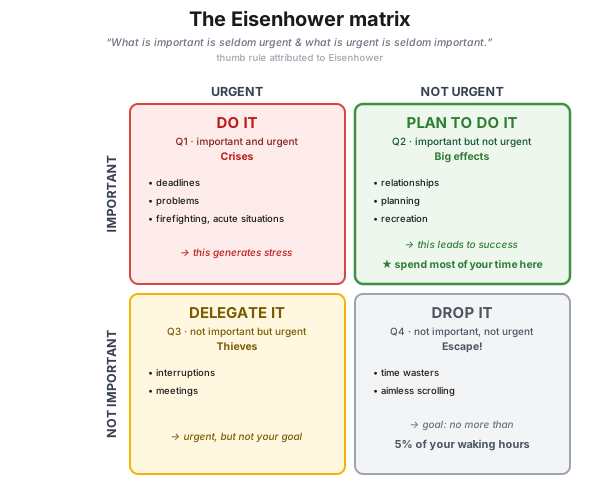
Figure 1 — the Eisenhower matrix. The four quadrants of the urgent (column) and important (row) axes assign four actions to your tasks. The goal is to spend the most time in Q2, and no more than 5% of your waking hours on Q4.
Who is this for?
Section titled “Who is this for?”This article is for those whose day is overwritten by other people’s requests, and whose important work keeps slipping to the evening: shift supervisor · plant manager · process engineer · maintenance planner · HSE specialist · project manager · team leader · Lean/CI coordinator.
Learning objectives
Section titled “Learning objectives”After reading this article you will be able to:
- separate urgency from importance, and name which one puts you in which mode;
- sort your own tasks into the four quadrants, together with the character of each quadrant;
- calculate how much of your time goes to Q4, and measure it against the 5% target;
- move more time into Q2 with one concrete step;
- decide when the matrix is not the right tool, and what takes its place.
In brief
Section titled “In brief”- Two axes, two questions. Urgent: demands immediate attention, the to-do that shouts “Now!”. Important: serves your long-term mission, goals and values. The two are not the same, and typically they do not coincide.
- Four quadrants, four decisions. Q1 Do it (Crises), Q2 Plan to do it (Big effects), Q3 Delegate it (Thieves), Q4 Drop it (Escape!).
- The urgent makes you reactive, the important makes you responsive. Urgency brings a defensive, negative, hurried and narrowly focused mode; focusing on the important keeps you calm, rational and open to new opportunities.
- Q2 deserves the most time, because it is what provides lasting happiness, fulfillment and success.
- Q4 has a numeric target: the goal is not to eradicate it completely, but to keep it to 5% or less of your waking hours.
- Classification on its own is not prioritization. The benefit comes from actually moving the freed-up time into Q2.
Why it matters (the stakes)
Section titled “Why it matters (the stakes)”Today’s working environment stimulates you constantly: a notification, a request, a phone call, a group email. In this noise it becomes a basic skill to be able to filter the signal from the noise, that is, to distinguish between what is urgent and what is truly important. Whoever does not filter has their day filled by other people’s priorities.
The stake is more concrete than that. Without a filter, the day slides by itself toward Q1 and Q3: constant firefighting, with interruptions and unnecessary loops on top. Prevention and planning (Q2) get squeezed out, because there is no deadline pressure behind them. The consequence is predictable: more crises, because less prevention happened, and less energy, because sustained firefighting burns you out. The value of the matrix is not a nicer list, but that it makes this spiral visible and reversible.
What is the Eisenhower matrix, and where does it come from?
Section titled “What is the Eisenhower matrix, and where does it come from?”Short answer: a 2×2 decision grid that places tasks in the cross-table of urgency and importance, and assigns a different action to each cell.
The matrix is named after Dwight D. Eisenhower, American general and president. The thumb rule attributed to him captures the essence: “What is important is seldom urgent and what is urgent is seldom important”. The attribution is worth handling with care: the method’s own introductory materials also present it as a thumb rule, not as a verbatim quotation.
The tool was made famous worldwide by Stephen Covey in his book The 7 Habits of Highly Effective People, where the logic of the quadrants is built around the third habit (“put first things first”). This is the source of the quadrant numbering still used today, and of the prominent role of Q2.
How does urgent differ from important?
Section titled “How does urgent differ from important?”Short answer: urgency tells you when a task asks for attention, importance tells you whether it matters to you at all. The two are independent of each other, and the power of the matrix comes precisely from this separation.
- Urgent: the task demands immediate attention; these are the to-dos that shout “Now!”. Typically it is somebody else’s clock ticking behind them.
- Important: the task contributes to your long-term mission, values and goals. Sometimes the important is also urgent, but typically it is not.
The difference is not only logical but also psychological: the two axes switch you into a different mode.
| When the urgent leads (reactive mode) | When you focus on the important (responsive mode) |
|---|---|
| defensive | calm |
| negative | rational |
| hurried, narrowly focused | open to new opportunities |
The trap is that urgency is loud and importance is silent, so urgent but inconsequential things almost automatically crowd out important but unhurried ones. The basis of a lasting responsive mode is to concentrate on your own circle of influence.
What are the four quadrants of the Eisenhower matrix?
Section titled “What are the four quadrants of the Eisenhower matrix?”Short answer: Q1 is urgent and important, Q2 is important but not urgent, Q3 is urgent but not important, Q4 is neither. Each quadrant has its own character and its own decision.
- Q1 — Crises → DO IT (“Do it”). Deadlines, problems, acute situations. These have to be solved now, by yourself. The character of the quadrant, however, generates stress, and whoever lives here permanently gets stuck in firefighting mode.
- Q2 — Big effects → PLAN TO DO IT (“Plan to do it”). Relationships, planning, rest and recreation. The essence is in the name: this is where the big effects are born. Lacking deadline pressure, this is the quadrant most easily postponed, even though it is what delivers lasting results. Putting rest here is not an afterthought: performance is built on energy, not on hours (energy management).
- Q3 — Thieves → DELEGATE IT (“Delegate it”). Interruptions and meetings. The name is accurate: they look urgent, while they serve someone else’s goals, and it is your time they consume. Meetings are the biggest item, so even the necessary ones are worth bringing into an effective format, and the rest delegated or declined.
- Q4 — Escape! → DROP IT (“Drop it”). Time wasters, aimless scrolling. The name of the quadrant describes what actually happens: this is not rest but escape from the other three quadrants.
Why should Q2 get the most time?
Section titled “Why should Q2 get the most time?”Short answer: because Q2 provides lasting happiness, fulfillment and success, and because preventive work done in Q2 reduces the number of future Q1 crises.
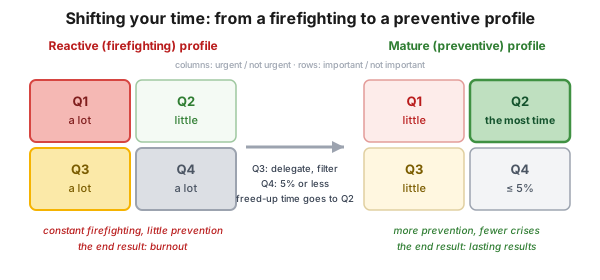
Figure 2 — the same four quadrants, with two time profiles. In the reactive profile Q1 and Q3 eat up the day; in the mature profile Q2 gets the most time. The figure shows a pattern, not measured data; the only numeric target value is the 5% for Q4.
The practical question is not how to eradicate the neither-urgent-nor-important (Q4) tasks completely. The method gives a concrete target for this: try to spend only a very limited amount of time on them; 5% or less of your waking hours is a good goal. This is the method’s single numeric measure, and that is exactly why it is usable: it can be checked within a week.
The freed-up time comes from two directions. Q3 is one: filtering interruptions and delegating meetings gives time back directly. Q4 is the other: kept below 5%, the day no longer leaks away unnoticed. What is freed up this way must be deliberately put into Q2, otherwise it flows back into Q1 by itself. Whoever works in Q2 will have fewer Q1 crises, because planning pre-empts firefighting.
How to use it in practice
Section titled “How to use it in practice”Short answer: list your activities, sort them into the four quadrants, then cut Q1, Q3 and Q4 time so that more goes to Q2. These three steps are the established introduction recipe for the matrix.
Hands-on — a one-week time log (mini-scenario)
Section titled “Hands-on — a one-week time log (mini-scenario)”Classification becomes more than a thought experiment when you put real data under it. One week is enough:
- Log five working days (5 minutes a day). At the end of the day write down what your time went on, in roughly half-hour blocks. The log only has value if the scrolling and the unnecessary alignment meetings also get in.
- Sort the items (20 minutes). For each line ask the two questions, in this order: is it important, then is it urgent. Write the quadrant number next to it.
- Calculate the ratios (10 minutes). Add up the hours of the four quadrants and work out the percentages. Compare the Q4 share with the 5% target, and look at how big the Q2 share is.
- Pick a single Q3 item (5 minutes). The one that takes the most time. Decide whom you delegate it to or how you shorten it, and assign a name and a deadline to it.
- Book a Q2 block for next week (5 minutes). Put two named Q2 blocks of 60 minutes each into your calendar (for example “preparing next month’s shutdown”), and treat them like a meeting agreed with an external party.
- Close the loop the following week. Log one more day and see whether the Q2 share has moved. If it has not, something overwrote the Q2 block: find out what, because that is your real priority.
The filter for incoming tasks: four decisions
Section titled “The filter for incoming tasks: four decisions”Short answer: the matrix is not only a weekly planning tool but also a fast handling rule for incoming emails and requests: after the two questions, every item lands in one of the four decisions.
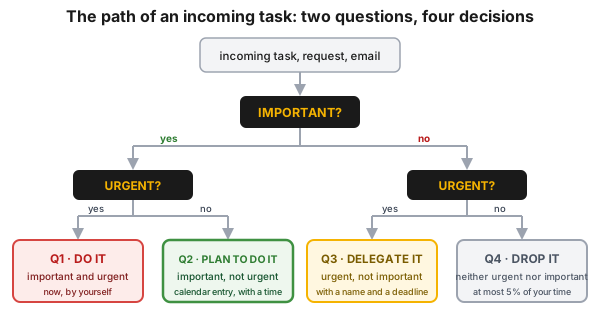
Figure 3 — the path of an incoming task. After two questions (is it important, is it urgent), four outcomes: “Do it”, “Plan to do it”, “Delegate it”, “Drop it”, with the method’s original action verbs.
The time-management literature often refers to these four decisions as 4D (do, defer, delegate, delete or dump); the matrix’s own vocabulary, however, is the “Do it / Plan to do it / Delegate it / Drop it” foursome. The practical difference lies in the second one: “defer” suggests postponement, “plan to do it” suggests scheduling. Q2 works precisely because you do not postpone it but give it a time slot. The wider frame is covered in the time management article.
Plant and safety context
Section titled “Plant and safety context”Short answer: in the process industry, separating the urgent from the important is a safety question, because preventive work almost always lives in Q2, from where the urgency of the day squeezes it out.
Constant firefighting (Q1) is a sign of reactive operation: permanent troubleshooting, rushing, exhausted shifts. Reliability and safety, by contrast, are built by Q2: preventive maintenance, processing near-miss reports, risk assessment, the standard operator round and competence development. These are important but “unhurried”, so they are exactly the work that the urgency of the day sacrifices first.
A similar way of thinking works here as behind leading and lagging indicators: Q2 activity acts ahead, while the number of Q1 crises measures the result afterwards. The maturity of a plant is well indicated by whether preventive tasks get protected time in the calendar. The culture of continuous improvement (ci-mindset) asks for the same thing: regular, non-urgent work on the system itself.
Common mistakes
Section titled “Common mistakes”- Taking the urgent for the important. A task shouting “Now!” is not necessarily important, and a delegable Q3 often disguises itself as a Q1. Instead: always start with the question of importance, and only then ask about urgency.
- Living permanently in Q1. Constant firefighting burns you out and takes time away from prevention, which produces more Q1. Instead: for every Q1 event, ask what missed Q2 work led here.
- Postponing Q2. Lacking deadline pressure, planning and prevention slip forever. Instead: Q2 goes into the calendar, not onto a task list, with a concrete time.
- Tolerating Q4. Aimless time-spending eats the day unnoticed. Instead: measure its share and keep it below the 5% target. Mind the boundary: deliberate recharging is Q2, only aimless scrolling is Q4.
- Only listing, not acting. Classification on its own is not prioritization. Instead: let every round of sorting produce one delegation and one Q2 block put into the calendar.
When NOT to use it (the limits of the method)
Section titled “When NOT to use it (the limits of the method)”Short answer: the matrix is an individual attention-allocation tool. Where the order is decided by a rule, by risk or by technical logic, the matrix is not the right tool.
- In an acute plant upset or an alarm. The order is decided by the alarm priority and the operating instruction, not by whether the operator feels it is important. Instead: alarm handling rules and procedures.
- Where legislation or a permit sets the deadline. A regulatory deadline does not become less binding because it looks inconsequential in the matrix. Instead: a compliance register.
- For delegating a safety event. The logic of Q3 (“urgent, but not my business”) is a dangerous transfer here; on-site intervention cannot be handed on. Instead: escalation according to the procedure.
- At team level, without a shared definition of priority. “Important” is subjective, so the same task ends up in two different quadrants for two people. Instead: first agree on the goal against which something is important, and only then sort.
- In fixed-schedule work. In a fixed shift pattern most of the day is predetermined. Instead: apply the matrix to the freely plannable part of your time.
How does it show up in digital practice?
Section titled “How does it show up in digital practice?”The principle of the matrix does not stop at a sheet of paper: the same logic is realized in a digital task manager and calendar too, only the mechanism differs.
| Element of the matrix | Digital implementation | What it delivers |
|---|---|---|
| the two questions (important, urgent) | a mandatory priority label when the task is created | the classification does not get skipped, and can be filtered later |
| Q2 block | a recurring, named calendar entry | preventive work has protected time |
| Q3 delegation | a task handed over with an owner and deadline field | the handover is trackable, it does not get lost |
| Q4 share | a time log or a label-based time report | the 5% target becomes measurable |
| the weekly close | an automatic list of closed and slipped items | the real priority becomes visible |
Take it home (keys)
Section titled “Take it home (keys)”- Start with importance, not urgency. Urgency is loud, so if you start with it, it decides for you.
- Measure before you reorganize. One week of time logging tells you more about your day than any plan.
- Give Q4 a number. 5% or less of your waking hours; this is the only immediately checkable target value.
- Q2 goes into the calendar, not onto a list. Whatever gets no time slot will be claimed by urgency.
- Delegate Q3 with a name and a deadline. Delegation without an owner is just postponement.
- Rest is Q2. Without recharging there is no responsive mode, only rushing.
Self-test
Section titled “Self-test”- What is the difference between an urgent and an important task, and which one puts you in which mode?
- What are the names of the four quadrants in the method’s own vocabulary, and which action belongs to each?
- A shift supervisor measures that 45% of their time is Q1, 30% Q3, 15% Q4 and 10% Q2. What are their first two steps, and against which target value can they measure themselves?
Answer key
- The urgent demands immediate attention and puts you in a reactive (defensive, negative, hurried, narrowly focused) mode. The important contributes to your long-term mission, values and goals, and brings a responsive mode: calm, rational, open to new opportunities.
- Q1 Crises (Crises) → “Do it”; Q2 Big effects (Big effects) → “Plan to do it”; Q3 Thieves (Thieves) → “Delegate it”; Q4 Escape (Escape!) → “Drop it”.
- First they push Q4 down to the 5% target, which from a starting point of 15% frees up 10 percentage points on its own. Second, they delegate or shorten the biggest Q3 item (typically a recurring meeting). The freed-up time must be booked into named Q2 blocks immediately, otherwise it flows back into Q1. There is a measure only for Q4 (5%); for Q2 the direction is what counts, that is, whether it has grown by the next measurement.
Terminology (HU / EN)
Section titled “Terminology (HU / EN)”| Hungarian | English | Quadrant |
|---|---|---|
| sürgős | urgent | immediate attention |
| fontos | important | long-term goal, value |
| reaktív üzemmód | reactive mode | the effect of urgency |
| válaszkész üzemmód | responsive mode | the effect of focusing on the important |
| Tedd meg | Do it | Q1 — Crises (Crises) |
| Tervezd be | Plan to do it (defer, schedule) | Q2 — Big effects (Big effects) |
| Delegáld | Delegate it | Q3 — Thieves (Thieves) |
| Dobd el | Drop it (delete, dump) | Q4 — Escape (Escape!) |
The English variants in brackets are widespread synonyms; the first forms follow the method’s original wording.
What is the difference between urgent and important?
An urgent task demands immediate attention (“Now!”) and puts you in a reactive mode, that is, defensive, negative, hurried and narrowly focused, but it does not necessarily serve your goals. An important task contributes to your long-term mission, goals and values, and brings a responsive mode: calm, rational, open to new opportunities. Many urgent things are not important, and many important things are not urgent.
What are the four quadrants of the Eisenhower matrix and the decision belonging to each?
Q1 is urgent and important, the quadrant of crises, decision: do it now (“Do it”). Q2 is important but not urgent, the quadrant of big effects, decision: schedule it (“Plan to do it”). Q3 is urgent but not important, the quadrant of the time thieves, decision: delegate it (“Delegate it”). Q4 is neither urgent nor important, the quadrant of escape, decision: drop it (“Drop it”).
Why should Q2 get the most time?
Because Q2 (relationships, planning, rest, prevention) provides lasting happiness, fulfillment and success, and whoever works here will have fewer Q1 crises. The goal is not to eradicate the other quadrants but to shift the ratio deliberately: delegating Q3 and pushing back Q4 is what frees up the time.
How much time may go to Q4?
The method does not ask for complete elimination but for a very limited amount of time: a good target is that Q4 takes 5% or less of your waking hours. This is the single numeric measure in the matrix, and it can be checked with a one-week time log.
How does the Eisenhower matrix relate to safety?
Constant firefighting (Q1) is a reactive, burnout-inducing mode, whereas safety and reliability are built by Q2: preventive maintenance, processing near-miss reports, risk assessment and competence development. These are important but not urgent, so the urgency of the day squeezes them out first, and this shows up later in Q1 events.
Related concepts
Section titled “Related concepts”time management · circle of influence · energy management · effective meetings · leading and lagging indicators · self-awareness · ci-mindset
Next step
Section titled “Next step”If you have understood this, from here it is worth going on — in this order:
- time management — the wider frame: how what you saw here in a single matrix becomes a daily and weekly system.
- circle of influence — the basis of the responsive mode: what you have influence over, and what you do not.
- effective meetings — the biggest item in Q3; here you get the concrete tools for shortening them.
References / further reading
Section titled “References / further reading”- Stephen R. Covey: The 7 Habits of Highly Effective People. Free Press, 1989 — the well-known formulation of the quadrants and the foundational work of the Q2 focus, in the third habit (“Put First Things First”).
- Stephen R. Covey, A. Roger Merrill, Rebecca R. Merrill: First Things First. Simon & Schuster, 1994 — the practical elaboration of Q2-based weekly planning.
- Dwight D. Eisenhower — the “what is important is seldom urgent” thumb rule spread on the basis of his speeches and quotation collections. The attribution is not an authenticated verbatim quotation, so it should be treated as a thumb rule.