Time management
≈ 18 min read · 3,644 words
In the morning you still had a plan. By the evening the one task the whole day was launched for is untouched. Meanwhile you did everything that came up: the phone call, the colleague dropping by, the email that was “only two minutes”. The explanation is close at hand too: other things always seem more urgent. It is no accident that 75% of projects are not finished in time. Time management does not hinge on the clock, but on what you say yes to.
Time management is the conscious practice of spending our finite time on what truly matters while staying in control. Not more hours: different habits.
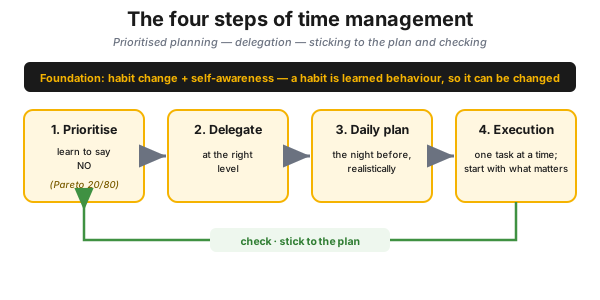
Figure 1 — the four steps of time management resting on habit change, with the feedback loop of checking.
Who is this for?
Section titled “Who is this for?”For those whose day is also shaped by other people’s requests, yet who are accountable for their own results: shift supervisor · plant manager · process engineer · team leader · maintenance planner · project manager · specialist · newly appointed leader.
Learning objectives
Section titled “Learning objectives”After reading this article you will be able to:
- name the five marks of good time management and the five reasons it fails;
- run a time audit, and sort your habits into beneficial and non-beneficial ones;
- pick which level of delegation a task belongs to;
- say no with ready-made phrases, without damaging the relationship;
- apply the 4D, and choose from five responses to an interruption;
- draw the line: when the daily plan is not the answer.
In brief
Section titled “In brief”- Not a question of time, but of habits. A habit is learned behaviour, so it can be changed: first identify your habits, then sort them into beneficial and non-beneficial ones.
- Four steps: (1) prioritise and learn to say no; (2) delegate at the right level; (3) make a daily plan; (4) execute it as precisely as you can.
- The Pareto principle (20/80): roughly 20% of our activity brings 80% of the results. It is this critical 20% that has to be protected.
- “One minute of planning saves ten minutes of execution.” Plan the day the evening before, realistically.
- One task at a time. Start with the most important one, and slice up whatever is too big.
- Delegate early: it is already worth it if the colleague can do at least 80% of the job.
- Plan time for planning and for breaks as well.
Why it matters (the stakes)
Section titled “Why it matters (the stakes)”Time management is not calendar cosmetics, because the bad end of it is measurable: 75% of projects are not finished in time, and managers spend 25–75% of their time in meetings, about 60% of which is wasted time.
The other end lands on the person. When employees are asked what stresses them most at work, the first item on the list is not having enough time; then come being treated unfairly, being overworked, not being listened to, role conflict and resource limitations. The symptoms are familiar: physically sweating, trembling hands, a higher pulse; mentally a feeling of being in a hurry, short temper, and the paralysis of “I don’t know where to start”. So an unplanned day produces stress, stress degrades judgement, and degraded judgement makes mistakes in places where they are expensive or dangerous.
What is good time management, and what steps does it consist of?
Section titled “What is good time management, and what steps does it consist of?”The five marks of good time management: being clear about what is important; spending time on the important things; spending less time on the unimportant ones; staying in control; and managing your work/life balance. It is realised in four steps: prioritising and saying no, delegation, a daily plan, precise execution. The steps rest on habit change, and checking closes the loop.
Time management typically fails for five reasons: lack of discipline, unrealistic planning, postponing difficult but important tasks, trying to do everything at the same time, and taking on too much work, because we cannot say no. Behind them stand comfortable myths: “I just don’t have enough time”, “it will get better … someday”, “I am irreplaceable”, “I’ll catch up this evening, over the weekend, in my vacation”, “I’ll have a life later”. The first step is to confront these with reality.
Habit is the key
Section titled “Habit is the key”Habits are the key to time management. Since a habit is learned behaviour, it can be changed, but first you have to identify the habits and sort them into two groups: beneficial and non-beneficial ones. Lasting improvement depends on replacing the non-beneficial routines, which is why it takes resolve and self-awareness. Time management is also multi-dimensional, so it is worth measuring that way: the time mastery profile, for instance, gives a picture along twelve key dimensions.
Attitude: the circle of influence
Section titled “Attitude: the circle of influence”Habit change presupposes a shift in attitude. Stephen R. Covey’s The 7 Habits of Highly Effective People gives us the picture of the two circles: the circle of influence (what you can affect) sits inside the larger circle of concern (what occupies you, but does not depend on you). Pro-activeness enlarges the circle of influence, complaining shrinks it (the circle of influence). The language test comes from the same place.
| Victim language | Accountable language |
|---|---|
| “I can’t…” | “I can…” |
| “I have to…” | “I choose to…” |
| “It’s not fair…” | “What might be possible is…” |
| “The problem is…” | “The reality is…” |
| “That won’t work…” | “My options are…” |
| “That person makes me…” | “I decide.” |
| “…, BUT…” | “…, AND…” |
Roles and goals: important compared to what?
Section titled “Roles and goals: important compared to what?”Prioritising only makes sense if there is a yardstick, and the yardstick comes from your roles and your goals. First identify the different areas of your life, that is, the roles you want to play (team leader, partner, parent, member of a sports team, specialist), then set goals for each role, broken down by time horizon: for the next 10 years, 3 years, 1 year and 3 months. At work the same thing appears as the chain desired results, goals, focus areas, concentrated execution: tasks have to be matched to your long-term goals as well, so write them down and check where you stand.
The four steps
Section titled “The four steps”The four steps work together: prioritising says what gets into the day, delegation takes out what belongs elsewhere, the daily plan makes room for the rest, and disciplined execution protects the plan.
1. Prioritise, and learn to say no
Section titled “1. Prioritise, and learn to say no”According to the Pareto principle, 20% of our activity brings 80% of the results: this is the “critical few” as against the “trivial many”. The three questions of prioritising: What brings my organisation the most benefit? What am I best at? How do I use my time most valuably? Whatever does not fit into the critical 20% must be met with a no: taking on too much is one of the five reasons for failure, and saying no is the antidote. For separating the urgent from the important, see the Eisenhower matrix.
2. Delegate at the right level
Section titled “2. Delegate at the right level”Before delegating, decide which level of delegation the colleague or the group is at. The four levels are not about “dropping” responsibility but about handing out degrees of freedom, and even the top level is not unlimited authority: feedback is mandatory there too.
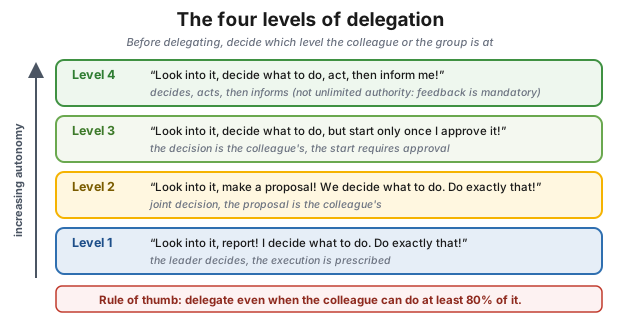
Figure 2 — the four levels of delegation along increasing autonomy, with the 80% rule of thumb.
The rule of thumb: it is already worth delegating if the colleague can do at least 80% of the job. Whoever waits for 100% never delegates.
What should be delegated? Frequently made decisions; whatever someone else is more qualified for; whatever gives useful experience; whatever breaks routine; where another perspective improves the result; whatever you have nothing left to learn from; and whatever increases the strength of the team.
3. Make a daily plan
Section titled “3. Make a daily plan”Plan your day the evening before, and write it down, and you will sleep more calmly. The rule of thumb: “One minute of planning saves ten minutes of execution.” Make only an achievable plan, decide on the basis of prioritisation what fits into it, and leave slack for the unexpected. It is also worth reviewing the “this is how we’ve always done it” items.
4. Execute as precisely as you can
Section titled “4. Execute as precisely as you can”Do one task at a time: parallel work is less efficient. Start with the most important task, don’t “warm up” on the small ones, because in the end there will be no time left for the big ones. If something is too big, slice it up like salami. Discipline is held together by a few concrete habits:
- Don’t be a slave to your email or your phone. What is not urgent you can read later too.
- Signal your “quiet hours”: a closed door, a sign or a calendar entry, so that others can respect them.
- Standardise recurring tasks, and schedule a fixed call window, for example every day between 1 and 2 p.m.
- Make a quick decision, or get hold of the information the decision needs.
- Manage the plan visually. It feels good to cross something out or tick it off as done.
How do you say no without damaging the relationship?
Section titled “How do you say no without damaging the relationship?”Saying no is not a rejection but a clarification of priorities, and it can be learned. The order: acknowledge the other person’s situation, listen actively, remain empathic, and say how you feel. Then comes the language.
| Avoid | Use instead |
|---|---|
| “can’t”, “won’t” | “rather”, “can do”, “possible”, “alternatives” |
| silent rejection | “on this occasion this is not possible…” |
| making excuses | “however, what is possible is…” |
| a vague promise | “what I can do is…, what I’m not able to do is…” |
Further handholds: plan for the outcome; be clear and specific; use assertive body language (a firm but not aggressive voice, eye contact); empathise (“I can imagine it’s a difficult situation for you…”); if needed, use the broken record; sell the benefits of your own solution, and ask: “what problems do you envisage if…?”. This language is part of assertive communication.
Plan time for planning and scheduling
Section titled “Plan time for planning and scheduling”Set aside fixed time for planning, for example an hour on Monday morning or at the end of the day on Friday for the week ahead. After a meeting, plan time to record the next steps, plan time for email and routine tasks, and for creative thinking as well. Finally, leave time for breaks: maintaining your own energy is part of planning too, see energy management.
The ground rule of scheduling: nothing happens unless you create space for it to happen. Schedule the most important activities, group related items, check what can run at the same time, and share the information with everyone involved.
Handling interruptions
Section titled “Handling interruptions”The plan’s biggest enemy is the interruption: the unplanned meeting, the colleague asking for help, the email alert, the phone. The first step is to list what interrupts you: until you have a list, you only have a feeling. After that you can choose from five ready-made responses.
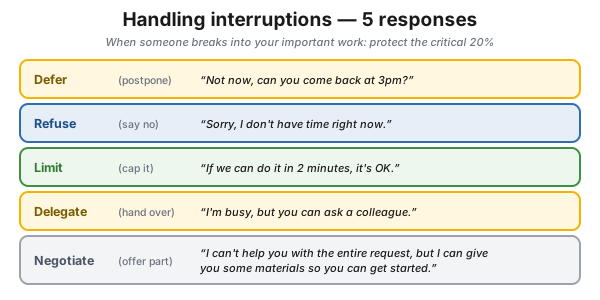
Figure 3 — the five responses to an interruption, with example sentences.
The general principle: keep the interruption short; bunch them together so they don’t cut the day into pieces; arrange for interruption-free time; put limits on socialising time, but get through the short courtesy round first; and tame the telephone. Even just switching off the sound of the alerts helps a lot.
How do you handle email and incoming information? (4D)
Section titled “How do you handle email and incoming information? (4D)”Deal with every incoming item once: decide what is to be done, and handle it accordingly. This is what the 4D is for.
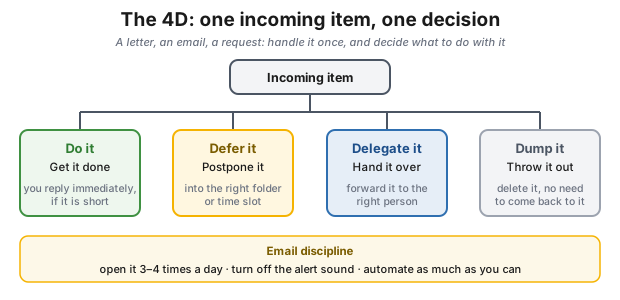
Figure 4 — the 4D rule for incoming information, with the three rules of email discipline.
These are the same four decisions as in the Eisenhower matrix, only applied to incoming information. Alongside it, it is worth deciding guidelines beforehand about what you keep and what you delete; screening rapidly and deciding on the spot; developing routines and standard responses; scheduling time for cleaning up; clearing out your files once a year; and finally planning time to read.
Procrastination
Section titled “Procrastination”Procrastination is having another cup of coffee when you should already be back in the office, with your boss, or in the meeting. It is human to put off what is unpleasant, difficult, or involves tough decisions; typically because the task is large and we don’t know where to start, difficult people are involved, we don’t know how to go about it, or it lies outside our comfort zone.
The four antidotes: break it into smaller chunks, do it first thing in the morning, ask for help, and reward yourself when it’s done. The first step, though, is always to admit to ourselves that we are procrastinating.
Time is a shared resource: time management in a team
Section titled “Time is a shared resource: time management in a team”Putting your own calendar in order is only half the job; the other half is how you handle other people’s time: support your team, don’t wait for someone else to take the first step, develop the on-time habit, don’t be in too big a hurry when instructing others, and take time to be a good listener.
The meeting is the test of this. For preparation, Rudyard Kipling’s “six honest serving-men” are enough: what, why, when, how, where and who. Three disciplines matter in running one: stick to the agenda; close on time; and the meeting should end only with tasks, owners and deadlines assigned. In detail: effective meetings.
Putting it into practice: time audit and habit inventory
Section titled “Putting it into practice: time audit and habit inventory”Improvement starts from getting to know your own daily routine precisely. Three steps lead there.
- Record (1–2 weeks). Keep a table and twice a day, at noon and in the evening write down in 15-minute blocks what task you did: phone calls, email, a meeting, a technology check, watching parameters. A shorter sample works too: two days of a normal working week.
- Group. Write your beneficial and non-beneficial time-management habits on post-its, in two different colours. The recorded data shows how much time each one eats.
- Replace one. Pick a single non-beneficial habit and assign a concrete substitute to it (for example: I open my email three times a day, with the sound signal off). Measure again two weeks later.
Shift and plant context
Section titled “Shift and plant context”In a continuous-operation environment, time management takes shape in planning the shift: what is the critical 20% of the shift, what can be delegated, and what can wait. Here the critical 20% is not a matter of taste: safety-critical and production-critical tasks belong to it, the operator round, checking parameters, watching the intervention limits, and the shift handover.
“Saying no” is therefore a clarification of priorities, not a refusal to engage: a non-urgent administrative request must not squeeze out the safety round. An instruction handed over in a rush is a risk in the same way: a misunderstood instruction in a plant is not only a loss of time. And the daily plan is directly connected to the standard operator round and the shift handover: these are themselves built-in time-management routines.
Common mistakes
Section titled “Common mistakes”- Everything at once (multitasking). Parallel work is less efficient.
- Starting with the small ones. No energy and no time are left for the big, important task.
- An unrealistic daily plan. An over-planned day guarantees slippage and stress.
- Not saying no. Taking on too much wipes out the critical 20%.
- Postponing the important but difficult task, because “other things always seem more urgent”.
- Not planning time for planning. Without planning, the day runs after whatever is urgent.
- Waiting for 100% when delegating.
When NOT to use it (the limits of the method)
Section titled “When NOT to use it (the limits of the method)”The daily plan and prioritisation are tools for normal operation. There are times when they have to be set aside:
- In a crisis and in emergency operation. In case of an alarm, a fire or a serious deviation, the plan is suspended and the emergency procedure takes its place. You re-plan afterwards, not in the middle.
- In a continuously interrupted role, without adaptation. For a dispatcher or an on-call engineer, a daily plan carved up to the minute fails: there the plan is not a list of hours but an order of priority with plenty of slack.
- You don’t say no to a safety-critical request. If the request concerns a safety intervention, a signal or the immediate handling of a deviation, there is no “on this occasion this is not possible” there.
- If time is not the bottleneck. In case of chronic understaffing or unclear responsibilities, individual time management only masks the system fault: there an organisational decision is needed. The same is true of exhaustion: if the energy is missing, a better calendar does not help (energy management).
How does this show up in digital practice?
Section titled “How does this show up in digital practice?”The principle of time management does not stop at the paper diary: what is a matter of discipline on paper, a digital tool turns into a default.
| Concept | Digital implementation | Value |
|---|---|---|
| Daily plan | calendar blocking for the critical 20% | the important task gets a place |
| Prioritisation | task manager with a priority and due-date field | the list is ranked, not first-come-first-served |
| 4D for information | mail rules, standard responses | an item is picked up only once |
| Delegation | assignment with an owner, a deadline and a status | the level and the feedback are trackable |
| Quiet hour | “do not disturb” status, busy time in the calendar | the protected time becomes visible |
| Time audit | digital shift log, timestamps | the content of the day can be analysed afterwards |
Take it home (keys)
Section titled “Take it home (keys)”- Measure before you change. Two weeks, recording twice a day, in 15-minute blocks.
- Pick out the critical 20%, and write it into the calendar before others fill it up.
- Replace one habit, not the whole list.
- Delegate at 80%, not at 100%, and say out loud which level you are delegating to.
- Prepare your no: practise the “on this occasion this is not possible…, however, what is possible is…” phrase in advance.
- Close the day with planning.
Self-test
Section titled “Self-test”- Which of the five reasons for failure does saying no directly counteract, and why is good intention not enough for it?
- A colleague could do a task of yours roughly 80% well. Which level would you hand it out at, and what would you say to them word for word?
- Look back at yesterday. How much of it went on the critical 20%, and which three interruptions took the rest? Which response would you have handled them with?
Terminology (HU / EN / JP)
Section titled “Terminology (HU / EN / JP)”| Hungarian | English | Japanese | Note |
|---|---|---|---|
| időgazdálkodás | time management | タイムマネジメント | time spent on what is important |
| priorizálás | prioritisation | 優先順位付け | picking out the critical few |
| nemet mondani | saying no | 断る | the antidote to taking on too much |
| delegálás | delegation | 権限委譲 | handing out the right degree of freedom |
| Pareto-elv | Pareto principle (80/20) | パレートの法則 | 20% → 80% of the results |
| napi terv | daily plan | 日次計画 | the evening before, realistically |
| megszakítás | interruption | 中断 | five possible responses |
| halogatás | procrastination | 先延ばし | putting off the unpleasant |
What is good time management, and what steps does it consist of?
Spending our finite time on what really matters: being clear about what is important, spending time on it, spending less on the unimportant, staying in control, and keeping your work/life balance. Four steps: prioritising and saying no, delegation, a daily plan the evening before, precise execution.
Why is habit the key in time management?
Because “I don’t have enough time” depends on our habits, and a habit is learned behaviour, so it can be changed: first you have to identify the beneficial and the non-beneficial habits, then replace the latter.
When is it worth delegating a task?
Already when the colleague can do at least 80% of it. It is worth delegating frequently made decisions, whatever someone else is more qualified for, whatever gives experience or breaks routine, where another perspective improves the result, whatever you have nothing left to learn from, and whatever increases the strength of the team.
How do I say no without damaging the relationship?
Acknowledge the other person’s situation, listen actively, remain empathic, and say how you feel. Use positive language (“rather”, “can do”, “possible”, “alternatives”) instead of “can’t” and “won’t”, with ready-made phrases: “on this occasion this is not possible…, however, what is possible is…”.
How should I handle interruptions and email?
There are five responses to an interruption: defer, refuse, limit, delegate, negotiate. Keep it short, bunch them together, and arrange for interruption-free time. For incoming information the 4D applies: Do it, Defer it, Delegate it, Dump it. Open your email only 3–4 times a day, with the sound signal switched off.
What can I do about procrastination?
Admit to yourself that you are procrastinating, and get started. Break the difficult task into smaller chunks, do it first thing in the morning, ask for help, and reward yourself.
Related concepts
Section titled “Related concepts”the Eisenhower matrix · energy management · the circle of influence · self-awareness · assertive communication · effective meetings · standard operator round · shift handover
Next step
Section titled “Next step”If you have understood this, from here it is worth going on — in this order:
- the Eisenhower matrix — the working tool of prioritising: how to put your to-do list onto the important and urgent axes.
- assertive communication — the wider framework of saying no.
- energy management — if time is already in order but you still run out, time was not the bottleneck.
References / further reading
Section titled “References / further reading”- Stephen R. Covey: The 7 Habits of Highly Effective People. Free Press, 1989 — the source of the circles of concern and influence, and of pro-activeness.
- Tony Schwartz – Catherine McCarthy: Manage Your Energy, Not Your Time. Harvard Business Review, 2007 — the energy-side complement.
- Vilfredo Pareto’s 80/20 principle — the distinction between the “critical few” and the “trivial many”.
- Rudyard Kipling: The Elephant’s Child (Just So Stories, 1902) — the source of the “six honest serving-men”.
- The training materials of the “self-awareness and personal efficiency” and “time management” modules of a process-industry leadership development programme (anonymised reference).