Circle of Influence (Covey)
≈ 16 min read · 3,156 words
“I don’t have enough time.” “One day it will get better.” “Only I can do this.” “I’ll catch up in the evening, at the weekend, on holiday.” These sentences are said in every team, and they all point to the same place: outward. To the circumstances, to the system, to the other person, to time. Whoever talks like this is usually genuinely overloaded, and yet this is precisely the attitude that keeps the situation stuck. The Circle of Influence model answers one question: where is it worth putting your attention if you really do want to change something?
Covey’s Circle of Influence: focus on what you can affect, not on what only worries you. Proactive focus widens the circle, reactive focus shrinks it.
The Circle of Concern is everything that occupies you but that you do not control; the Circle of Influence is its inner part: your actions, your attitude, your relationships. The proactive person spends their energy on their Circle of Influence, so it widens; the reactive person broods over what they do not control, so their circle shrinks.
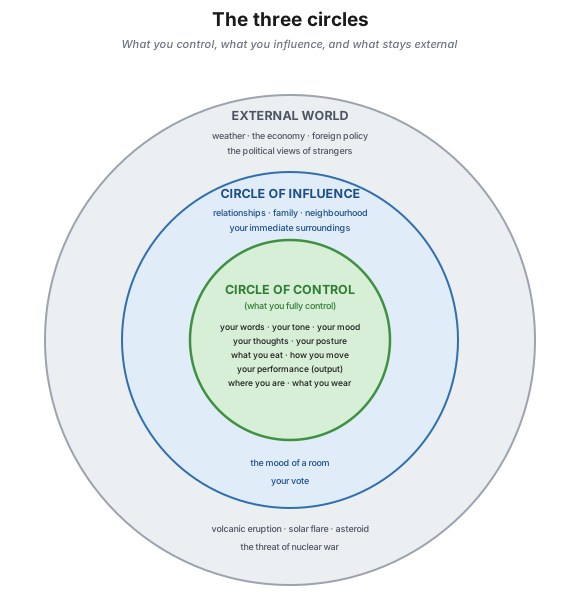
Figure 1 — the three concentric circles. Innermost is the Circle of Control (your words, your tone, your thoughts), around it the Circle of Influence (relationships, family, immediate surroundings, voting), and outermost the external world (weather, the economy, foreign policy, a solar flare).
Who is this for?
Section titled “Who is this for?”This article is for those who feel overloaded, or who lead people in an environment where there is a lot of complaining and little movement: shift supervisor · plant manager · group and team leader · process engineer · operator and maintenance technician · project manager · mentor and coach · HR partner.
Learning objectives
Section titled “Learning objectives”After reading this article you will be able to:
- sort a concrete matter into one of the three circles (I control it, I influence it, it is external);
- explain why the proactive person’s Circle of Influence widens and why the reactive person’s shrinks;
- recognize victim language in your own and other people’s sentences, and replace it with accountable language;
- run a weekly sorting exercise on your own irritations;
- draw the line: when the Circle of Influence is not the right answer to a problem.
In brief
Section titled “In brief”- Three circles. The Circle of Concern (what occupies you but you do not control) is wider than the Circle of Influence (what you can affect), whose core is the Circle of Control (your own actions and reactions).
- Proactivity widens, reactivity narrows. If you spend your energy on what you can affect, your influence grows; if you brood over what you do not control, it shrinks.
- Language gives you away. Victim language (“I can’t”, “I have to”, “it’s not fair”) and accountable language (“I can”, “I choose to”, “my options are”) describe the same situation with a different consequence.
- Change opens from the inside. Nobody can be convinced from outside; everyone opens their own gate themselves.
- This is not a denial of circumstances. The model shifts the focus to what you can change, it does not deny reality.
- Note: this is not the same as the McKinsey influence model.
Why does it matter? (the stakes)
Section titled “Why does it matter? (the stakes)”The Circle of Influence is the attitude dimension of time management. Classic self-awareness and time-management courses put it next to the techniques (calendar, priorities, the Eisenhower matrix) because technique on its own does not work where the attitude is reactive. The same model also closes the block on saying no assertively: whoever does not know what is theirs and what is not either takes on everything or complains about everything.
So the stake is twofold. On one side it is energy: brooding over the Circle of Concern is tiring and fruitless, because the energy goes to a place from which nothing comes back. On the other side it is credibility: the environment responds to the person who acts, and effective action itself opens the next door. The Circle of Influence is not a theory about focus, it is the entry ticket to self-management.
What are the Circle of Influence and the Circle of Concern?
Section titled “What are the Circle of Influence and the Circle of Concern?”The Circle of Influence is the area you can really affect; the Circle of Concern is everything that occupies you, including what you have no effect on. The two are concentric: the Circle of Influence sits inside the Circle of Concern, and its innermost core is what you fully control. On the three-circle diagrams this outermost ring is often called simply the external world (external); this corresponds to Covey’s Circle of Concern.
The model becomes usable when you think not in abstract categories but in concrete items:
| What you control (Circle of Control) | What you influence (Circle of Influence) | What is external |
|---|---|---|
| your words, your tone | your relationships, your family | the weather, the economy |
| your mood, your thoughts | your immediate surroundings, your neighbourhood | foreign policy |
| the posture you take up | the mood of a room | the political views of strangers |
| what you eat, how you move | your vote | volcanic eruption, solar flare, asteroid impact |
| your performance (output), where you are | the threat of nuclear war |
The practical question is always the same: which column does this matter fall into? The items in the right-hand column deserve no more attention than being taken note of. The middle column is where the invested energy pays off, and the left-hand one is where you can act immediately, today.
Origin: Covey’s first habit
Section titled “Origin: Covey’s first habit”The model comes from Stephen R. Covey’s book The 7 Habits of Highly Effective People, and belongs to the first habit: Be proactive. The list of the seven habits, supplemented with a later, eighth one:
- Be proactive
- Begin with the end in mind
- Put first things first
- Think win/win
- Seek first to understand, then to be understood
- Synergize
- Sharpen the saw
- Find your voice and inspire others to find theirs
The Circle of Influence is the practical tool of the first habit: the drawing on which proactivity becomes measurable. The three-circle variant (control → influence → external) is a finer resolution of the same idea.
How does proactivity grow the Circle of Influence?
Section titled “How does proactivity grow the Circle of Influence?”By the invested energy coming back: the environment also responds to effective action, so in the next matter you already have more room to move. Reactive focus is the reverse of this: the energy leaks away into an area from which no result comes, the sense of helplessness grows in the meantime, and the circle shrinks.
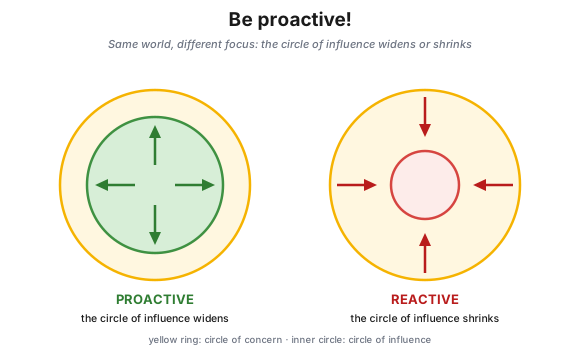
Figure 2 — the same two circles, with two people. In the proactive case the arrows push outward from the Circle of Influence and the circle widens. In the reactive case the arrows press inward from outside and the circle shrinks.
The proactive person spends their time on their Circle of Influence and their Circle of Control: they concentrate on what they can change, and accept the circumstances as givens to plan for. The reactive person broods over their Circle of Concern: they complain about the economy, the boss, the regulation, that is, about things they do not control. The same two people, the same world, only the focus is different.
Language gives you away: victim or accountable?
Section titled “Language gives you away: victim or accountable?”Focus shows up first in language, and this is the cheapest entry ticket to change: you can switch your sentences today. The classic pair in self-awareness training is victim and accountable language:
| Victim (VICTIM) | Accountable (ACCOUNTABLE) |
|---|---|
| “I can’t…” | “I can…” |
| “I have to…” | “I choose to…” |
| “It’s not fair…” | “What might be possible is…” |
| “The problem is…” | “The reality is…” |
| “That won’t work…” | “My options are…” |
| “That person makes me…” | “I decide” |
| “…BUT…” | “…AND…” |
Covey’s first habit brings the same list as the pairing of reactive and proactive language: instead of “there’s nothing I can do” and “that’s just the way I am”, it offers “let’s look at the alternatives” and “I choose a different attitude”. The most telling element is the last row: “but” invalidates what was said before it, “and” adds to it. One conjunction, two different conversations.
Change opens from the inside
Section titled “Change opens from the inside”Marilyn Ferguson’s line describes exactly why nobody can be changed from outside: no one can persuade another to change, because each of us guards a gate that can only be opened from within; we cannot open another person’s gate either by argument or by emotional appeal. That is why change and influence always start in our own circle. This is the same idea as the “change starts with me” Lean principle.
Practice: sort out this week’s irritations
Section titled “Practice: sort out this week’s irritations”This exercise can be done in one sitting, on paper, and repeated quarterly.
- Write down this week’s irritations. In 10 minutes list everything that annoyed or worried you in the past week, unfiltered, one item per line.
- Sort them into three circles. Next to each line write C (control), I (influence) or X (external). If you are unsure, the “what can I do about it tomorrow morning” question decides.
- Cross out the X items. What you really have no effect on, take note of and close. This is not indifference, it is energy management.
- Write one concrete step and one deadline next to every I and C item. One item, one sentence, one date. If you cannot write a step for an item, it is in fact an X.
- Sort your habits. On sticky notes of two different colours write up your useful and your not useful time-management habits. A habit is learned behaviour, therefore it can be changed, but first it has to be named.
- Set goals role by role. Name your life roles (for example team leader, professional, parent, team member), then for each role write a goal for the next 3 months, 1 year, 3 years and 10 years. Setting your own goal is itself a proactive act.
- Close with a personal action plan. Pick the three things you will really do in the next 30 days, and put them into your calendar.
Plant and leadership context
Section titled “Plant and leadership context”In a shift-based environment the Circle of Influence is the language of ownership. The operator does not control the market price or the maintenance budget (Circle of Concern), but does control their own shift, the order of their area, the quality of their round, their near-miss report and their shift handover (Circle of Influence and Circle of Control). This is the core of the ownership principle of the production reliability program and of the continuous improvement mentality.
In plant practice the two attitudes differ in observable behaviours, not in intentions:
| Reactive, defensive behaviour | Proactive, offensive behaviour |
|---|---|
| blaming the circumstances | accepting the circumstances and planning for them |
| deflecting responsibility | taking ownership |
| inaction | result-oriented action taken in time |
| looking for excuses, procrastinating | prioritizing, anticipating problems |
| firefighting, looking busy | planning ahead |
| speculation | fact-based decision, treating the root cause |
Circle of Influence (Covey) ≠ influence model (McKinsey)
Section titled “Circle of Influence (Covey) ≠ influence model (McKinsey)”Two frequently confused concepts. The Circle of Influence is Covey’s self-management model: where to put your own energy. The McKinsey influence model is a tool of organizational change: how to influence other people’s thinking and behaviour with four levers (role modelling, understanding and conviction, reinforcing formal mechanisms, capabilities). The former looks inward, the latter outward. The two are not in competition: the leader first puts their own circle in order, and only then can operate the four levers credibly.
Common mistakes
Section titled “Common mistakes”The most common mistakes come not from misunderstanding the model but from the fixed sentences of the attitude. These are the “big myths”, and each has a correction:
- “I don’t have enough time.” → Time is given, focus is not. Sort your weekly items and see how many of them went to X.
- “One day it will get better.” → Waiting is not a plan. Until there is a concrete step and a deadline, the matter stays in the Circle of Concern.
- “I’m irreplaceable. Only I can do this.” → This is the refusal of delegation. What is in the Circle of Control is who you train next week.
- “I’ll catch up in the evening, at the weekend, on holiday.” → This is not a solution but a postponement. The cause of overload is the focus, not the number of hours.
- Using the model to deflect responsibility (“there’s nothing I can do anyway”). This is reactivity itself; the point is the conscious use of the Circle of Control.
- Putting everything into the Circle of Control. There are things you really have no effect on, and realism is choosing the focus correctly.
When NOT to use it? (the limits of the method)
Section titled “When NOT to use it? (the limits of the method)”The Circle of Influence is a thinking frame, not a management tool. It has no metric, it does not replace analysis, and not every problem is an attitude problem. Avoid it in the following situations:
- To individualize a system fault. If a process is badly designed, that is not a question of the operator’s attitude. There you need root-cause analysis and a process change, not a conversation about proactivity.
- To silence a complaint. In a leader’s hands the sentence “that is in the Circle of Concern” easily becomes the closing down of a signal. The signal has to be understood first.
- In case of real danger or a legal breach. Harassment, a safety risk, a rule violation is not a matter of attitude: there you have reporting, a procedure and consequences.
- Instead of dealing with burnout or lasting overload. If someone is already exhausted, the advice “focus on what you can affect” adds a burden. Then reducing the load and energy management is the first step.
- As a criterion of individual appraisal. Proactivity cannot be graded; you can give feedback on observable behaviours, not on the label “reactive person”.
Take it home (keys)
Section titled “Take it home (keys)”- Ask about every matter: which circle is it in? This single question gives you the whole practical value of the model.
- Take note of the external and let it go. Not indifference, energy management.
- Every item in the Circle of Influence should have a concrete step and a date. Without a step, every matter slides back into the Circle of Concern.
- Replace “but” with “and”. The language element that moves fastest, and it is audible immediately.
- Start with your own Circle of Control if you want to change others. Everyone opens the gate from the inside, but the example shines through it.
- Technique rests on attitude. Calendar, priority matrix, lists: all of them can be used with a reactive focus too, and then they do not work.
Self-test
Section titled “Self-test”- Take three matters that annoyed you in the past week. Which one falls into which circle, and for which of them can you write a step for tomorrow?
- A colleague says: “I can’t do this, because they don’t give me time for it.” Rephrase it into accountable language so that the content is not lost.
- What is the difference between someone focusing on their Circle of Influence and someone ignoring system faults? Where does the line run?
Terminology (HU / EN)
Section titled “Terminology (HU / EN)”| Hungarian | English | Note |
|---|---|---|
| érdeklődési kör | Circle of Concern | what occupies you but you do not control |
| befolyási kör | Circle of Influence | what you can affect |
| kontrollkör | Circle of Control | what you fully control |
| külső világ | External | what you have no effect on at all |
| proaktivitás | proactivity | focusing on the Circle of Influence |
| reaktivitás | reactivity | brooding over the Circle of Concern |
| felelősségvállalás | ownership / accountability | the conscious handling of your own circle |
| áldozat-nyelv | victim language | “I can’t”, “I have to”, “but” |
What is the difference between the Circle of Concern and the Circle of Influence?
The Circle of Concern contains everything that occupies us but that we largely do not control: the economy, the weather, foreign policy, other people’s decisions. The Circle of Influence is its inner, smaller part: what we really can affect, that is, our own actions, attitude, reactions and immediate relationships. On the three-circle diagram the innermost core is the Circle of Control: what you fully control.
How does proactivity grow the Circle of Influence?
It puts the energy into what can be affected, and the environment also responds to effective action, so in the next matter there is more room to move. Reactive brooding works the other way round: the energy goes where no result comes from, the sense of helplessness grows, and the Circle of Influence shrinks.
Is the Circle of Influence the same as the McKinsey influence model?
No. The Circle of Influence is Covey’s self-management model about where to put your own energy. The McKinsey influence model is a four-lever tool of organizational change for changing other people’s behaviour. One looks inward, the other outward.
Isn't this about accepting everything and not criticizing?
No. The model does not forbid naming problems, it asks for the next step: after the signal, the question is who does what and by when. A system fault has to be uncovered and fixed; the Circle of Influence tells you what your part in that is.
Which habit does the Circle of Influence belong to in Covey?
To the first one, whose name is Be proactive. The Circle of Influence is the practical drawing of this habit, and through goal setting it connects to the second habit (Begin with the end in mind).
Related concepts
Section titled “Related concepts”the Eisenhower matrix · time management · energy management · assertive communication · self-awareness · change starts with me · the continuous improvement mindset · the influence model · the production reliability program
Next step
Section titled “Next step”If you have understood this, from here it is worth going on — in this order:
- time management — the Circle of Influence is the attitude base of time management; here come the techniques that build on this base.
- the Eisenhower matrix — the operational tool of focus: even within your Circle of Influence you have to decide what is important and what is merely urgent.
- assertive communication — the practice of saying no, that is, the skill with which you can state the boundary of your Circle of Influence.
References / further reading
Section titled “References / further reading”- Stephen R. Covey: The 7 Habits of Highly Effective People. Free Press, 1989 — the foundational work on proactivity (the first habit) and on the Circle of Concern and the Circle of Influence.
- Marilyn Ferguson — the idea about the gate of change comes from her, and the teaching of proactivity quotes it regularly.
- Tony Schwartz – Catherine McCarthy: Manage Your Energy, Not Your Time. Harvard Business Review, 2007 — the energy-side answer to overload, see energy management.