The Lean transformation journey — stages, pilot, culture change
≈ 16 min read · 3,184 words
An organization does not become “lean” from one training, one poster, or one well-run workshop. Anyone who has tried it knows the resistance: “we’ve always done it this way,” “we’ll always do it this way,” “and who are you to tell me to do it differently?” That is why a genuine Lean rollout is not a project but a journey (in Lean terms a Lean journey): a multi-year, staged process, until the thinking flips from “me” toward “us.” Let’s look at what this journey consists of, what the pilot is for, and why culture is the real stake.
The Lean transformation journey (Lean journey) is an organization-wide, multi-year change process whose goal is to introduce Lean thinking and culture. Its typical stages are: diagnosis/preparation, design, pilot, implementation (scaling) and continuous improvement. The emphasis is not on a one-off project but on the durable mindset and culture change: from “me” to “we,” from a hierarchical to a process-based organization. The pilot has a dual role: it proves that the approach works and it “sells” Lean to the organization.
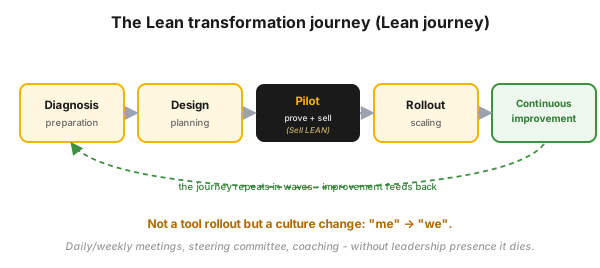
Figure 1 — the five stages of the Lean journey; the pilot proves and “sells” Lean, and continuous improvement feeds back. The essence is the “me → we” culture change.
Who is this for?
Section titled “Who is this for?”This article is for those who are planning, leading or living through a Lean or Operational Excellence rollout: plant and factory manager · shift supervisor · Lean/CI leader and navigator · HSE and process engineer · middle manager · change-management owner · senior executive (sponsor).
Learning objectives
Section titled “Learning objectives”After reading this article you will be able to:
- list the five stages of the Lean transformation journey, and say what happens in each;
- justify why a pilot is needed, and what it means to “sell” Lean (Sell LEAN);
- explain why the essence of the journey is a culture change, not a tool rollout (“me → we”);
- describe how responsibility is handed over from the navigator to the business team (the “cyclist” model);
- recognize the key success factors and the most common failures before you run into them.
The essence (TL;DR)
Section titled “The essence (TL;DR)”- Five stages: diagnosis, design, pilot, implementation, continuous improvement.
- Not a tool rollout but a culture change: “me” → “we,” from hierarchy to process-based.
- The pilot’s dual role: it proves AND it sells (Sell LEAN) — it provides an internal success story.
- Rhythm is needed: daily/weekly meetings, steering committee, coaching; without leadership presence it dies.
- It scales in waves: after one focus team, further areas follow.
- Responsibility is handed over gradually from the navigator to the business team; the goal is independent, sustainable operation.
Why it matters (the stakes)
Section titled “Why it matters (the stakes)”The stake of the transformation is whether the invested training, workshop and leadership energy becomes durable operation, or evaporates. The most common failure is not that the tools are bad, but that the organization experiences them as a one-off project: the program closes, enthusiasm runs out, and half a year later everything is back to the old way. The journey is precisely a defense against this: the staged build-up, the pilot and the gradual handover of responsibility exist so that the change lives on not from momentum, but from an embedded routine.
The bad news is that culture change is slow and begins invisibly; the good news is that it can be broken into stages and measured. Whoever skips the pilot or the rhythm does not reach the goal faster — they do not reach it at all: the organization slides back to where it started.
What stages does the Lean transformation journey consist of?
Section titled “What stages does the Lean transformation journey consist of?”The Lean journey consists of five stages that build on one another: diagnosis assesses the present, design plans the target, the pilot proves and convinces, implementation scales in waves, and continuous improvement keeps it alive. The first four take you to the goal, the fifth makes sure you stay there.
- Diagnosis / preparation — assessing the current state and the maturity, planning the journey, convincing stakeholders (internal lobbying at senior management). More deeply: the diagnose phase.
- Design — shaping the approach and the goal hierarchy.
- Pilot — on a focus team, with external or internal help; it proves that it works in your own organization too, and provides an internal success story.
- Implementation (scaling) — it spreads in waves: after the first success, further areas follow, with your own internal change agents. For the unit-level, six-phase schedule see: mini-t.
- Continuous improvement — the transformation is never “done”: kaizen and the MOS keep it alive.
Why a pilot is needed, and what does “selling” Lean mean?
Section titled “Why a pilot is needed, and what does “selling” Lean mean?”The pilot is key because it simultaneously proves and sells: technically it shows that the approach works in your own organization too, while it also provides an internal success story with which Lean can be “sold” to the wider organization. Without it, the transformation remains an abstract promise that is easy to reject.
In practice the pilot runs on a well-delimited focus team, initially with external or internal help. The first success must be consciously communicated to senior management (Sell your 1st success to Head Quarters), to secure the support and the resources for scaling. The logic is simple: the organization does not believe abstract principles, but evidence from its own house. Without a pilot, scaling starts with weak support and stalls early.
Why is it a culture change, not a tool rollout?
Section titled “Why is it a culture change, not a tool rollout?”The essence of the journey is not the introduction of tools, but the mindset and culture change: from “me” to “we,” from a hierarchical, command-driven organization to a process-based, collaborative one (see the iceberg model, the three lenses). Culture is built from the bottom up: the shift in outlook is durable if the teams live it themselves, not if it is proclaimed from above.
This requires involvement, and involvement takes time. In practice this means daily and weekly meetings, steering committees, coaching sessions and all-staff forums. Without leadership commitment and continuous presence the transformation dies; this is one of the most common failures (see Lean anti-patterns). The leader does not “issue” Lean, but sets an example (role model): they change too, they are there on the gemba, they praise the teams and demand results.
The change agents (Lean navigators)
Section titled “The change agents (Lean navigators)”The transformation is carried by your own internal change agents (Lean navigators): they must be selected, trained and shaped (select, train and mold your own navigators). They run the pilot, build the rhythm, measure the impact realization (affected FTEs, impact achieved) and scale. The navigator is the engine of change: they question the status quo, hunt for waste and coach line managers. Details: lean-navigator.
Who carries the change, and how is responsibility handed over?
Section titled “Who carries the change, and how is responsibility handed over?”Responsibility migrates gradually from the navigator to the business team: at the start the navigator carries everything, by the end of the wave the team stands alone. The goal is not for the navigator to be there forever, but for the organization to keep operating independently.
The roles of the transformation are distinct: the management team sets the direction and launches the change; the navigator is the engine of improvement; the local champion carries it at the unit level; the “pull forward” role is the driving force of realization in a given area; and the actual work is done by the unit / organization itself on the gemba.
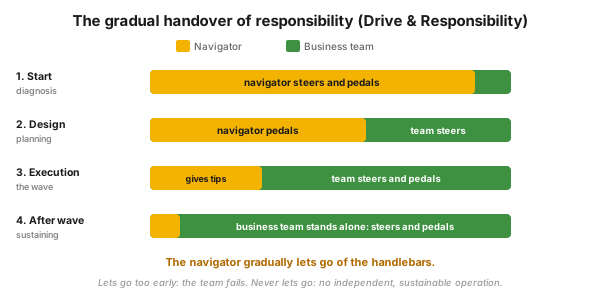
Figure 2 — the “cyclist” handover model (Drive and Responsibility): the navigator gradually lets go of the handlebars, until the business team steers and pedals on its own.
The established “cyclist” metaphor describes the handover in four steps:
- Start / diagnosis: the navigator steers and pedals, the business team accompanies and supports.
- Design and planning: the navigator still pedals, but the business team already steers.
- Realization: the navigator gradually eases off, only gives tips; the business team takes over the handlebars.
- After the wave: the navigator lets go, only watches and advises; the business team stands alone, steers and pedals — operation is sustainable.
This gradualness is the key to sustainability. If the navigator lets go too early, the team fails; if they never let go, there will be no independent, sustainable operation.
How do you keep the momentum alive? (rhythm and forums)
Section titled “How do you keep the momentum alive? (rhythm and forums)”The transformation lives from rhythm: the regular, short forums hold the focus and the accountability, while leadership presence lends the whole thing credibility. Momentum does not stay by itself, but at recurring daily and weekly points.
In practice this means the following forums: daily and weekly meetings with the team, Lean steering committees with management, coaching sessions with direct reports, alignment with the navigators and all-staff meetings with the whole organization. In the steering committee the leader’s role is simple and hard: talk, encourage the navigators, praise the teams, push for results, and be there. The presence is not symbolic: without it, the program’s message is that “it isn’t important enough.”
Process-industry context
Section titled “Process-industry context”In process industries and Seveso plants the same staged logic applies when introducing an Operational Excellence or Lean program: pilot on a plant section (for example, a distillation block), then scale in waves. In practice the diagnosis is often broken into workstreams, for example operations, energy and yield, maintenance. Part of the change journey is also strengthening the safety culture, where the shift supervisors and HSE managers are the key change agents. A special feature of continuous operation is that the pilot also reduces risk: the organization learns on a well-delimited unit before scaling to the whole complex.
Common mistakes
Section titled “Common mistakes”- Treating it as a one-off project. With a deadline and a tool list, without a culture change. Why it’s a problem: once the program closes, the momentum runs out, and the organization slides back. Instead: treat it as a multi-year journey, where the mindset is the real goal and the tool is only the vehicle.
- Scaling without a pilot. Going straight to the whole organization. Why it’s a problem: there is no internal evidence and no “sold” story, so support is weak. Instead: run a focused pilot, and use its success to win over senior management and the other areas.
- Working without rhythm. No regular meetings and coaching. Why it’s a problem: without focus and accountability the momentum evaporates in days. Instead: build a daily/weekly cadence and a steering committee where progress becomes visible.
- The leader delegates Lean. They “issue” it but do not change themselves. Why it’s a problem: it lacks credibility; the organization follows the actual behavior, not the speech. Instead: be a role model — be there on the gemba, change your own habits too.
- The navigator never lets go of the handlebars. The team relies on them the whole way. Why it’s a problem: no independent, sustainable operation develops. Instead: hand over responsibility gradually according to the “cyclist” model, until the business team carries it alone.
When NOT to use it? (limits of the method)
Section titled “When NOT to use it? (limits of the method)”The full, staged transformation journey is a strong framework, but it is not for every situation. Sometimes a simpler or different intervention is the right answer:
| Situation | Why (primarily) not the full journey | The right answer | ||
|---|---|---|---|---|
| A single, well-delimited problem needs solving | a multi-year culture program overshoots the goal | a targeted [[kaizen.en | kaizen]] event or [[a3-riport.en | A3]] problem-solving |
| No leadership commitment or sponsor | the journey dies from the start without leadership presence | first win over senior management, only then launch | ||
| An acute crisis / firefighting is under way | the organization needs stabilization now, not transformation | stabilize first, time the journey for a calmer phase | ||
| You only want to introduce a single tool (e.g. 5S in one workshop) | it does not need a full staged program | introduce the given tool on its own ([[5s.en | 5s]], [[vsm.en | vsm]]) |
Rule of thumb: the full journey is for transforming the durable operating mode of a whole unit or organization. A single problem or a single tool does not justify a multi-year transformation: there a focused intervention is faster and cheaper.
Take it home (keys)
Section titled “Take it home (keys)”- Not a project but a journey. Plan on a multi-year horizon, and regard culture as the real goal, not the tool list.
- Pilot first, then scaling. With the success of one focus team, “sell” Lean to the organization and to senior management.
- Rhythm keeps it alive. Daily/weekly meeting, steering committee, coaching; leadership presence is not optional.
- Hand over the handlebars gradually. The navigator lets go by the end of the wave; the goal is an independently operating business team.
- Lead by example. The team follows your behavior, not your words; you change too.
- Prepare for the low point. It is at the bottom of the change curve that it is decided whether the program survives; here leadership persistence matters most.
Self-test
Section titled “Self-test”- List the five stages of the Lean journey, and say what the pilot’s dual role is.
- Explain the four steps of the “cyclist” handover model: where is the navigator and where is the business team at the start and by the end of the wave?
- A leader has the Lean tools introduced, but does not change their own habits, and there is no regular forum. Which two common mistakes did they run into, and what should they do instead?
How does it appear in digital practice?
Section titled “How does it appear in digital practice?”The principle of the transformation journey does not stop at the workshops and the notice boards: rhythm, responsibility and progress are realized in the same way in a well-designed digital operating system. Instead of the physical steering board and the paper action log, here a logged cadence, action tracking and a live progress dashboard keep the change alive — the mechanism differs, the principle is the same.
| Journey principle | Digital implementation | What it adds |
|---|---|---|
| Rhythm / cadence | recurring meeting templates, logged daily/weekly forums | momentum is not person-dependent but built into the system |
| Handover of responsibility | action register with owner and deadline | it is visible who carries what — the handover of the handlebars is trackable |
| Pilot → scaling | milestone and progress tracking per wave | the pilot result and the scaling are documented auditably |
| Impact realization | performance dashboard, baseline vs. actual | the impact is measurable, it does not live in presentations |
| Leadership presence | logged performance dialogue, coaching trace | presence is provable and can be encouraged |
| Sustaining | usage data of the introduced daily routines | it becomes clear if a routine dies, before things slide back |
Connection to OPEREX (shift log)
Section titled “Connection to OPEREX (shift log)”The daily/weekly rhythm of the transformation (meetings, actions, milestones) leaves a durable trace in the shift log / action log (OPEREX): the pilot result and the progress of scaling are documented auditably, they do not live in presentations. The actions can be tracked tied to an owner and a deadline, so the “handover of the handlebars” is also visible: it is measurable how responsibility migrates from the navigator to the business team. This way “impact realization” is trackable and retrievable.
Terminology (HU / EN)
Section titled “Terminology (HU / EN)”| Hungarian | English | Note |
|---|---|---|
| Transzformációs út | Lean journey | multi-year culture change |
| Hullám | Wave | the pace of scaling |
| Változásügynök | Change agent / navigator | the engine of the transformation |
| „Eladni a Leant” | Sell LEAN | the internal communication of the pilot |
| Felelősség-átadás | Drive and Responsibility | the “cyclist” model |
| Siker kulcstényezői | Key Success Factors | the conditions of the transformation |
| Impact-realizáció | Impact realization | measuring the impact achieved (FTE) |
The technical terms are validated from the source material and the established Lean canon.
What is the Lean transformation journey, and what stages does it consist of?
An organization-wide, multi-year change process for introducing Lean thinking and culture. Its five typical stages are: diagnosis/preparation, design, pilot, implementation (scaling) and continuous improvement. The emphasis is not on the tools but on the durable mindset and culture change.
Why is it not enough just to introduce the Lean tools?
Because Lean is first of all a culture and mindset change. Without tools there is no result, but tools without a culture change are superficial and revert. Durable impact requires the “me-to-we” shift in outlook.
What is the role of the pilot in the Lean transformation?
The pilot proves that the approach works in your own organization too, and provides an internal success story with which Lean can be “sold” to the wider organization and to senior management.
What does it mean that it scales in waves?
That after the successful pilot, Lean spreads gradually to more and more areas — not to the whole organization at once, but in manageable waves, always building in the lessons learned.
How is responsibility handed over from the navigator to the organization?
Gradually, according to the “cyclist” model: at first the navigator “steers and pedals,” then the business team takes over the handlebars, and finally by the end of the wave it carries it alone. The goal is independent, sustainable operation: if the navigator lets go too early, the team fails; if never, there will be no independence.
Related concepts
Section titled “Related concepts”mini-t · the diagnose phase · the 8-step Lean rollout · Lean anti-patterns · lean-navigator · the iceberg model · Lean leadership · change-curve · kaizen
Next step
Section titled “Next step”Once you have grasped the big picture, from here it is worth going on — in this order:
- the diagnose phase — the first real stage of the journey: how to assess the present in a data-driven way, before you plan anything.
- mini-t — the unit-level, six-phase, ~3-month schedule: this is what a wave looks like in practice.
- lean-navigator — who carries the change, and how the navigator role is built, the one that gradually hands over the handlebars.
References / Further reading
Section titled “References / Further reading”- James P. Womack – Daniel T. Jones: Lean Thinking: Banish Waste and Create Wealth in Your Corporation. Free Press, 1996 (rev. 2003) — the five principles of the Lean transformation and the logic of organizational transformation.
- John P. Kotter: Leading Change. Harvard Business School Press, 1996 — the canonical framework of organizational change management (sense of urgency, coalition, quick wins, anchoring in the culture).
- Mike Rother: Toyota Kata: Managing People for Improvement, Adaptiveness, and Superior Results. McGraw-Hill, 2009 — the routines of continuous improvement and coaching that sustain the transformation.