Energy management, not time
≈ 18 min read · 3,540 words
Do you know the day when you worked twelve hours and still feel that nothing meaningful got done? A 37-year-old partner at a consulting firm was in exactly that place: 12–14 hours a day, four young children, poor sleep, no exercise, food gulped down at his desk. He got home in the evening, but he was not present with his family. It was not his time that had run out, but his energy. After a few scheduled habits, two months later he had breakfast with them 15 pounds lighter.
Energy management treats energy, not time, as the real limit of performance. Energy renews: the body, emotions, mind and spirit are refilled by rituals.
Time is finite; energy is renewable. Personal energy has four sources: the body, the emotions, the mind and the spirit, and each of them can be refilled with rituals, that is, with deliberately practised, precisely scheduled behaviours. The goal is not to get more out of people, but to invest more in them.
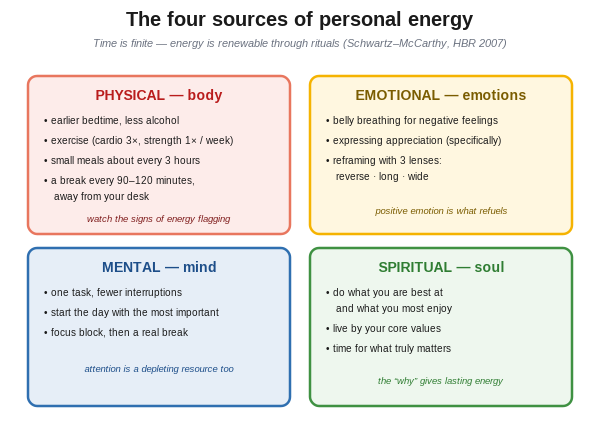
Figure 1 — the four sources of personal energy and their rituals.
Who is this for?
Section titled “Who is this for?”For those who work in rotating shifts or amid many interruptions, and who want to make their own or their team’s capacity to perform sustainable: shift supervisor · plant manager · operator and maintenance technician · process engineer · HSE lead · project manager · team leader · HR partner.
Learning objectives
Section titled “Learning objectives”After this article you will be able to:
- name the four sources of personal energy, and say which one governs what;
- complete the 16-statement energy audit, and interpret your score;
- recognize the signs of flagging at the end of the ultradian cycle, and schedule recovery for them;
- name the correct sequence of the roll-out, and when this is not the answer.
In brief
Section titled “In brief”- Time is finite, energy is renewable. The real limit of performance is not the number of hours.
- Four energy sources: the body (the base level), the emotions (quality), the mind (focus), the spirit (meaning). All four have to be fed separately.
- Rituals, not resolutions: scheduled behaviours that become automatic.
- A fixed sequence: the roll-out starts with the physical dimension; the spiritual part only takes hold in someone after they have experienced a result.
- Measurable business return (an energy renewal programme vs. a control group) and a safety stake: fatigue degrades alertness and effortful thinking.
Why it matters (the stakes)
Section titled “Why it matters (the stakes)”The stake is that the instinctive answer to overload, more working hours, backfires: falling engagement, growing loss of attention, high turnover, healthcare costs spiralling. People burn out, become disillusioned, then leave for a healthier work environment.
In a plant environment the chain is one link longer: a tired person is more prone to misjudging risk, and where the consequence is not a missed deadline but a near miss, that is already a safety question.
What is energy management, and what are the four sources of personal energy?
Section titled “What is energy management, and what are the four sources of personal energy?”Energy management is the deliberate expansion and refilling of personal energy, instead of the allocation of time. In physics, energy is the capacity to do work; in a person it springs from four sources. The four do not govern the same thing, so none of them substitutes for another. All of them can be refilled with the same instrument: with a ritual, because willpower is a depleting resource, whereas a habit works on the hard days too (just as time management also hinges on habits).
| Dimension | What it governs | Key question |
|---|---|---|
| Body (physical) | the base level of energy | Do I have enough energy? |
| Emotions | the quality of energy | Is my energy positive or negative? |
| Mind | the focus of energy | What is my attention aimed at? |
| Spirit | the meaning and purpose of energy | Why do I do what I do? |
Physical energy: the body
Section titled “Physical energy: the body”Physical energy is the foundation of the other three: inadequate nutrition, exercise and sleep also degrade the handling of emotions and attention. The rituals: going to bed earlier and less alcohol; regular exercise (cardio three times a week, strength once); small meals every three hours to smooth out the blood sugar level; short, regular breaks away from the desk.
The timing of the breaks is not arbitrary. The ultradian rhythm is a 90–120 minute cycle in which the body sinks into a physiological trough and, towards the end, asks for recovery: restlessness, yawning, hunger, difficulty concentrating. Most people ignore these, which is why their remaining capacity burns out over the course of the day.
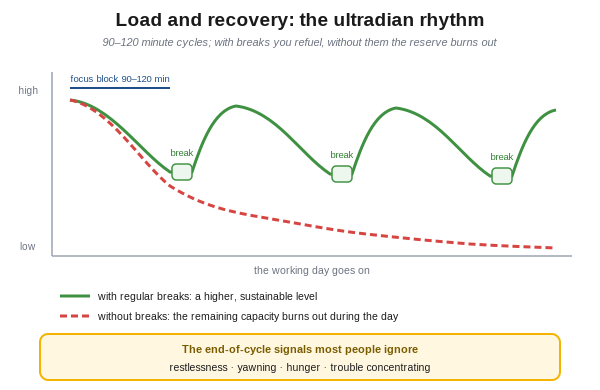
Figure 2 — load and recovery. The length of the break matters less than its quality: even a few minutes are worth a lot if you really do “change channel”. For one leader, the twenty-minute walk in the afternoon became the part of the day with the best ideas: while walking he does not think actively, so the left hemisphere gives way to the right.
Emotional energy: the quality of the emotions
Section titled “Emotional energy: the quality of the emotions”Emotional energy gives the quality of energy: in a positive state we perform substantially better, and in another state one cannot lead well. Without continuous recovery we are physiologically incapable of sustaining high positive emotion for long: under pressure we slip several times a day into “fight or flight” mode, which drains energy and makes clear thinking impossible.
- Buy time (buying time). Negative emotion is released by deep abdominal breathing: a slow exhalation of 5–6 seconds switches off the fight-or-flight response. For one leader this replaced the stress cigarette: it was not the smoking that eased the tension, but the deep exhalation.
- Express appreciation. Positive emotion is refilled most by recognizing others concretely and in detail, and this gives as much to the sender as to the receiver. Here, too, a fixed time slot decides whether it happens at all.
- Reframe with three lenses. In a conflict it is easy to slip into the victim’s role; without denying the facts, it is worth telling yourself the most hopeful, empowering story.
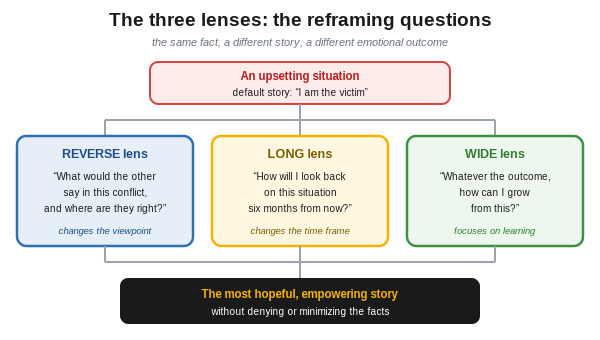
Figure 3 — the same fact, three different questions, three different emotional outcomes.
Mental energy: the focus of attention
Section titled “Mental energy: the focus of attention”Mental energy governs the focus of energy, and multitasking destroys exactly this. A temporary shift of attention (an e-mail, a phone call) increases the time needed to finish the original task by as much as 25%; this is called switching time. It is more effective to concentrate on one thing for 90–120 minutes, take a real break, and then start the next: these are the ultradian sprints. Three rituals bring the most:
- Physical separation. One bank vice president leaves her desk for work that demands concentration and goes into a meeting room, away from phone and e-mail. She finishes the reports written this way in a third of the time she needed before.
- Voicemail during the meeting. The same person used to take every call during meetings with her subordinates, which is why meetings planned for one hour often stretched to two. Since she lets the phone go to voicemail, the meeting takes as long as she planned, and she gives the other person her full attention.
- E-mail at designated times. Instead of every “ping”, one consulting partner checks his mail twice a day, at 10:15 and 14:30, and attends to nothing else for 45 minutes. Before, he never got to the end of it; this way he empties his inbox every single time. In an urgent matter he can be phoned: in nine months not a single such call came.
As a fourth item, it is worth designating the most important task of the next day every evening, and starting with it in the morning: what is valuable but not pressing otherwise gets left out.
Spiritual energy: meaning and purpose
Section titled “Spiritual energy: meaning and purpose”Spiritual energy opens up when our daily work coincides with what we consider most important: then there is more positive energy, better focus, greater perseverance. Rituals have to be built in three categories.
1. Do what you are best at and what you most enjoy. These two are not necessarily the same: you can get recognition for something you do not enjoy, and you can love something you have no talent for, so that success consumes a disproportionate amount of energy. Lasting spiritual energy comes from the intersection of the two, from the sweet spot.
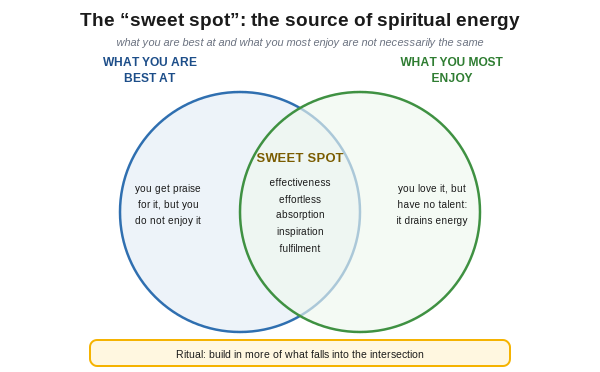
Figure 4 — the sweet spot. Recall two such work situations, and break them down: what energized you, and which of your abilities did you draw on.
One senior executive handed his least favourite task, summarizing the detailed sales reports, to a subordinate who is immersed in numbers, and put a free-form, 90-minute strategy session into his calendar every two weeks.
2. Devote time to what you genuinely consider important. With almost everyone there is a gap between what they say is important and what their time actually goes on. The ritual closes the gap: one leader switches off for three hours every evening for his family, another puts the phone away 20 minutes before he reaches his house.
3. Live by your core values. It is not worth having values recited, because the answer is too predictable. An indirect question tells you more: “Which qualities do you find most repellent in others?” Whoever recoils from stinginess has generosity as a value; whoever is bothered by rudeness has considerateness. Then comes the ritual: if considerateness is a value but you are always late, finish your meeting five minutes earlier and arrive five minutes earlier at the next one.
Where is your energy leaking? The energy audit
Section titled “Where is your energy leaking? The energy audit”The energy audit is 16 statements, four per dimension; you tick the ones that are true of you. Participants tick 8–10 on average, and what surprises them is not that these are counterproductive, but that they see them in one place.
| Dimension | The four statements (tick if true of you) |
|---|---|
| Body | I do not sleep 7–8 hours · I skip breakfast · I exercise little · I have no real break |
| Emotions | I am irritable or anxious · little and not-present time with my loved ones · little time for what I enjoy · I do not express appreciation |
| Mind | I find it hard to concentrate · I react to crises instead of high-return work · no time for thinking · I work in the evenings and at weekends too |
| Spirit | I do little of what I am good at and enjoy · a gap between the stated priorities and the actual schedule · external expectation drives my decisions · I do little for others |
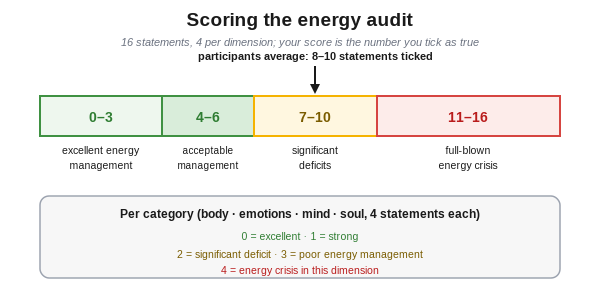
Figure 5 — the score bands. The audit shows in which dimension the deficit is largest, that is, where to start.
What does it deliver in business terms?
Section titled “What does it deliver in business terms?”An energy renewal programme produced measurably better business results compared with the control group. At Wachovia Bank, in early 2006, 106 employees from 12 regional branches went through a four-module programme (one module per dimension, a monthly rhythm, groups of 20–25); the control group was made up of similarly graded employees at nearby branches.
| Metric (year on year) | Result compared with the control group |
|---|---|
| Revenue from three key loan types | +13 percentage points (in the first three months) |
| Deposit revenue | +20 percentage points (in the same period) |
| Customer relationships | 68% of participants reported a positive effect |
| Productivity, performance | 71% of participants reported a noticeable or significant effect |
The participants outperformed the control group for a further year after the programme.
Why is fatigue a safety issue in the process industry?
Section titled “Why is fatigue a safety issue in the process industry?”In continuous, 24/7 operation, energy management is a direct safety question. The industry definition of fatigue: the gradual degradation of alertness and performance caused by sleep of insufficient quality or quantity, by too long a period awake, or by the daily circadian rhythm. Shift work produces exactly this: 12-hour shifts are common, as are rotations of 14 or 28 consecutive shifts, with a day-to-night switch in the middle of the rotation, and long travel across time zones before the rotation is not unusual.
The mechanism is not the cliché of “slower reaction time”. One of the most important effects of fatigue is a general decrease in motivation and energy: the willingness to make an effort falls, and conscious thinking is precisely what requires that, so a tired person is more prone to cognitive biases and to misjudging risk. Two conclusions:
- The state of the team is part of the leader’s own alertness. It is expected that a superior senses the signs of fatigue, distraction or “not coping” in their team members. Here, the end-of-cycle signs are fitness-for-duty signals, leading indicators just like an unusual noise on a machine. The answer: a break, rotation, rescheduling a critical task, reassigning a standard operator round.
- Incident investigation is blind to this. Investigations do not typically uncover the role of fatigue, so the risk remains under-measured.
Putting it into practice (roadmap)
Section titled “Putting it into practice (roadmap)”The sequence is not freely chosen: the programme starts with the physical dimension, and the spiritual part is left to the end. Starting with the spiritual has minimal effect: people only open up to questions of meaning after they have experienced the benefit of the rituals elsewhere.
- Have everyone complete the energy audit, and look at the category scores, not just the total: the highest one is the entry point.
- Start with the physical dimension, and ask everyone for a single ritual: not a goal, but a time slot.
- Build the other dimensions one after another, one module per dimension, in a monthly rhythm, then pair everyone with a supporting colleague who asks about the ritual between the modules. Good intentions left alone wear off.
- Secure senior leadership commitment as a precondition, and spread it top down. The regional president leading the pilot introduced the rituals himself; at the European organization of one large company, several hundred leaders first went through the programme, and only afterwards more than 2000 of their staff.
- Reset the frame as well: a recovery room (“renewal room”), a subsidized gym membership, midday exercise organized by a leader, an e-mail-free meeting, a meeting-free zone between 8 and 9 o’clock.
Three exercises you can run tomorrow
Section titled “Three exercises you can run tomorrow”- Interruption simulation (group, 20 minutes). Give a complex task, and interrupt them regularly. The feedback is almost always the same: this is exactly how their day goes. From there nobody needs convincing about switching time.
- Sweet-spot recall (individual, 15 minutes). Recall two work situations where you felt effective and absorbed, then break them down: what energized you, which of your abilities did you draw on?
- Value-revealing question (individual, 10 minutes). What do you find most repellent in others? Turn it around, name the value behind it, and write a ritual for it.
Common mistakes
Section titled “Common mistakes”- Answering overload with more hours. Instead, the same work in shorter, fully focused blocks.
- Handling only physical energy. Sleep and exercise do not solve work that has lost its meaning.
- Building on willpower instead of a ritual. Put it in the calendar with a time, otherwise it drops out on the hard days.
- Ignoring the signs of flagging. They are a physiological signal about the end of the cycle, and in a plant a safety signal as well; the answer is the break, not pushing on.
- Starting with the spiritual dimension. Talking about values to someone who has not even had enough sleep is not credible.
When NOT to use it (the limits of the method)
Section titled “When NOT to use it (the limits of the method)”- In a crisis mentality. The optimal candidate is an organization that feels enough pain to want a new solution, but not so much that it is overwhelmed. A programme launched with CEO backing failed because, under growth pressure, the leadership team could not tear itself away from immediate survival.
- Entering through the spiritual dimension. This is not a matter of style but a rule of sequence.
- Instead of organizational fatigue management. A personal ritual does not replace the formal fatigue management system (shift pattern, maximum number of shifts, rest time, risk assessment). Where the rotation itself produces the fatigue, a system-level answer is needed, not individual self-discipline.
- In the case of a health problem. A sleep disorder, an underlying illness or burnout at a clinical level belongs with a specialist.
Take it home (keys)
Section titled “Take it home (keys)”- Introduce one ritual, not five good intentions. Give it a fixed time slot, and hold it until it runs without thinking.
- Start with the body. Without the physical base, the other three dimensions remain mere talk.
- Protect the focus block physically: leave your desk, let the phone go to voicemail, e-mail twice a day.
- Watch the end-of-cycle signs, and stop for them. The quality of the break counts for more than its length.
- Look for the sweet spot, and delegate towards it: what you hate may be someone else’s favourite.
- As a leader, reset the frame too: a meeting-free morning hour, an e-mail-free meeting.
Self-test
Section titled “Self-test”- Which energy source governs the quality of energy, and which its focus? Give a ritual for each.
- By how much can the completion time of a task grow because of one temporary shift of attention, and what is this called?
- Why does the roll-out not start with the spiritual dimension, and what does it start with instead?
Answer key
- Quality is governed by the emotional dimension (a slow exhalation of 5–6 seconds); focus by the mental one (a 90–120 minute ultradian sprint without phone and e-mail).
- By as much as 25%; the phenomenon is called switching time.
- Because questions of meaning only take hold in someone after they have experienced a result; you have to start with the physical dimension.
Terminology (HU / EN; the JP column is omitted here, the concept is not of Japanese origin)
Section titled “Terminology (HU / EN; the JP column is omitted here, the concept is not of Japanese origin)”| Hungarian | English | Note |
|---|---|---|
| energiamenedzsment | energy management | managing energy instead of allocating time |
| fizikai / érzelmi energia | physical / emotional energy | body: base level; emotions: quality |
| mentális / szellemi energia | mental / spiritual energy | mind: focus; spirit: meaning |
| rituálé | ritual | a scheduled behaviour that becomes automatic |
| ultradián ritmus / fókuszblokk | ultradian rhythm / sprint | a 90–120 minute cycle, and the fully focused block |
| idő-nyerés / váltási idő | buying time / switching time | slow exhalation for negative emotion; the time cost of switching attention (as much as 25%) |
| sweet spot | sweet spot | the intersection of what you are good at and what you enjoy |
| fáradás jelei | signs of energy flagging | restlessness, yawning, hunger, loss of concentration |
Why should energy be managed rather than time?
Because time is a finite resource: putting in more hours leads to exhaustion and declining performance. Energy, by contrast, is renewable, so the real limit of performance is not the number of our hours, but how much energy we can refill and what we spend it on.
What are the four sources of personal energy?
The body (base level), the emotions (quality), the mind (focus) and the spirit (meaning and purpose). All four require separate feeding, because no strong dimension makes up for the lack of another.
How long is it worth concentrating in one stretch, and how much time does an interruption take?
It is worth working in full focus for 90–120 minutes, then taking a real break; this is the length of the ultradian rhythm. A single temporary shift of attention (an e-mail, a phone call) can increase the time needed to finish the task by as much as 25%; this is called switching time.
Why is energy management a safety issue in a plant?
Because fatigue reduces the willingness to engage in effortful thinking, so a tired person is more prone to cognitive bias and to misjudging risk. The shift work pattern (12-hour shifts, long rotations, day-night switches) produces exactly this, which is why recovery is part of prevention.
Related concepts
Section titled “Related concepts”time management · the Eisenhower matrix · self-awareness · circle of influence · standard operator round · leading and lagging indicators
Next step
Section titled “Next step”- time management — the counterpart of energy: once you know how much energy you have, where does your time go?
- the Eisenhower matrix — what should go into the focus block, and what should not.
- circle of influence — where to put energy, and what to let go of.
References / further reading
Section titled “References / further reading”- Tony Schwartz – Catherine McCarthy: Manage Your Energy, Not Your Time. Harvard Business Review, October 2007 (reprint R0710B) — the founding publication of the methodology, with the Wachovia pilot.
- Jim Loehr – Tony Schwartz: The Power of Full Engagement. Free Press, 2003 — the foundational work of the approach. The Energy Project — Schwartz’s organization, the canonical source of the methodology.
- Ronald W. McLeod: Designing for Human Reliability in the Oil, Gas, and Process Industries. Elsevier, 2015 — fatigue and human reliability in the process industry.
- ANSI/API RP 755 — the fatigue management standard for the refining and petrochemical industry; IPIECA — the industry definition of fatigue and risk assessment guidance; Energy Institute, IOGP — FRMS guidance.