Introducing Lean in a process plant — the 8-step Implementation Prescription
≈ 19 min read · 3,821 words
Management enthusiastically declares “from now on we are Lean,” they buy a few training courses, put up a few 5S boards — and half a year later everything is back to how it was. This is the most common Lean failure in process industries: the problem is not the intent, but that there is no orderly prescription behind it. That is exactly what the 8-step Implementation Prescription provides: a step-by-step, cyclical plan for how a plant truly becomes Lean. Let’s look at what it is, how it is built up, and where to start.
The 8-step Lean implementation prescription (Implementation Prescription) is the step-by-step, cyclical plan for a plant’s Lean transformation. It consists of two blocks: steps 1–3 are a systemwide evaluation (culture, production system, the workforce’s competence), while steps 4–8 are value-stream-specific action (current-state map, future state, goal-setting, kaizen, testing). The process is cyclical: after step 8 it returns to step 4, thus forming a continuous improvement loop. The model is applicable even to large, >250,000 BPD process-industry plants, and it delivers the first results quickly, without capital investment.
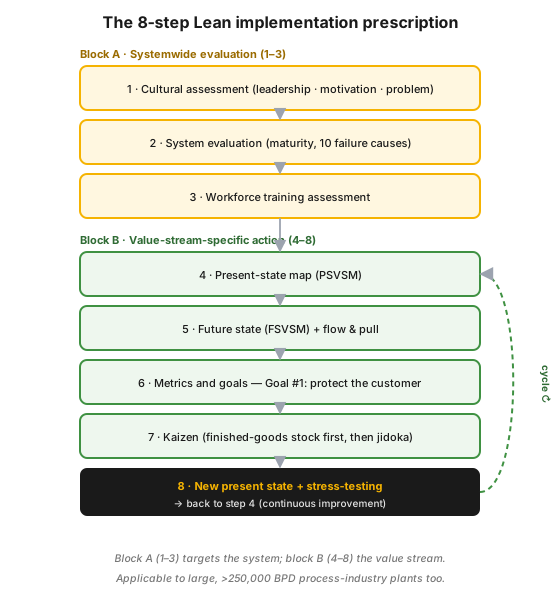 Figure 1 — the 8 steps: block A (1–3) targets the system, block B (4–8) targets the value stream; after step 8 the cycle continues at step 4, which is what makes it continuous improvement.
Who is this for?
Section titled “Who is this for?”This article is for those who are responsible for, or take part in, introducing Lean in a process plant: plant and site manager · process technologist · process engineer · Lean/CI coordinator · maintenance manager · shift supervisor · senior manager (sponsor) · HSE.
Learning objectives
Section titled “Learning objectives”After reading this article you will be able to:
- explain why the prescription consists of two blocks, and what the difference is between the systemwide and the value-stream-level steps;
- list all 8 steps in the right order, and justify why the process is cyclical;
- decide whether to introduce Lean across the whole plant at once or value stream by value stream;
- name the three roles of the introducing coalition (planner, assessor, supporter) and the “get organized → focused → going” logic;
- draw the line: when NOT to start with this comprehensive prescription.
The essence (TL;DR)
Section titled “The essence (TL;DR)”- Two blocks: 1–3 = systemwide evaluation (culture, system, competence); 4–8 = value-stream-specific action.
- Cyclical: after step 8, back to step 4, which turns it into continuous improvement (see PDCA).
- Goal #1: protect the customer — in the goal-setting and in the kaizen sequence alike, security of supply comes first.
- Kaizen sequence: first the control of finished-goods inventory (security of supply), then jidoka, and finally the rest.
- Start small: usually one value stream at a time, not the whole plant in one sweep (the “clean sweep”).
- Treat it as a big project: data coming from two sources (system + value stream), prioritized, turned into kaizen, tracked on a Gantt chart.
- Brutal honesty is the foundation: the rollout begins with an honest assessment of where we really stand.
Why does it matter? (the stakes)
Section titled “Why does it matter? (the stakes)”In process industries Lean is not a toolkit but a cultural transformation, and that is precisely why it fails so often. The typical failure pattern is familiar: the organization looks for the flashy, technological “silver bullet” (a new piece of equipment, a big investment), and looks down on the slow, disciplined, teamwork-based process improvement. Without this prescription the Lean initiative either never truly gets going, or it runs out of steam as a one-off project.
The stakes are tangible. A well-introduced Lean in process industries brings results quickly, without capital investment: typical early results include reducing post-maintenance machine start-up failures from 3.5% to below 1%, cutting the re-tubing of cooling-water heat exchangers by 30–60%, and drawing down mid-distillate inventory by 36%. These are not the yield of a piece of software or a machine, but of an orderly, disciplined rollout.
What is it, and where does it come from?
Section titled “What is it, and where does it come from?”The 8-step Implementation Prescription is Lonnie Wilson’s prescription, which he developed in his book How to Implement Lean Manufacturing (McGraw-Hill, 2009), and which he presents tailored to the process industries (specifically, oil refining). The author spent twenty years in the management of a large international oil company, and as a senior manager applied the Lean principles in the plant himself. So the prescription grew out of real plant experience, not textbook abstraction.
Its background is the Toyota Production System (TPS): in Taiichi Ohno’s formulation “the basis of the TPS is the absolute elimination of waste,” and “the goal is cost reduction.” Lean is the generalized version of this, popularized by The Machine That Changed the World (Womack–Jones–Roos, 1990). The process industries stayed out of this movement for a long time: the competitive pressure — unlike in the automotive and electronics industries — was missing, and in the capital-intensive plants management preferred to look for flashy technological solutions.
Wilson’s key message is that in process industries too everything is in place for Lean: the specialists are skilled, the resource demand is low. What is typically missing is the culture and the brutal honesty — the ability of the organization to face management, the ingrained habits and the self-deception of “here this works well for us” honestly. He borrows this concept from Jim Collins’s Good to Great, and makes it the very first condition of the rollout.
How do you introduce Lean in a process plant, step by step?
Section titled “How do you introduce Lean in a process plant, step by step?”The prescription organizes the rollout into 8 steps, in two blocks: the first three steps evaluate the whole system (is the organization ready?), and the last five carry out real change on one specific value stream. After step 8 the process returns to step 4, so that the rollout is not a one-off project but a continuous improvement loop. The whole thing is treated as a single big project, tracked on a Gantt chart.
Block A — systemwide evaluation (1–3)
Section titled “Block A — systemwide evaluation (1–3)”This block assesses whether the organization is ready for Lean. It is purely evaluation, there is no intervention yet:
- Cultural assessment — the 3 basic questions of cultural change: Leadership, Motivation and Problem Solving Capability. This is where the leader of the rollout is chosen, and an experienced sensei is sought alongside them — these two are the two most important actors of the initiative.
- System evaluation — a full review of the current production system: the 5 tests of management commitment, the 10 most common causes of Lean failure, the 5 preconditions (precursors) and the assessment of process maturity (see Lean anti-patterns).
- Workforce training evaluation — assessing the team’s readiness: identifying formal Lean introductory training and the necessary skills training.
Block B — value-stream-specific action (4–8)
Section titled “Block B — value-stream-specific action (4–8)”This block carries out the real transformation on one specific value stream. This is where the kaizen actions are born:
- Present-state map (PSVSM) — drawing the real, current value stream (with VSM tools).
- Future state (FSVSM) — the future-state map, which synchronizes supply outward to the customer and inward to production, creates flow (building in the jidoka concept too) and the pull system; the waste-reducing redesign is also supported by a spaghetti diagram (the path of the material/movement).
- Metrics and goals — defining the critical process metrics and setting concrete goals for this process. The rule: “Goal No. 1 is to protect the customer” — the first goal is always to protect the customer.
- Kaizen — carrying out the improvements in a defined order: first the control of finished-goods inventory (to protect customer supply), then the jidoka concept (which you designed in step 5), and finally the rest of the kaizen actions.
- New present state + “stress-testing” — after the changes you evaluate the new present state, load (stress) the system, and then return to step 4.
The whole plant at once, or value stream by value stream?
Section titled “The whole plant at once, or value stream by value stream?”Usually one value stream at a time is the better choice, not the whole plant in one sweep. The “clean sweep” (everything at once) approach is surprisingly popular, but experience shows it is weaker than the one-value-stream-at-a-time rollout. Four strong reasons argue for the latter:
| Reason | Why it matters |
|---|---|
| Steep learning curve | the experience gained on the first value stream is invaluable for the next ones — better to learn on a small scale |
| Scarce resource | the trained “eyes and ears” (assessors) are few; migrating from value stream to value stream, they carry the knowledge along |
| Interactions | transforming one line often affects another; going one by one, these can be managed and exploited |
| Historical success | line-by-line rollouts perform much better; global attempts typically struggle to hit the goals |
The (rare) exception, when the rollout is nonetheless plant-wide: if the customer explicitly works only with a fully Lean plant, or if the manufacturing is trivial compared to the whole operation (e.g. the complexity is in warehousing and material handling).
Who does it? The three phases of organizing
Section titled “Who does it? The three phases of organizing”The rollout is led by a small, dedicated team, in three simple phases: get organized → get focused → get going.
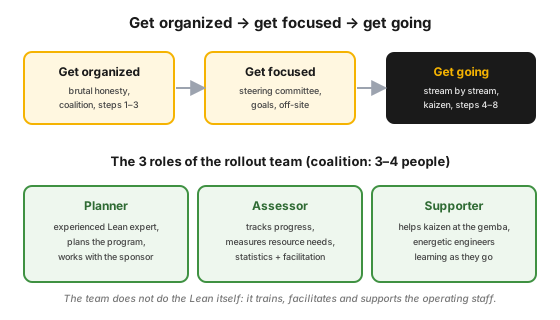 Figure 2 — the three phases of organizing and the three roles of the introducing coalition. The team does not do the Lean itself; it trains, facilitates and supports the operating staff.
- Get organized. It begins with brutal honesty: where the organization stands, and what it takes to get there. This is where the Lean owners are designated. Even in a large plant (>250,000 BPD) a 3–4-person coalition is enough, with three clarified roles: planner (an experienced Lean expert, who plans the program with the sponsor), assessor (who tracks progress, measures resource needs, with statistical and facilitation skills) and supporter (who helps the concrete kaizen at the gemba, energetic engineers who learn as they go).
- Get focused. Setting up the steering committee made up of senior managers, often with an off-site meeting where they understand and accept the mainly cultural changes. In the first 2–3 years the committee meets quarterly, and then, once Lean is “just how we do things here,” it can be dissolved.
- Get going. The actual execution, value stream by value stream, with steps 4–8. The team does not do the Lean itself: it trains, facilitates and supports the operators, technologists, engineers and maintenance staff, so that they carry out the process improvement.
Process-industry context and safety
Section titled “Process-industry context and safety”The model was developed specifically for a large, continuous-operation environment (including the >250,000 BPD plants), which is why several of its elements answer to the specifics of process industries:
- Security of supply first. In continuous operation the most expensive fault is the interruption of supply, which is why the prescription makes protecting the customer the very first goal, and the control of finished-goods inventory becomes the first kaizen.
- System vs. process optimum. The process-industry culture is good at short-term bottleneck management, but this process-specific focus often undermines the optimization of the whole system. The prescription reinforces precisely the systems view (block A).
- Safety boundary — MANDATORY. The Lean rollout improves efficiency and quality, but it does not replace the certified functional safety and protection layers. The emergency-shutdown and protection logic must always be designed according to risk analysis and the relevant standards (LOPA / SIL, IEC 61511). A change introduced during kaizen can never weaken the existing safety functions: management of change (MOC) is a mandatory gate here.
Introduction in practice (roadmap)
Section titled “Introduction in practice (roadmap)”If you had to start tomorrow, this is the minimum viable path:
- Get a sponsor and set up a 3–4-person coalition (planner, assessor, supporter). Without management commitment, do not start.
- Face the starting situation honestly (block A): culture, system maturity, the team’s competence. This is the “brutal honesty” step.
- Choose ONE painful, well-delimited value stream — not the whole plant. This is where you learn the most with the least risk.
- Draw the present state (PSVSM), design the future state (FSVSM), set the goals so that protecting the customer is first.
- Carry out the kaizen in the right order (inventory control → jidoka → the rest), tracking every action and milestone on a Gantt chart.
- Stress the system, evaluate the new state, and return to step 4 — then carry the lessons to the next value stream.
Practical part / mini-scenario
Section titled “Practical part / mini-scenario”Mini-scenario (one value stream). A plant starts Lean on the blending and packaging value stream. The coalition assesses the culture and the system maturity (block A), then draws the present-state map: it turns out that the variance of finished-goods inventory is large, and customer service is therefore uncertain. The future-state map synchronizes the blending to customer demand and sets up a pull system. In the goal-setting, protecting the customer comes first, so the first kaizen is inventory control, and only afterwards comes jidoka and the rest of the improvements. Every action goes onto the Gantt chart with an owner and a deadline. In step 8 the team loads the system, evaluates what has improved, and carries the lessons to the next value stream.
Homework. Choose one value stream in your own plant. Write down: (a) who would be the sponsor and the 3-person coalition; (b) what the first kaizen would be if protecting the customer is the primary goal; (c) how many value streams you would start with — and why not the whole plant at once.
Measurement / audit
Section titled “Measurement / audit”The rollout is “alive” if it is trackable and auditable. For this the prescription uses the Gantt chart as a minimum; a good project documentation contains at least this:
| What to track | Why |
|---|---|
| Every kaizen action | you can see what is happening and what is slipping |
| Key milestones | progress is measurable, not just activity |
| Deadlines and owners | every action has an owner and a deadline |
The result of the rollout is measured by the critical process metrics (step 6), value stream by value stream: the goal is not the number of kaizens, but the improvement of the metrics, while customer supply remains protected throughout. Because of the cyclicity (8 → 4), the measurement never closes: each round yields a new present state and new goals.
Common mistakes
Section titled “Common mistakes”- Starting with block B (tools, VSM, kaizen) without the assessment of block A. Why it’s a problem: without culture and system maturity the improvement cannot be sustained → zero sustainability. Instead: first the 3 systemwide evaluations, only then the action.
- “Leaning” the whole plant at once (clean sweep). Why it’s a problem: the learning curve is steep, the few assessors are spread thin, the interactions become unmanageable. Instead: one value stream at a time, carrying the lessons to the next.
- Dropping the cycle: after step 8 there is no return to step 4. Why it’s a problem: the rollout becomes a one-off project, not continuous improvement. Instead: after each round a new present state, new goals (see pdca).
- Neglecting protection of the customer in the kaizen sequence. Why it’s a problem: the chase for efficiency can interrupt supply, which in process industries is the most expensive fault. Instead: inventory control first, “Goal #1: protect the customer.”
- “Silver bullet” thinking: looking for the flashy technological solution instead of disciplined process improvement. Why it’s a problem: Lean is a cultural transformation, not an investment. Instead: brutal honesty + persistent kaizen, without capital investment.
- Starting without management commitment. Why it’s a problem: the cultural change must be wanted and backed by senior management. Instead: sponsor + steering committee already in the “get focused” phase.
When NOT to use it? (limits of the method)
Section titled “When NOT to use it? (limits of the method)”This prescription is the comprehensive plan of a complete Lean rollout that transforms culture too. There are times when a different answer is the right one:
| Situation | Why (primarily) not this prescription | The right answer | ||
|---|---|---|---|---|
| A single, local problem needs solving | it is not worth launching a whole rollout program for it | targeted [[kaizen.en | kaizen]] / [[5-miert.en | root-cause analysis]] |
| No management commitment | the cultural transformation collapses without senior-management backing | first establish the sponsorship and the “brutal honesty” | ||
| A certified safety function is needed | Lean is not a certified protection layer | design per [[lopa-sil.en | SIL/LOPA]], IEC 61511 + [[moc.en | MOC]] |
| An acute crisis / firefighting is in progress | the rollout needs a calm, persistent rhythm | first stabilize, then the orderly rollout |
Rule of thumb: the 8-step prescription is the right tool when the goal is a durable, systemwide Lean transformation, there is management commitment for it, and there is patience for cyclical, value-stream-by-value-stream progress. For a one-off problem it is too heavy; for safety-critical protection it does not replace the appropriate tool.
Take it home (keys)
Section titled “Take it home (keys)”- A prescription, not enthusiasm. A Lean rollout is successful when an orderly plan stands behind it — the 8 steps provide this.
- Evaluation first, then action: without block A (1–3), block B (4–8) cannot be sustained.
- Start with one value stream, not the whole plant — that is where you learn the most with the least risk.
- The customer is first: in the goal-setting and in the kaizen sequence, security of supply is what protects.
- Close the loop: after step 8 return to step 4 — this is what makes it continuous improvement, not a one-off project.
- Track it on a Gantt: every kaizen, milestone, deadline and owner should be visible and auditable.
Self-test
Section titled “Self-test”- What is the difference between block A (1–3) and block B (4–8) of the prescription, and why do you have to proceed in this order?
- In step 7, in what order do you carry out the kaizens, and why exactly is the control of finished-goods inventory first?
- In a large plant you would start a Lean rollout on 6 value streams at once. Give two reasons why this is usually worse than going one by one.
How does it appear in digital practice?
Section titled “How does it appear in digital practice?”The principle of an orderly, step-by-step rollout does not stop at the paper Gantt: the same logic is realized in software too, in a well-designed digital operation. Instead of the board plan, here a live, logged workflow records who does what, by when and in what order — the mechanism differs, the principle is the same.
| Prescription element | Digital implementation | What it delivers |
|---|---|---|
| Kaizen actions + owner + deadline | action register with status and reminder | in one place you see what is slipping and what is done |
| Key milestones | milestone tracking on a dashboard | progress is measurable, not just activity |
| Critical process metrics (step 6) | automatic KPI collection, before/after trend | the improvement is seen from source data, not from memory |
| Cyclicity (8 → 4) | recurring review cadence, logged rounds | the rollout does not close, it stays continuous |
| Kaizen sequence / enforced priority | a workflow that helps the right order | the customer-protecting step is not skipped |
| Audit trail | timestamped, retrievable log entries | progress is demonstrably documented |
Connection to OPEREX (shift diary)
Section titled “Connection to OPEREX (shift diary)”The kaizen actions, milestones, owners and deadlines of the 8 steps can be recorded in a structured way in an action / shift-diary (OPEREX) system. This way the Gantt is not a static plan but a live, trackable state: every action has an owner, a deadline and a status, the rounds (8 → 4) recur in a logged way, and the system provides an audit trail per ISO 45001 §10.3 of the progress of continuous improvement — retrievably, even after the gate of human review.
Terminology (HU / EN / JP)
Section titled “Terminology (HU / EN / JP)”| Hungarian | English | Note |
|---|---|---|
| Bevezetési recept (8 lépés) | (8 Step) Implementation Prescription | Wilson’s prescription for the Lean project |
| Rendszerszintű kiértékelés | systemwide evaluation | block A (steps 1–3) |
| Értékfolyam-kiértékelés | value stream evaluation | block B (steps 4–8) |
| Jelenállapot-térkép | Present State Value Stream Map (PSVSM) | 現状 — the real process |
| Jövőállapot-térkép | Future State Value Stream Map (FSVSM) | 理想 — the designed process |
| Áramlás / húzó rendszer | flow / pull | フロー / プル |
| Brutális őszinteség | brutal honesty | the first condition of the rollout (after Collins) |
| “A vevő védelme az 1. cél” | “Goal No. 1 is to protect the customer” | the guiding principle of goal-setting and the kaizen sequence |
The technical terms are validated from the source material (Wilson: Lean in the Oil Refinery; How to Implement Lean Manufacturing) and the established Lean canon.
What is step 1 of a Lean rollout in a process plant?
Assessing the 3 basic questions of cultural change: Leadership, Motivation and Problem Solving Capability. In parallel, the leader of the rollout is designated and an experienced sensei is sought alongside them.
What is the most important goal in the goal-setting step?
Protecting the customer — “Goal No. 1 is to protect the customer.” When defining the goals, the security of customer supply comes first, and the kaizen too starts with the control of finished-goods inventory.
Why are the 8 steps cyclical?
Because after step 8 (new present state + stress-testing) you have to return to step 4 (new present-state map), so that the rollout is not a one-off project but a continuous improvement loop.
Should the whole plant be introduced at once, or value stream by value stream?
Usually value stream by value stream. The one-value-stream-at-a-time rollout generally outperforms the “clean sweep” approach that transforms the whole plant at once, because of the learning curve, the scarce assessor resource, the interactions between the lines, and the better historical results.
Does introducing Lean in process industries require a large capital investment?
Typically not. Lean in the plant brings results quickly, without capital investment (e.g. reducing start-up failures or excess inventory); what it takes is management commitment, brutal honesty and disciplined kaizen.
Related concepts
Section titled “Related concepts”the transformation journey · Lean anti-patterns · the VSM toolbox · kaizen · pdca · jidoka · flow · pull system · toyota-production-system
Next step
Section titled “Next step”If you have understood this, from here it is worth going on — in this order:
- Lean anti-patterns — the 10 most common causes of Lean failure and the 5 preconditions: these are what block A uses to assess whether the organization is ready.
- the VSM toolbox — the toolkit of the present- and future-state map (PSVSM/FSVSM) that steps 4–5 work with.
- pdca — the logic of cyclical improvement, which turns the 8 → 4 return into continuous improvement.
References / Further reading
Section titled “References / Further reading”- Lonnie Wilson: How to Implement Lean Manufacturing. McGraw-Hill, 2009 (ISBN 0071625070) — the canonical source of the 8-step Implementation Prescription.
- Lonnie Wilson – Jason Farley: Lean Manufacturing in the Oil Refinery. BridgeGap Consulting Syndicate, 2010 — the process-industry (oil-refining) application of the prescription.
- Taiichi Ohno: Toyota Production System: Beyond Large-Scale Production. Productivity Press, 1988 — the foundational work on the TPS and the elimination of waste.
- James P. Womack – Daniel T. Jones – Daniel Roos: The Machine That Changed the World. Rawson Associates, 1990 — the popularizer of the “lean” concept.
- Jim Collins: Good to Great. HarperBusiness, 2001 — the source of “brutal honesty” (honest situation assessment).