The change formula (Dannemiller / Gleicher): D × V × F > R
≈ 18 min read · 3,629 words
In January you decide that this year you will really quit smoking, start exercising, sort out the paperwork. By February everything is back to the old ways. Not because you are lazy, but because wanting is not enough for change: one of the driving forces was missing. The same thing happens to a whole plant or organization when a well-thought-out transformation simply does not get going. The change formula tells you exactly which driving force is missing, and so why the change stalls. Let’s look at what it is, why it is a product, and how it can be used as a diagnostic tool.
According to the change formula, organizational change starts when the product of dissatisfaction, vision and first steps overcomes the resistance. As a formula: D × V × F > R, where D is dissatisfaction with the status quo, V is a clear, attractive vision, and F is the first concrete steps; the product of these must exceed the resistance R. Because the three factors are multiplied, if any one is zero or low, the product is also zero or low, and so it cannot overcome the resistance. Trust (TRUST) is indispensable for breaking the resistance.
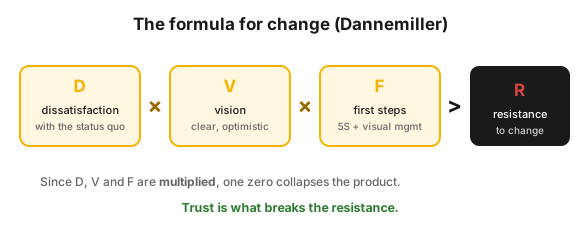
Figure 1. The change formula: the product of the three factors (dissatisfaction × vision × first steps) overcomes the resistance; if any factor is missing, the product collapses too. Trust (TRUST) breaks the resistance.
Who is this for?
Section titled “Who is this for?”This article is for those who launch, lead or live through an organizational or operational change: plant and site manager · shift supervisor · Lean/CI coordinator · change leader · project manager · HSE manager · process engineer · HR and organizational development.
Learning objectives
Section titled “Learning objectives”After reading this article you will be able to:
- write down and explain the D × V × F > R formula and all four of its factors;
- justify why the three driving forces are a product and not a sum, and what that entails;
- for a stalling change, say which factor is the weakest, and strengthen it in a targeted way;
- recognize the role of trust (TRUST) in breaking resistance;
- apply the formula to a process-industry culture change (safety, efficiency).
The essence
Section titled “The essence”- A product, not a sum: D × V × F > R. If any factor is near zero, the whole product falls to zero, and the change fails, however strong the other two are.
- D, Dissatisfaction: dissatisfaction with the current state, especially at (senior) management level. If “everything is fine,” there is no driving force.
- V, Vision: a clear and optimistic vision. A poor or missing vision kills the change just as surely as missing dissatisfaction.
- F, First steps: first concrete steps, in the Lean context typically 5S and visual management (the base of the House of Lean).
- R, Resistance: the natural resistance to change. The formula does not remove it; the product must grow above it.
- A diagnostic tool: if a transformation stalls, ask which factor is missing (D, V or F) and strengthen that one, rather than pushing further the one you already have.
- Trust (TRUST) is what ultimately breaks through the resistance.
Why does it matter? (the stakes)
Section titled “Why does it matter? (the stakes)”A change initiative rarely fails on a single big mistake. Far more often two driving forces are perfect while the third is missing, and the product collapses because of it. This is the easiest thing to get wrong, because the project owner sees that “two things are very much in order” and does not understand why nothing is moving.
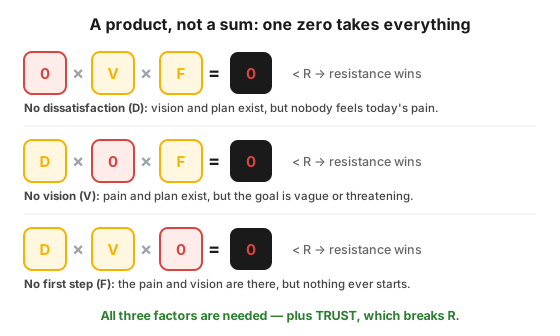
Figure 2. The collapse of the product. Whether D, V or F falls near zero, the whole D × V × F result becomes zero too, so it cannot overcome the resistance. This is the explanation for the most common failures.
The stakes are tangible. In a process-industry plant, a stalled safety or efficiency transformation is not neutral: meanwhile the recurring near-misses, the slow permitting, the energy losses keep going. A badly launched change is not merely postponed, it also burns credibility: whoever has once lived through a stalled, abandoned “big program” will meet the next one with far greater resistance (a higher R). The formula is valuable because it shows, still before the start, where the weak link is, while it is still cheap to reinforce.
Where does the formula come from?
Section titled “Where does the formula come from?”The change formula stands on its own even if you do not know its origins. In short: it is one of the oldest and most-cited ideas about what gets a change going.
It is originally attributed to Richard Beckhard and David Gleicher (often called the “Gleicher formula,” in the form C = D × V × F > R), and was later popularized and simplified by Kathleen Dannemiller into the form known today. The letters and exact wording of the various versions differ slightly, but the core is the same: change starts when the combined force of dissatisfaction, vision and first steps exceeds the resistance.
In Lean practice the formula usually spread attributed to Dannemiller, in the D × V × F > R form, and this article follows this reading too. Lean is essentially continuous change, so the logic of getting change going is one of the fundamental questions of a Lean introduction.
The four factors in detail
Section titled “The four factors in detail”Under each main H2 comes a self-standing answer, then the elaboration. The four letters together yield a diagnosis, so it is worth understanding each one separately, and what they mean.
D — Dissatisfaction (with the status quo)
Section titled “D — Dissatisfaction (with the status quo)”The engine of change is pain with the present. As long as the organization, and especially the senior and middle management, is satisfied with “the way we have always done it,” there is no energy for change.
The classic trap is when management, citing high profit and weak competition, feels no dissatisfaction (D near zero). Then “there is no need for change,” leadership honestly believes this, while the troubles slowly accumulate: frequent leadership turnover, constant reorganization in senior and middle management. The lesson: D is not “a bad mood” but the rational, fact-based necessity of change. Management-level dissatisfaction is key because this is where the resources and the mandate come from.
V — Vision (a clear, attractive vision)
Section titled “V — Vision (a clear, attractive vision)”The vision is the “where we are heading,” the clear and optimistic picture of the future. A good vision is attractive and looks achievable; it is not a threat but a goal.
Here the most common mistake is the poor vision. If the vision is merely “survival and cost cutting,” it is not attractive, it does not energize, and the transformation fails. There was a site where the vision of the Lean introduction was literally survival, cost and inventory reduction, and the site was eventually sold and closed. The vague or defensive vision zeroes out the product just as the missing dissatisfaction does.
F — First steps (first concrete steps)
Section titled “F — First steps (first concrete steps)”A vision on its own stays a slogan if there are no immediate, tangible steps behind it. In the Lean context these are typically 5S and visual management, the cornerstone of the House of Lean.
The first steps are critical because they deliver proof: they show that the change is real, is happening, and works. A typical turnaround started precisely with the first, Toyota-minded steps: appointing a Lean coordinator, 5S, visual management. Where all three driving forces (vision, dissatisfaction, first step) came together at once, a small site making simple products eventually became one of the region’s largest production units. The lesson: a small, visible start > a perfect but never-launched plan.
R — Resistance
Section titled “R — Resistance”Resistance is natural and unavoidable; every change dislodges us from the familiar. The formula does not promise to remove it; it says the D × V × F product must grow above it.
The degree of resistance is not constant, however. Where people have previously experienced positive change, it is low; where distrust sits, it is high. That is why it matters how each earlier initiative ends: a well-run change that brings results reduces the R of the next one, while an abandoned one increases it.
Why a product, and why TRUST?
Section titled “Why a product, and why TRUST?”The power of the formula is in the multiplication: if D, V and F are multiplied, then a zero in any factor drags the whole result to zero, however perfect the other two are. With a sum, a strong factor could “make up for” the missing one; with a product, it cannot. This is the explanation for the most common failures (see Figure 2): there is a vision and there are steps, but no one is dissatisfied; or there is pain and a plan, but the vision is vague; or the pain and the vision are there, but the first step never starts.
A highlighted lesson of the formula is that trust (TRUST) is indispensable for breaking resistance. In a typical case it was precisely mutual trust that made it possible to completely redesign a process and its associated layout, with a significant and lasting result, amid low resistance. Trust is the “lubricant” without which even the product of the three factors does not turn into real motion: trust curbs R, while the D × V × F pushes the change.
How is it used in practice? (diagnostics)
Section titled “How is it used in practice? (diagnostics)”The greatest practical benefit of the change formula is that it can be turned into a diagnostic checklist. When an initiative stalls, do not push your existing strength further; find the missing factor.
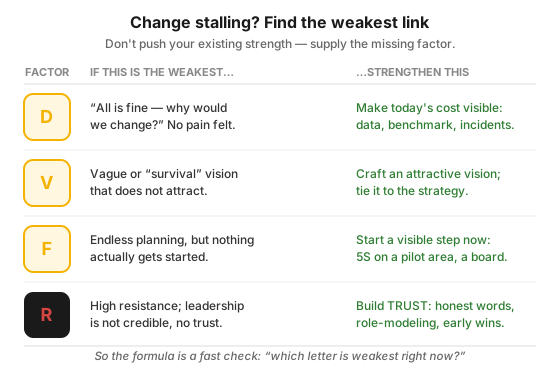
Figure 3. The formula as a diagnostic table: from the symptom you work back to which factor is the weakest, and you choose the intervention that strengthens exactly that letter.
- Is D (dissatisfaction) missing? Make the real cost and risk of the present visible (data, benchmark, incident trends), at management level too.
- Is V (vision) missing or weak? Formulate an attractive, optimistic vision, and tie it to the strategy (the three lenses, OGSM). Avoid the “survival” vision.
- Is F (first steps) missing? Launch an immediate, visible step (5S on a pilot area, a visual board), a quick win that proves the point.
- Is R (resistance) too great, or is TRUST missing? Build trust: honest communication, leadership role-modeling, an early tangible benefit (see change curve, resistance to change).
The formula is thus not theory but a fast situational assessment: “which of our letters is the weakest right now?”
Introduction in practice (mini-scenario)
Section titled “Introduction in practice (mini-scenario)”This is what the formula looks like in the hands of a shift supervisor, in an everyday culture change.
- Monday, sharpening the D. The shift supervisor does not give a speech but lays out the facts: the near-misses of the last quarter, the most frequent permitting delays, an energy-loss figure. The goal is not blame, but for the team and the superior to feel that the present is untenable.
- Formulating the V together. In a short team conversation a one-sentence, attractive vision takes shape: “a stable, predictable, safe plant where we treat a problem as a learning opportunity.” It is not dictated from above, so it becomes their own.
- The F that same day. Not a “big plan” is drawn up, but one visible step is launched: 5S in a panel room or at one unit, plus a visual performance board. The point is that by the end of the week there is something to look at.
- The TRUST continuously. The leader keeps what they promised, acknowledges the partial result, and does not punish the problem brought to the surface. This way the resistance to the next step is already smaller.
Homework. Choose a stalled change, or one that never started, in your own area. Score the four factors (D, V, F and the TRUST level) from 0 to 5. For the lowest score, write one concrete intervention for this week, and launch only that; do not strengthen the already-strong factor further.
Process-industry context and safety
Section titled “Process-industry context and safety”In a safety or efficiency culture change at a Seveso plant, the formula is directly applicable. The four letters here take on concrete operational content.
| Factor | What it means in a process-industry culture change |
|---|---|
| D — dissatisfaction | the untenability of the present in facts: recurring near-misses, slow permitting, energy loss, demonstrated at shift-supervisor and plant-manager level too |
| V — vision | “a stable, predictable, safe plant where we treat a problem as a learning opportunity,” not a threat |
| F — first step | 5S in a panel room or at one unit, a visual performance board, a structured shift handover |
| R + TRUST | trust and the quick, visible result (fewer incidents, faster permitting) break the “it has been safe so far” resistance |
Common mistakes
Section titled “Common mistakes”Every mistake is best seen paired with the correct practice, and each ties back to the formula’s own logic.
- We communicate only the vision (V), while no one feels the pain of the present (D near zero). Why it’s a problem: the product is zero, people nod but do not move. Instead: first make the cost of the present visible (data, benchmark, incident trend).
- A threat vision: “change, or we close.” Why it’s a problem: this gives a D, but a poor V; in the absence of an attractive vision the energy turns into fear, not action. Instead: formulate an attractive goal that looks achievable.
- Endless planning without F. Why it’s a problem: the “big plan” is prepared for months, but there is no immediate, visible first step; momentum and credibility are lost. Instead: launch a small, visible step this very week.
- Skipping trust (TRUST). Why it’s a problem: the three factors are there, but leadership is not credible or does not set an example, so the resistance is not broken. Instead: keep your promises, and do not punish the problem brought to the surface.
- We strengthen the existing instead of the missing. Why it’s a problem: whoever is a good vision-communicator produces even more vision, while the F is missing. Instead: the formula directs attention precisely to the weak link; supply that.
When NOT to use it? (limits of the method)
Section titled “When NOT to use it? (limits of the method)”The change formula is a strong thinking frame, but it is not for everything. Knowing when it is not the right tool is just as important as the model itself.
| Situation | Why (primarily) not the formula | The right answer |
|---|---|---|
| A concrete technical/process problem (not behavior, but e.g. equipment failure) | the formula is about getting change going, not about solving the root cause | 5 Whys, PDCA, FMEA, engineering analysis |
| Safety-critical protection is needed | the formula is not a certified, audited protection layer | design per SIL/LOPA, IEC 61511 |
| The real measurement of the factors is missing | the 0–5 scoring is subjective on its own; false precision | first obtain data (near-miss, KPI, survey), then diagnose |
| An acute crisis, where immediate, direct instruction is needed | the participatory, vision-based logic is slow in an emergency | crisis management, a clear chain of command, the culture afterwards |
Rule of thumb: the formula is strong for the diagnostics of intentional, people- and culture-centered change. It does not replace a technical root cause, certified safety or an acute crisis, but complements the tool that fits it.
Take it home (keys)
Section titled “Take it home (keys)”- A product, not a sum: one near-zero factor zeroes out the whole change, even if the other two are perfect.
- Diagnose, don’t push the existing: for a stalling change, find the weakest letter (D, V or F), and strengthen that one.
- Let the vision be attractive, not threatening: the “survival” vision gives a D but not a V, and turns energy into fear.
- Start small, but visibly: the first concrete step (typically 5S and visual management) proves the point and gives momentum.
- Trust (TRUST) breaks the resistance: without role-modeling and an early, tangible result, the formula does not turn into motion.
Self-test
Section titled “Self-test”- Why does the whole change collapse if only a single factor (say the F) falls near zero? What would be different if the formula were a sum, not a product?
- In a plant the vision is strong and the first steps are in place, but senior management says “everything is fine.” Which factor is missing, and what is your first step to supply it?
- What is the difference between an attractive vision and a threat vision, and why is the “change, or we close” message not enough to get change going?
How does it appear in digital practice?
Section titled “How does it appear in digital practice?”The factors of the change formula do not remain abstractions: in a well-designed digital operation each letter has a tangible, recordable counterpart. The mechanism differs, the principle is the same: making the change visible and measurable.
| Factor of the formula | Digital implementation | What value it delivers |
|---|---|---|
| D (dissatisfaction) | trends, KPIs, incident and near-miss log in one place | the untenability of the present in numbers, not on a hunch |
| V (vision) | targets and milestones on the performance board / dashboard | the vision becomes a measurable, trackable state |
| F (first step) | action/task tracking, a log of closed items | the small wins happen documented |
| R + TRUST | a transparent, searchable log: who promised what, what was delivered | the kept promise builds trust, reduces resistance |
Connection to OPEREX (shift diary)
Section titled “Connection to OPEREX (shift diary)”The formula’s F factor (first concrete steps) and the building of TRUST both call for early, tangible results. At the low point of the change curve and at the launch of the change, documenting the quick wins builds trust. The OPEREX shift diary is a tangible tool for this: in the searchable entries recorded shift by shift, the early results (fewer incidents, faster permitting, closed actions) become visible and searchable. This at once feeds the D (the untenability of the old state demonstrated in numbers) and builds the TRUST (the change demonstrably works), that is, it directly strengthens the two most frequently weak points of the formula.
Terminology (HU / EN / JP)
Section titled “Terminology (HU / EN / JP)”| Hungarian | English | Japanese (rōmaji) |
|---|---|---|
| Változásformula | Formula for change / Change formula | henka no kōshiki |
| Elégedetlenség (a status quóval) | Dissatisfaction (with the status quo) | fuman |
| (Vonzó) jövőkép | Vision | bijon |
| Első konkrét lépések | First (concrete) steps | daiippo |
| Ellenállás | Resistance | teikō |
| Bizalom | Trust | shinrai |
What is the change formula (D × V × F > R)?
An organizational development model according to which successful change requires the product of dissatisfaction (D), vision (V) and first concrete steps (F) to exceed the resistance (R). Because the factors stand in a product, if any is zero or low, the change fails.
Why is D × V × F a product, and not a sum?
Because if any factor (dissatisfaction, vision or first step) is missing or zero, the whole product falls to zero or low, and so cannot overcome the resistance to change. With a sum, a strong factor could “make up for” the missing one; with a product, it cannot.
Is the formula attributed to Dannemiller or Gleicher?
It was originally formulated by Beckhard and Gleicher (in the form C = D × V × F > R), then popularized by Kathleen Dannemiller in the simplified form known today. The letters of the versions differ slightly, but the essence is the same. In Lean practice it is typically referred to as Dannemiller’s formula.
What is the typical content of F (first steps) in a Lean transformation?
The first concrete steps are typically the introduction of 5S and visual management, which form the base of the House of Lean and give quick, visible proof that the change is real and works.
How is the formula used in practice?
As a diagnostic tool: if a transformation stalls, identify which factor (D, V or F) is missing or weak, and strengthen that one, rather than pushing further the one you already have. Building trust (TRUST), in turn, reduces the resistance (R) side.
Is trust (TRUST) part of the formula?
The classic formula is D × V × F > R. Trust is not a separate letter but the condition that reduces the resistance (R) side: without credible leadership and an early, tangible result, even the product of the three driving forces does not turn into real motion.
Related concepts
Section titled “Related concepts”change-curve · resistance to change · behaviour change · the three lenses · 5s · the iceberg model
Next step
Section titled “Next step”If you have understood this, from here it is worth going on, in this order:
- change-curve — the change curve shows what happens to the people during a change, and why the low point is the riskiest phase.
- resistance to change — a deeper understanding of resistance (the R factor): where it comes from, and how it can be reduced.
- behaviour change — how the launched change becomes lasting, everyday behavior, so it does not slide back to the old ways.
References / Further reading
Section titled “References / Further reading”- Richard Beckhard, Reuben T. Harris: Organizational Transitions: Managing Complex Change. Addison-Wesley, 1987. — the canonical source of the Beckhard–Gleicher change formula (C = D × V × F > R); Beckhard attributes the formula to David Gleicher.
- Kathleen D. Dannemiller and colleagues (Dannemiller Tyson Associates): the Whole-Scale Change methodology, which simplified the formula to the widely known D × V × F > R form and popularized it in organizational development.
- John P. Kotter: Leading Change. Harvard Business School Press, 1996. — a related, complementary frame on leading organizational change (sense of urgency, vision, quick wins), which pairs well with the D, V and F factors of the formula.