Resistance to change — a symptom, not an enemy
≈ 19 min read · 3,740 words
“There goes Joe, making trouble again — he’s a classic resister.” You hear this sentence in almost every change project. But when we brand someone a “resister,” we almost always look in the wrong place: we do not ask what they are afraid of, what they do not understand, which of their questions went unanswered. Yet the visible resistance is only the tip of the iceberg. This article is about resistance being a symptom, not a cause, and about its handling being primarily the leader’s job, not the employee’s.
Resistance to change is not a cause but a symptom. Behind it typically stand fear, confusion, mistrust, lack of information, misunderstanding, unanswered questions or an unclear goal, and most of these lie within the control of the person leading the change. Whoever labels someone a “resister” is really shifting their own inability to lead and influence effectively onto the other person. A good leader therefore does not punish the symptom but uncovers and addresses the underlying, often legitimate concern.
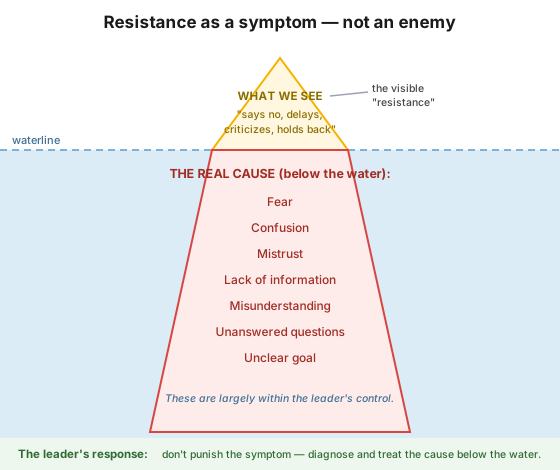
Figure 1 — above the waterline only the visible behavior appears (“says no, delays, criticizes, holds back”); the real cause is below the water. The leader’s job is not to punish the symptom but to address the root cause.
Who is this for?
Section titled “Who is this for?”This article is for those who lead change or work in the middle of one: shift supervisor · plant manager · process engineer · project manager · Lean/CI specialist · HR and organizational development · HSE · senior executive.
Learning objectives
Section titled “Learning objectives”After reading this article you will be able to:
- explain why resistance is a symptom and not a cause, and list the seven recurring root causes;
- recognize why labeling someone a “resister” is harmful and self-deceiving;
- refute the “the crowd resists” myth, and name where change actually stalls;
- match a concrete resisting behavior to its likely root cause and the intervention that fits it;
- draw the line: when resistance is not merely a symptom to be managed (a legitimate concern, a safety stop).
The essence
Section titled “The essence”- Resistance is a symptom, not a cause: behind it stand fear, confusion, mistrust, lack of information, misunderstanding, an unanswered question or an unclear goal.
- To label = to blame: the “resister,” “obstacle,” “roadblock” label paints a good-versus-bad battle, and hides the leader’s own lack of influence.
- The “the crowd resists” myth: change most often loses momentum in the middle-management layer, not on the front line.
- The most common reason behind a middle manager’s reluctance: senior management itself is unwilling to change (it does not “walk the talk”).
- Change begins with me (change begins with me): the leader first examines their own behavior.
- We resolve the symptom through the root cause: trust, vision, understanding, transparency and involvement, through the four pillars of the influence model.
Why does it matter? (the stakes)
Section titled “Why does it matter? (the stakes)”Roughly 70% of Lean and organizational transformations fail to reach their goal. Among the most common causes of failure it is not technology that stands out but two human factors: senior management behavior does not support change and employee resistance. Alongside the other pitfalls (too few resources or too little budget, other obstacles), these two are the most stubborn.
The stake, then, is not abstract: if the leader misdiagnoses the resistance and sees “stubborn people” where there is really an unanswered question or missing trust, then even the best technical improvement stalls. Reading resistance correctly is therefore not a “soft” skill but one of the decisive conditions for the change to succeed.
Why is it a symptom, and not a cause?
Section titled “Why is it a symptom, and not a cause?”In short: because the visible resisting behavior always conceals a deeper, unspoken cause, and in most cases that cause is within the leader’s control. “Employee resistance” is therefore a misleading label. Behind it lie seven recurring root causes (resistance is a symptom of…):
- Fear: of losing status, competence, the familiar role;
- Confusion: it is not clear what to expect;
- Mistrust: the memory of earlier initiatives that ended in failure;
- Lack of information: valid, timely, reliable data is missing;
- Misunderstanding: the message did not arrive the way it was intended;
- Unanswered questions;
- Unclear goal: there is no attractive, comprehensible end state.
The decisive insight: these root causes are largely within the control of the person leading the change. Lack of information is resolved by transparent, two-way communication; an unclear goal by a clear vision; mistrust by the leader’s consistent, predictable behavior. That is why handling resistance is primarily a leadership task, not an employee task.
It follows that labeling someone a “resister,” an “obstacle” or a “roadblock” is harmful in two ways. First, nobody likes these labels: they carry the connotation of a good-versus-bad battle, in which the leader stands on the “good” side and the employee on the “bad.” Second, the label hides the leader’s own responsibility. Instead of asking “what did I fail to get across, what did I fail to communicate, which concern did I leave unaddressed?”, it shifts the problem onto the other person.
Resistance as a signal — a concern that went unheard
Section titled “Resistance as a signal — a concern that went unheard”If resistance is a symptom, then it carries information: an unspoken but often entirely legitimate concern. The operator who refuses to use the new performance board may not be stubborn but simply does not understand what it is for, or fears it will be used to hold things against them. The shift that balks at introducing a new standard may see a real practical problem the designers overlooked.
In this sense resistance is a diagnostic signal: it shows where the case for change is weak, where trust is missing, where the goal is unclear. For the leader this is not an obstacle but free feedback — provided they listen to it rather than suppress it.
Human reactions to change follow a natural, predictable arc: from the comfort and control zone, through the fear–anger–resistance stage, on to questioning and experimenting, and then toward learning, acceptance and commitment. Passive or active resistance is a normal, early stage of this arc, not a failure of the process. This curve is discussed in detail in the change curve article.
The key point: the appearance of resistance does not mean something has broken, but that the change has touched people. The question is not how to make the resistance go away, but what it is telling us, and how to help people through it.
Where does change stall? — the middle-management myth
Section titled “Where does change stall? — the middle-management myth”In short: not on the front line but at the leadership. One of the most stubborn misconceptions is that “the crowd resists,” that the problem lies with the front-line workers. This, however, is a fallacy (that is a fallacy). Change typically loses momentum in two places, and both are at the leadership:
- The change leaders themselves are not truly willing to change. Senior management issues the message but does not adjust its own behavior to match — the “not walking the talk” phenomenon.
- The initiative runs out of steam in the middle-management layer. The middle manager is ground between two millstones, and often fails to carry the change forward because no example is set above them either. The most common reason a middle manager does not support the change: the top level itself is unwilling to change.
It is important, however, that the middle manager is not a helpless victim: a good middle manager can lead the change even without strong role-modeling from above, if they believe in the vision, set an example themselves, hold people to account, communicate and clarify the goal for their team. Responsibility is therefore shared, but the focus is clearly on leadership behavior, not the front line’s “stubbornness.”
How do we handle it? — from symptom to root cause
Section titled “How do we handle it? — from symptom to root cause”In short: do not label the person; diagnose the cause behind the symptom, and address that with the evidence that fits it. This approach reframes resistance: the employee is not an enemy but someone with an unaddressed concern.
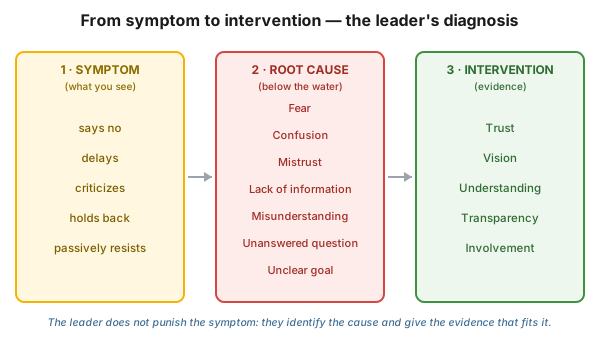
Figure 2 — the diagnostic chain: behind the visible symptom (1) lies a root cause (2), which the leader addresses with the evidence that fits it (3). The goal is not to punish the behavior but to name and dissolve the cause below the water.
The four kinds of evidence that lead to acceptance
Section titled “The four kinds of evidence that lead to acceptance”The key is simple: effective leaders provide evidence for people to accept the change. Instead of mere persuasion, four (plus one) tools tip rejection over into acceptance:
| Evidence | What it means | Why it works |
|---|---|---|
| Trust | the leader earns trust before leading people through the change | “trust is the one thing that changes everything” (Stephen M. R. Covey) |
| Vision | an attractive, imaginable end state | until people see the goal and feel enthusiasm for it, they will be reluctant to set out; a vision is not conveyed by PowerPoint |
| Understanding | valid, timely, reliable information | communication is a two-way conversation, not a one-way announcement |
| Transparency | the real story, not a censored PR message | people sense when they are given an “edited” picture, and lose trust |
| Involvement | a genuine invitation to co-create the solution | nobody likes being “made to drink the Kool-Aid”; whoever takes part in the cooking is not an adversary |
The root tool: start with behavior
Section titled “The root tool: start with behavior”Jon R. Katzenbach’s principle turns the usual logic on its head: “Start with changing behaviours, not mindsets. It is much easier to act your way into new thinking than to think your way into new actions.” That is, we do not first convince people so that they then act differently; rather, the performance that comes from repeated, consistent behavior reshapes feelings, thoughts and beliefs over the long run. For the details, see the Lean as behavior change article.
Introduction in practice (roadmap)
Section titled “Introduction in practice (roadmap)”The next time you run into “resistance,” do not try to change the person. Follow these six steps:
- Name the concrete behavior, not the person. “Joe doesn’t fill in the performance board,” not “Joe is a resister.” Behavior can be diagnosed; a label closes the diagnosis down.
- Look at yourself first (change begins with me). Ask: “What do I myself need to do differently to inspire others to change?” Without visible, genuine personal change there is no credible organizational change (see change begins with me).
- Diagnose the root cause. Which of the seven is it? Fear? Lack of information? An unclear goal? The intervention differs by cause: lack of information → transparent, two-way communication; unclear goal → a clear, attractive vision; mistrust → consistent, predictable leadership behavior.
- Give evidence for acceptance: trust, vision, understanding, transparency (see the table above).
- Involve as many people as possible from the front line in the change (involving as many people as possible from the line). Whoever is part of the solution is not its adversary.
- Start with behavior (Katzenbach): make the new action easy, and let performance shape the thinking.
Together these six steps operate the four pillars of the influence model: Understanding & Commitment, Capability Building, Role Modeling & Leadership, Aligned Systems & Structures. This is the systemic frame for handling the symptom.
Hands-on part — the six scenarios
Section titled “Hands-on part — the six scenarios”A group exercise that is easy to run, one a shift supervisor could have their team do tomorrow. Form 6 small groups, each gets a real situation, and has to draw up an action list against the four pillars of the influence model (“how do you convince them to act differently?”):
| # | Scenario | Which cause is suspected? |
|---|---|---|
| 1 | In plant “A,” the shift supervisor refuses to use the performance board | unclear goal / fear of being held to account |
| 2 | In plant “B,” shift 3 doesn’t want to cut stripping-steam consumption | lack of information / quality fear |
| 3 | In the central workshop, Mr. Smith won’t cooperate in the mixed team | mistrust / unanswered question |
| 4 | In plant “C,” the plant manager doesn’t want SOPs, doesn’t assign the task | unclear expectation / the missing “why” |
| 5 | In plant “D,” the operator doesn’t use personal protective equipment | misunderstanding / mistrust |
| 6 | At a logistics site, the terminal manager doesn’t want to increase the loading speed | fear / unanswered question |
Homework. Choose a recurring “resistance” from your own area, describe the visible behavior, guess the likely root cause, and assign to it one concrete intervention from among the four kinds of evidence that you will try out next week.
Process-industry context and safety
Section titled “Process-industry context and safety”In an operating environment, “resistance” is rarely ill will. A few typical situations known from practice:
- A shift refuses to cut stripping-steam consumption. On the surface, stubbornness; below the water, often that they do not understand the why, or fear that product quality will suffer. Clarifying the goal and providing proof (measurement data) resolves it.
- The shift supervisor is reluctant to use the performance board. Behind it is often the fear that the board serves to hold people to account rather than to improve, or simply that they were never trained on it (a lack of capability building).
- An operator does not write SOPs, does not do autonomous maintenance. An unclear expectation or a missing why, not defiance.
Common mistakes
Section titled “Common mistakes”Every mistake turns one of the article’s claims on its head. The pattern: anti-pattern → why it’s a problem → correct practice.
- Labeling. “He’s a resister.” → With this the leader closes the diagnosis down and shifts away their own responsibility. → Instead: name the concrete behavior, and ask what cause lies behind it.
- Punishing the symptom. We sanction the behavior instead of uncovering the root cause. → The resistance goes underground (turns passive) but does not disappear. → Instead: diagnose and address the cause.
- Blaming the “crowd.” We blame the front line. → While the change actually fails at middle management or on the missing example from the top. → Instead: examine leadership behavior and walking the talk first.
- A lack of walking the talk. The leader asks for change but does not adjust their own behavior. → This is the most common deeper cause; people sense that it is “not serious.” → Instead: show visible, personal change (change begins with me).
- Persuasion without proof. We push the message without vision, understanding and transparency. → People stay reluctant, with good reason, and feel it as manipulation. → Instead: give evidence (trust, vision, understanding, transparency) and involve them.
When NOT to use it? (limits of the frame)
Section titled “When NOT to use it? (limits of the frame)”The “symptom, not cause” frame is powerful, but it must not be debased into a justification for manipulation. There are times when resistance is not a symptom to be managed:
| Situation | Why “treat the symptom” is NOT the answer | The right response |
|---|---|---|
| The resistance is a legitimate, valid concern: the change itself is flawed or risky | it is not the person who needs “convincing,” it is the decision that needs fixing | listen to the concern, and modify the change |
| A safety or ethical stop: someone refuses to carry out an unsafe instruction | this is not “resistance to overcome” but a valid stop | support the stop, analyze the risk |
| Persistent, deliberate sabotage even after genuine handling | the diagnosis was made, the cause addressed, yet deliberate obstruction remains | this is now a performance and consequence matter, not coaching |
| The leader uses the “it’s just a symptom, I’ll coach it out” move to force through their own bad decision | a self-deceiving abuse of the frame | look at yourself (change begins with me), review the decision |
Rule of thumb: the frame is for understanding the resistance, not for ignoring the truth contained in it. If the concern is legitimate, the right response is to modify the change, not to suppress the symptom.
Take it home (keys)
Section titled “Take it home (keys)”- Resistance is a symptom, not a cause — behind the visible behavior there is always a deeper, often legitimate concern.
- Most of the causes are in your hands — information, vision, trust: the responsibility is the leader’s, not the “stubborn” person’s.
- Don’t label, diagnose — name the concrete behavior, and look for the real one among the seven causes.
- Change stalls at the leadership — at the middle manager and on the missing walk the talk from the top, not on the front line.
- Give evidence, not persuasion — trust, vision, understanding, transparency, involvement.
- Start with behavior, and with yourself — act your way into new thinking, and change begins with me.
Self-test
Section titled “Self-test”- List at least five of the seven root causes that can lie behind resistance, and say why they are “within the leader’s control.”
- Why is it a misconception that “the crowd resists,” and where does change actually stall? What is the most common reason for it?
- Give a concrete example of when resistance is not a symptom to be managed but a legitimate signal, and what the right leadership response is in that case.
How does it appear in digital practice?
Section titled “How does it appear in digital practice?”The symptom-nature of resistance does not stop at the level of conversation: the same logic can be supported in software too. In a well-designed digital operation, the system helps the root cause, rather than the surface behavior, become visible and trackable — the mechanism differs, the principle is the same.
| Element of the concept | Digital implementation | The value |
|---|---|---|
| Recording the symptom | a structured handover / log field for the “what was not done and why” entry | instead of the surface complaint, the concrete cause gets written down |
| Making the root cause visible | surfacing a recurring pattern from the log (the same obstacle multiple times) | it can be decided whether the concern is systemic or one-off |
| Two-way communication | a logged feedback and question channel, to which an answer is also recorded | the “unanswered question” as a cause is visibly closed out |
| Involvement | action assignment by name, with joint closure | whoever takes part in the solution is not an adversary |
| Transparency | a searchable trail of decisions and their reasons | mistrust decreases, there is no “censored” story |
Connection to OPEREX (shift diary)
Section titled “Connection to OPEREX (shift diary)”The real cause behind surface resistance (an unclear expectation, an unanswered question, an unaddressed concern) most often surfaces at the shift handover and the daily review (“shift 3 didn’t do it again…”). If this is recorded in the OPEREX shift diary (who, what, why not), the leader sees the root cause instead of the symptom, and can trace it back to the right intervention (information, training, clarifying the goal). The recorded, recurring pattern is at the same time an objective signal of whether the concern is systemic, and forms an auditable trail (ISO 45001 §8.1.3 Management of change) of how the change was handled.
Terminology (HU / EN / JP)
Section titled “Terminology (HU / EN / JP)”| Hungarian | English | Japanese |
|---|---|---|
| Ellenállás (a változással szemben) | Resistance (to change) | 抵抗 (teikō) |
| Tünet | Symptom | 症状 (shōjō) |
| Kiváltó ok / gyökérok | Root cause | 根本原因 (konpon gen’in) |
| Bizalom | Trust | 信頼 (shinrai) |
| Példamutatás (vezetői) | Role modeling | 率先垂範 (sossen suihan) |
| „A változás velem kezdődik” | “Change begins with me” | — |
“Teikō” (抵抗) in technical language also means “resistance” (for example electrical); in the change-management context it is used in the sense of “psychological/organizational resistance.”
Why is resistance to change a symptom, and not a cause?
Because behind it there is always a deeper root cause: fear, confusion, mistrust, lack of information, misunderstanding, an unanswered question or an unclear goal. The resisting behavior itself is only their visible sign; the solution is to address the root cause, not to punish the behavior.
Where does organizational change most often stall?
Not at the front-line “crowd” but in the middle-management layer, and the most common reason for this is that senior management itself sets no example (“does not walk the talk”). The responsibility is primarily the leadership’s.
Why is it harmful to label someone a "resister"?
Because the label paints a good-versus-bad battle, and hides that most of the root causes of resistance are within the leader’s control. Labeling is really the shifting of the leader’s own inability to influence onto the employee.
How should a leader handle resistance in practice?
First they look at themselves (“what do I need to do differently?”), then they diagnose the cause behind the symptom and address it: with trust, an attractive vision, valid information and transparency, while involving as many people as possible. They start from the behavior side (Katzenbach), and operate the four pillars of the influence model.
Is resistance always a bad sign?
No. Resistance is a normal, early stage of the human reaction to change, and it often carries a legitimate concern. If the concern is true (the change itself is flawed or risky), the right response is to modify the decision, not to suppress the symptom.
Related concepts
Section titled “Related concepts”change-curve · behaviour change · the influence model · change starts with me · the change formula · the trust model · the iceberg model · Lean leadership
Next step
Section titled “Next step”If you have understood this, from here it is worth going on, in this order:
- change-curve — the full arc of the human reaction to change; you will understand that resistance is a normal, early stage of it, not a failure of the process.
- the influence model — the four pillars (understanding, capability, role modeling, systems) with which you address the cause behind the symptom at a systemic level.
- change starts with me — the principle of leadership self-examination: credible organizational change begins with your own behavior.
References / Further reading
Section titled “References / Further reading”- Stephen M. R. Covey: The Speed of Trust: The One Thing That Changes Everything. Free Press, 2006 — trust as the basis of acceptance (the source of “trust is the one thing that changes everything”).
- Jon R. Katzenbach, Ilona Steffen and Caroline Kronley: Cultural Change That Sticks. Harvard Business Review, 2012 — “act your way into new thinking,” the behavior-first principle.
- John P. Kotter: Leading Change. Harvard Business Review Press, 1996 — leading organizational change and the sources of resistance.
- Kübler-Ross change curve — the arc of the emotional reaction to change (discussed in detail in the change curve article).