The Lean navigator and the transformation team — internal change agents
≈ 19 min read · 3,702 words
When you go to driving school, at first the instructor sits beside you with the dual pedals. But the goal is not for them to sit there forever; it is for you to drive alone, confidently, one day. In a Lean transformation the stakes are exactly this: who is at the wheel when the external consultant leaves? If no one, a year later everything slides back to the old ways. The answer is the navigator: an internal change agent selected and trained from within the organization, who takes the wheel and teaches the others to “navigate alone” too. Let’s look at who they are, why it works, and how a whole transformation team is built around them.
The Lean navigator is an internal change agent, selected and trained from within the organization, who leads improvements and spreads the Lean culture. Their task is twofold: they are at once the engine of change (driving improvements, challenging the status quo) and a carrier of the culture (coaching leaders and colleagues). Effective navigating requires three things: skill (knowledge of the Lean tools), standing (authority and credibility with colleagues) and energy (the persistence to drive change). A critical mass of navigators makes the transformation self-sustaining and scalable, without lasting dependence on external consultants, reaching the point where the organization “navigates alone” (navigate alone).
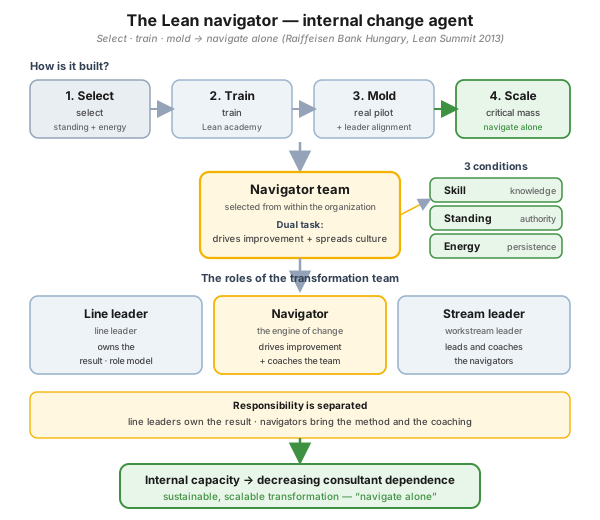 Figure 1 — the navigator model: the path of building the internal change agent (select → train → mold → scale), the three conditions (skill, standing, energy), the roles of the transformation team (line leader, navigator, stream leader) and the separation of responsibility, reaching the self-sustaining “navigate alone” state.
Who is this for?
Section titled “Who is this for?”This article is for those who are planning, leading or working within a Lean/OE transformation: plant manager · shift supervisor · process engineer · Lean/CI specialist · HR / training lead · program manager (PMO) · senior executive launching a transformation · aspiring navigator.
Learning objectives
Section titled “Learning objectives”After reading this article you will be able to:
- explain who the navigator is, and what their twofold task is (leading improvement + spreading culture);
- list the three conditions of a good navigator (skill, standing, energy), and justify why all three are needed;
- walk through the path of building a navigator (select → train → mold → scale) and the See → Do → Teach maturity ladder;
- distinguish the roles of the transformation team (line leader, navigator, stream leader), and say who owns the result and who brings the method;
- recognize when the navigator program is NOT the right answer.
The essence (TL;DR)
Section titled “The essence (TL;DR)”- The navigator = an internal change agent selected, trained and “molded” from within one’s own organization (select, train, mold).
- Twofold task: they lead improvements AND spread the culture, so they are not merely an analyst but the engine of change.
- Three conditions: skill (knowledge), standing (authority/credibility) and energy (persistence) — all three are needed.
- Builds internal capacity: dependence on external consultants decreases, the transformation becomes sustainable.
- A Lean academy institutionalizes the training and harmonizes the tools and methods (otherwise they drift apart).
- Maturity: across the waves the navigator develops in the See → Do → Teach direction, while the organization “navigates alone.”
- Separation of responsibility: the line leader owns the result, the navigator brings the method and the coaching.
Why does it matter? (the stakes)
Section titled “Why does it matter? (the stakes)”The stake is whether the improvement slides back. A top-down, hard cost-cutting program brings results quickly, but if no internal capability is built alongside it, the “fat grows back”: the savings evaporate within a few years, the cut cost stagnates, the squeezed-down inventory creeps back up. The navigator is precisely what prevents this slide-back.
The difference is decided between the two kinds of end state:
| The “treadmill” | The “Holy Grail” | |
|---|---|---|
| What happens | the result is achieved once, then slowly lost | the mindset and behavior continuously multiply the impact |
| What it stems from | a one-off, top-down intervention | a built-in organizational capability for continuous improvement |
| Who sustains it | no one — the momentum runs out | the critical mass of internal navigators |
That is why the internal change agent is not a luxury but the precondition of sustainability. In a large organization the navigators can reach into the hundreds, and the transformation becomes self-propelled when the organization “navigates alone” even without external help. The key to the return is not the one-off result, but that the impact keeps growing by itself.
Who is the Lean navigator, and what is their role in the transformation?
Section titled “Who is the Lean navigator, and what is their role in the transformation?”The navigator is the engine of the transformation: a credible person who came from within, who leads improvements while spreading Lean thinking. They are not an external expert but a person from the organization itself, who is selected, trained and “molded” (select, train, mold). This internal origin is the point: the navigator knows the process, colleagues accept them, and the change is not “imposed on us from outside” but “we do it ourselves.”
The navigator challenges the status quo (“we’ve always done it this way,” “we always will”), hunts for waste, explains the necessary changes, independently applies the Lean methodology, and coaches middle managers and colleagues. In practice, in process industries the role is often filled by shop-floor people, for example shift supervisors or process engineers, who lead the improvements at the level of the gemba. Their credibility stems from operational experience, which is key to getting safety and production improvements accepted: a shift supervisor who knows a unit well is a more convincing change agent than a consultant arriving from outside.
What are the three conditions of a good navigator?
Section titled “What are the three conditions of a good navigator?”A good navigator must possess knowledge, authority and energy at the same time: the lack of any one of the three paralyzes the coaching. These three are summarized by the model:
| Condition | English | What it means | What happens if it is missing |
|---|---|---|---|
| Knowledge | Skill | knows the Lean tools and the methodology | chooses the wrong tool, cannot coach |
| Authority | Standing | credible, accepted by colleagues | the coaching has no effect, the suggestion is brushed off |
| Energy | Energy | persistence, momentum to drive the change | at the first resistance the initiative dies |
Standing is critical because coaching is a relationship of trust: if the team does not accept the navigator, it does not matter that they know the method. That is why, in selection, credibility and energy weigh at least as much as existing Lean knowledge, which the training provides anyway.
How is a navigator built? (select → train → mold → scale)
Section titled “How is a navigator built? (select → train → mold → scale)”A navigator is not recruited ready-made but built step by step: selected, trained, molded on real ground, then scaled into a critical mass. The four steps:
- Select. From within, based on credibility and energy. Lean knowledge can be supplied; authority and momentum are hard to replace.
- Train. In a structured way, within a Lean academy that institutionalizes the training and harmonizes the tools and methods, so the teams do not drift apart.
- Mold. Give a real pilot where the navigator practices live, and align them with the leaders (alignment). Knowledge solidifies in the field, not in the classroom.
- Scale. A critical mass of navigators carries the transformation forward independently, reaching the “navigate alone” state.
As the waves follow one another, the navigator’s maturity also grows: by the See → Do → Teach logic they first see the method in operation and learn the basics (see), then apply it independently (do), and finally teach and spread the knowledge (teach). As the navigators reach the “do” and “teach” levels, the role of external support shifts from direct doing toward coaching and quality assurance, and 3 navigators per unit already suffice.
Who makes up the transformation team?
Section titled “Who makes up the transformation team?”The transformation is not a single role but a cast, in which it is sharply separated who owns the result and who brings the method. The most important roles:
| Role | English | Main task |
|---|---|---|
| Line leader | line leader | Owns the result of the Lean introduction in their own unit; treats it as a priority; is a role model (present, interested, cooperative); changes their own mindset as well. |
| Experienced navigator | experienced navigator | The engine of change: drives the improvement, hunts for waste, applies the methodology independently, and coaches middle managers, colleagues and the new navigators. |
| New navigator / local champion | new navigator / local champion | Learns to recognize waste, masters the Lean tools, and spreads the new thinking in their own unit. |
| Stream leader | workstream leader | Leads the team’s work (plans, assigns, tracks), ensures a timely, high-quality result, and coaches the navigators (regular feedback). |
The key is the separation of responsibility: the line leader owns the result, the navigator brings the method and the coaching. If this boundary blurs — the navigator “takes over” responsibility for the result from the leader — the leader backs out, and the improvement dies when the navigator leaves.
A day in a navigator’s life — field and teamwork
Section titled “A day in a navigator’s life — field and teamwork”The navigator’s day starts on the gemba, not in the office. A typical day combines fieldwork and teamwork: in the morning the navigator goes out with the operators or the maintenance staff to their daily tasks, analyzes waste (e.g. wrench-time), gathers ideas for process improvement, and tests the new solutions live with the team. Afterwards they coordinate with the process owner and the navigators, coach the leader for the weekly performance dialogue, run an idea-generation workshop, and finally coach the other navigators. The emphasis is on the navigator working together with the blue- and white-collar colleagues, on site, not from behind a desk.
Where does the navigator fit into the Lean transformation?
Section titled “Where does the navigator fit into the Lean transformation?”The navigator works on each of the three Lean lenses, and the organization shapes all three starting from the voice of the customer (VOC). The three lenses:
- Operating System (OS) — how the process is designed to create value (process simplification, standard work, 5S).
- Management Infrastructure (MI) — the formal systems through which the process is managed (cascaded KPIs, performance boards, daily meetings, performance dialogue).
- Mindset & Behaviours (MB) — how people think and behave (the part of the iceberg below the water).
Durable change “sticks” when all four elements are present together: conviction (why), role modeling, formal mechanisms (tools, systems) and capability building. Capability building is itself staged: the five levels of learning lead from unconscious incompetence through conscious incompetence and conscious competence to unconscious competence (the ingrained routine), and the navigator takes the team all the way up this ladder.
Introduction in practice (roadmap)
Section titled “Introduction in practice (roadmap)”Building a navigator program with source-faithful logic:
- Select credible, energetic people from within your own organization — let standing and energy be the main criteria.
- Build a Lean academy: institutionalize the training, and harmonize the tools so that every navigator speaks the same language.
- Launch a real pilot where the navigators practice live, alongside experienced navigators and line leaders.
- Align with the leaders (alignment): the line leaders own the result and set an example; senior management visibly supports the program (“be there, praise the teams, drive for the result”).
- Scale and lock in: take the navigators through the See → Do → Teach ladder; spread the proven pattern to further units, and refine it with the PDCA cycle, until the organization “navigates alone.”
Hands-on / mini-scenario
Section titled “Hands-on / mini-scenario”This is how you would launch a navigator tomorrow. Choose a painful, recurring problem on a unit (e.g. a long, unpredictable shift handover). Designate a credible shift supervisor who knows the area as the navigator. In the first week let them go out to the gemba and analyze the waste with the team (where time is lost, where there is unnecessary administration). In the second week let them run a short idea-generation workshop where the team itself proposes a solution, and try out a standard. Meanwhile the stream leader coaches the navigator, and the line leader owns the result and is present. The goal is not a single improvement, but that the navigator carries the pattern over to the next area with more confidence.
Homework. Name a potential navigator from your own organization. Write down which condition (skill / standing / energy) is strongest in them, which is weakest, and how you would make up for the missing one (with training, a pilot, a mentor).
Measurement / audit
Section titled “Measurement / audit”The health of a navigator program is measured not only by the number of improvements but by the built-in capability:
- The number and maturity of trained navigators (how many are at the “see,” “do,” “teach” level) — progress toward critical mass.
- The self-reliance of the transformation: how much external support is still needed, and in what role (direct doing vs. coaching/QA).
- Sustainability: whether the result of earlier waves is retained (whether the “fat” slides back), and whether the improvements keep growing by themselves.
- Coaching intensity: the navigator’s actual field and coaching time relative to administration (the goal is high gemba presence).
The target-value logic: the goal is not the number of improvements, but that the organization itself be able to continuously improve — this is “navigate alone.”
Common mistakes
Section titled “Common mistakes”- Only an external consultant, without an internal navigator. The consultant gives an initial push. Why it’s a problem: without internal capacity the change dies when the contract expires, the “fat” grows back. Instead: the consultant’s task is building the navigators, not doing the work for them.
- Selecting a navigator without standing. Their knowledge is good, but they are not accepted. Why it’s a problem: in the absence of standing the coaching has no effect, the suggestion is brushed off. Instead: the main criterion of selection is credibility and energy; the Lean knowledge is provided by the training.
- Training without a system. Ad-hoc, person-by-person differing knowledge. Why it’s a problem: without a Lean academy the tools and methods drift apart, there is no common language. Instead: institutionalized, harmonized training.
- Blurred responsibility. The navigator “owns” the result instead of the line leader. Why it’s a problem: the leader backs out, responsibility blurs, and the improvement dies when the navigator leaves. Instead: the leader owns the result, the navigator brings the method and the coaching.
- An auditor’s stance instead of a coach’s. “I want to catch you.” Why it’s a problem: the team hides the problems, does not bring them to the surface. Instead: a coach’s stance — “I want you to succeed,” in the field, with feedback.
- Launching without leadership support. Senior management does not set an example, middle management is in the way. Why it’s a problem: the navigator alone cannot carry the change through the organizational resistance. Instead: visible leadership commitment and role modeling — without it the program does not survive.
When NOT to use it? (limits of the method)
Section titled “When NOT to use it? (limits of the method)”The navigator model is a tool for a durable cultural change, but it is not for every situation:
| Situation | Why (primarily) not the navigator program | The right answer |
|---|---|---|
| Fixing a one-off, technical fault | an isolated problem does not require a culture-building program | targeted expert intervention, root-cause analysis |
| Leadership is not committed / not willing to set an example | the navigator alone will not carry the change through the organizational resistance | first win leadership commitment, alignment |
| A very small organization | the critical-mass logic does not scale down meaningfully | training a few key people, not a separate navigator layer |
| The goal is replacing line responsibility | the navigator brings the method, not responsibility for the result | the leader owns the result; the navigator coaches |
Rule of thumb: the navigator is strongest when internal, credible and supported by leadership; for a one-off technical fix or with uncommitted leadership, this is not the right tool.
Take it home (keys)
Section titled “Take it home (keys)”- The stake is the slide-back: without an internal navigator the “fat” grows back; the navigator makes the improvement self-sustaining.
- Select from within, don’t substitute from outside: train the credible, energetic person in Lean knowledge, not the other way round.
- Skill + standing + energy: all three are needed; without standing the coaching has no effect.
- See → Do → Teach: take the navigator through the maturity ladder, until the organization “navigates alone.”
- Who owns the result? The line leader. The method and the coaching belong to the navigator; do not blur the two.
- Coach, not auditor: “I want you to succeed,” in the field, with feedback.
Self-test
Section titled “Self-test”- What is the navigator’s twofold task, and why is it not enough if someone does only one of them (leading the improvement)?
- Of the three conditions (skill, standing, energy), which one’s absence paralyzes the coaching the most, and why?
- In a transformation the navigator “takes over” responsibility for the result from the line leader. Why is this dangerous, and where should the boundary run?
How does it appear in digital practice?
Section titled “How does it appear in digital practice?”The navigator’s work does not stop on the gemba: the trail of the improvements, the coaching and the capability building can be recorded and followed digitally too. Instead of the paper board and the idea list kept in one’s head, here digital action tracking, a coaching log and a skills matrix make the transformation visible and sustainable — the mechanism differs, the principle is the same.
| Navigator principle | Digital implementation | What it delivers |
|---|---|---|
| Leading improvement | digital action/idea register (owner, deadline, status) | not a single improvement is “lost” |
| Coaching and feedback | logged coaching conversations, development plan | the coaching is auditable, trackable |
| Capability building | digital skills matrix (current / target level) | it is visible where everyone stands on the See → Do → Teach ladder |
| Performance dialogue | digital KPI board, recorded daily/weekly dialogue | the leader-coaching becomes routine |
| Sustainability | tracking the result of the earlier waves | it becomes apparent if the “fat” would grow back |
Connection to OPEREX (shift diary)
Section titled “Connection to OPEREX (shift diary)”The trail of the improvements and coaching interventions led by the navigators can be logged in the shift diary (OPEREX), so it becomes auditable which improvements were started, who coached and with what result. The log kept shift by shift also shows whether the result of the earlier waves was retained or slid back — this is an early signal of the “fat grows back” risk, and documented proof of continuous improvement.
Terminology (HU / EN)
Section titled “Terminology (HU / EN)”| Hungarian | English | Note |
|---|---|---|
| Lean navigátor | Lean navigator / change agent | internal change agent |
| Tekintély | Standing | the basis of credibility, the precondition of coaching |
| Lean akadémia | Lean academy | the institution of training, the harmonization of tools |
| Helyi bajnok | local champion | a unit-level new navigator |
| Stream leader | workstream leader | the role that leads and coaches the navigators |
| Egyedül navigálni | navigate alone | the self-sustaining state, without external help |
| Lásd → csináld → tanítsd | see → do → teach | the navigator’s maturity ladder |
Who is the Lean navigator?
An internal change agent selected and trained from within the organization, who leads improvements and spreads the Lean culture. Not an external consultant but a credible person who came from within, the engine of the transformation.
Why is it worth training internal navigators instead of external consultants?
Because internal navigators are credible and have local knowledge, so they make the transformation sustainable and scalable. The external consultant gives an initial push, but the durable cultural change requires internal capacity; without it the “fat” grows back.
What are the three conditions of a good navigator?
Skill (knowledge of the Lean tools), standing (authority and credibility with colleagues) and energy (the persistence to drive change). All three are needed; the lack of standing paralyzes the coaching.
What is the difference between the responsibility of the navigator and the line leader?
The line leader owns the result in their own unit, and sets an example. The navigator brings the method and the coaching. If this boundary blurs, the leader backs out, and the improvement dies when the navigator leaves.
What does "navigate alone" mean?
The self-sustaining state in which the organization, with a critical mass of navigators, is able to continuously improve even without an external consultant. By then the navigators have reached the “teach” level on the See → Do → Teach ladder.
Related concepts
Section titled “Related concepts”the transformation journey · the diagnose phase · change-curve · Lean leadership · learning organization · the three lenses · gemba-walk · pdca · standard work
Next step
Section titled “Next step”If you have understood this, from here it is worth going on — in this order:
- the transformation journey — the full transformation path (diagnosis → design → pilot → scaling) within which the navigator works. Start with this: you will understand the frame around the role.
- change-curve — the change curve: which emotional stages the transformation takes you through (shock → denial → acceptance → success), and how the navigator handles it.
- Lean leadership — the leadership side: how the line leader sets an example, and what makes an inspector into a coach.
References / Further reading
Section titled “References / Further reading”- James P. Womack – Daniel T. Jones: Lean Thinking: Banish Waste and Create Wealth in Your Corporation. Simon & Schuster, 1996. — the canonical foundational work on the Lean principles and the transformation, including the role of the “change agent.”
- John P. Kotter: Leading Change. Harvard Business Review Press, 1996. — the classic of organizational change leadership (the eight steps of urgency, coalition and anchoring).
- Mike Rother: Toyota Kata: Managing People for Improvement, Adaptiveness and Superior Results. McGraw-Hill, 2009. — building in the coaching kata and the improvement routines — the methodological background of the navigator’s coaching role.