Lean anti-patterns — how NOT to "do lean" (and why transformations fail)
≈ 17 min read · 3,351 words
Recognize the January gym membership? You buy it (that’s the tool), you go eagerly for the first two weeks, then by February the whole thing lapses, because your daily habits and your attitude never changed. Most failed Lean rollouts look exactly like this: the tools (5S, Kaizen, VSM) are handed down from above, some results show in the first months, and then everything reverts. Let’s look at why this happens, what its tell-tale sign is, and how the people who make the impact stick actually do it.
Lean most often fails when it is introduced as a tool and top-down, without the genuine commitment of the workforce and the leaders. The tell-tale symptom of such a tool-based rollout is zero sustainability: the initial result reverts once the momentum fades, because the supporting culture is missing. Lean is not the installation of a toolkit but a change of culture and mindset: the lasting impact starts from the problem, not from the tool.
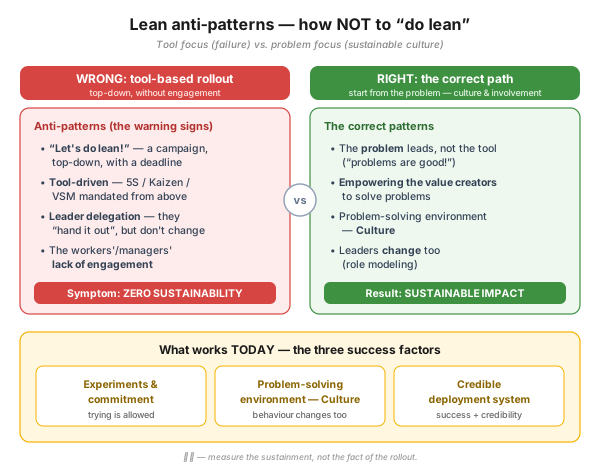 Figure 1 — on the left the wrong, tool-based, top-down rollout with the symptom of zero sustainability; on the right the correct path: the problem leads, the leaders change too, and the impact is retained. Below, the three factors that genuinely work.
Who is this for?
Section titled “Who is this for?”This article is for those who plan, lead or live through a Lean or process-improvement rollout: plant and factory manager · shift supervisor · Lean/CI specialist and coordinator · process engineer · project manager · HR and organizational-development specialist · senior executive (sponsor) · operator and maintenance technician who has already seen a “Lean campaign” die out.
Learning objectives
Section titled “Learning objectives”After reading this article you will be able to:
- recognize the four classic anti-patterns of a failing Lean rollout before you run into them;
- distinguish the tool-based from the problem-based rollout, and justify why the latter is more sustainable;
- explain what zero sustainability is, and why it is the earliest measurable sign of failure;
- apply five concrete antidotes that turn a failed rollout into a sustainable one;
- draw the line where formal, “ticked-off” Lean poses a direct safety risk in a process-industry plant.
The essence (TL;DR)
Section titled “The essence (TL;DR)”- Main anti-pattern: a top-down, tool-based “Let’s do lean!” campaign, without genuine commitment.
- Symptom, zero sustainability: the improvement falls back to the starting level after the initial momentum.
- Missing element: the actual involvement (engagement) of the workforce and the leaders.
- Tool vs. culture: the tools (5S, Kaizen, VSM) are superficial without a supporting culture.
- Antidote: start from the problem, not the tool; the leaders too must change their behaviour.
- Measure sustainment, not the fact of the rollout: the retention 3-6 months later is the real result.
Why does it matter? (the stakes)
Section titled “Why does it matter? (the stakes)”A dying Lean rollout is not neutral: it is actively worse than if it had never been started. You spent the training and consulting budget, tied up the time of your best people, and in return the organization learned that “Lean too is just another passing fad.” This cynicism is the most expensive loss: the next initiative, even a well-led one, hits a wall, because people have “already seen this movie.”
In the process industry the stakes are even more concrete. If the safety routines (near-miss reporting, structured shift handover) are also “introduced” only formally, as a box to tick, then the ticked-off but lifeless process gives a false sense of security. The boards are up, yet the willingness to report is zero. That is why sustainability here is not a soft topic but a direct plant-safety question.
Why do Lean transformations most often fail?
Section titled “Why do Lean transformations most often fail?”Because they are introduced as a tool and top-down, without the genuine commitment of the workforce and the leaders. The classic failure scenario consists of a few easily recognizable steps: someone declares “let’s do lean,” draws up a list of the tools, mandates them top-down, and the leaders “hand out” the task without changing their own behaviour. For the worker this is yet another expectation imposed from outside, one they do not identify with.
From the five characteristics of the source (“Let’s do lean!” · tools top-down · Kaizen-5S · the absence of involvement · zero sustainability), the four recurring anti-patterns can be tabled as follows (zero sustainability is discussed separately below, as a symptom):
| Anti-pattern | How you recognize it |
|---|---|
| “Let’s do lean!” | the programme is organized around its name and its deadline, not around a real problem |
| Tool-driven | the tools (5S, Kaizen, VSM) are mandated from above, not selected by the problem |
| Leader delegation | the leaders “hand out” Lean, but do not change their own behaviour |
| No commitment | the workers and the managers do not get involved; participation is formal |
The common denominator of the four anti-patterns is that Lean is treated as a project: it has a start and an end date, it has a tool list, and the measure of success is whether “we introduced it,” not whether it solved a real problem and whether the solution stuck.
What is the difference between the tool and the culture?
Section titled “What is the difference between the tool and the culture?”The tool tells you what to do; the culture tells you how you think about your work. Lean is not the installation of a toolkit but a change of mindset, and the difference between the two decides whether the impact lasts. A tool forced from above as a mandatory task (5S as a one-off “cleaning action,” Kaizen as a box to tick) breeds resistance, because it drives the what and the why behind it is missing.
- Tool-based (bad): “Let’s roll out 5S everywhere by the end of Q3.” The goal is the existence of the tool itself.
- Problem-based (good): “Here is this concrete problem; which tool helps solve it?” The goal is the problem, the tool is only the answer to it.
The lasting result comes from the supporting culture and from genuine commitment, not from the number of tools delivered. In the words of an experienced Lean leader, the essence is the empowerment of the value creators to solve problems, and then the courage to let them work in their own way. The “problems are good” attitude is key here: the trouble that surfaces is not a failure but the raw material of improvement, as opposed to the tool fetish, where the problem is hidden so the metrics stay pretty.
What is “zero sustainability,” and why is it the most tell-tale sign?
Section titled “What is “zero sustainability,” and why is it the most tell-tale sign?”Zero sustainability means that the rollout does bring a short-term improvement, but it does not stick: once the momentum fades, everything reverts to the starting state. This is the earliest measurable sign of failure, because it does not show at the start but a few months later, when the attention moves on.
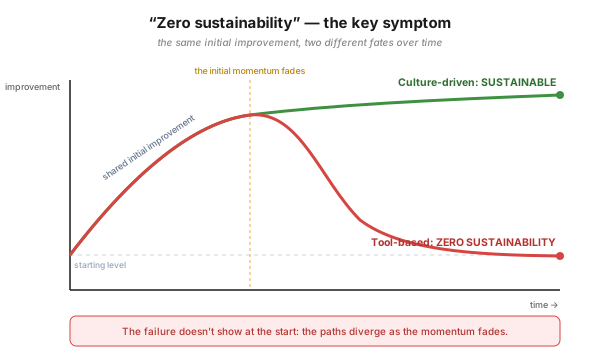 Figure 2 — the two paths rise the same way at first. The tool-based rollout falls back to the starting level as the momentum fades (zero sustainability); the culture-driven one remains and keeps growing. The difference becomes visible not at the rollout, but afterwards.
The relapse reveals that the change happened only on the surface: the visible behaviour and the tool changed for a while, but the layer below the waterline (values, beliefs, habits) did not move. As soon as the external pressure ceases, the old habit takes back the ground, because nothing ever replaced it. That is exactly why it is misleading to celebrate the fact of the rollout: the real question is not “did we start it,” but “is it still there half a year later.”
How can it be reversed? The antidote
Section titled “How can it be reversed? The antidote”What turns a failed rollout into a sustainable one is that you start from the problem, involve the people, and the leaders themselves change too. The antidote is not yet another tool, but a reversal of the logic of the rollout:
- Start from the problem, not the tool. First the real, painful problem; let the tool be selected by the problem, not the other way round.
- The leaders too participate and change (role modeling). Anyone who delegates Lean but does not adjust their own behaviour undermines the whole thing. Leadership by example is the foundation of credibility.
- Create a problem-solving environment. Let the trouble that surfaces be a value, not a shame; give the freedom to experiment, and accept that an attempt sometimes fails.
- Involve everyone (engagement): the actual participation of the workers and the managers, not their formal presence (see the transformation journey).
- Measure sustainment, not the rollout: track what is retained 3-6 months later, and make the deployment system credible by ensuring the decisions are genuinely made at the gemba.
Practical part / mini-scenario
Section titled “Practical part / mini-scenario”This is how you would recognize it tomorrow. Pick a running or past Lean rollout in your own area, and go through it wearing the lens of the four anti-patterns: (1) does it live off its name and its deadline, or off a real problem; (2) were the tools mandated from above, or did the problem select them; (3) did the leaders merely “hand it out,” or did they change their own behaviour too; (4) did the workers and the managers genuinely get involved, or was participation formal. Tick off which is present.
Homework. Wherever you marked at least one anti-pattern, draw the point of sustainment measurement: name a concrete routine (near-miss reporting, shift handover, performance dialogue), and write down where and with what you would measure its retention 3-6 months later (e.g. the weekly number of entries, the proportion of participants). This yardstick is what tells you whether the change really stuck, or whether you merely celebrated the rollout.
Measurement / audit
Section titled “Measurement / audit”Sustainability is decided not at the start but months later, so measure sustainment, not the fact of the rollout:
| What to measure | Good sign | Failure sign (zero sustainability) |
|---|---|---|
| The liveness of the routine 3-6 months later | the number of entries (handover, near-miss, dialogue) is stable or rising | the entries dry up, the routine wears off |
| Involvement | actual, recurring participation of the workers and the leaders | participation is formal, narrowed to one or two people |
| Visibility of problems | issues raised and closed continuously | the problems disappear for the sake of pretty metrics |
| Leadership by example | regular gemba presence, decision on the spot | the leader delegates, their behaviour has not changed |
Target-value logic: the goal is not the number of boards put up or audit sheets filled in, but whether the routine is still alive half a year on. A short, quarterly sustainment audit signals the slip-back earlier than the declining result does.
How does it show up in the process industry?
Section titled “How does it show up in the process industry?”In the process industry the tool-based “Lean campaign” can be not only ineffective but directly dangerous. In a Seveso plant the formal, “ticked-off” introduction of the safety-critical routines gives a false sense of security: the near-miss reporting, the shift handover or the work-permit process exists on paper, while the actual reporting and handover discipline is missing.
- The culture is the yardstick, not the number of boards put up or audit sheets: the real sign is the willingness to report and the liveness of the structured handovers.
- Sustainability here is a direct safety stake: a dying safety routine leads back to the old, riskier practice, while the organization believes it has “introduced” it.
- The layer below the surface (the actual attitude to reporting and to stopping) decides whether the programme protects or merely gives the appearance.
How does it show up in digital practice?
Section titled “How does it show up in digital practice?”The principle of sustainability does not stop at the workshops and the boards put on the wall: the same logic also appears in data. Where the daily routines leave a digital trace, the slip-back of the transformation shows not by feel but measurably; the mechanism is different, the principle is the same.
| The principle of sustainability | Digital implementation | What it makes visible |
|---|---|---|
| Is the routine still alive? | time-series collection of the daily entries (handover, near-miss, dialogue) | if the reports dry up, an early slip-back sign |
| Measuring involvement | who uses a routine, and how often | the formal vs. genuine participation is separated |
| Visibility of problems | tracking of issues/actions raised and closed | whether the “problems are good” culture really works |
| Leadership participation | logging of the leaders’ feedback, gemba entries | role modeling becomes measurable, not just declared |
| Sustainment vs. rollout | trend over 3-6 months, not a one-off snapshot | instead of rollout-celebration, the retention counts |
Connection to OPEREX (shift log)
Section titled “Connection to OPEREX (shift log)”One measure of sustainability is whether the daily routines (shift handover, near-miss, performance dialogue) actually still work months later; this is shown by the usage data of the shift log (OPEREX). If the reports and the structured handovers dry up, that is an early, measurable sign of the transformation slipping back, well before the old results visibly decline, or before a near-miss turns into an incident.
When NOT to use it? (the limits of the frame)
Section titled “When NOT to use it? (the limits of the frame)”“Anti-pattern” thinking is a useful diagnostic, but it is not the right frame for every situation. Sometimes another viewpoint is the more accurate one:
| Situation | Why the explanation is (primarily) not an anti-pattern | The right answer | |
|---|---|---|---|
| A Lean initiative stalled once, for a specific reason | not a systemic anti-pattern, but a concrete blocker | ad-hoc root-cause analysis ([[5-miert.en | 5-why]]), recording the lesson |
| The trouble is actually structural (lack of resources, senior support) | not “bad culture,” but a missing precondition | sort out the sponsorship and the resources before you talk about culture | |
| A new organization, where there is nothing yet to “relapse” to | there is no starting routine against which to measure sustainability | first build the base standards and the [[lean-vezetes.en | leadership cadence]] |
| The team deliberately experiments and sometimes fails | here the failure is part of learning, not an anti-pattern | do not brand the experimental failure as a defeat; reinforce PDCA ([[pdca.en | pdca]]) |
Rule of thumb: the anti-pattern lens is strongest for systemic, recurring failure patterns. Do not stick the “you’re doing it wrong” label on a one-off obstacle, a missing structural precondition, or a deliberate experiment.
Common mistakes
Section titled “Common mistakes”- “Let’s do lean!” campaign, top-down, with a deadline. Why it’s a problem: the programme lives off its name and its date, not off a real problem, so it has nothing to attach to. Instead: start from a concrete, painful problem, and call on Lean to help solve it.
- Tool fetish instead of the problem. Why it’s a problem: “5S everywhere by Q3” as a goal measures the existence of the tool, not its impact, so it stays on the surface. Instead: let the problem select the tool, and measure success on the problem solved.
- Leader delegation without their own change. Why it’s a problem: if the leader “hands out” Lean but does not change their behaviour, the organization reads that this is not serious. Instead: the leaders too should change visibly (role modeling); credibility starts from the top.
- Celebrating the rollout instead of measuring sustainment. Why it’s a problem: the “we introduced it” snapshot hides the relapse a few months later. Instead: measure the retention 3-6 months later, not the fact of the launch.
- Hiding the problem for the sake of pretty metrics. Why it’s a problem: if the trouble that surfaces is a shame, everyone covers it up, and the raw material of improvement disappears. Instead: make the problem a value (“problems are good”), and reward raising it, not concealing it.
Take it home (keys)
Section titled “Take it home (keys)”- Lean is not tool installation but a culture change. The tool is the what, the culture the why; without the culture the tool is an empty prop.
- Start from the problem, not the tool. Let the tool be selected by the real, painful problem, not the other way round.
- The leader must change too. Anyone who delegates but does not set an example undermines the rollout; credibility starts from the top.
- Zero sustainability is the early warning. It shows not at the start but months later, in the drying-up of the usage data.
- Measure sustainment, not the rollout. The real result is what is still there half a year on.
- In the process industry this is a safety stake. The formal, “ticked-off” safety routine gives a false sense of security.
Self-test
Section titled “Self-test”- List the four anti-patterns of the failing Lean rollout, and say what their common denominator is.
- What is zero sustainability, and based on Figure 2, why does the failure not become visible at the rollout?
- Give a process-industry example where the formally “introduced” but lifeless Lean routine poses a direct safety risk, and say what the real yardstick would be.
Next step
Section titled “Next step”Once you understand why the rollout fails, from here it is worth going on:
- the transformation journey — what the sustainable path based on involvement and problem-solving looks like in practice.
- problem-solving culture — building the “problems are good” culture, which is the real antidote to the anti-patterns.
- role-modeling — the leadership by example, without which the transformation cracks from the top.
References / Further reading
Section titled “References / Further reading”- James P. Womack – Daniel T. Jones: Lean Thinking. Simon & Schuster, 1996 (revised edition: Free Press, 2003). — the foundational work of Lean thinking that starts from value and the problem (not as a tool list).
- Taiichi Ohno: Toyota Production System: Beyond Large-Scale Production. Productivity Press, 1988. — surfacing the problems and respect for people as the foundation of the system.
- John P. Kotter: Leading Change. Harvard Business School Press, 1996. — why change initiatives fail (top-down, without a coalition and without durable anchoring).
- Jeffrey K. Liker: The Toyota Way. McGraw-Hill, 2004. — Lean as a philosophy and culture, not a toolkit.
- W. Edwards Deming: Out of the Crisis. MIT Press, 1986. — performance is decisively a system and management question, not individual blame.
Terminology (HU / EN)
Section titled “Terminology (HU / EN)”| Hungarian | English | Note |
|---|---|---|
| Anti-minta | anti-pattern | a recurring, recognizable failure pattern |
| Zéró fenntarthatóság | zero sustainability | the initial improvement does not stick (source: Honan) |
| Elkötelezés / bevonódás | engagement | the actual participation of the workers and leaders (source: Honan) |
| Lebontó rendszer | deployment system | carrying the strategy and the decisions down to the gemba (source: Honan) |
| Vezetői példamutatás | role modeling | the leader changes their own behaviour too |
| „Hogyan ne csináld a Leant” | How not to do Lean | the source’s frame title for the failure patterns (Honan) |
The EN terms are validated from the source material (AmRest, Alan Honan 2013: “Zero sustainability,” “engagement,” “Deployment system”) and from the established Lean canon.
Why is it not enough to introduce the Lean tools?
Because the tools (5S, Kaizen, VSM) are not sustainable without a supporting culture and genuine commitment: the initial result falls back once the momentum fades. This is zero sustainability.
What does "zero sustainability" mean in Lean?
That the rollout brings a short-term improvement, but it does not stick: the process and the behaviour revert to the starting state as soon as the initial attention and momentum cease.
What is the main difference between a successful and a failed rollout?
The successful one starts from the problem, involves the people, and the leaders change too (culture). The failed one starts from the tool, forces it from above, and the leaders merely delegate, without changing themselves.
Why is a tool-based Lean campaign dangerous in a process-industry plant?
Because the formal, “ticked-off” introduction of the safety routines gives a false sense of security. The board is up, yet the reporting and handover discipline is missing, so the process that exists on paper does not protect against the real risk.
How can a formal rollout be turned into a sustainable one?
Start from the problem, not the tool; the leaders too should change (role modeling); create a problem-solving environment that encourages experimentation; involve everyone; and measure sustainment, not the fact of the rollout.
Related concepts
Section titled “Related concepts”the transformation journey · problem-solving culture · the iceberg model · role-modeling · Lean leadership · change-curve · 5s · kaizen · pdca