Lean as a change-leadership program — the wave, resistance and the lessons of deployment
≈ 22 min read · 4,472 words
Anyone who has ever tried to break an old habit knows: it is not information that is missing, but the persistence and the environment that hold the new in place. With a Lean introduction exactly this happens on an organizational scale. The training is done, the boards go up, the consultant comes, and then half a year later everything runs just as before. Not because the tools are bad, but because the introduction was run as a project, not as a change-leadership program. Let’s look at what a structured Lean wave looks like, how resistance can be handled, and what deployment lessons are worth observing.
A Lean introduction is first and foremost a culture change, so it must be run as a change-leadership program, not as a tool introduction. It proceeds in structured, time-boxed waves: Preparation, Diagnose, Design, Plan, Implement, and finally Sustain & CI. The implementation is orchestrated per work stream by the Tactical Implementation Plan (TIP), and responsibility gradually transfers from the Navigator to the business team. The program’s success depends on the human factor: on handling the natural resistance (transparent communication, involvement, strong leadership support) and on the deployment principle that one must start from the goals and the strategic intent, not from the methodology.
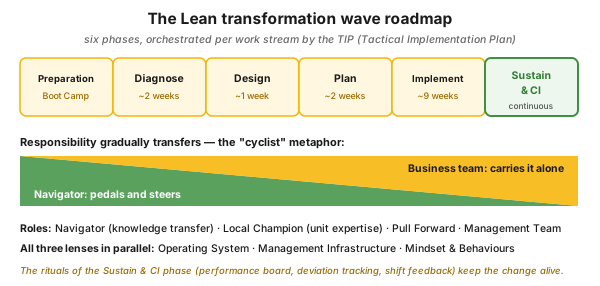
Figure 1 — the six phases of the Lean transformation wave. The implementation is orchestrated per work stream by the TIP; responsibility transfers according to the “cyclist” metaphor: the Navigator first pedals and steers, then gradually lets go, and the business team carries it on independently.
Who is this for?
Section titled “Who is this for?”This article is for those who do not want to learn a tool but have to carry an introduction through in a working plant: plant manager · shift supervisor · Lean/CI coordinator and internal change agent (Navigator) · stream leader · process engineer · maintenance manager · HR and organizational development · senior executive sponsor · project and program manager.
Learning objectives
Section titled “Learning objectives”After reading this article you will be able to:
- list the six phases of the Lean transformation wave, and say what each one adds to the program;
- explain the role of the Tactical Implementation Plan (TIP) and why it is prepared per work stream;
- distinguish the four roles of the wave (Navigator, Local Champion, Pull Forward, Management Team), and describe the “cyclist” handover of responsibility;
- recognize the typical resistance patterns, and give source-faithful answers to them;
- apply the ten lessons of Lean Six Sigma deployment to your own introduction plan;
- judge when the wave format is NOT suitable, and what the right answer is instead.
The essence
Section titled “The essence”- Lean equals continuous improvement, and continuous improvement equals continuous change. That is why the primary object of the introduction is not the tool but the habit, the culture and the behavior (for the conceptual path see: the Lean transformation path).
- It proceeds in waves: Preparation, Diagnose, Design, Plan, Implement, Sustain & CI; from the diagnosis to the end of the implementation typically ~2 + 1 + 2 + 9 weeks.
- The TIP (Tactical Implementation Plan) orchestrates the implementation per work stream, with tracked progress; it develops all three lenses (OS, MI, M&B) in parallel.
- Four roles carry it: Navigator, Local Champion, Pull Forward, Management Team. Responsibility transfers from the Navigator to the business team according to the “cyclist” metaphor.
- Resistance is a natural part of the process. Typical fears: “there will be layoffs,” “it was fine as it was,” “they won’t act on my suggestions anyway.” The key message: the goal is the elimination of waste, not headcount reduction.
- There is no copyable template. An introduction does not become successful because you look at what a similar company does; every organization must solve its own problems based on its own processes, site and people.
- Deployment principle: start from the goals and the strategic intent, not from the methodology; never brand the program after the method; metrics are the tool for influencing behavior.
Why does it matter? (the stakes)
Section titled “Why does it matter? (the stakes)”Lean programs rarely fail on the wrong tool. Far more often they fail because no one planned what keeps the result alive once the enthusiasm runs out.
At first everything looks good: the training is there, the workshop is there, a few spectacular quick wins are born. Then the wave closes, the dedicated people go back to their daily work, and the performance board stays empty. Half a year later the old routine returns, and the organization draws the most expensive lesson: “this doesn’t work here.” This sentence blocks the way to the next attempt for years, because what is lost is the credibility of the method, not just of one project.
The stake is therefore twofold. In the short term the working time and attention invested in the wave are lost. In the long term the organization’s capacity for change is damaged, even though the process industry (shrinking markets, sharp competition, tightening expectations) is demanding precisely that. As Deming put it: it is not compulsory to change, just as survival is not compulsory.
Why is Lean change leadership and not a tool introduction?
Section titled “Why is Lean change leadership and not a tool introduction?”Because the lasting result comes not from installing tools but from acquiring a new way of thinking and new competencies.
From this follows the program’s guiding principle too: sustainability is achieved through developing people, not through collecting quick wins. If you only apply methods on isolated units, you get quick wins; if you build people across the whole value stream, you get a solution.
This is the essence of the Lean journey. This article focuses on the operational running of the program: how we run a wave, how we handle resistance, and what deployment lessons to observe. The concrete, eight-step introduction recipe is given by the 8-step Lean introduction.
What is the wave, and what phases does it consist of?
Section titled “What is the wave, and what phases does it consist of?”The wave is a structured, time-boxed change program that leads the organization through six phases, from preparation to the transition into continuous improvement.
| # | Phase | Time | Main content | Who carries it |
|---|---|---|---|---|
| 1 | Preparation | — | setting up teams, communication, roadmap, Boot Camp (Lean basics) | line management |
| 2 | Diagnose | ~2 weeks | data collection, assessing the current state (diagnostic phase) | Navigator team |
| 3 | Design | ~1 week | shaping the approach | Navigator team |
| 4 | Plan | ~2 weeks | preparing the Tactical Implementation Plan (TIP) per work stream | Navigator team |
| 5 | Implement | ~9 weeks | introducing the changes per the TIP, progress tracking, standardization | Navigator team, with handover |
| 6 | Sustain & CI | — | transition into continuous improvement | line management |
The phases are punctuated by regular steering points (preparatory meeting, Boot Camp, operational and steering-committee sessions), so the wave does not drift: at the end of each stage there is a decision point.
The implementation breaks down into work streams. In a process-industry plant these are typically organized along the technological and functional blocks, for example distillation and reforming units, energy and yield, operations, maintenance, logistics. The wave develops all three lenses (Operating System, Management Infrastructure, Mindset & Behaviours) in parallel: if you only bring the tools, the management system and the behavior pull back.
Who carries the wave, and how does responsibility transfer?
Section titled “Who carries the wave, and how does responsibility transfer?”The wave is carried by four complementary roles, and the program is successful if, in the end, none of them is indispensable.
| Role | What they do |
|---|---|
| Navigator | transfers knowledge, supports and issues a challenge to the organization; they drive the continuous improvement during the wave |
| Local Champion | the local “owner”: brings in the operational expertise and contributes to the work |
| Pull Forward | a forward-driving role: contributes and is open to new approaches in their own unit |
| Management Team | responsible for the transformation and its result; sets challenging goals and direction, and rallies the people behind it |
There is a separate expectation of the stream leaders that they lead from the front: always prepared, impartial, motivating and with a coaching attitude, focusing the team toward True North.
The transfer of responsibility is described by the “cyclist” metaphor in five stages:
- At the start the Navigator steers and pedals, the business team accompanies.
- During diagnosis the Navigator still steers and pedals, and the team gets on and pedals along.
- During design and planning the Navigator pedals, but the team already holds the handlebars.
- During implementation the Navigator gradually pulls back, and rather gives tips.
- After the wave the Navigator lets go: watches and advises, and the business team carries it independently.
This gradualness is the precondition of sustainability. If the Navigator lets go too early, the wave collapses; if they steer too long, the capability is not built into the organization. For a detailed exposition of the role, see: the Lean navigator.
How do we handle resistance?
Section titled “How do we handle resistance?”In short: we do not suppress it, we answer it. Since Lean is a culture change, doubt and resistance are a natural accompaniment of the process, and the most common fears can be given a concrete, credible answer (for the deeper logic see: resistance as a symptom and the change curve).
| What you hear | What is behind it | Source-faithful answer |
|---|---|---|
| “There will be layoffs.” | existential fear | The goal is the elimination of superfluous, non-value-creating activities, not the reduction of the human resource. |
| “I’ve been doing this for 20 years, it was fine as it was.” | defense of the status quo | It is not the program that tells you how to work. We collect the shifts’ differing work methods, compare them, and together choose the best practice. |
| “We’ll have to work even more, and we’re short-handed as it is.” | fear of overload | Not more and not faster, but differently: we drop the unnecessary things and do the necessary ones on a schedule. |
| “Again they expect the solution from us.” | the sense of extra work | Yes, because you know the work best. The program’s role is to surface the waste, the weak points and the contradictions. |
| “My suggestions weren’t acted on before either.” | earlier disappointment | Please say it again. The program has strong leadership support; this time the suggestions reach the decision-makers. |
| “They’ll time our work with a stopwatch.” | the feeling of being watched | We do not use a stopwatch. The order-of-magnitude time requirement of the activities has to be known for scheduling; a few minutes’ difference does not matter. |
| “This is for assembly-line work, not for a plant.” | methodological doubt | Lean thinking started in Japan, but for decades it has proven itself outside manufacturing too, in services and maintenance. |
The practical elements of handling resistance are therefore: a clear message about the program’s goal, the involvement of the workers through interviews, mini-workshops and idea-generation sessions, the recognition of tacit knowledge (in the process industry decades of routine are a key value), strong and visible leadership support, and finally the renewed request for the previously ignored suggestions. It is also important that the program does not look for a scapegoat and does not investigate the mistakes of the past: the purpose of the observation is to further develop the current methods.
Lean Six Sigma deployment: what are the ten lessons?
Section titled “Lean Six Sigma deployment: what are the ten lessons?”The ten lessons summarize why a methodology introduction lives or dies, and each of them speaks from the program side, not the tool side. Lean Six Sigma is a strategic change-management approach: the full benefit is realized only if it is applied at the strategic AND operational level. Purely operational, isolated tool use brings only cost reduction.
- The methods are complementary, not competing (Lean and Six Sigma together).
- Start with goals and strategic intent: let the need for the result choose the method, not the other way round.
- Understand where the approach is appropriate and where it is not.
- Test the approach.
- Focus on the result: the methodology loses credibility if it takes too long to bring a result, or if it is too hard to introduce.
- Involve the staff and the change agents.
- Senior management should participate actively; without active sponsorship no change process works.
- Resources are needed to start (in the short term extra ones too).
- Influence behavior with metrics: measuring and understanding variance is a strong influencing force.
- Teach, listen actively, and create an environment receptive to continuous improvement.
One frequently violated rule deserves separate emphasis: never brand the initiative after its methodology. An ambition of the “let’s be a Lean Six Sigma company” type does not materialize; the method must stay in the background, the goal is the better result. And the greatest gain can be achieved at the system level, because value streams cross organizational and departmental boundaries.
What makes a wave successful?
Section titled “What makes a wave successful?”The conditions of success split into what we expect from the program and what we expect from the organization.
The result expected from the wave:
- clear, tangible results from the work streams, through executing the TIP;
- a shift toward the Lean principles in flow, performance management and leadership;
- a built structure for Lean to survive even after the wave.
The contribution expected from the organization:
- the change should start from the leadership team;
- there should be a clear idea of how Lean fits the strategy of the plant and the organization;
- a cleanly structured transformation team should be set up;
- enough internal Lean capability should be built to steer the transformation;
- there should be openness to new ways of working and to trying them out;
- there should be the courage to issue a challenge to the results and the organization.
Process-industry context and safety
Section titled “Process-industry context and safety”In the process industry it is the strategic-level application (system-level reliability, availability, energy efficiency) that brings the real benefit; isolated, operational tool use is only a local saving.
The safety aspect is twofold. On the one hand, change leadership must recognize the tacit knowledge of the shift workers, otherwise the knowledge that is critical from a process-safety point of view does not come to the surface, and the standard dictated from above gives rise to unrealistic, workaround solutions. On the other hand, metric-driven behavior change is also applicable to safety indicators: measuring and reducing variance works there too. The credibility of the “not layoffs, but elimination of waste” message is especially important here, because without it the front line hides the problems instead of surfacing them.
Introduction in practice
Section titled “Introduction in practice”If you had to launch a wave in your own area tomorrow, this sequence can be followed:
- Secure an active senior-executive sponsor, and clarify how the program fits the organization’s strategy.
- Set up the team: appoint Navigator, Local Champion and Pull Forward roles per work stream, and lock in the dedication.
- Communicate before the wave: say openly what the goal is and also what is not the goal; announce the Boot Camp.
- Assess the current state from data (Diagnose), not from assumptions.
- Design the target state and the goal hierarchy (Design), then break it down into a TIP per work stream (Plan).
- Execute and track the TIP (Implement), on a weekly cadence, with visible progress.
- Standardize, then hand over: the Navigator gradually steps back, the business team takes the handlebars.
- Lock in the rituals (Sustain & CI): performance board, deviation tracking, shift feedback.
Hands-on — the resistance workshop
Section titled “Hands-on — the resistance workshop”A half-day, repeatable exercise at the start of the wave: with the team, collect the fears and doubts about the program on anonymous slips. Group them following the pattern of the table above (existential, overload, credibility, methodological). For each group the leadership team formulates a one-sentence, defensible answer, and names who says it, where and when. Homework: at the next shift meeting everyone gives the three most important answers in their own area, and brings back what they were asked about.
Common mistakes
Section titled “Common mistakes”- Treating it as a tool introduction instead of a culture change; this is the surest path to sliding back.
- Copying another organization’s recipe. You can look at a benchmark, but you have to identify and solve your own challenges yourself.
- Letting the Navigator go too early (the wave collapses) or steering too long (the capability is not built in).
- Starting from the methodology instead of the goals, and branding the program after the method.
- Suppressing resistance instead of treating it as a symptom and answering the fears openly.
- Running it without leadership support: the suggestions do not reach the decision-makers, and the program’s credibility is lost.
- Looking for a scapegoat on the basis of the observations; the purpose of the diagnosis is to improve the methods, not to investigate the mistakes of the past.
- Applying Lean Six Sigma only at the operational level; the full benefit comes with strategic-level application.
- Skipping the Sustain & CI phase: without rituals the wave’s result evaporates.
When NOT to use it? (limits of the program format)
Section titled “When NOT to use it? (limits of the program format)”The wave is a strong format, but not for every situation. Knowing its limits is part of professional judgment.
| Situation | Why the wave is not the answer | The right answer |
|---|---|---|
| A single, well-defined technical problem (a recurring failure of one piece of equipment) | the wave’s organizational apparatus is disproportionate for a cause investigation | targeted problem solving: 5 Whys, A3 report, FMEA |
| There is no active senior-executive sponsorship | by the program’s own lesson, without sponsorship the change stalls, while the method loses credibility | first obtain leadership commitment, only then start |
| An acute crisis situation (plant upset, safety event) | the weekly-cadence program is not suitable for immediate intervention, and it drains attention | extraordinary event handling per your own procedures; let the wave wait |
| A single unit, small scope | the multi-work-stream wave is too heavy a frame | a unit-level, shorter schedule: mini-T |
| There is no free capacity for any role | without dedication the TIP cannot be executed, the program becomes a sham | first provide resources (this is the eighth deployment lesson), then start |
| A certified safety function is missing | a culture change does not replace a protection layer | design per SIL/LOPA, MOC |
Rule of thumb: the wave is the right format when the problem is system-level, affects several organizations, and the solution requires behavior change. For a single technical fault, an acute event or missing leadership commitment, a different tool is needed.
What this article does NOT cover
Section titled “What this article does NOT cover”This article is the program side of the introduction. What did not fit in here:
- the concrete, eight-step introduction recipe (cultural assessment, PSVSM/FSVSM, kaizen sequence): the 8-step Lean introduction;
- the big picture of the full transformation path (diagnostics, design, pilot, scaling, CI): the Lean transformation path;
- the methodology and dimensions of the diagnostic phase: the diagnostic phase;
- the human and psychological side of change: the change curve, resistance to change, the change formula;
- the detailed exposition, selection and development of the change-agent role: the Lean navigator;
- the shorter schedule of the unit-level introduction: mini-T.
Take it home (keys)
Section titled “Take it home (keys)”- Plan the end, not just the beginning. The wave is successful if the Sustain & CI rituals work even without the Navigator.
- Hand over gradually. The “cyclist” model is not a decorative metaphor but a schedule: the handlebars must be handed over at planning, the pedaling at implementation.
- Start from the goal, not from the method. Formulate what result you want, and only then choose the tool; the methodology should not appear in the program’s name.
- Answer resistance, don’t argue with it. Write down the three most common fears in your area, and prepare a defensible sentence for each.
- Ask for the suggestions again. Whoever was once disappointed will only speak up again when they see that this time there is leadership support behind it.
- Measure variance, not just the average. Measuring and understanding the spread is a strong behavior-influencing tool.
Self-test
Section titled “Self-test”- List the six phases of the wave, and say in which phase the TIP is prepared, and which is the longest.
- In the “cyclist” model, in which stage does the business team take the handlebars, and what happens if the Navigator lets go earlier than this, or much later?
- Which two of the ten deployment lessons would a program called “Let’s be a Lean company by 2027,” starting from the methodology, violate, and why?
How does it appear in digital practice?
Section titled “How does it appear in digital practice?”The principle of the change-leadership program does not stop at the bulletin board and the paper action list: the same logic is realized in software too. The mechanism is different (record, permission, scheduling, alert), the principle is the same: what is not recorded and tracked did not happen.
| Program element | Digital implementation | What it delivers |
|---|---|---|
| TIP per work stream | action register with owner, deadline and status, broken down by work stream | the progress is visible in one place, not in emails |
| Progress tracking | milestone dashboard and automatic reminder | the slippage comes to light in time, not at the steering-committee session |
| Standardization | digital standard work, versioned procedure, mandatory acknowledgment | the introduced change is not optional and is searchable |
| Sustain & CI rituals | scheduled performance-dialogue log, deviation recording, shift feedback | the ritual is measurable, the omission is visible |
| Metric-driven behavior | automatic data collection, spread and trend display | the variance is visible, therefore it can be influenced |
| Handover of responsibility | the role and permission assignment is trackable with a timestamp | the handover is a documented event, not a feeling |
Connection to OPEREX (shift diary)
Section titled “Connection to OPEREX (shift diary)”The riskiest point of the wave is sustaining the Sustain & CI: after the implementation the rituals often die out. The OPEREX shift diary makes this auditable: the performance boards, the deviation tracking and the shift feedback can be logged with a timestamp, tied to a shift, so the progress of the implementation and the sustainability are measurable and searchable, and do not live in presentations. The metric-driven behavior change (the ninth lesson) thus gets a daily data basis: the variance and the deviations can be tracked from the log, and the leadership commitment and the observance of the controls are documented.
Terminology (HU / EN / JP)
Section titled “Terminology (HU / EN / JP)”| Hungarian | English (canonical) | 日本語 (rōmaji) | Note |
|---|---|---|---|
| transzformációs hullám | wave | — | time-boxed change program |
| Taktikai Implementációs Terv | Tactical Implementation Plan (TIP) | — | orchestration per work stream |
| munkafolyam | work stream | — | the unit of implementation |
| változásügynök | Navigator / change agent | — | the engine of the wave |
| helyi bajnok | Local Champion | — | operational expertise, local owner |
| továbblendítő | Pull Forward | — | a contributing role in the unit |
| vezetői csapat | Management Team | — | responsible for the transformation and its result |
| fenntartás és folyamatos fejlesztés | Sustain & CI | Kaizen (改善) | the closing phase of the wave |
| stratégiai és operatív bevezetés | strategic and operational deployment | — | the full benefit needs both |
| ideális állapot | True North | — | the compass of the program |
What phases does a Lean transformation wave consist of?
Preparation, Diagnose, Design, Plan, Implement, and Sustain & Continuous Improvement. The implementation is orchestrated per work stream by the Tactical Implementation Plan (TIP); from the diagnosis to the end of the implementation the typical pace is ~2 + 1 + 2 + 9 weeks.
What is the Navigator's role, and what does the "cyclist" metaphor mean?
The Navigator is the internal change agent: transfers knowledge, supports and issues a challenge to the organization. By the cyclist metaphor, at first they steer and pedal, in the planning stage the business team takes over the handlebars, during implementation the Navigator gradually steps back, and after the wave they only watch and advise.
Is the Lean program about layoffs?
No. The goal is the elimination of superfluous, non-value-creating activities (waste), so that the processes work better, not the reduction of the human resource. Change leadership must represent this message clearly and credibly.
Where should a Lean Six Sigma introduction start?
From the goals and the strategic intent, not from the methodology: let the need for the result choose the approach. The method should stay in the background (never brand the program after the method), and for the full benefit apply it at both the strategic and the operational level.
Why is resistance natural, and how do we handle it?
Because Lean is a culture change, which raises fears (layoffs, extra work, earlier disappointment). Handling it: a clear “not layoffs” message, involvement through interviews and idea-generation sessions, recognition of the workers’ knowledge, and strong leadership support that gets the suggestions in front of the decision-makers.
Can you copy another company's successful Lean introduction?
No. It is a widespread assumption that it is enough to find a similar, “lean” organization and copy what it does. In practice, however, every organization must identify and solve its own challenges based on its own processes, site and people.
Related concepts
Section titled “Related concepts”the transformation journey · the 8-step Lean rollout · lean-navigator · the diagnose phase · mini-t · resistance to change · change-curve · the change formula · lean-six-sigma · ogsm · Hoshin policy deployment · Lean anti-patterns · mos
Next step
Section titled “Next step”If you have understood this, from here it is worth going on, in this order:
- the 8-step Lean rollout — the concrete introduction recipe: what you do step by step within what this article framed as a program.
- lean-navigator — the engine of the wave: how you select, prepare and step back the internal change agent.
- resistance to change — resistance as a symptom: the mechanism behind the fears, when you need to go deeper than the answers above.
References / Further reading
Section titled “References / Further reading”- Helen Bevan, Neil Westwood, Richard Crowe, Michael O’Connor: Lean Six Sigma: some basic concepts. NHS Institute for Innovation and Improvement — the comparison of Lean and Six Sigma, and the ten lessons of deployment drawn from the experience of a large public-service introduction.
- John P. Kotter: Leading Change. Harvard Business School Press, 1996 — the canonical foundational work of organizational change leadership (sense of urgency, coalition, vision, quick wins, anchoring the change in the culture).
- Jeffrey K. Liker, Gary L. Convis: The Toyota Way to Lean Leadership. McGraw-Hill, 2012 — the role of leadership development and coaching in sustaining Lean.
- James P. Womack, Daniel T. Jones, Daniel Roos: The Machine That Changed the World. Macmillan, 1990 — the introduction of the concept of Lean and the first large comparative analysis of organization-level transformation.