The Lean organization and the empowered workforce
≈ 16 min read · 3,180 words
Picture a shift crew where a small abnormality does not require a phone call “upward”: the line decides for itself, intervenes, and only reports afterward. In the classic organization responsibility sits at the top, and every decision creeps up the pyramid. Lean turns exactly this around: it stands the pyramid on its head and puts responsibility where the work and the value arise — at the front line. This is what we call an empowered workforce: the leader no longer spends the day firefighting but develops their people; the front-line workers, the value creators, get both the authority AND the competence to solve problems on the spot. Let’s look at what this is, why it works, and how to introduce it.
A Lean organization is a flatter, empowered structure: the traditional pyramid flips, and responsibility moves to the front-line value creators. The logic is bottom-up: the organization serves the operating system, not the other way around, and the support functions assist the value-creation process. The leader’s role, instead of fire fighting, is to coach the operators; problem-solving happens where the work is done; knowledge is built with on-the-job training. Empowering (empower) and enabling (enable) the value creators is the practical realization of Lean’s respect principle.
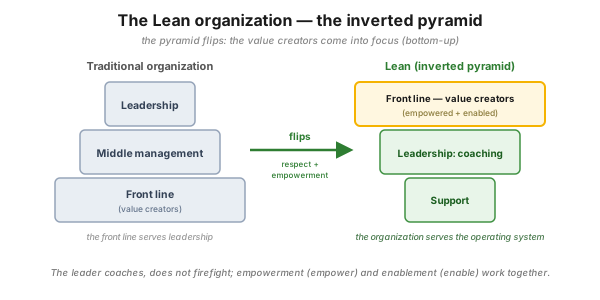 Figure 1 — the traditional pyramid (leadership on top, front line at the bottom) flips: in the Lean organization the front-line value creators come into focus (empowered and enabled), leadership coaches, and the organization serves the operating system (bottom-up).
Who is this for?
Section titled “Who is this for?”This article is for those who are moving an organization in a Lean direction, or who work in an empowered team: shift supervisor · production and plant manager · operator · process engineer · HR and organizational-development specialist · Lean/CI specialist · senior manager.
Learning objectives
Section titled “Learning objectives”After reading this article you will be able to:
- explain why the pyramid “flips,” and what the bottom-up organizational logic means;
- distinguish empowering (empower) and enabling (enable), and justify why they only work together;
- describe how the leader’s role changes from firefighting to coaching;
- explain the role of the step-down model and on-the-job training in stable operation;
- draw the line between the empowered organization (the target state) and the navigators (the engines of the change).
The essence (TL;DR)
Section titled “The essence (TL;DR)”- The pyramid “flips”: the front-line workers and shift supervisors come into focus, not the top.
- Bottom-up: the organization serves the operating system, not the other way around; the support functions assist value creation.
- Responsibility to the line: problem-solving happens where the work is, not in the office.
- The leader coaches, does not firefight: capability-building instead of reactive firefighting.
- Empower + enable together: authority without competence is risk; competence without authority is frustration.
- On-the-job training + the step-down model keep operations stable (by covering absences).
Why does it matter? (the stakes)
Section titled “Why does it matter? (the stakes)”Answer-first: if responsibility stays at the top, the organization becomes slow and fragile. Every small decision creeps upward, the leaders spend their days firefighting, and the front line learns to wait and not to think. The stake is not abstract: in a process plant a delayed reaction carries safety and production consequences.
What do you lose without an empowered organization?
- Speed. The line cannot react to a weak signal until approval arrives “from above.”
- Leadership capacity. The leader’s time goes to daily firefighting, so none is left for strategy or developing people.
- Engagement and knowledge. The front line’s best local knowledge stays unused if it has no right to use it.
What does a Lean organization and an empowered workforce mean?
Section titled “What does a Lean organization and an empowered workforce mean?”A Lean organization is built around the value-creation process, and this is why the traditional, upward-looking pyramid “flips”: it is not the front line that serves leadership, but the organization that serves the operating system in which value arises. In practice this rests on four supporting pillars:
| Organizational principle | What it means in practice |
|---|---|
| The organization serves the OS (bottom-up) | the support functions (HR, procurement, engineering) assist the value-creation process, not the other way around |
| More responsibility to the line | problem-solving happens where the work is done |
| Coaching instead of firefighting | the leader develops the operators, does not solve every problem themselves |
| On-the-job training | competence is built during the work, on the gemba |
| Step-down model | to cover absences, the more skilled level “steps down” and fills in, so the line does not stop |
The flipped pyramid is not a denial of hierarchy: leadership remains, but the center of gravity moves lower. The top’s task is no longer to command, but to secure the conditions and the competence so the line can work independently.
How do we enable and empower the value creators?
Section titled “How do we enable and empower the value creators?”The practical form of the “respect the person” principle is that we provide the value creators with two things at once, and the two are inseparable:
- Empowering (empower): the authority to decide and solve problems where the work happens.
- Enabling (enable): building competence with on-the-job training and coaching.
The key insight is that neither is enough on its own — indeed each backfires. The 2x2 picture below is a didactic frame that sets the source’s two organizational elements (the empowered workforce and the building of execution capability) side by side. Empowerment without competence is risk: the line receives responsibility but does not know what to do with it, so it makes mistakes. Competence without empowerment is frustration: the worker would know what to do but has no authority to do it, so their knowledge is wasted. The goal is the top-right corner, where the authority and the competence are present together.
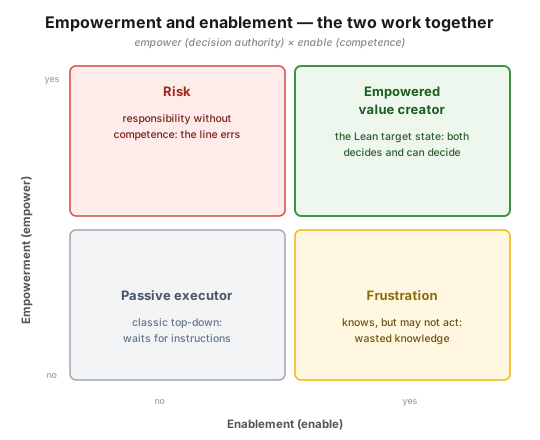 Figure 2 — empowering (empower) and enabling (enable) are two different things: only together do they yield the empowered value creator. Separately, they produce risk or frustration.
How is the leader’s role different in an empowered organization?
Section titled “How is the leader’s role different in an empowered organization?”Answer-first: in an empowered organization the leader is not the solver of problems, but the developer of problem-solvers. Reactive “firefighting” becomes coaching, and commanding becomes capability-building. The difference role by role:
| Traditional leader | Lean (empowered) leader |
|---|---|
| firefights (fire fighting) | coaches the operators |
| solves every problem themselves | the line solves it, where the work is |
| commands | builds capability (on-the-job) |
| an absence halts operations | step-down model (the higher level steps in) |
This shift is hard: the leader must give up the “hero firefighter” role, and must tolerate that the line may solve a problem more slowly, but by itself, while learning from it. In exchange, the leader’s time is freed for the more important thing: developing the people and the standard.
How is this different from the Lean navigator?
Section titled “How is this different from the Lean navigator?”Answer-first: the empowered organization is the target state (a flatter structure and culture in which the line decides), while the navigator is one tool of the road that leads there (the internal change agent who drives the transformation). The two are not the same, and neither replaces the other:
- The empowered organization is about how operations are built day to day: who decides, who owns responsibility, what the leader does. This is the steady state.
- The navigator is about who moves the organization from the old state to the new: a selected, trained internal person who leads improvements and coaches during the transformation.
In short: the navigators build the empowered organization in which, in the end, the line works independently. When the transformation matures, the empowered structure becomes self-sustaining, and the navigator role gradually becomes part of normal operations.
Process-industry context
Section titled “Process-industry context”In a process plant, empowerment means that the shift crew and the shift supervisors are given greater decision-making and problem-solving responsibility for the stability and safety of the operation, while the leaders’ coaching role strengthens competence and reduces reactive firefighting. An empowered shift reacts faster to a weak signal, because it does not have to wait “upward” for permission.
Introduction in practice (roadmap)
Section titled “Introduction in practice (roadmap)”An empowered organization is not created by a single decision but is built step by step:
- Fix the standard (standard work). You can only empower on a stable base: with no standard, there is nothing against which to decide. Stable operation first, empowerment after.
- Move responsibility to the line. Define which decisions the shift may make independently (an authority map), and where the safety boundary runs.
- Build competence on-the-job. Make a skill map (which skill is needed, what exists, what is missing), and close the gap with a development plan, alongside the work.
- Switch the leaders into coach mode. The leader should not solve the problem for the line, but guide them to the solution with questions (Lean leadership, gemba).
- Build in the step-down model. Prepare the higher levels to step in during an absence, so that empowered operation is not broken by outages either.
- Measure and refine (pdca). Track whether problems really are solved on the line, and whether the coaching actually happens, then adjust.
Hands-on part / mini-scenario
Section titled “Hands-on part / mini-scenario”This is how you would introduce it in a shift tomorrow. Choose a recurring, low-risk type of problem (for example, a well-defined parameter deviation) that the shift supervisor has always solved so far. Write it down precisely: what the standard is, at what deviation the shift may do what independently, and where the reporting/escalation obligation begins. Hand this decision to the line, and in the following week the shift supervisor should not intervene, but observe and coach: at the end of the shift, review with questions what happened and what was learned. A month later, measure whether the reaction got faster, and whether the leader’s time was freed up.
Homework. Map one decision in your own area, where it is now (the empower × enable matrix, Figure 2): does the line get decision authority, and is there competence to go with it? If the answer is “risk” or “frustration,” write down the missing half (authority or knowledge), and plan one step toward it.
Measurement / audit
Section titled “Measurement / audit”The impact of an empowered organization is “soft,” but the metrics below make it auditable:
- Where are decisions made? The share of problems closed independently on the line versus those escalated upward (the goal: routine problems should close on the line).
- The leader’s time balance. The ratio of time spent on firefighting vs. coaching/development (as empowerment succeeds, coaching time grows).
- Competence coverage. For how many critical skills the skill map shows a trained person, and how large the gap is.
- Reaction time. The time elapsed from signal to intervention on the line (shorter = better; the direct effect of empowerment).
Target-value logic: the degree of empowerment is not the goal in itself, but that routine decisions are made on the line, in competent hands, within the safety boundary.
Common mistakes
Section titled “Common mistakes”The pitfalls almost all stem from granting half of empowerment, or from skipping the stable base. In anti-pattern ↔ correction pairs:
- Empowerment without competence. The line receives responsibility but has no competence for it, so it makes mistakes. Instead: always build competence with on-the-job training alongside the decision authority (empower + enable together).
- Competence without empowerment. We train people, and then still don’t let them decide. Instead: where the competence exists, grant the decision authority too, otherwise the knowledge turns into frustration.
- The leader still firefights. If the leader solves everything, the line does not develop, and empowerment stays on paper. Instead: the leader should coach, let the line decide, and learn from the mistake (Lean leadership).
- Empowerment without a standard. Lacking a stable standard, there is nothing against which to make a “good” decision. Instead: first the standard work, then empowerment.
- Missing step-down. A single absence halts empowered operation, because there is no one to step in. Instead: prepare the higher level to cover (the step-down model).
- Confusing empowerment with loosening control. The front line’s decision authority extends to the safety limits too. Instead: empowerment speeds things up within the scope of authority; the safety limits remain bound.
When NOT to use it? (limits of the method)
Section titled “When NOT to use it? (limits of the method)”Empowerment is strong but not for every situation. Knowing where its boundary is is just as important as the principle itself:
| Situation | Why (primarily) not empowerment | The right answer | ||
|---|---|---|---|---|
| No stable standard | there is nothing against which to make a “good” decision, empowerment breeds chaos | first [[standard-munka.en | standard work]] and [[5s.en | 5s]], then empowerment |
| A safety-critical, certified decision | the authority is bound to risk analysis and a standard | the decision stays with the designated, empowered role and procedure (it cannot be pushed freely lower) | ||
| Competence is missing | decision authority without competence leads to mistakes | first competence-building (on-the-job), gradual empowerment | ||
| A one-off, extraordinary crisis | in an acute situation the immediate, unambiguous leadership decision is faster | after crisis mode, return to the coaching and empowerment logic |
Rule of thumb: empowerment is strongest in stable, standard-measurable, competent operation. It does not substitute for safety authority or for a missing stable base — those first need other tools.
Take it home (keys)
Section titled “Take it home (keys)”- Flip the pyramid: put responsibility where the work and the value arise.
- Empower + enable together: give decision authority AND competence, otherwise it turns into risk or frustration.
- Coach, don’t firefight: the leader should develop the problem-solvers, not solve the problems for them.
- Standard first, empowerment after: without a stable base, empowerment is chaos.
- Build in the step-down model, so an absence does not break empowered operation.
- The safety boundary is bound: empowerment speeds up within the scope of authority, it does not widen the authority.
Self-test
Section titled “Self-test”- Why does the pyramid “flip” in a Lean organization, and what does it mean that the organization serves the operating system?
- What is the difference between empowering (empower) and enabling (enable), and what happens if you grant only one of them?
- How does the role of the empowered organization (the target state) differ from the navigator (the engine of the change)?
How does it appear in digital practice?
Section titled “How does it appear in digital practice?”The principle of the empowered organization does not stop at the org chart: in a well-designed digital operation the same logic appears in software too. Instead of paper approval loops, here recording the decision made on the line, an authority-based workflow and a retrievable trace carry the “decide on the spot, but leave a trace” principle — the mechanism differs, the principle is the same.
| Organizational principle | Digital implementation | What it delivers |
|---|---|---|
| Decision on the line | the shift records the decision and the intervention in the system, without upward approval | faster reaction, fewer escalations |
| Authority boundary | the system allows an independent decision only within the empowered band, above it it escalates | empowerment stays within the safety boundary |
| Coaching instead of firefighting | the logged decisions and deviations provide the basis for the coaching conversation | the leader develops from data, not from memory |
| On-the-job competence | the skill matrix and the trace of the decisions show who is skilled at what | targeted development alongside the work |
| Step-down continuity | the open decisions and handovers are visible to the person stepping in | an absence does not interrupt operations |
Connection to OPEREX (shift diary)
Section titled “Connection to OPEREX (shift diary)”Responsibility pushed to the front line works reliably only if the shift crew’s decisions and the coaching interactions leave a trace. The shift-level decisions and handovers logged in the OPEREX shift diary make it transparent whether problem-handling really happened on the line: empowerment thus becomes not uncontrollable but auditable. The diary also supports step-down continuity, because the person stepping in sees at a glance the pending decisions and the shift’s open matters.
Terminology (HU / EN)
Section titled “Terminology (HU / EN)”| Hungarian | English | Note |
|---|---|---|
| Felhatalmazott munkaerő | Empowered workforce | the front line’s decision authority |
| Képessé tétel | Enablement / enable | competence-building on-the-job |
| Értékteremtő | Value creator | the front-line worker, where the value arises |
| Fordított piramis | Inverted pyramid | bottom-up organizational logic |
| Tűzoltás | Fire fighting | reactive, defect-solving leadership |
| Step-down modell | Step-down model | covering an absence from a higher level |
| On-the-job tréning | On-the-job training | training alongside the work |
What is a Lean organization and an empowered workforce?
A flatter, empowered structure where the traditional pyramid flips: responsibility moves to the front-line value creators, the organization serves the operating system (bottom-up), and the leader coaches their people instead of firefighting.
How is a Lean organization different from a traditional one?
Compared to the traditional pyramid it is flatter and empowered: more responsibility moves to the front line, the leaders provide coaching instead of firefighting, and the organization serves the operating system, not the other way around.
Why does empowerment also need enablement?
Because responsibility without competence leads to mistakes (risk), and competence without decision authority leads to frustration. Empowering (empower) and enabling (enable) only work together.
What is the leader's role in an empowered organization?
Instead of reactive firefighting, coaching the operators and building capability. The line solves the problem; the leader secures the conditions and the competence.
Is the empowered organization the same as the Lean navigator?
No. The empowered organization is the target state (the structure and culture in which the line decides), while the navigator is the engine of the change (the internal change agent who drives the transformation). The navigators build the empowered organization in which, in the end, the line works independently.
Related concepts
Section titled “Related concepts”lean-navigator · Lean leadership · standard work · gemba-walk · pdca · the three lenses · shift handover
Next step
Section titled “Next step”If you have understood this, from here it is worth going on — in this order:
- Lean leadership — how the leader becomes a coach: the empowered organization stands or falls on the leadership behavior change. Start with this.
- standard work — the stable base against which the line’s independent decisions can be measured; without it empowerment is chaos.
- lean-navigator — who and how build up this empowered organization during the transformation.
References / Further reading
Section titled “References / Further reading”- Jeffrey K. Liker: The Toyota Way. McGraw-Hill, 2004 — the “respect for people” pillar and the development of people in the Toyota model.
- James P. Womack – Daniel T. Jones: Lean Thinking. Free Press, 2003 — the foundational work on the value-creation process and organizing the organization around it.
- Mike Rother: Toyota Kata. McGraw-Hill, 2009 — the methodology of coaching-based leadership and capability-building (improvement kata / coaching kata).
- Raymond C. Floyd: Liquid Lean: Developing Lean Culture in the Process Industries. CRC Press, 2010 — Lean culture and the empowered workforce in a process-industry environment.