Mini-T — a focused mini-transformation in one value stream
≈ 14 min read · 2,793 words
When you renovate your flat, you don’t gut the whole thing at once so you can live in a hotel for half a year. You take one room all the way through: plumbing, wiring, tiling, painting — and at the end you have a finished, better room you can already live in. Along the way you learn what works, you use the same tradesman and the same tools on the next room, and every finished room raises the value of the whole flat. A Lean rollout is most effective in exactly the same way: you don’t turn the entire organization upside down at once, you take one delimited unit all the way through. This is the Mini-T (mini-transformation). Let’s look at what it is, why it works, and where it is used.
A Mini-T is a smaller transformation focused on a delimited part of a value stream that brings a step change in performance and builds a continuous-improvement engine. On a single unit it covers all three Lean pillars (operating system, management infrastructure, mindset and capabilities), delivers a quick impact, and secures sustainability. Mini-Ts are tied into a larger transformation by cross-linked initiatives (capability building, performance management, supplier development), so the rollout is not a “big bang” but advances in focused, manageable waves.
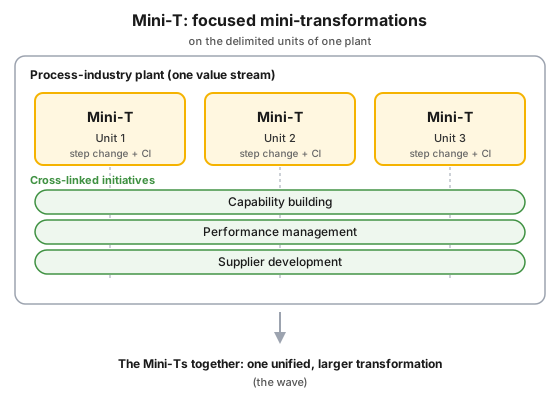 Figure 1 — the concept of the Mini-T: each Mini-T steps up (step change + CI) on one delimited unit of a plant, and the cross-linked initiatives tie them into one unified, larger transformation (the wave).
Who is this for?
Section titled “Who is this for?”This article is for those who meet the rollout of Lean or an operational-excellence program in practice: plant and production manager · shift supervisor · process engineer / process technologist · Lean/CI specialist (navigator) · project and program manager · change agent · HSE.
Learning objectives
Section titled “Learning objectives”After reading this article you will be able to:
- explain what makes a transformation “mini”: the focused, unit-level scope;
- distinguish the step change from the continuous-improvement engine (CI engine), and justify why both are needed;
- list what ties the Mini-Ts together (cross-linked initiatives), and what happens if these are missing;
- justify why we scale on focused units instead of a “big bang”;
- recognize when the Mini-T is not the right tool.
The essence (TL;DR)
Section titled “The essence (TL;DR)”- Focus: a well-delimited part of a value stream (one unit, block or workshop), not the whole organization at once.
- Dual impact: a step change in performance (step change) AND a continuous-improvement engine (CI engine) at the same time.
- All three pillars on one unit: operating system, management infrastructure, mindset and capabilities (the three lenses).
- About 3 months, with a unit-level schedule: quick impact, yet long enough for a local mindset change.
- Cross-linked: the Mini-Ts are tied into a larger transformation by shared initiatives (capability building, performance management, supplier development) (the wave).
- Why not a big bang: on one delimited unit it proves itself quickly, builds, learns and reduces risk before it scales.
Why does it matter? (the stakes)
Section titled “Why does it matter? (the stakes)”The stake of a transformation is enormous, and failure is the rule rather than the exception: the overwhelming majority of large, all-at-once, whole-organization changes do not reach their goal. The Mini-T cuts exactly this risk down to size.
About 70% of transformation programs fail to reach the set goal, and the most common cause is not technical but human. Behind the failures most often stand employee resistance to change (about 39% of failures) and leadership behavior that does not support change (about 33%), far ahead of scarce resources or other obstacles. This is why the Mini-T deliberately focuses on changing mindset and behavior, not just on deploying tools.
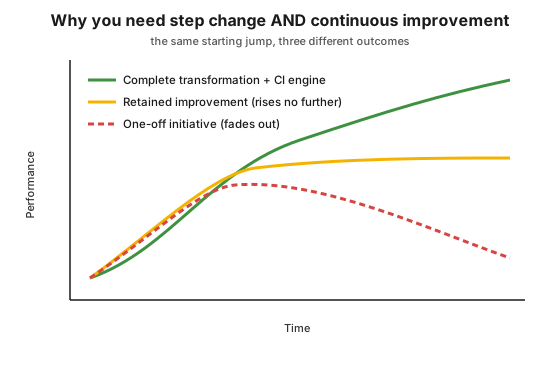 Figure 2 — from the same starting jump three outcomes are possible: the momentum of the one-off initiative runs out, the retained improvement settles at a level, the complete transformation keeps rising with the continuous-improvement engine.
From the same starting jump in performance three futures can grow:
- One-off initiative: the opportunities are identified, but the momentum runs out over time and the improvement slides back.
- Retained improvement: the improvement is retained and continuously harvested, but it does not multiply — it only settles at a higher level.
- Complete transformation: the changed mindset and behavior continuously multiply the impact, so the curve keeps rising.
The lesson is simple: a step change on its own is not enough. Durable, indeed growing, impact needs the CI engine (the built-in capability that keeps improving). Precisely for this reason the Mini-T targets both at once: a quick step change and a continuous-improvement engine.
What is a Mini-T, and why not a “big bang”?
Section titled “What is a Mini-T, and why not a “big bang”?”A Mini-T is a smaller, defined transformation focused on a well-delimited part of a value stream, which brings a step change in performance and builds a continuous-improvement engine. Instead of the “big bang” (the whole organization at once), it advances on focused, manageable units.
Five characteristics distinguish it from a large, simultaneous change:
| Characteristic | What it means |
|---|---|
| Focused scope | it targets a delimited part of a value stream (one unit, block, workshop) |
| Cross-linked | it connects to other Mini-Ts through shared initiatives |
| Dual impact | a step change in performance (operational and financial) + a continuous-improvement engine |
| Built into the wave | it embeds the rollout in the wave, it is not a stand-alone project |
| Behavior-centered | it focuses on changing mindset and behavior and on improving performance |
The “big bang” is risky because it turns the whole organization upside down at once: many moving parts, large resistance, and there is the ~70% failure rate. The Mini-T, by contrast, proves itself quickly on one delimited unit, builds up the team’s capabilities, learns in its own environment, and scales to the next units with the lessons learned. The risk is small and manageable, and the success is internal proof for the further waves.
What ties the Mini-Ts together?
Section titled “What ties the Mini-Ts together?”The Mini-Ts are tied into one unified, larger transformation by cross-linked initiatives. Without these, the Mini-Ts would remain lonely islands.
A cross-linked initiative is a shared workstream spanning several units that runs through every affected Mini-T and connects them (see Figure 1). Typical examples:
- Capability building (developing the navigators and the local teams),
- Performance management (a shared KPI and dialogue system),
- Production management,
- Supplier development,
- as well as the support functions (finance, engineering, procurement).
It is this fabric that makes the individual unit-level jumps add up into a larger transformation pointing in one direction, rather than a heap of independent, isolated improvements.
How does a Mini-T run in practice?
Section titled “How does a Mini-T run in practice?”A Mini-T is a unit-level schedule of about three months that handles all three Lean pillars at once, delivers a quick impact, and at the end switches over to continuous improvement.
The schedule has six phases building on one another: Preparation, Diagnosis, Design, Plan, Implementation, then Refinement. The detailed, phase-by-phase breakdown (what the diagnosis examines, what the Tactical Implementation Plan is) is covered by the the diagnose phase article. Two things are worth highlighting already here:
- The implementation must be long enough. The delivery phase cannot be rushed: a real mindset change of the local leadership and workforce takes time, and hurrying leads to backsliding.
- The Mini-T does not run in isolation. During the rollout it continuously aligns with the cross-linked initiatives, and progress is tracked in a test-and-learn manner.
The broader, organization-level, multi-year picture (the series of waves, the dual role of the pilot, the culture change, the “me to we”) lives in the the transformation journey article. The Mini-T is the smallest, independently working building block of that journey.
Process-industry context
Section titled “Process-industry context”In the first wave of a large process-industry plant the “first island” of the Mini-T is typically a delimited part of the plant: for example a distillation complex and the local maintenance workshops belonging to it. This is where the Lean tools are introduced to sustainably improve performance (people, HSE, energy, yield), typically on three focus areas: energy and yield, maintenance, operations.
The goal of the “first island” is deliberately dual:
- improve the unit’s performance sustainably (get the process close to its optimum in people, HSE, energy and yield), and
- build the organization’s own capability to lead the further waves. This is the navigator team, which is trained here and tested “live” before independently running several successive waves.
In the continuous, safety-critical operation the Mini-T also reduces risk: people learn on one delimited unit before scaling to the other parts of the plant and to other sites. The program thus transforms the units one after another, at an accelerating pace, flowing into continuous improvement.
When NOT to use it? (limits of the method)
Section titled “When NOT to use it? (limits of the method)”The Mini-T is a strong framework, but not right for every situation. Knowing when it is not the right answer is just as important as the method itself:
| Situation | Why (primarily) not the Mini-T | The right answer | |
|---|---|---|---|
| A single, well-defined, isolated problem | a full, three-month Mini-T is too heavy a tool for a single problem | a targeted [[kaizen.en | kaizen]] event or root-cause analysis |
| Acute, immediate “firefighting” (a safety / production crisis) | the ~3-month schedule is too slow for an acute situation | immediate intervention, then record the lesson | |
| No leadership commitment or resources | the Mini-T moves all three pillars, without leadership presence it dies | first secure the leadership commitment and the resources ([[lean-anti-mintak.en | Lean anti-patterns]]) |
| The scope cannot be delimited | if there is no meaningful “delimited part,” the focus is lost | first a value stream map ([[vsm.en | vsm]]) to mark out the boundaries |
Rule of thumb: the Mini-T is strongest for a system-level performance problem that is interconnected within one unit, where there is leadership support and a scope that can be delimited. For a single symptom, an acute crisis, or without commitment, it does not replace the appropriate tool.
Common mistakes
Section titled “Common mistakes”The pitfalls of the Mini-T almost all arise where focus, time or sustainability is compromised. In anti-pattern ↔ correction pairs:
- Too broad a scope. If the Mini-T is not delimited, the focus and the quick, provable impact are lost. Instead: designate a truly delimited unit (one block, one workshop), and size the team to it.
- Too short an implementation, rushing. The mindset change takes time; a delivery that is cut short leads to backsliding. Instead: the implementation phase should be long enough for a real habit change of the local leadership and workforce.
- No cross-linking. Lonely Mini-Ts remain islands, they do not add up into a larger transformation. Instead: tie them to shared initiatives (capability building, performance management, supplier development).
- Step change without a CI engine. The step change stays one-off, and the momentum runs out (see the “one-off initiative” curve of Figure 2). Instead: build the routines of continuous improvement into the Mini-T already, so the impact stays and grows.
- Tool deployment only, without mindset. If you only touch the operating system, and the management infrastructure and the mindset are left out, the impact is not durable. Instead: handle all three pillars at once on one unit.
- The pilot is not used for learning and scaling. The Mini-T is not only about improving the unit but also about building capability. Instead: on the “first island” deliberately train the navigator team for the next waves.
Take it home (keys)
Section titled “Take it home (keys)”- Don’t turn the whole organization upside down at once: pick one delimited unit and take it all the way through.
- Target a step change AND build a CI engine: the bare jump runs out, continuous improvement keeps it up and grows it.
- All three pillars on one unit: operating system + management infrastructure + mindset; separately none of them is durable.
- Give the mindset change time: of the roughly 3 months, let the implementation be long enough for a real habit change.
- Tie the Mini-Ts together with cross-linked initiatives, otherwise they remain islands.
- The first island is dual-purpose: improve the unit AND build up the team’s capability for the next waves.
Self-test
Section titled “Self-test”- What are the two simultaneous impacts of a Mini-T (what is the difference between the step change and the continuous-improvement engine), and why is either one insufficient on its own?
- List three cross-linked initiatives, and explain what happens to the Mini-Ts if these are missing.
- Why does an organization scale with focused, unit-level Mini-Ts, instead of transforming the whole organization at once (a “big bang”)?
How does it appear in digital practice?
Section titled “How does it appear in digital practice?”The success of a Mini-T depends on whether the new routines introduced on the unit stay alive after the wave closes. The same digital logic supports it as the shop-floor Lean tools: it records, makes visible and holds accountable the daily operation, so that the step change does not remain a passing enthusiasm.
| Mini-T element | Digital implementation | What it delivers |
|---|---|---|
| Unit-level performance target (baseline → target) | digital KPI board, automatic data collection | the step change is measurable and visible |
| Daily routines (shift handover, performance dialogue, near-miss) | structured digital log / template | the introduced habit is not forgotten |
| Continuous-improvement engine (CI engine) | action and improvement log with owner and deadline | the improvement ideas are trackable, they are not lost |
| Cross-linked initiatives | a shared action list / dashboard spanning several units | the Mini-Ts do not become isolated |
| Sustainability after the wave | the actual usage data of the routines | it signals early if the step change is sliding back |
Connection to OPEREX (shift diary)
Section titled “Connection to OPEREX (shift diary)”The sustainability of a Mini-T depends on whether the daily routines it introduces (shift handover, performance dialogue, near-miss) stay alive after the wave closes. This is what the shift diary’s (OPEREX) usage data reveals: if the routines die out, the step change slides back. This way OPEREX gives an early, auditable signal about the “afterlife” of the Mini-T, not in presentations.
Terminology (HU / EN)
Section titled “Terminology (HU / EN)”| Hungarian | English | Note |
|---|---|---|
| Mini-transzformáció | Mini-T / mini-transformation | a unit-level, defined transformation |
| Lépésszerű ugrás | step change | a one-off, large performance step |
| Folyamatos fejlesztési motor | Continuous Improvement engine | the sustained, self-improving capability |
| Keresztkapcsolt kezdeményezés | cross-linked initiative | a shared workstream tying several Mini-Ts together |
| Hullám | wave | the pace of scaling, several Mini-Ts together |
| Első sziget | first island | the pilot unit, the ground for capability building |
| Három pillér / lencse | three pillars / lenses | operating system, management infrastructure, mindset and capabilities |
What is a Mini-T in a Lean rollout?
A smaller, defined transformation focused on a well-delimited part of a value stream that brings a step change in performance and builds a continuous-improvement engine. It covers all three Lean pillars on one unit, delivers a quick impact, and the cross-linked initiatives tie it into a larger transformation.
Why is a Mini-T better than an all-at-once ("big bang") rollout?
Because on one delimited unit it delivers a result quickly and provably, builds up the team’s capabilities and reduces risk, then scales with the lessons learned. The overwhelming majority of large, simultaneous transformations fail, typically because of mindset and behavior.
What ties the Mini-Ts together?
Cross-linked initiatives, for example capability building, performance management and supplier development, which tie the focused mini-transformations into one unified, larger transformation (a wave).
How long does a Mini-T last?
A unit-level Mini-T is about three months, with a six-phase schedule (Preparation, Diagnosis, Design, Plan, Implementation, Refinement). The delivery phase must be long enough for a real mindset change of the local leadership and workforce.
Is a step change enough on its own?
No. A bare jump stays one-off, and the momentum runs out over time. For a durable, indeed growing, impact the Mini-T also builds a continuous-improvement engine (CI engine), which — through the changed mindset and behavior — keeps multiplying the result.
Related concepts
Section titled “Related concepts”the transformation journey · the diagnose phase · lean-navigator · the three lenses · the 8-step Lean rollout · Lean anti-patterns · kaizen · vsm
Next step
Section titled “Next step”If you have understood this, from here it is worth going on, in this order:
- the transformation journey — the broader picture: how the Mini-Ts add up into the organization-level, multi-year transformation journey (waves, pilot, culture change). Start with this.
- the diagnose phase — the engine of the Mini-T schedule: the six-phase roadmap and the diagnosis that provides the baseline.
- lean-navigator — who runs the Mini-T: the navigator team, trained on the “first island” for the next waves.
References / Further reading
Section titled “References / Further reading”- Scott Keller & Colin Price: Beyond Performance: How Great Organizations Build Ultimate Competitive Advantage. Wiley, 2011. — treating performance AND health (performance & health) as equals; the failure of about 70% of transformations and the role of mindset/behavior.
- James P. Womack & Daniel T. Jones: Lean Thinking. Free Press, 1996 (expanded edition 2003). — the concept of the value stream, on a delimited part of which the Mini-T focuses.
- Taiichi Ohno: Toyota Production System: Beyond Large-Scale Production. Productivity Press, 1988. — the roots of continuous improvement and step-by-step, on-site improvement.