Problem-solving culture: why the sustainability of Lean depends on it
≈ 18 min read · 3,567 words
Two plants roll out the same Lean toolkit: 5S, kaizen, boards, audits. Six months later, in one of them the boards are dusty decorations, no one shows up to the workshops, and the program quietly dies. In the other, workers raise problems on their own, they experiment, and the improvement does not stop. The difference is not in the tools, but in how the organization relates to problems. Where a problem is seen as a fault to be hidden, Lean stays a stage set; where it is seen as a learning opportunity, it becomes a self-propelling culture. This difference is what we call a problem-solving culture, and without it even the best toolkit runs out of steam.
A problem-solving culture is an organizational environment in which a problem is treated as a learning opportunity, not as a fault to be hidden. It rests on three pillars: people can experiment and get engaged; leadership creates the environment for problem solving (it gives time, empowerment and psychological safety, not a ready-made solution); and the deployment system is credible, because it shows tangible results and word matches deed. This is what makes a Lean transformation durable: sustainability comes not from the number of tools but from the culture — without culture the program runs out of steam.
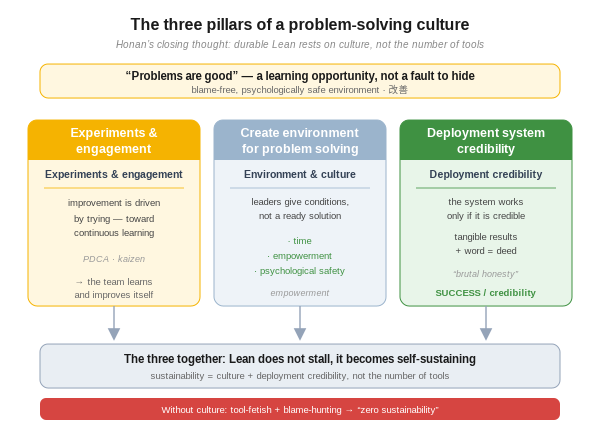 Figure 1 — the three pillars of a problem-solving culture: experiments and engagement, creating the environment for problem solving, and the credibility of the deployment system. Together the three make Lean self-sustaining; without culture, “zero sustainability.”
“Problems are only opportunities in work clothes.” — Henry J. Kaiser (1882–1967)
Who is this for?
Section titled “Who is this for?”This article is for those who not only roll out Lean tools but also want the improvement to last: plant and shift manager · Lean/CI lead and specialist · production manager · HSE manager · team leader · senior executive sponsoring a transformation.
Learning objectives
Section titled “Learning objectives”After reading this article you will be able to:
- explain why it is not the number of tools but the culture that makes Lean durable;
- recognize the three pillars of a problem-solving culture, and say which one is leadership’s job;
- distinguish “tool-based” from “problem-based” Lean deployment;
- name the leadership behaviors that destroy the willingness to speak up in an instant;
- assess whether, in your own organization, a problem is “good news” or “bad news.”
The essence (TL;DR)
Section titled “The essence (TL;DR)”- Durable Lean is founded on culture, not on the number of tools — sustainability comes from the attitude toward problems.
- “Problems are good”: a problem is a learning opportunity, not a shameful fault to be hidden.
- Three pillars: experiments and engagement · creating the environment for problem solving · a credible deployment system.
- Leadership gives the environment, not a ready-made solution — time, empowerment and psychological safety.
- Credibility = word and deed in harmony: if the leader asks for problems but punishes the one who raises them, the culture collapses at once.
- Tool-fetish is the typical failure: more boards and workshops without culture lead to “zero sustainability.”
Why does it matter? (the stakes)
Section titled “Why does it matter? (the stakes)”Lean rollouts fail not for lack of tools, but because the culture does not keep them alive. The most common pattern is familiar: a few tools are handed down top-down (kaizen, 5S), a couple of trainings are held, and then the momentum runs out, because the workers and the middle managers were never truly engaged. The result is “zero sustainability”: the program is formally alive, practically dead.
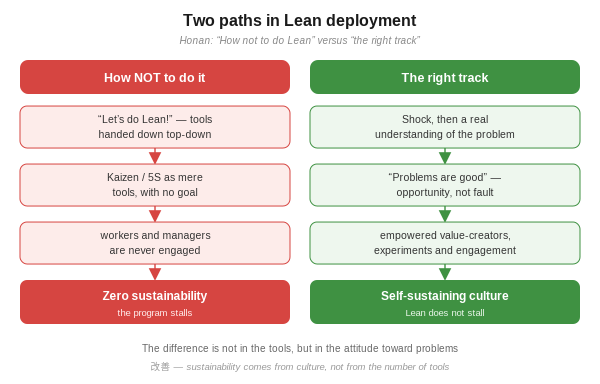 Figure 2 — two paths from the same toolkit. The left one, a tool-based, top-down deployment, stalls for lack of engagement; the right one, the path that treats the problem as an opportunity, leads to a self-sustaining culture. The difference lies in the attitude toward the problem.
So the stake is not the success of one workshop or another, but the return on the whole investment. If the culture does not turn over, the time, money and attention poured into Lean evaporate, and worse: the organization draws the lesson “we tried it, it doesn’t work,” which shuts the door on the next attempt for years. In a Seveso plant the stake is even greater: if a problem is “bad news,” the weak signals and the near-misses stay hidden, and the next report will already be an incident.
Where does it come from? — the “problems are good” idea
Section titled “Where does it come from? — the “problems are good” idea”A problem-solving culture is not an abstract management theory: it grew out of practice, where Lean transformations ran aground one after another at the very same point. One well-documented lesson was summed up by the operations lead of a large, multi-country service company: the organization at first expected the change to come from the tools (Lean transformation = “let’s introduce the tools”), and the team was honestly shocked when it turned out this does not work that way. The turning point was understanding the problem, and from it the realization that “problems are good”: they are not faults to be made to disappear, but the raw material of improvement.
From this followed the other core principle: “to empower the value-creators to solve problems, and to take the courage to actually let them do their work that way.” This sentence distills the essence of the culture: it is not enough to grant permission to solve problems; the leader must also let go of control, so that the team can really solve them.
What are the three pillars?
Section titled “What are the three pillars?”A durable problem-solving culture rests on three mutually reinforcing pillars (Figure 1). If any one of them is missing, the other two wobble too.
| Pillar | In English | What it means |
|---|---|---|
| Experiments and engagement | Experiments & engagement | improvement is driven by trying; the team learns and improves itself, it is not a passive executor |
| Creating the environment for problem solving | Create environment for problem solving | leadership provides the culture and the conditions (time, empowerment, psychological safety), not a ready-made solution |
| The credibility of the deployment system | Deployment system credibility | the program lives only if it is credible: it shows tangible results, and word matches deed |
Together the three ensure that Lean does not run out of steam but becomes self-sustaining. The logic is simple: experimentation drives the improvement, the environment makes the experimentation possible, and credibility sustains both.
Pillar 1 — experiments and engagement
Section titled “Pillar 1 — experiments and engagement”The engine of a problem-solving culture is experimentation: we learn through small-scale trials, not through big, risky leaps. This is directly the logic of the PDCA cycle and of kaizen: try a change, see what you learn from it, standardize what worked. The key word is engagement: the improvement is not devised and handed down by headquarters staff, but driven by the value-creators (those who actually do the work), because they see the problem from closest up.
Pillar 2 — leadership gives the environment, not the solution
Section titled “Pillar 2 — leadership gives the environment, not the solution”This pillar is the most misunderstood, and it is where the culture most often fails. Leadership’s task is not to hand out ready-made solutions, but to ensure the conditions for problem solving:
- time for learning and experimentation (if there is no time for it, there is no improvement),
- empowerment to act and decide within one’s own area,
- psychological safety, so that a problem can be raised without retaliation.
When a leader “quickly solves” the problem instead of the team, they mean well but do harm: the team does not learn, does not get engaged, and next time waits for the boss to solve it. A good leader resists the temptation to solve, and instead asks questions (“5 Whys, not 1 Who”), so the team reaches the cause itself.
Pillar 3 — the credibility of the deployment system
Section titled “Pillar 3 — the credibility of the deployment system”The third pillar is credibility. A Lean program lives exactly as long as people believe it is real and matters. Two things feed it: tangible results (the improvements genuinely make daily work better, they do not just produce reports) and the alignment of word and deed. If leadership asks for problems but punishes the messenger, the program’s credibility is lost with a single case, and once credibility is gone, the best toolkit is in vain. Part of this credibility is also a culture of open, honest feedback: the problem must be spoken aloud, even if it is uncomfortable.
How the attitude flips — “a problem is good news”
Section titled “How the attitude flips — “a problem is good news””The core of the culture is flipping the attitude toward problems: a problem is not a sin to be hidden, but an opportunity we learn from. In practice it is a surprisingly hard switch: people are often honestly shocked when leadership treats a problem as an opportunity instead of assigning blame, because over an entire career they have learned the opposite.
This shift in perspective is directly connected to the “5 Whys, not 1 Who” principle (we look for the cause, not the culprit) and to the blame-free reporting culture. Without it, near-misses and weak signals stay hidden: people do not lie, they simply stay silent, and silence is exactly as dangerous as denial.
Process-industry context and safety
Section titled “Process-industry context and safety”In the process industry a problem-solving culture is a direct safety stake, not a “soft” HR topic. In a Seveso plant, near-misses and weak signals surface only if reporting is blame-free and leadership treats the problem as an opportunity. Safety literature has long known the pattern: a serious accident is almost always preceded by many small, unreported deviations — these reports are the organization’s “early warning system.”
- Open, honest risk communication is a sign of maturity. Where risk is spoken aloud, even when it is uncomfortable (bad news for the schedule, the budget, or the boss’s plan), the process-safety culture is mature. Where the bringer of bad news is punished, the next risk stays hidden.
- Psychological safety is not permissiveness. It does not mean there is no accountability: it means that raising a problem carries no consequence, even if the problem holds an uncomfortable truth.
- A safety boundary. A problem-solving culture is the foundation of everyday learning and of surfacing weak signals, but it does not replace formal risk analysis and the certified protection layers (LOPA/SIL, HAZOP). A good culture ensures that these systems receive real input: people actually report what they see.
Introduction in practice
Section titled “Introduction in practice”A problem-solving culture cannot be “rolled out” with a training, but its conditions can be deliberately created. A shift or plant manager can do the following starting tomorrow:
- Ask for problems, and react well to them. At the shift meeting, ask: “what got in the way of your work today?” The reaction to the first report decides everything: if you say thank you and act, the next one comes; if you get defensive or assign blame, you shut off the tap.
- Pick a painful, recurring problem, and give it to the team. Do not solve it for them. Ask questions (5 Whys), give time and empowerment, and let them find the solution.
- Run small experiments (PDCA). A small, reversible trial is safer than a big decision, and you learn from it faster. The goal is not the perfect solution on the first try, but learning.
- Make the result visible. Show the solved problem and its impact (a board, the shift diary). The tangible result feeds credibility, and credibility feeds the next report.
- Guard the alignment of word and deed. Keep what you promise; if there is something you cannot solve, say honestly why. Credibility is lost with a single broken promise.
Measurement — the early signs of the culture
Section titled “Measurement — the early signs of the culture”Culture is “soft,” but its signs are measurable. What matters is not the number of solved problems in itself, but the trend in the willingness to report:
- Number and source of reports: is the number of raised problems/near-misses growing, and does it come from the front line (not only from the managers)? A falling number of reports rarely means fewer problems; far more often it means a deteriorating culture.
- Lead time from report to action: how much time passes until something happens about a raised problem? A long, silent lead time kills the willingness.
- Who solves it? does the team solve the problems (engagement), or does everything wait for the leader (the absence of pillar 2)?
Common mistakes
Section titled “Common mistakes”- Tool-fetish. Rolling out more kanban, boards and workshops, without culture. Why it’s a problem: in the absence of engagement, “zero sustainability”: the program is formally alive, practically dead. Instead: first flip the attitude toward problems; the tool only serves this.
- Scapegoating. Blaming the person who raised the problem. Why it’s a problem: a single case silences all the other reports too. Instead: hunt for the cause, not the culprit, and thank people for the bad news.
- Handing out ready-made solutions. The leader “quickly solves” it instead of the team. Why it’s a problem: the team does not learn, does not get engaged, and next time waits for the boss (pillar 2 is damaged). Instead: ask questions, give time and empowerment, let go of control.
- Word and deed diverging. Leadership asks for problems but punishes the messenger, or does not keep its promises. Why it’s a problem: the credibility of the deployment system (pillar 3) is lost with a single case. Instead: keep what you promise; if it can’t be done, say honestly why.
- A “culture” handed down top-down. Culture is decreed in a circular. Why it’s a problem: culture is built from behaviors, not from an order. Instead: the leader should model the behavior: let them welcome the bad news themselves.
When NOT to use it? — the limits
Section titled “When NOT to use it? — the limits”A problem-solving culture is the foundation of durable improvement, but it is not the answer to every situation. It is important to know where its limit lies:
| Situation | Why culture alone is not enough | The right answer |
|---|---|---|
| An immediate, acute safety hazard | there is no time to “experiment” and learn — one must act | emergency shutdown, the relevant emergency procedure; the learning comes afterward |
| A certified protective function is needed | culture is not an audited, certified barrier | SIL/LOPA, HAZOP, design per IEC 61511 |
| Deliberate rule-breaking, not an honest error | psychological safety is not a safety net for irresponsibility | accountability; a “just culture” separates honest error from culpable violation |
| No leadership commitment | culture is built from leadership behavior; without it there is nothing to build on | first win over the leadership level, model from the top |
Rule of thumb: a problem-solving culture makes everyday learning and the surfacing of weak signals durable: it replaces neither the emergency response, nor the certified safety systems, nor accountability.
Take it home (keys)
Section titled “Take it home (keys)”- Sustainability comes from culture, not from the number of tools. Flip the attitude first; the tool only serves this.
- Ask: in your workplace, is a problem good news or bad news? The answer predicts the fate of your Lean.
- Leadership’s job is the environment, not the solution: time, empowerment, psychological safety. Let go of control.
- Credibility is the alignment of word and deed: a single punished messenger or broken promise sets you back for years.
- The trend in reports is the thermometer of the culture — a falling number signals a deteriorating culture, not fewer problems.
- In the process industry this is a safety stake: blame-free reporting is the early warning system, but it does not substitute for the certified barriers.
Self-test
Section titled “Self-test”- Name the three pillars of a problem-solving culture, and say which two are directly leadership’s responsibility.
- A leader, with good intentions, “quickly solves” the team’s problem. Which pillar does this weaken, and what is the long-term harm?
- In a plant, the number of reported near-misses fell over the past quarter. Why might this be bad news, and how would you check what is really happening?
How does it appear in digital practice?
Section titled “How does it appear in digital practice?”A problem-solving culture is primarily behavior, not software, but a well-designed digital system can strengthen its conditions. Software does not create the culture, but it can make reporting visible and frictionless, and the signs of the culture measurable.
| Element of the culture | Digital implementation | What it strengthens |
|---|---|---|
| Low-threshold reporting | a few-clicks problem/near-miss capture at the point of work | raising is frictionless → more weak signals surface |
| Blame-free operation, visibility | the status of a report and the action taken on it are trackable by everyone | the messenger sees that their problem is taken seriously |
| Alignment of word and deed | action tracking with a deadline and an owner; the closure is logged | keeping the promise is measurable, credibility builds |
| The thermometer of the culture | reporting trend, lead time, breakdown by source | the deteriorating willingness shows early, before trouble hits |
Connection to OPEREX (shift diary)
Section titled “Connection to OPEREX (shift diary)”One daily tool of blame-free problem-raising is the shift diary (OPEREX): recording a near-miss and a deviation truly works only if the culture treats the problem as an opportunity, not a fault. The diary provides the factual basis for learning (timestamp, description, action), and by making the reporting trend visible it gives an early signal if the willingness declines, which is one of the earliest symptoms of a deteriorating culture. The diary does not create a culture on its own; it is the leadership reaction that decides whether anything happens about the recorded problem.
Terminology (HU / EN / JP)
Section titled “Terminology (HU / EN / JP)”| Hungarian | English | 日本語 / note |
|---|---|---|
| Problémamegoldó kultúra | Problem-solving culture | the foundation of durable Lean |
| Kísérletezés és bevonódás | Experiments & engagement | the driver of improvement |
| Környezet a problémamegoldáshoz | Create environment for problem solving | leadership provides the conditions |
| Pszichológiai biztonság | Psychological safety | 心理的安全性 — the precondition of raising a problem |
| Bevezetési rendszer hitelessége | Deployment system credibility | results + word = deed |
| Felhatalmazás | Empowerment | value-creators solving problems on their own |
| „A problémák jók” | Problems are good | the core of the shift in perspective |
Where does the sustainability of Lean come from?
From the problem-solving culture and the credibility of the deployment system, not from the number of tools applied. If the organization treats a problem as an opportunity, the improvement becomes self-propelling; if as a fault to be hidden, even the best toolkit runs out of steam.
What does "creating the environment" for problem solving mean?
That leadership does not give ready-made solutions but ensures the conditions — time, empowerment and psychological safety — so that people can experiment and solve the problems themselves.
Why are problems "good" in Lean?
Because every problem is an improvement opportunity the organization learns from. If a problem is hidden (because the one who raises it is punished), the learning and the improvement fail to happen too, and in the process industry a hidden problem is the seed of the next incident.
What is psychological safety, and isn't it giving up accountability?
Psychological safety means that raising a problem or bad news carries no retaliation. This is not permissiveness: accountability remains for deliberate rule-breaking; the safety applies to reporting, not to irresponsibility.
How can a problem-solving culture be destroyed in an instant?
If leadership asks for problems but punishes the messenger, or does not keep its promises. The credibility of the deployment system is lost with a single case, and once credibility is gone, people do not lie, they simply stay silent.
Related concepts
Section titled “Related concepts”5 Whys · the iceberg model · the trust model · learning organization · ci-mindset · kaizen · pdca · near-miss · Lean leadership
Next step
Section titled “Next step”If you have understood this, from here it is worth going on — in this order:
- the iceberg model — why the “iceberg” beneath the visible tools (attitude, behavior) decides the fate of the transformation. This gives the deeper explanation of the culture.
- the trust model — trust is the foundation of psychological safety and the alignment of word and deed; here you learn how it is built from concrete behaviors.
- 5 Whys — the daily tool with which the leader “looks for the cause, not the culprit,” and with which they engage the team in problem solving.
References / Further reading
Section titled “References / Further reading”- Alan Honan (AmRest): How not to do Lean / Right track talk, International Lean Summit, Hungary, 2013 — the source of “problems are good” and the three pillars (experiments & engagement, environment for problem solving, deployment credibility).
- Henry J. Kaiser’s quote: “Problems are only opportunities in work clothes.” — the classic formulation of the shift in perspective.
- Amy C. Edmondson: The Fearless Organization (Wiley, 2018) — the canonical, research-based treatment of the concept of psychological safety.