The learning organization — the leader as teacher (Toyota Way)
≈ 18 min read · 3,516 words
“Let’s roll out Lean in one quarter.” Anyone who promises fast behavioral change in an organization is misleading you. Brain science says so for a simple reason: an adult’s behavioral patterns are transformed only by long time and constant feedback, because a new habit means new neural connections, and those are strengthened by repetition, not by command. That is why an organization does not get better by setting a target, but by building learning into its everyday life. This is what we call a learning organization, and according to Lean its key is a single role: the leader as teacher.
A learning organization achieves organization-level learning and development through the continuous elimination of the roots of problems. In the Lean view, training the operators is not enough for this: leaders too must be taught problem-solving, because if the leader is not a good teacher, the organization does not develop. Problem-solving ability (the “wisdom”) is built from accumulated experience, whose acquisition requires years and the mastery of the details, so the development strategy must be aligned to the brain’s pace of learning, not the other way round.
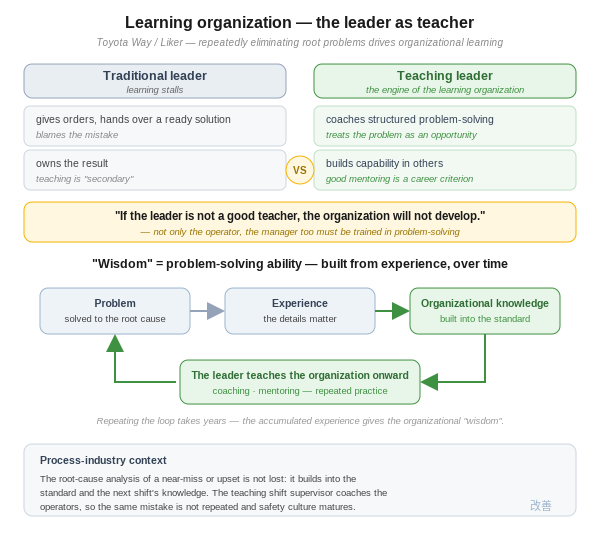 Figure 1 — the “leader as teacher” contrast and the learning loop: the traditional leader (gives orders, owns the result) versus the teaching leader (coaches problem-solving, builds capability). Below, “wisdom” as a root-cause-based learning loop: problem (solved to the root cause) → experience (the details matter) → organizational knowledge (built into the standard) → the leader teaches onward, and the circle restarts.
Who is this for?
Section titled “Who is this for?”This article is for those who are responsible for learning and development at the organizational level: plant and shift manager · process engineer · Lean/CI specialist · production manager · HR and training lead · mentor and newly appointed team leader · reliability/HSE lead.
Learning objectives
Section titled “Learning objectives”After reading this article you will be able to:
- articulate what makes an organization a learning organization, and why the leader is the key player;
- explain why behavioral change is slow and needs coaching (reasons rooted in how the brain develops);
- distinguish the traditional leader from the teaching leader, and decide which behavior to show when;
- apply the principles of “learning and teaching” in a concrete onboarding or problem-solving situation;
- draw the line: when the slow, experience-building kind of learning is NOT the right answer.
The essence (TL;DR)
Section titled “The essence (TL;DR)”- The engine of the learning organization is the repeated elimination of problems down to the root cause (5 Whys, PDCA).
- The leader is a teacher: not only the operator but the manager too must be trained in problem-solving, because it is the manager who teaches the organization onward.
- “Wisdom” = problem-solving ability, built from experience and the mastery of the details, not from theory.
- Learning is slow: transforming adult behavior takes time and works only with constant coaching. Anyone who promises fast change is misleading you.
- The place of practice is the plant floor: Lean can be practiced on the gemba, where the work and the problem truly are.
- It takes time: so make good mentoring a career criterion, so that teaching has prestige.
What is a learning organization, and what makes it one?
Section titled “What is a learning organization, and what makes it one?”A learning organization is one that learns from the continuous solving of root problems: every root cause eliminated for good is a durable piece of knowledge that becomes part of the standard and of the next shift’s knowledge. The Lean-canonical formulation of the idea comes from Jeffrey Liker (The Toyota Way): “the continuous elimination of the roots of problems results in organization-level learning and development.”
The key realization, however, is that this is not an operator question. If we train only the front line in problem-solving, learning stalls at the first level of leadership. Managers must be taught structured problem-solving just as much (A3, PDCA, 5 Whys), because an organization learns only as much as its leaders can teach onward. Hence the thesis, sharply: if the leader is not a good teacher, the organization will not develop.
Why does it matter? (the stakes)
Section titled “Why does it matter? (the stakes)”Most Lean or improvement programs fail not on the wrong tools but on impatience. If the organization expects fast results, introduces superficial “solutions,” and the leader gives orders instead of teaching, then learning never comes together: they treat the symptom of the problem, the root cause remains, and the same fault returns again and again. The training invested evaporates, because the organization built no problem-solving ability, it only staged events.
A learning organization, by contrast, is an investment that compounds: every root cause solved is durable knowledge, every problem well coached is a team one degree more self-reliant. The stake, then, is not a KPI but whether the organization’s wisdom accumulated over years becomes an advantage practically impossible for a competitor to copy, or whether it stays forever in the trap of starting over.
Why is learning slow? (what brain development dictates)
Section titled “Why is learning slow? (what brain development dictates)”Behavioral change is slow because the brain physically rebuilds itself in the process. Learning is nothing other than creating new neural connections and strengthening existing ones between neurons. A few facts that also determine the development strategy:
- Repetition matters, not intensity. A connection is strengthened not by the strength of the stimulus but by the frequency of repeated occurrences. That is why nothing can be trained in “once, strongly.”
- The brain is not made for complex decisions. Small steps, uncovering the cause-and-effect relationships, and patience: this is exactly the logic of PDCA too. A fast, large leap runs against how the brain works.
- The adult brain develops too, just in different things. Learning does not stop in adulthood, but the emphasis shifts to systems thinking and problem-solving: precisely what a learning organization needs.
- The leader’s face is a tool too. The brain is motivated by novelty, emotion, an interesting story and a friendly, supportive leadership presence, while fear and stress inhibit learning. A “who is to blame?” atmosphere holds back development at the neurophysiological level.
The lesson is clear: the development strategy must be aligned to the brain’s pace of learning, not the other way round. Lean sums this up in a single sentence too: anyone who promises fast change is misleading you.
Mastery takes practice, and its place is the Gemba
Section titled “Mastery takes practice, and its place is the Gemba”A master’s level is always the result of long, repeated practice. Just as a professional musician has practiced orders of magnitude more hours than an amateur, so the expertise of the operator and the leader is assembled from accumulated practice: on the shop-floor learning curve the skilled operator’s performance slowly approaches the achievable technical limit.
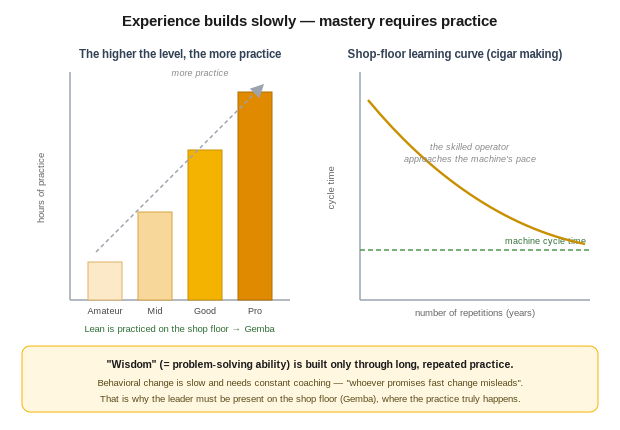 Figure 2 — left: the higher the level, the more practice behind it; right: on the shop-floor learning curve the cycle time approaches the machine’s pace with repetitions. “Wisdom” is built only through long, repeated practice, and behavioral change requires constant coaching.
Two practical questions follow from this for every organization: how high is turnover (because every leaver takes the accumulated experience away), and how good is the onboarding organization (because the steepness of the learning curve depends on it). And one on-site conclusion: Lean can be practiced not in the office but in the plant, on the gemba, where the work and the deviation are truly visible.
“Wisdom”: from experience, over time
Section titled ““Wisdom”: from experience, over time”The “wisdom” of a learning organization is not age but problem-solving ability, which:
- is built from experience (not from theory),
- requires the mastery of the details (the fine details matter),
- comes together over a long time, through repeated practice.
That is why it is worth regarding the experienced technician and plant manager as carriers of the organization’s accumulated knowledge, not as a replaceable resource. The good mentor–mentee relationship in which this knowledge is passed on is a success factor, not a side activity.
The leader as teacher — the key role
Section titled “The leader as teacher — the key role”The learning organization stands or falls on leadership behavior. The difference is not style but whether the leader owns the result or builds capability in others:
| Traditional leader | Teaching leader (learning organization) |
|---|---|
| gives orders, hands over a ready solution | coaches structured problem-solving |
| blames the mistake | treats the problem as an opportunity |
| owns the result | builds capability in others |
| teaching is “secondary” | good mentoring is a career criterion |
| directs from the office | is present in the plant (Gemba) |
Good mentoring is therefore a leadership competency, not an option: where teaching counts in one’s career, there will be people who invest energy in it.
How do you build a learning organization? The principles of learning and teaching
Section titled “How do you build a learning organization? The principles of learning and teaching”Effective teaching is not a matter of talent but of a few principles derivable from how the brain works, which you can use in any onboarding, A3 coaching or shift training:
| # | Principle | What it means in practice |
|---|---|---|
| 1 | Overview first, detail after | the big picture first, so the brain has something to “hang” the detail on |
| 2 | A clear goal | whoever understands why they are learning learns more openly |
| 3 | Spark interest | curiosity is the strongest learning motivation |
| 4 | Repeat | it is not the one-off strong stimulus but the frequency of repetition that fixes it |
| 5 | Engage several senses | see, hear, touch, but the most important: the learner does it themselves |
| 6 | Attend to feelings | fear and stress inhibit, a positive atmosphere helps |
| 7 | Give feedback | immediate, affirming feedback helps it stick |
| 8 | Take a break | the brain needs time to anchor the new knowledge |
| 9 | Teach in a good order | a logical build-up connects better with existing knowledge |
| 10 | Build connections | link to the existing, across areas, with a project mindset |
These ten principles are practically the skeleton of standard training and daily coaching: not theory but an immediately usable checklist for every teaching leader.
Process-industry context and safety
Section titled “Process-industry context and safety”In an operational environment a learning organization is very concrete: the root-cause analysis of a near-miss or upset is not lost but becomes part of the standard and of the next shift’s knowledge. The shift supervisor as teacher coaches the operators in structured problem-solving, so the organization does not repeat the same fault, and the safety culture matures.
- A signal-friendly atmosphere is a safety issue. Because fear inhibits learning and silences reporting, a “who is to blame?” culture is directly dangerous in the process industry: the weak signal (the near-miss) stays hidden. A learning organization treats the fault as a source of learning, so the weak signals come to light.
- Turnover is a risk. Every experienced operator who leaves takes accumulated plant knowledge away. A learning organization saves this knowledge into the standard and into mentoring, so that it does not stay person-dependent.
- Safety boundary. A learning organization is about culture, and it does not replace the certified protection layers. Safety-critical functions must always be designed according to risk analysis and the standards (LOPA/SIL, IEC 61511), regardless of how mature the learning culture is.
Introduction in practice (roadmap)
Section titled “Introduction in practice (roadmap)”A learning organization is not built all at once but from small changes in the leadership routine. A shift supervisor can start like this tomorrow:
- Choose a recurring, painful problem in your own area, and solve it down to the root cause (5 Whys), not just the symptom.
- Don’t hand over the ready solution: at the next similar problem, lead the operator through structured problem-solving with questions (coaching, not orders); for the GROW structure of the conversation and OILS feedback, see Lean leadership and coaching.
- Build in feedback and repetition: short, immediate, affirming feedback, and the same pattern several times so that it sticks.
- Go to the gemba and teach seeing: show how a deviation can be noticed from a different angle.
- Lock the lesson into the standard (standard work), and make mentoring recognized in the team, so that teaching has value.
Hands-on / mini-scenario
Section titled “Hands-on / mini-scenario”The situation. A pump seal fails for the third time in a month. The traditional reaction: have it replaced and move on.
The teaching leader’s reaction. The shift supervisor does not give the answer. They sit down with the operator on the gemba and, with 5 Whys, uncover the cause together (wrong setting? fit? material?). The operator reaches the root cause themselves, and therefore remembers it. They write the lesson into the standard, and the following week the shift supervisor checks back: did it stick? One problem, two lessons: the fault was solved, and the team became one degree more self-reliant.
Homework. Choose a problem that you solved yourself this week instead of your team. Plan how you would next time lead your colleague through the same questions, so that they find the answer.
Measurement / audit
Section titled “Measurement / audit”The “maturity” of a learning organization is measured not by a single number but by a few recurring questions worth asking regularly:
| What we look at | Question | Why it is telling |
|---|---|---|
| Recurring faults | how many times does the same problem return? | if it decreases, the root-cause solving really became learning |
| Turnover | how high is the attrition rate? | every leaver takes accumulated experience away |
| Onboarding time | how long until a new operator is self-reliant? | it measures the quality of the onboarding organization |
| Leadership coaching | does the leader give orders or ask questions? | teaching behavior is the engine of learning |
| Prestige of mentoring | does it count in one’s career who is a good teacher? | without it no one invests in teaching |
Common mistakes
Section titled “Common mistakes”- Training only the operator. If the manager is not a good problem-solver and teacher, learning stalls at the first level of leadership. Instead: train the leaders in structured problem-solving just as much, because they teach onward.
- Giving orders instead of teaching. The ready solution is faster, but it builds no capability, and the problem returns. Instead: coach with questions, let the team reach the root cause themselves.
- Symptomatic fix. Avoiding the root cause means the problem (and with it the lesson) returns. Instead: solve it down to the root cause (5 Whys), and lock it into the standard.
- Impatience. Wisdom builds over years, the fast “solution” stays superficial. Instead: small steps, repetition, constant coaching, aligned to the brain’s pace of learning.
- A fear-based culture. A “who is to blame?” atmosphere inhibits learning at the neurophysiological level and silences the weak signal. Instead: the fault is a source of learning, and reward the reporting.
- Devaluing mentoring. If teaching does not count in one’s career, no one invests in it. Instead: make good mentoring a career criterion.
When NOT to use it? (limits of the method)
Section titled “When NOT to use it? (limits of the method)”A learning organization is a tool for durable capability building, not the answer to every situation. There are times when the slow, experience-building logic is the wrong tool:
| Situation | Why (primarily) not this | The right answer |
|---|---|---|
| Immediate safety danger | you must act now, not learn | emergency shutdown, intervention, then root-cause analysis |
| A certified safety function is needed | culture does not protect on its own | design per SIL/LOPA, IEC 61511 |
| A one-off, non-recurring case | there is nothing to “learn” from it durably | case-by-case analysis, recording the lesson, moving on |
| A purely technical, design fault | it needs not training but redesign | an engineering solution (VSM, redesign) |
Rule of thumb: a learning organization is strongest for recurring, people- and process-dependent problems and for capability building. It does not substitute for acute danger and certified protection; handle those with the appropriate tool.
Take it home (keys)
Section titled “Take it home (keys)”- Learning is slow but compounds: accumulated wisdom is an advantage impossible to copy, whereas impatience is the trap of starting over.
- Don’t hand over the solution: coach with questions, let the team reach the root cause themselves, because that is the only thing they remember.
- The leader is the engine: if the manager is not a good teacher, the organization does not develop, so the manager too must be trained in problem-solving.
- Repeat and be present: the brain is taught by repetition and supportive presence, not by the one-off strong stimulus. The place of practice is the Gemba.
- Make mentoring prestigious: where teaching is a career criterion, there will be people who invest in it.
Self-test
Section titled “Self-test”- Why is it not enough to train only the operators in problem-solving, and what happens if the leader is not a good teacher?
- Name three reasons from brain development why organizational behavioral change is slow and needs coaching.
- What does it mean that “wisdom = problem-solving ability,” and what is it built from? Where can this ability be practiced?
How does it appear in digital practice?
Section titled “How does it appear in digital practice?”The principle of the learning organization does not stop at the physical gemba: the same logic is realized in a digital operation too. Knowledge becomes organizational when it lives not in one person’s head but in a searchable, traceable system, and the lesson is automatically placed in front of the next situation.
| Principle | Digital implementation | The value |
|---|---|---|
| Preserving root-cause analysis | a structured problem and action log | the lesson is not lost at shift change |
| Visibility of recurring faults | a searchable event and near-miss record | it becomes clear what returns and where a root cause is still outstanding |
| Coaching and feedback | logged, immediate feedback tied to the task | the trail of teaching remains, it is not lost in words |
| Building into the standard | digital standard work / check questions | the lesson is immediately in everyone’s hands |
| Mentoring and onboarding | onboarding status and competency records | knowledge and the risk of turnover become visible |
Connection to OPEREX (shift diary)
Section titled “Connection to OPEREX (shift diary)”Recurring problems, root-cause analyses and the lessons drawn from them, together with leadership problem-solving coaching and mentor–mentee development, become organizational knowledge when documented in the shift diary (OPEREX). This way the next shifts do not start the same troubleshooting from scratch, and organizational learning is trackable and auditable.
Terminology (HU / EN / JP)
Section titled “Terminology (HU / EN / JP)”| Hungarian | English | 日本語 / note |
|---|---|---|
| Tanuló szervezet | learning organization | root-cause-based organizational learning |
| A Toyota-módszer | The Toyota Way | Liker’s source |
| Vezető mint tanító | leader as teacher | the key role |
| Bölcsesség | wisdom | = problem-solving ability |
| Gyökérok-elemzés | root-cause analysis | the engine of learning |
| Menj és nézd meg | Go to Gemba | 現地現物 — the place of practice |
| Coaching / mentorság | coaching / mentoring | the tool of behavioral change |
What is a learning organization according to Lean?
An organization that learns from the continuous elimination of the roots of problems, and turns this knowledge into organization-level development by building it into the standard. According to Lean, the key is that not only the operators but the leaders too are trained in problem-solving.
What is the leader's role in a learning organization?
The leader acts as a teacher: they coach structured problem-solving and teach the organization onward. If the manager is not a good teacher and problem-solver, the learning of the whole organization stalls.
Why is building organizational problem-solving ability time-consuming?
Because problem-solving wisdom is built from experience, the details matter, and accumulation is possible only through long, repeated practice. Transforming adult behavior requires constant coaching; anyone who promises fast change is misleading you.
Where does the idea of the learning organization come from in Lean?
The Lean-canonical formulation comes from Jeffrey Liker’s The Toyota Way: the continuous solving of root problems drives organizational learning and development.
Where can Lean and problem-solving be "practiced"?
In the plant, on the gemba, where the work and the deviation are truly visible. A master’s level is always the result of long, repeated practice, so the leader must be present where the practice happens.
Related concepts
Section titled “Related concepts”Lean leadership · 5 Whys · problem-solving culture · A3 report · pdca · gemba-walk · standard work · feedback · ci-mindset
Next step
Section titled “Next step”If you have understood this, from here it is worth going on, in this order:
- Lean leadership — the broader role of the teaching leader: how the Lean leader behaves day by day.
- 5 Whys — the basic tool of root-cause analysis, which you coach as the engine of the learning organization.
- problem-solving culture — the signal-friendly, learn-from-mistakes culture, without which learning stalls.
References / Further reading
Section titled “References / Further reading”- Jeffrey K. Liker: The Toyota Way: 14 Management Principles from the World’s Greatest Manufacturer. McGraw-Hill, 2004. — the canonical source of “the continuous solving of root problems as organizational learning.”
- Peter M. Senge: The Fifth Discipline: The Art and Practice of the Learning Organization. Doubleday, 1990. — the classic, broader (systems-thinking) exposition of the “learning organization” concept.